The "anti-consensus" choice of an eight-year-old established exchange: Why give up on easy profits and not treat trading as the end point?

CN
链捕手
Follow
2 hours ago

Many crypto builders seem to have reached a "consensus" after several cycles: no matter what you initially intended to do, it's ultimately better to focus on trading.

Take the former NFT leader OpenSea as an example; its transformation path is very typical. When the NFT market cooled down and revenues shrank to around $3 million per month, OpenSea simply pivoted in October 2025 to become a comprehensive platform for "anything that can be traded," supporting tokens and memecoins across 22 chains.

As a result, the trading volume surged to $2.6 billion in the first month of the transformation, with nearly 90% coming from token trading. CEO Devin Finzer's remark, "You can't fight the trend," sounds like riding the wave, but it also reveals a sense of resignation to compromise.

OpenSea is not an exception. Looking back at this bull market, shifting to memecoin trading has become a "lifeline" for many projects. In the “2 notes for crypto builders in 2026” released by a16z in January this year, partner Arianna Simpson candidly pointed out that this trend is accelerating: almost every well-performing crypto company has already shifted or is shifting to trading business.

While pivoting to trading for revenue is understandable, what comes next? This is evolving into a "marshmallow experiment" for the crypto industry: pursuing short-term satisfaction often comes at the cost of losing product depth.

As Ethereum founder Vitalik Buterin pointed out in a recent discussion about decentralized social: if the industry merely shoves a speculative token into a product and claims to be "innovative," it is merely creating corporate waste.

If the endpoint of all innovation is merely to exchange for higher turnover rates, what can individuals, projects, and the industry leave behind for this era?

Fortunately, as the collective begins to reflect, divisions are starting to emerge. Amid the overarching trend of "everyone moving towards trading," some established trading platforms like CoinW are beginning to explore whether there is a longer-term, more effective path.

Divisions in the Industry's Dilemma

Why is it said that entering trading too early and only doing trading is not feasible? The former star products Friend.tech and Pump.fun may provide an answer to this question.

Friend.tech, once a top player in SocialFi, succeeded and failed through trading. It directly pivoted to trading with the intention of social interaction, making every KOL a tradable asset, with prices determined by buying and selling, and the platform taking a cut. This model led to rapid product explosion and skyrocketing fees, setting a record for daily earnings exceeding Ethereum within just over a month of establishment. However, once speculation faded, the social relationships themselves left no independent value and could not retain any users, ultimately leading Friend.tech to announce its failure.

On the other hand, Pump.fun pushed the trading-centric model to the extreme, profiting immensely from the rise of memecoins. However, most trading is a zero-sum game; once the market turns bearish, the platform's trading volume can drop by 90% compared to its peak.

How to find a longer-term scenario or a second growth curve remains unanswered.

For the entire industry, the rampant "trading supremacy" model will only lead to an ecosystem overly reliant on short-term games, falling into homogeneous competition, making it difficult to solidify true long-term value. This is also a significant reason why the crypto industry has been criticized for lacking innovation in this cycle.

But if we cannot rely solely on trading, where is the new way out?

Some different attempts are beginning to emerge in the industry. The starting point of this path is not to deny trading but to redefine its position: making trading not the endpoint but an entry point to a richer participation system. In other words, users should not only speculate on the platform but also generate value in more "consumption" and participation scenarios.

This path is not difficult to understand; looking back at traditional fields, any sustainable business model must allow users to naturally generate value during daily use, participation, or consumption, so that the platform can solidify long-term relationships and ecological resources.

However, this path may be destined to be difficult. It requires the platform itself to have enough capital and patience, needing to survive first before engaging in those slow-yielding activities, such as nurturing developers, managing communities, or connecting real-world scenarios.

Thus, currently, you can see that this adjustment is not the industry mainstream; it is mainly some established projects with sufficient user bases and relatively stable business fundamentals that are trying. For example, CoinW, an established exchange, has reached a user scale of tens of millions, with relatively stable daily trading volume, and has enough capital flow to support building a long-term valuable ecosystem, even if it yields slow short-term results.

What is the Logic Behind the "Counter-Consensus Choice"?

For some crypto projects, focusing solely on trading signifies long-term survival issues, while for trading platforms like CoinW, which could easily profit, why must they engage in these slower-yielding activities? Looking back at CoinW's public discussions and strategies with this question in mind, some clues can be found.

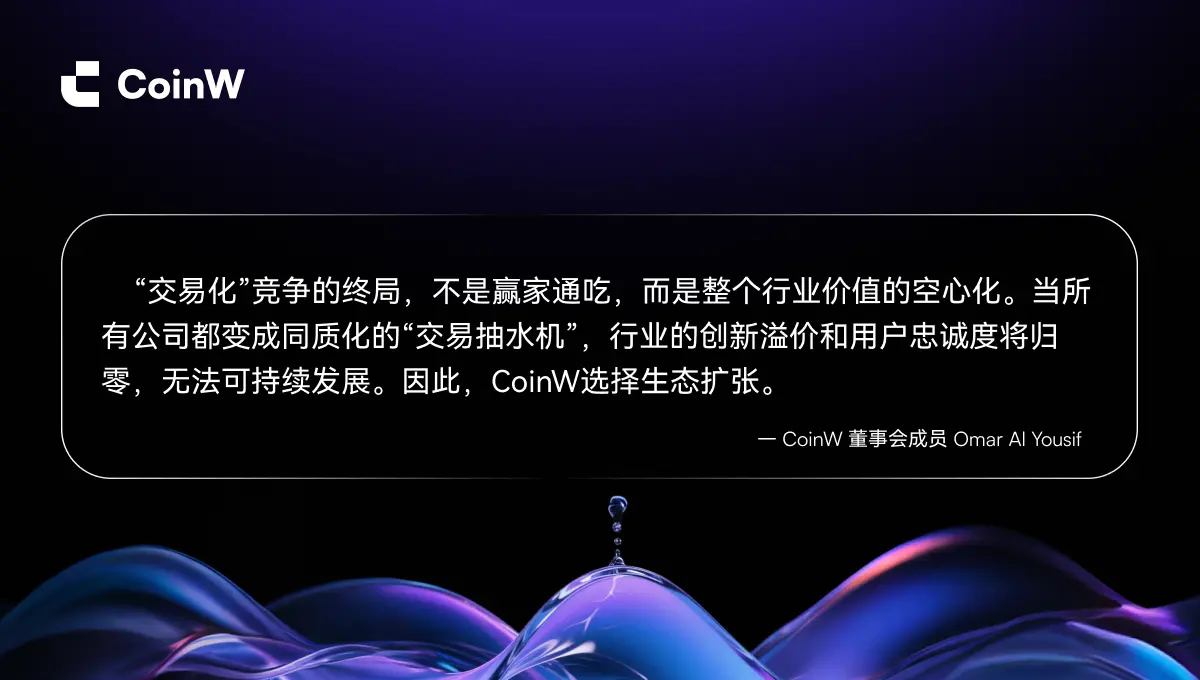
This may relate to the background of the CoinW team. Board member Omar Al Yousif has extensive experience in traditional finance and investment; he currently serves as the vice chairman of 7-E Emirates Holding and a partner at 10X Capital.

He has mentioned in several internal and public communications that this race to trade and homogeneous competition is actually the old path of traditional finance: when all players are competing on the same metric, what often remains is just a mess. It appears prosperous but is actually overdrawn on long-term value.

Currently, for established platforms like CoinW, promoting ecological construction may not only be a capability guarantee based on an existing stable foundation but also a strategic choice made under "long-term considerations": in the next round of competition, relying solely on trading will be difficult to form an advantage, and the earlier one lays out value scenarios beyond trading, the more likely they are to gain a first-mover advantage in industry differentiation.

So how specifically to implement value scenarios beyond trading? CoinW announced a full-stack upgrade at its eighth anniversary. A closer look at this upgrade can be summarized as primarily achieving this through two strategies: "internal circulation" and "external circulation."

1. Internal Circulation: Making It Easier for Users to Stay

Internal circulation can be understood as CoinW redesigning the "stay path" for users within the platform: no longer assuming that users will only repeatedly trade the same type of asset, but rather extending their effective participation time on the platform as much as possible.

For example, as exchange users, we generally start operations from the most familiar spot and contract trading. However, many people do not just want to "place more orders" but hope for other on-chain participation opportunities beyond market conditions. On CoinW, this demand is not cut off but is instead embraced.

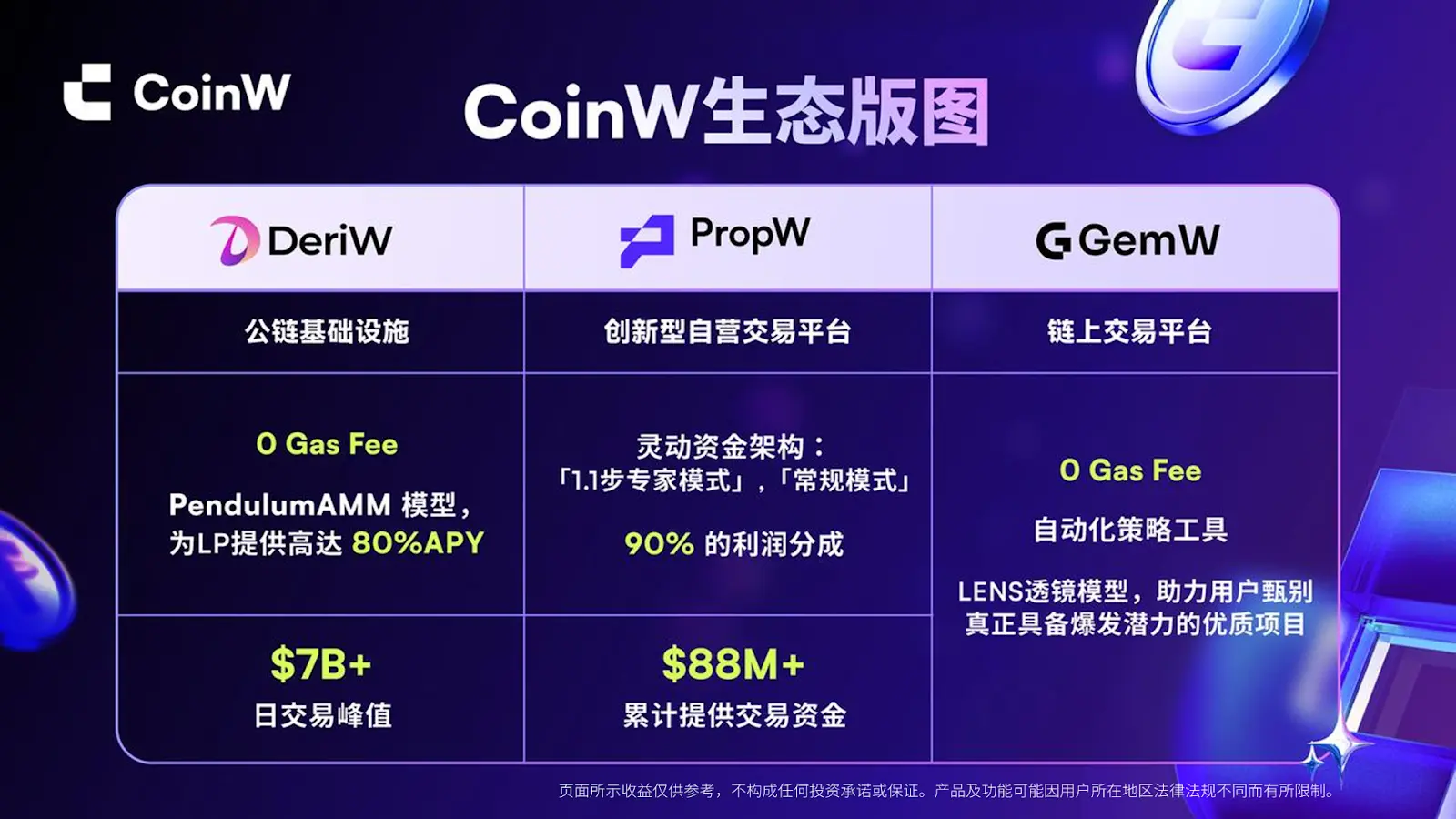
Under a unified account system, users do not need to prepare wallets or handle gas fees separately, allowing them to quickly try more gameplay:

For instance, on GemW, users can directly explore on-chain assets, with costs and thresholds kept very low; in DeriW, while still doing perpetual contracts, the on-chain structure is more transparent, and the zero gas design makes me more willing to try different strategies; in PropW, trading is no longer just about self-risk, but users' trading abilities can be treated as a "skill," receiving financial support within platform rules, thus changing the way they participate.

In the short term, such designs may not immediately amplify trading volume, but a very intuitive change is: I no longer leave the platform immediately when the market cools down. When trading opportunities decrease, there are other ways to engage attention; and when new assets or gameplay emerge, they can naturally connect to the existing paths.

The result is that the psychological threshold for users to explore new things is significantly lowered, the time spent on the platform is extended, and participation stickiness increases. From this perspective, internal circulation is not about forcing users to "trade more," but about making it easier for users to stay.

2. External Circulation: Moving Beyond Pure Trading and Pure Crypto Scenarios

External circulation, in essence, is CoinW actively pulling the platform from a single "trading venue" into a larger industry ecosystem. By connecting externally, CoinW allows users and the platform to participate together in project growth and resource allocation, rather than continuing to compete on the trading level.

In practice, CoinW does not equate ecological cooperation with listing coins or traffic exchange but establishes deeper cooperative relationships with projects that have long-term potential. The platform opens real user access, liquidity, and infrastructure support to projects, which are then incorporated into a long-term ecological structure rather than being one-off trading targets.

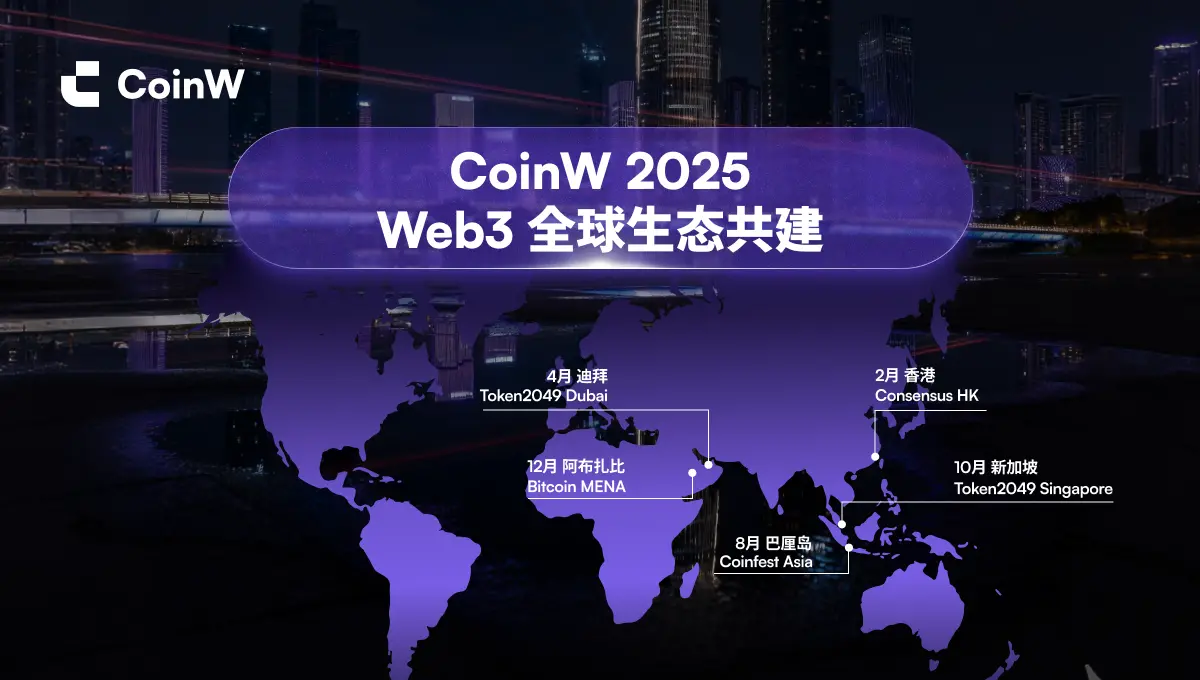
This thinking is reflected in its industry collaboration methods, such as through flagship events like WConnect, where CoinW builds cross-ecosystem dialogues between exchanges, developer communities, and project parties; at the same time, it continues to participate in regional industry conferences like Coinfest Asia, embedding the platform into a broader global crypto collaboration network, not just as a trading infrastructure.

For users, the logic of participation changes accordingly. Users no longer trade repeatedly around established assets but can intervene in projects at early stages, establishing more sustained relationships through product use and participation mechanisms, with participation time significantly advanced.

At the same time, CoinW is also trying to bring crypto assets out of pure financial contexts. In the sports field, it collaborates with events like La Liga and the East Asian Football Championship; in the cultural field, it sponsors events like TAIWAN GQ Style Fest, bringing crypto into more tangible public scenarios.

These external circulation actions do not pursue amplified trading volume in the short term but change the platform's role from a mere matchmaker to a hub connecting projects, users, and real scenarios. In an industry long dominated by trading logic, this choice may not yield immediate results but provides confidence for the platform's long-term competition.

Conclusion

Looking back, it is difficult to judge the effectiveness of this industry division with just one or two sets of data. However, it at least reflects a different understanding of the long-term shape of the industry by a certain type of platform.

As trading capabilities gradually become standardized, the real difference may not come from higher-frequency matching efficiency but from whether one is willing to reserve space for value beyond trading. CoinW's choice is an attempt made under this judgment.

CoinW's eighth anniversary theme "Trot On To Infinity" is less of a slogan and more of a stance: it does not provide a definite endpoint but assumes that this is a long run that requires patience and constant direction correction.

In a highly utilitarian market environment, this path may not be the most convenient, but it at least offers a possibility that when the tide recedes, what supports the platform's continued growth may not be a greater "extraction ability," but whether it is truly rooted in a more long-term valuable ecological soil.

Disclaimer:

The content of this article is for general informational reference only and does not constitute any investment or legal advice. The services or products mentioned in the text may not be available in all regions. Trading in crypto assets carries high risks; please fully understand the relevant risks before participating.

免责声明:本文章仅代表作者个人观点,不代表本平台的立场和观点。本文章仅供信息分享,不构成对任何人的任何投资建议。用户与作者之间的任何争议,与本平台无关。如网页中刊载的文章或图片涉及侵权,请提供相关的权利证明和身份证明发送邮件到support@aicoin.com,本平台相关工作人员将会进行核查。

Share To
APP

X

Telegram

Facebook

Reddit

CopyLink