1011 Insider Whale Garrett: Why is it extremely absurd to use the bear market script of 2022 to "carve a boat to seek a sword"?

CN
链捕手
Follow
2 hours ago

Original author: Garrett

Original translation: Jiahua, ChainCatcher

Recently, some analysts have been comparing the current BTC price trend with that of 2022. Indeed, the short-term price patterns may appear somewhat similar. However, when looking at the long-term picture, such comparisons are completely absurd.

Whether from:

  • Long-term price patterns

  • Macroeconomic background

  • Investor composition and supply/holding structure

the underlying logic has fundamental differences.

In financial market analysis and trading, the biggest mistake is to focus solely on short-term, superficial statistical similarities while ignoring long-term, macro, and fundamental driving factors.

Opposite Macroeconomic Background

In March 2022, the U.S. was deeply entrenched in a high inflation and interest rate hike cycle, driven by:

  • Excess liquidity during the COVID-19 pandemic

  • A crisis triggered by the outbreak of the Ukraine war, which further intensified inflation

At that time, risk-free interest rates were continuously rising, liquidity was systematically withdrawn, and financial conditions were tightening. In this environment, the primary goal of capital was to avoid risk. What we saw in BTC was essentially a high-level distribution structure during a tightening cycle.

Currently, the macro environment is completely opposite:

  • The Ukraine conflict is cooling down (partly due to U.S. efforts to reduce inflation and interest rates)

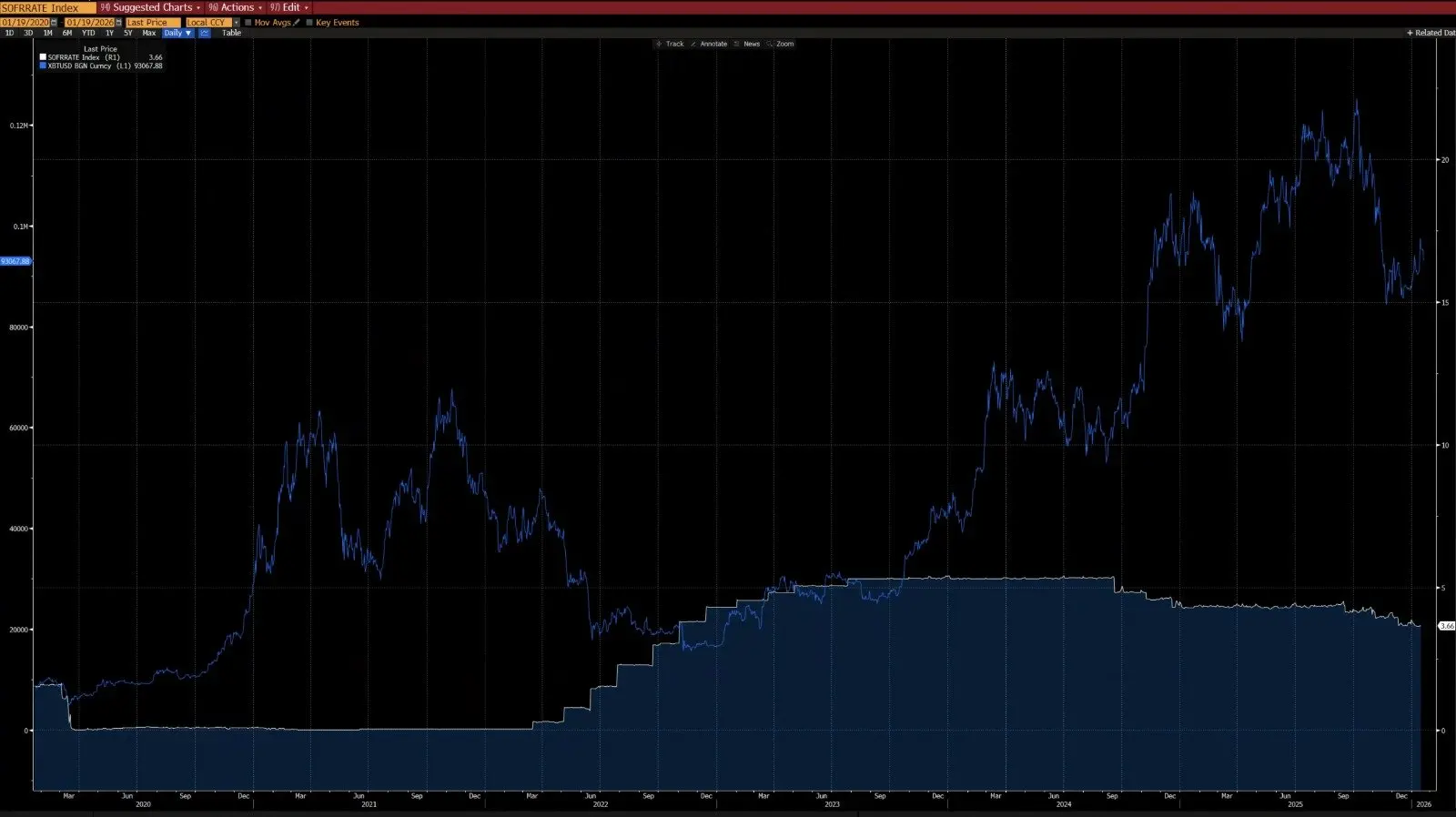
  • CPI (Consumer Price Index) and U.S. risk-free interest rates are declining

  • The AI technology revolution greatly enhances the likelihood of the economy entering a long-term "disinflation" cycle. In the larger cycle, interest rates have entered a phase of reduction

  • Central bank liquidity is being re-injected into the financial system

  • The behavior pattern of capital is "increased risk appetite"

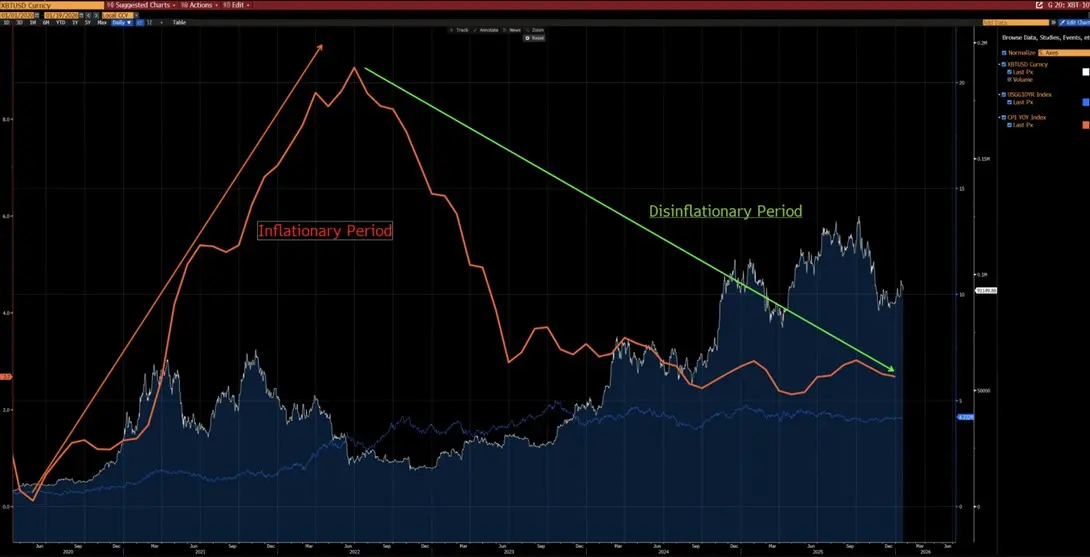
From the above chart, it can be seen that since 2020, BTC has shown a clear negative correlation with CPI—BTC tends to fall during inflationary periods and rebound during disinflationary periods. Under the AI-driven technological revolution, long-term disinflation is a high-probability event—Elon Musk has echoed this view, further validating our argument.

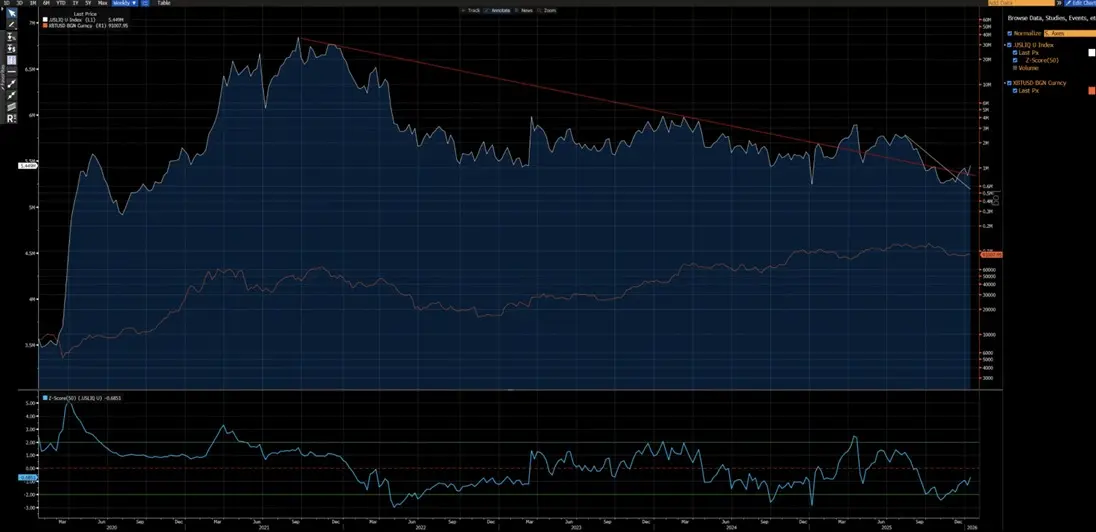
From the above chart, it can be seen that since 2020, BTC has shown a strong correlation with the U.S. liquidity index (excluding distortions caused by ETF fund inflows in 2024). Currently, the U.S. liquidity index has broken through its short-term (white) and long-term (red) downward trend lines, a new upward trend is on the horizon.

Different Technical Structures

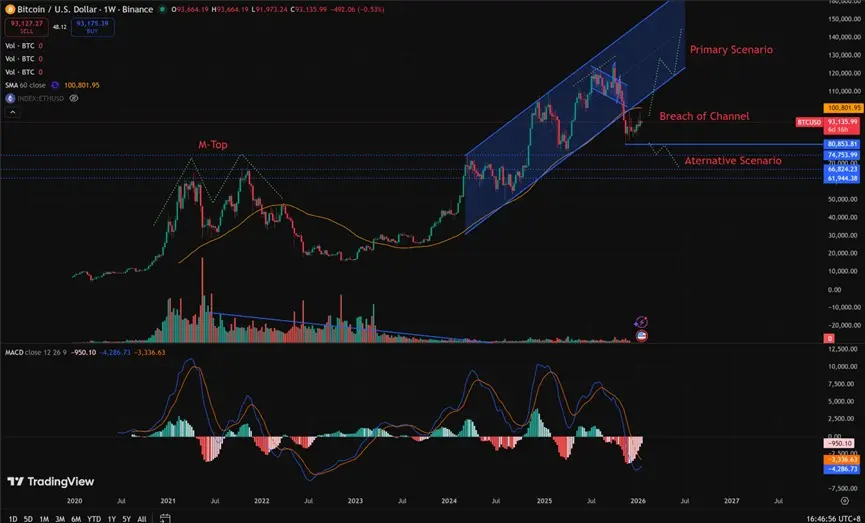
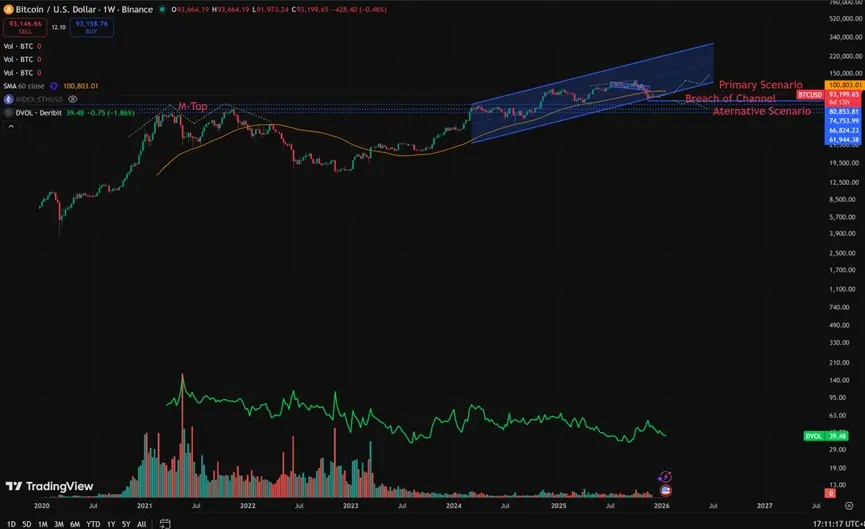
2021–2022: A weekly "M top" structure, which is typically associated with long-term market tops, leading to prolonged price suppression.

2025: A weekly breakdown of the upward channel. From a probabilistic perspective, this resembles a "bear trap" before a rebound.

Yes, we cannot completely rule out the possibility of this evolving into a bear market continuation similar to 2022. However, the key is to note that the 80,850 / 62,000 area has undergone sufficient consolidation and chip turnover. This prior chip digestion provides an excellent risk-reward ratio for bullish positioning: upside potential significantly outweighs downside risk.

What Conditions Are Needed to Reproduce a 2022-style Bear Market?

Several hard conditions must be met:

  1. A new round of inflation shock, or a significant geopolitical crisis similar in scale to that of 2022
  2. The central bank resumes interest rate hikes or balance sheet reduction
  3. Prices decisively and persistently break below 80,850

Before these conditions are met, asserting a structural bear market is premature and speculative, rather than based on rational analysis.

Different Investors

2020–2022: A market dominated by retail investors, with limited institutional participation, especially lacking long-term allocation funds.

Post-2023: The introduction of BTC ETFs has brought in structural long-term holders, effectively locking in supply, significantly reducing trading turnover, and materially lowering volatility.

2023 marks a structural turning point for BTC as an asset on both macro and quantitative levels. The volatility mechanism of BTC has shifted: from a historical 80–150% to 30–60%, representing a fundamentally different asset behavior pattern.

Core Structural Differences

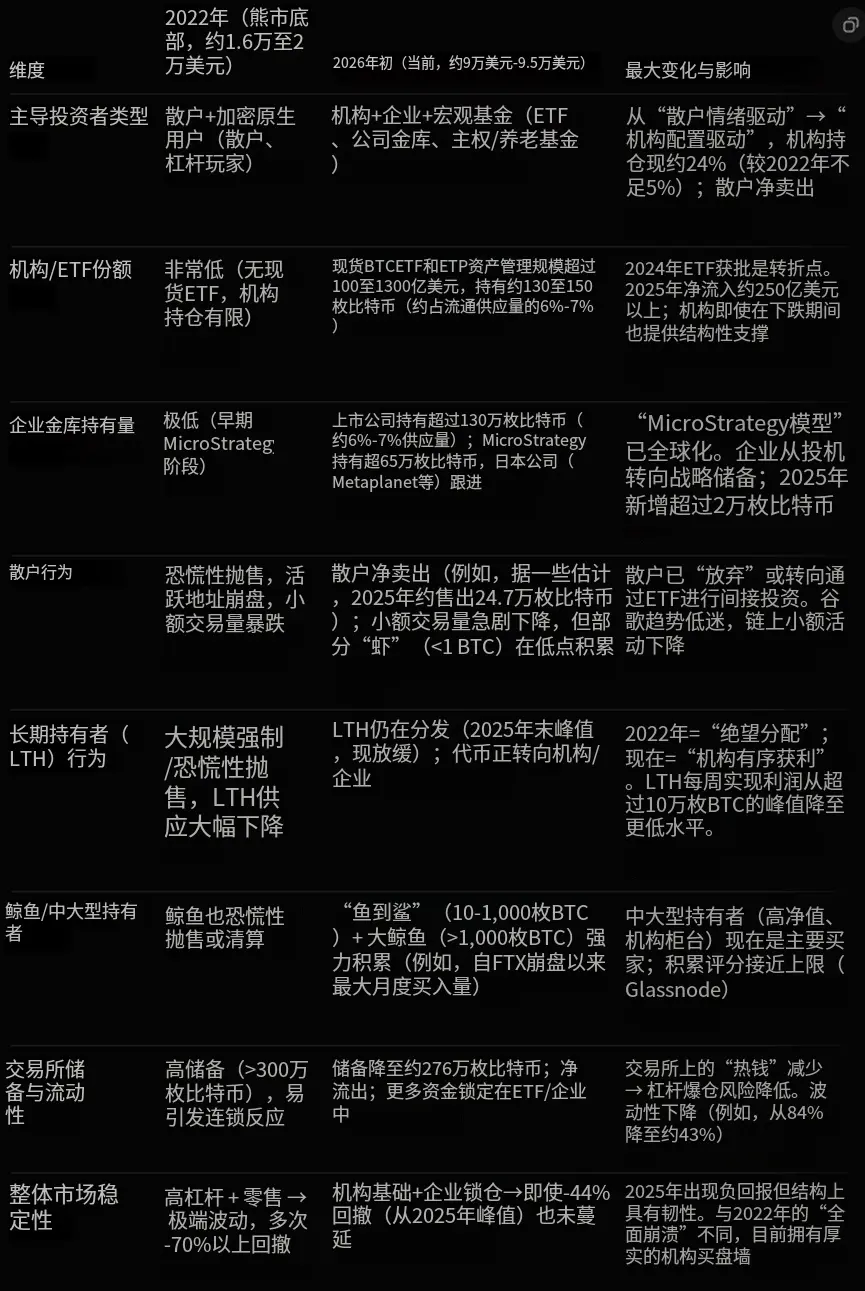
Now (early 2026) compared to 2022, the biggest difference in BTC investor structure is the following transformation:

  • From retail-dominated, high-leverage speculation

  • To institution-dominated, structural long-term holding.

In 2022, BTC experienced a classic "crypto-native bear market," primarily driven by panic selling from retail investors and cascading leverage liquidations. Today, BTC operates in a more mature institutional era characterized by:

  • Stable underlying demand

  • Locked supply

  • Institution-level volatility

The following is a core comparison made by Grok based on on-chain data (such as Glassnode, Chainalysis) and institutional reports (such as Grayscale, Bitwise, State Street), with data as of mid-January 2026 (BTC price around $90k–$95k):

免责声明:本文章仅代表作者个人观点,不代表本平台的立场和观点。本文章仅供信息分享,不构成对任何人的任何投资建议。用户与作者之间的任何争议,与本平台无关。如网页中刊载的文章或图片涉及侵权,请提供相关的权利证明和身份证明发送邮件到support@aicoin.com,本平台相关工作人员将会进行核查。

Share To
APP

X

Telegram

Facebook

Reddit

CopyLink