Author: Lawyer Liu Zhengyao
Introduction
In recent years of criminal justice practice, virtual currency has often been mistakenly regarded as a "barrier" that can completely shield investigations. As a lawyer in the cryptocurrency space, Lawyer Liu has found that even individuals with a profound understanding of blockchain technology, like Yao Qian, the former director of the Technology Supervision Department of the China Securities Regulatory Commission, are still unable to "escape unscathed" in complex judicial reviews.
Today, multiple media outlets reported on the anti-corruption documentary "The Power-Money Transaction Under the 'Digital Cloak'" aired by CCTV, which provides a comprehensive disclosure of Yao Qian's case.

From the perspective of a criminal defense lawyer, this case is not only a typical case of occupational crime but also a practical lesson in "de-anonymization" investigations. Many parties involved, even fellow lawyers, have a technical misconception about virtual currency, believing that its "decentralization" means "untraceability." However, in fact, based on the following three investigative practical logics, the "sense of security" brought by virtual currency is often just a technical illusion.
The Starting Point of Investigative Logic is Always "People" Rather than "Currency"
In criminal investigations, technology is always an auxiliary means, and the core target is always "people." When the investigating agency lists an individual as a subject of investigation, their social relationships, administrative approval powers, and corresponding interests will first be penetrated.
In many cases, it is not the investigating agency that discovers abnormal transactions on the blockchain first and then finds the person, but rather through controlling the person, the truth of the technology is forced out. Once the relevant personnel are brought to justice, under the deterrence of law and the guidance of criminal policy, as long as they choose to cooperate, no matter how complex the hierarchical transitions or how hidden the cold wallet private keys are, they will become "transparent" in the face of testimonial evidence. For the investigative agency, these so-called high-end operations ultimately only become evidence materials fixed in the pre-trial dossier, and even serve as examples for summarizing new criminal investigation experiences (just like in the Yao Qian case).
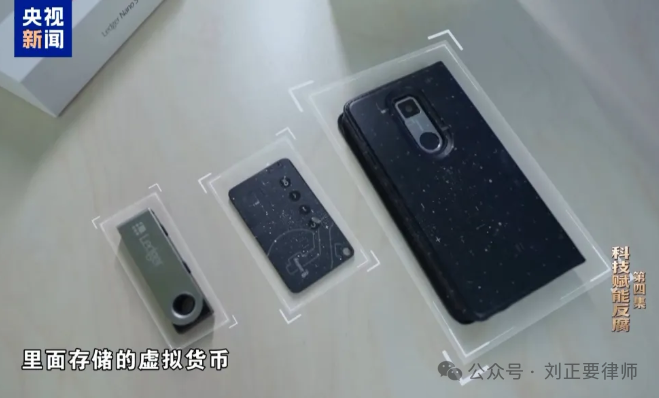
(The image shows a cold wallet for storing virtual currency, source: CCTV News)
The "Interaction Point" Between Virtual and Reality is a Natural Breakthrough for Investigations
The anonymity of virtual currency only exists in a purely on-chain environment. However, for many people, the value of virtual assets must ultimately be reflected in purchasing power in real life. This process of "moving from virtual to real" is the "interaction point" where legal risks erupt.
Investigative agencies typically track through two dimensions:
(1) Fiat Currency Exchange (C2C / Exchange Stage)
The vast majority of parties cannot bypass centralized exchanges or fiat currency exchange merchants (OTC). As long as there is an inflow or outflow of RMB or foreign currency, it will leave behind bank transaction records, IP addresses, and identity verification (KYC) records.
(2) The Obvious and Hidden Aspects of Asset Disposal
As seen in the Yao Qian case, even if the source of funds is virtual currency, if the final destination is the purchase of real estate, luxury goods, or large expenditures, the investigating agency can lock in the original source of funds through a reverse approach of "finding money through goods."
As long as virtual assets are associated with the real world once, the originally hidden blockchain address will be assigned a real identity label.
The Popularization and Specialization of Investigative Technology
In the early years, there was indeed a certain "technical gap" in virtual currency investigations. However, today, virtual currency tracking has transformed from "black technology" into a "basic skill" for investigators.
Currently, judicial authorities have widely introduced professional on-chain tracking tools, which possess a vast "label library" of virtual currency wallet addresses and can provide real-time annotations for addresses of major global exchanges, mixers, and online gambling platforms. Investigators no longer find blockchain mysterious; their understanding of hash values, smart contracts, and hardware wallets is now very deep.
As a lawyer in the cryptocurrency space, the author needs to remind that in the current judicial environment, one should not hope to evade legal scrutiny through technical means. With the standardization of electronic data collection technology, those once considered "unbreakable" technical barriers are actually very fragile in the face of a systematic investigative network.
Conclusion
From an objective perspective, the significance of the Yao Qian case lies in its breaking of the superstition that "technical means can override judicial sovereignty." From a legal practice standpoint, any attempt to use algorithms to obscure the flow of funds is difficult to justify under the principle of "penetrative judgment."
As legal professionals, we advise individuals or enterprises involved in Web3 to focus on compliant operations and risk prevention, rather than researching how to exploit technical loopholes to resist investigations. In an increasingly transparent digital age, genuine legal compliance is the only "safe harbor."
免责声明:本文章仅代表作者个人观点,不代表本平台的立场和观点。本文章仅供信息分享,不构成对任何人的任何投资建议。用户与作者之间的任何争议,与本平台无关。如网页中刊载的文章或图片涉及侵权,请提供相关的权利证明和身份证明发送邮件到support@aicoin.com,本平台相关工作人员将会进行核查。


