Author: Jae, PANews
In the long journey of Ethereum scaling, Polygon was once remembered as a "sidechain." Now, it is quietly shedding its old shell, attempting to be reborn.
Recently, Polygon co-founder Sandeep Nailwal has designated 2026 as the "year of rebirth" for POL. Following his announcement, the price of the POL token surged over 30% within a week.
With Polygon completing the acquisitions of Coinme and Sequence and disclosing its technical roadmap, it aims to evolve from an Ethereum scaling solution into a global market "payment and tokenization infrastructure."
Spending over $250 million on acquisitions, bridging the last mile for cash on-chain
Polygon has begun to adopt a highly aggressive strategy, directly penetrating the financial gateways of the physical world.
On January 13, Polygon Labs announced the completion of its acquisitions of two crypto companies, Coinme and Sequence, with a total transaction value exceeding $250 million. Coinme focuses on cash and crypto asset exchange and operates a network of crypto ATMs in the United States; Sequence provides on-chain infrastructure services, including crypto wallets and other products.
Polygon Labs CEO Marc Boiron and Sandeep Nailwal stated that this acquisition is a crucial part of their stablecoin and payment strategy, aimed at strengthening Polygon's infrastructure layout. This move also marks Polygon's extension from "smart contracts" to "physical infrastructure."
It is worth mentioning that Coinme is one of the earliest licensed Bitcoin ATM operators in the U.S. This transaction not only acquires its ATM network covering 49 states and tens of thousands of retail locations (such as large supermarkets like Kroger) but, more importantly, secures a complete set of essential licenses for payment institutions in the U.S.—the Money Transmitter License (MTL).
The deeper logic behind this acquisition is to establish a physical deposit and withdrawal network. For those without traditional bank accounts or ordinary users who are hesitant to use centralized exchanges (CEX), Polygon provides a direct channel through Coinme's ATMs to convert cash into on-chain assets (such as stablecoins or POL) right at supermarket checkout counters.
This is a shortcut for "cash on-chain," as well as a substantial compliance barrier. Acquiring an entity that has been operational for over a decade and has a mature compliance framework will provide Polygon with a very high entry threshold. Although Coinme still faces some regulatory challenges (such as the refund directive from Washington State's DFI), for Polygon, this remains the optimal solution to unlock liquidity in the physical world.
In short, this significant acquisition is not just about buying equipment; it is about buying channels, licenses, and trust.
Sandeep Nailwal candidly stated that this move will put Polygon Labs in direct competition with Stripe. Over the past year, Stripe has also acquired stablecoin and crypto wallet startups and developed its own public chain for payment scenarios, aiming to build a complete tech stack from payment processing to user asset storage.
Overall, in the new round of the stablecoin arms race, Polygon Labs is attempting to position itself on the same starting line as traditional fintech giants through acquisitions.
From 5,000 to 100,000 TPS in a performance sprint
Participating in the war for stablecoin payments cannot be separated from strong technical support.
According to the TPS (transactions per second) roadmap disclosed by Sandeep Nailwal, Polygon aims to elevate the execution efficiency of its blockchain to the level of traditional internet.
The recent Madhugiri hard fork upgrade completed by Polygon has already shown initial results, increasing on-chain TPS by 40% to reach 1,400 TPS.
The team's first phase plan is to achieve 5,000 TPS within six months, with the goal of addressing the congestion issues currently faced by the PoS chain during peak transaction periods, enabling Polygon to meet the throughput demands of global retail payments.
A more aggressive second phase upgrade plan aims to boost the TPS of the entire ecosystem to 100,000 within 12 to 24 months, which means Polygon is expected to handle transaction densities comparable to Visa.
Achieving this goal relies on two major technological leaps:
Rio Upgrade: Introducing stateless validation and recursive proofs, reducing transaction finality from minutes to about 5 seconds, and eliminating chain reorganization risks;
AggLayer (Aggregation Layer): Achieving seamless sharing of multi-chain liquidity through ZK proofs, making 100,000 TPS not a burden on a single chain, but a distributed effort of the entire Polygon network.
It can be said that Polygon is not just transforming a single chain; it is building a federation.
Payment business penetrating retail scenarios, integrating three major fintech giants
Once the deposit and withdrawal channels and throughput capabilities are in place, payments will naturally follow.
Polygon is shaping itself as the technical foundation of a global payment network through deep integration with fintech giants.
- Full integration with Revolut: As Europe’s largest digital bank with 65 million users, Revolut has integrated Polygon as its main infrastructure for crypto payments, staking, and trading. Revolut users can directly conduct low-cost stablecoin transfers and POL token staking through the Polygon network. By the end of 2025, the transaction volume of Revolut users on Polygon is steadily increasing, with cumulative transactions nearing $900 million.
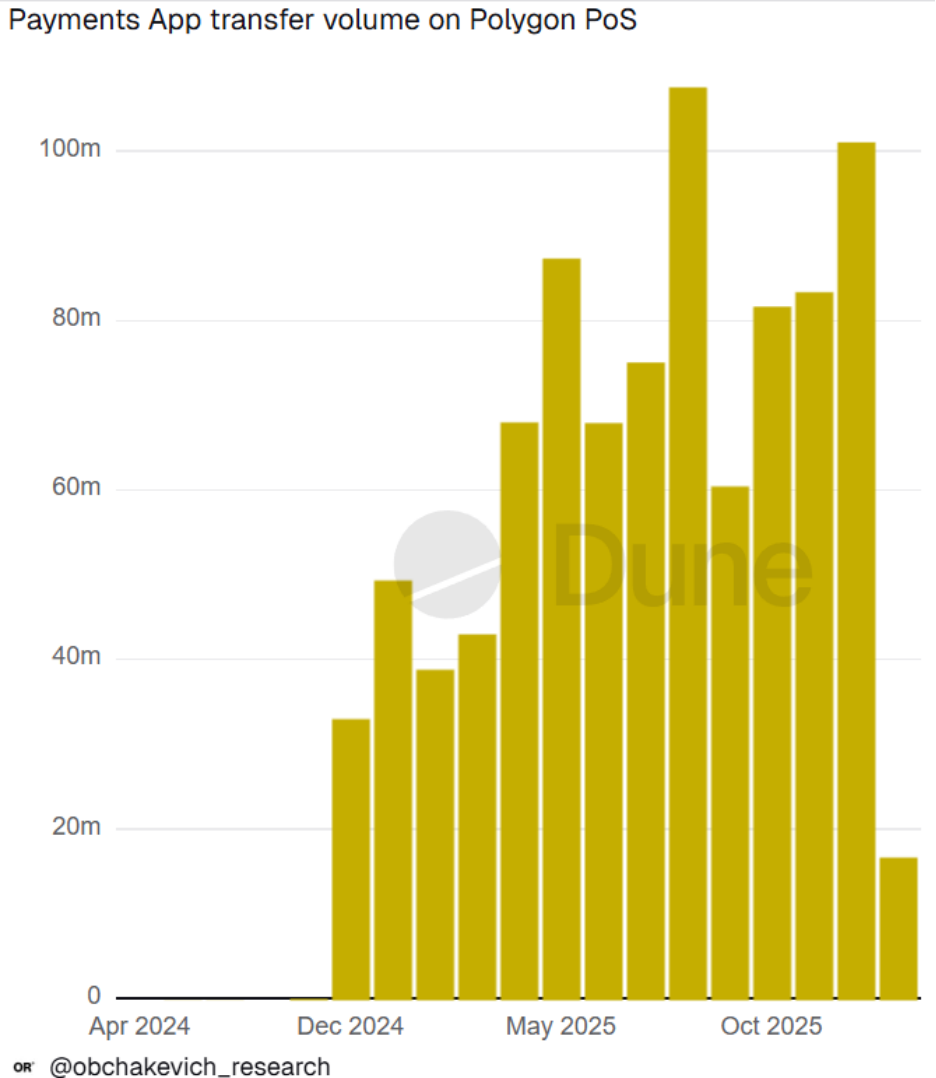
Settlement bridge with Flutterwave: African payment giant Flutterwave has also chosen Polygon as its default public chain for cross-border payments, focusing on stablecoin settlements. Given the high traditional remittance costs in Africa, Polygon's low fees and fast settlements provide better options for local drivers on platforms like Uber.
Identity solution with Mastercard: Mastercard has adopted Polygon to drive its "Mastercard Crypto Credential" identity solution, introducing verified username functionality for its self-custody wallets, significantly lowering the usage threshold and the address recognition risks users face during transfers, thereby enhancing the payment experience.
Polygon is also significantly penetrating everyday consumption scenarios. Data from Dune shows that by the end of 2025, the number of small payment transactions (ranging from $10 to $100) on Polygon is approaching 900,000, setting a historical high, with over a 30% increase since November.
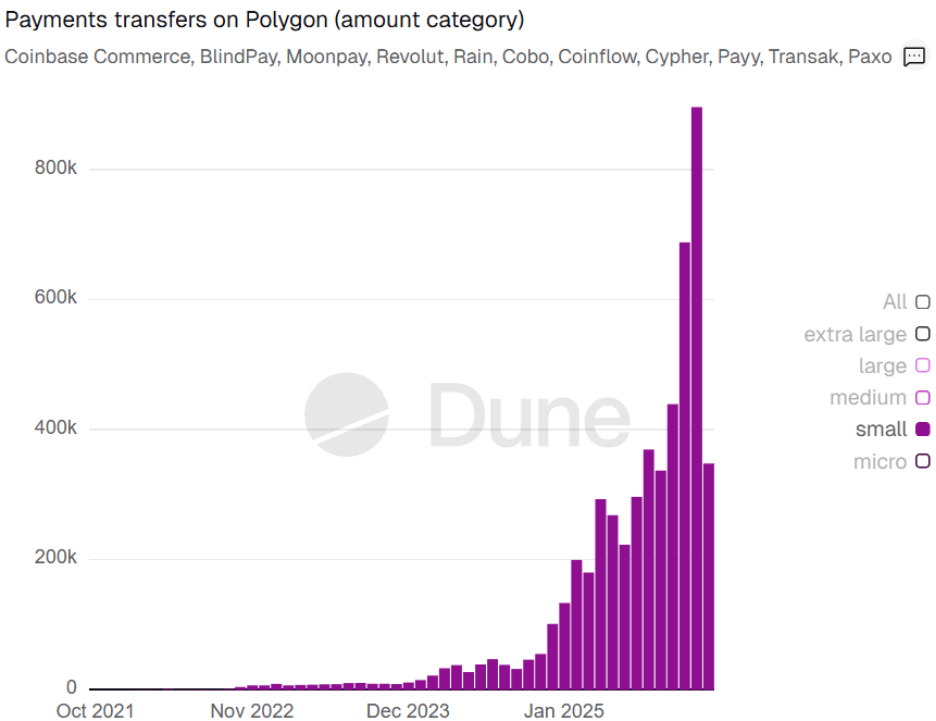
Onchain research head Leon Waidmann emphasized that this transaction range highly overlaps with daily credit card spending, indicating that Polygon is gradually becoming a major channel for payment gateways and PayFi (payment finance).
Tokenization business targeting the institutional market, BlackRock bets $500 million
If payments are the entry point for user traffic for Polygon, then tokenization is its confidence as an institutional-grade infrastructure.
In the RWA (real-world assets) distribution field, Polygon has become a testing ground and preferred platform for top global asset management institutions, with its low interaction costs and seamless compatibility with the Ethereum ecosystem giving Polygon a significant advantage in the on-chain migration of traditional financial assets.
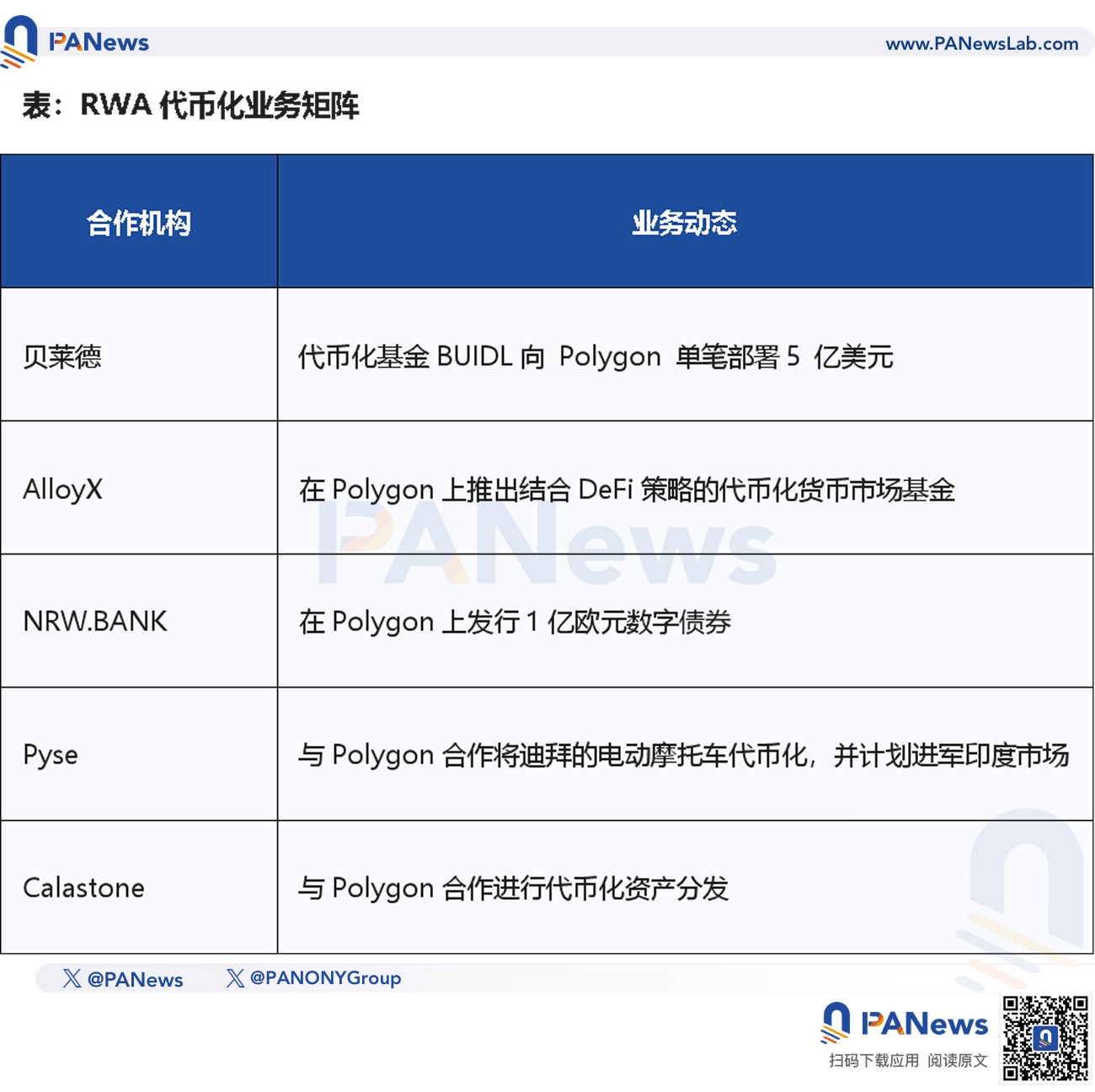
In October 2025, the world's largest asset management firm, BlackRock, deployed approximately $500 million in assets on the Polygon network through its BUIDL tokenization fund.
This move is the highest-level endorsement of the security of the Polygon 2.0 architecture. With the large-scale inflow of institutional funds, Polygon's TVL (total value locked) and liquidity depth may further improve.
The Real Yield Token (RYT) launched by AlloyX on Polygon is a typical case of combining traditional finance and DeFi. This fund invests in short-term, low-risk instruments like U.S. Treasuries, and its uniqueness lies in supporting looping strategies. Investors can use RYT as collateral to borrow funds in DeFi protocols and reinvest in the fund to amplify returns repeatedly.
Germany's NRW.BANK issuing digital bonds on Polygon marks a significant breakthrough in the regulated capital markets of Europe. This bond operates under Germany's Electronic Securities Act (eWpG), indicating that Polygon can not only issue conventional crypto tokens but also support compliance assets with strict regulatory requirements.
POL shows strong deflationary characteristics, token value capture restarts
Returning to the subject itself, the transition from MATIC to POL is not just a change in token symbol but a reconstruction of economic logic.
Since the beginning of 2026, Polygon has generated over $1.7 million in fees and burned more than 12.5 million POL tokens (approximately $1.5 million).
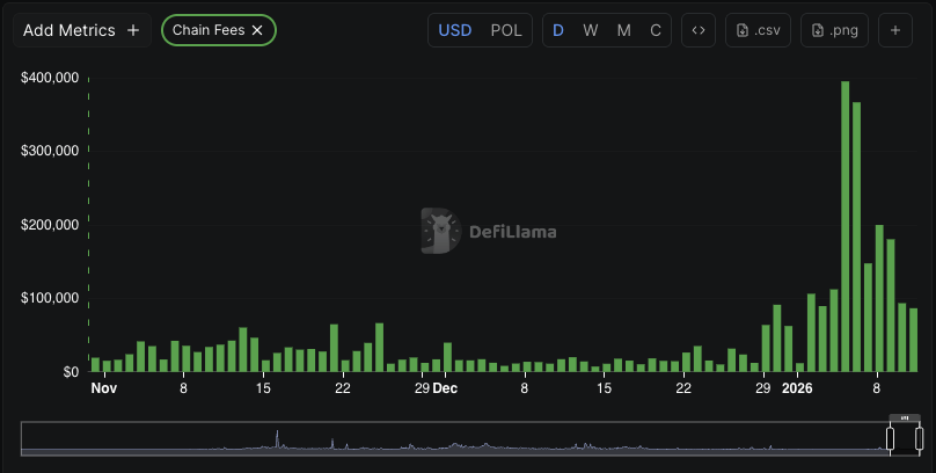
Castle Labs points out that the main reason for the surge in fees is that Polymarket has launched a 15-minute prediction market fee feature, which directly brought over $100,000 in daily revenue to Polygon.
Previously, the Polygon PoS network also set a historical record: burning 3 million POL in a single day, equivalent to about 0.03% of the total supply. This is not a coincidence but a natural result of the ecosystem entering a high-frequency usage phase.
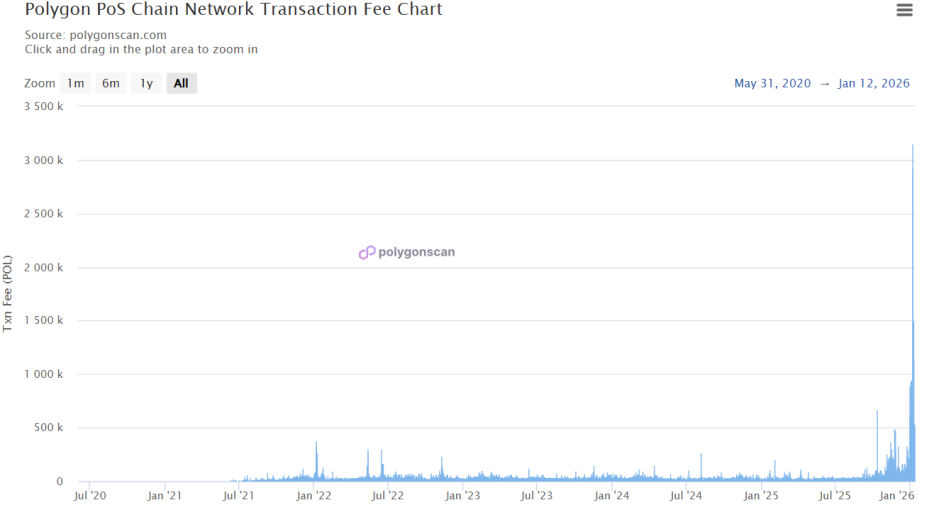
According to the EIP-1559 mechanism, when block utilization remains above 50% for an extended period, gas fees will enter a rapid rising channel. Now, Polygon's daily burn rate has stabilized around 1 million POL, with an annualized burn rate of about 3.5%, more than double its staking annual yield (approximately 1.5%). This means that, solely through on-chain activities, the circulating supply of POL is being "physically removed" at a considerable speed.
This high-density value capture may support what Sandeep Nailwal refers to as the "rebirth of the token."
Moat and Fourfold Risks Coexist
Although Polygon currently appears to be thriving, it still faces fourfold challenges:
- The double-edged sword of regulatory policies: While acquiring Coinme has secured licenses, it also exposes Polygon directly to regulations across various U.S. states. If compliance issues with Coinme's history escalate, it could impact the 2026 "rebirth" plan for the POL token.
- Challenges of fragmented technical architecture: Polygon 2.0 includes multiple complex modules such as PoS, zkEVM, AggLayer, and Miden. While a multi-component architecture will enhance functionality, maintaining such a large and technically diverse ecosystem poses significant engineering difficulties and security risks. Particularly, if vulnerabilities arise in AggLayer's cross-chain interactions, it could trigger systemic disasters.
- Intense competition in the public chain market:
- The rise of Base: Backed by Coinbase, Base has gained a substantial user influx, encroaching on Polygon's market share in social and payment sectors.
- The assault of high-performance public chains: High-performance L1s like Solana still hold advantages in transaction speed and developer experience, while Polygon's goal of 100,000 TPS requires time to validate.
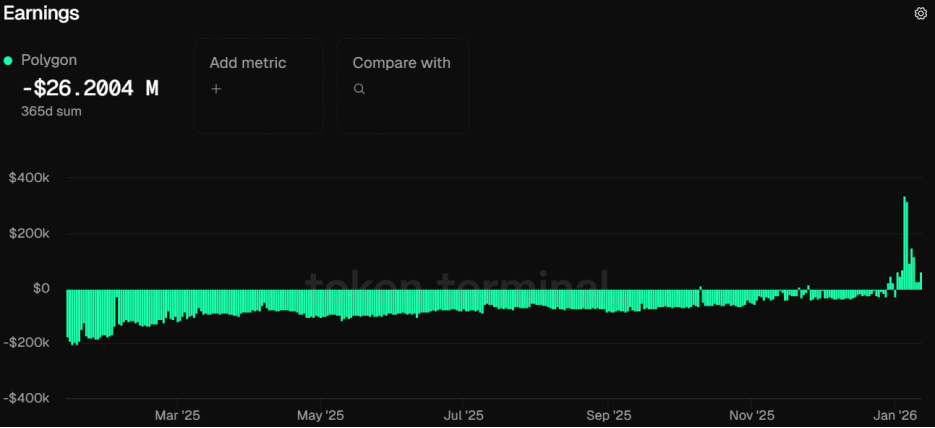
- Concerns over financial sustainability: According to Token Terminal data, Polygon incurred a net loss of over $26 million in the past year, with its fee income insufficient to cover validator costs. This reliance on ecosystem incentives indicates that it remains in a "burning cash for market" phase. Even if Polygon turns profitable in 2026, the sustainability of its revenue-generating capacity remains to be seen.
 Clearly, Polygon is no longer content to be just a "plugin" for Ethereum; its transformation route deserves careful consideration: breaking through performance bottlenecks through technical scaling, lowering entry barriers through investments and acquisitions, obtaining credit endorsements from top institutions, and finally reinforcing user stickiness through high-frequency scenarios.
As 2026 is designated the "year of rebirth," its significance will not only be marked by fluctuations in the POL token price but also by the deep resonance of Polygon as an infrastructure with the pulse of global finance. For investors, tracking the progress of Polygon 2.0's technical implementation, the inflow and turnover of funds, and its financial performance will be key to assessing whether Polygon can successfully achieve its rebirth.
免责声明:本文章仅代表作者个人观点,不代表本平台的立场和观点。本文章仅供信息分享,不构成对任何人的任何投资建议。用户与作者之间的任何争议,与本平台无关。如网页中刊载的文章或图片涉及侵权,请提供相关的权利证明和身份证明发送邮件到support@aicoin.com,本平台相关工作人员将会进行核查。


