Editor | Zhai Jun, Shanghai No. 2 Intermediate People's Court
Text Organization | Li Feng, Xu Hancheng
Layout Editor | Zhou Yanyu
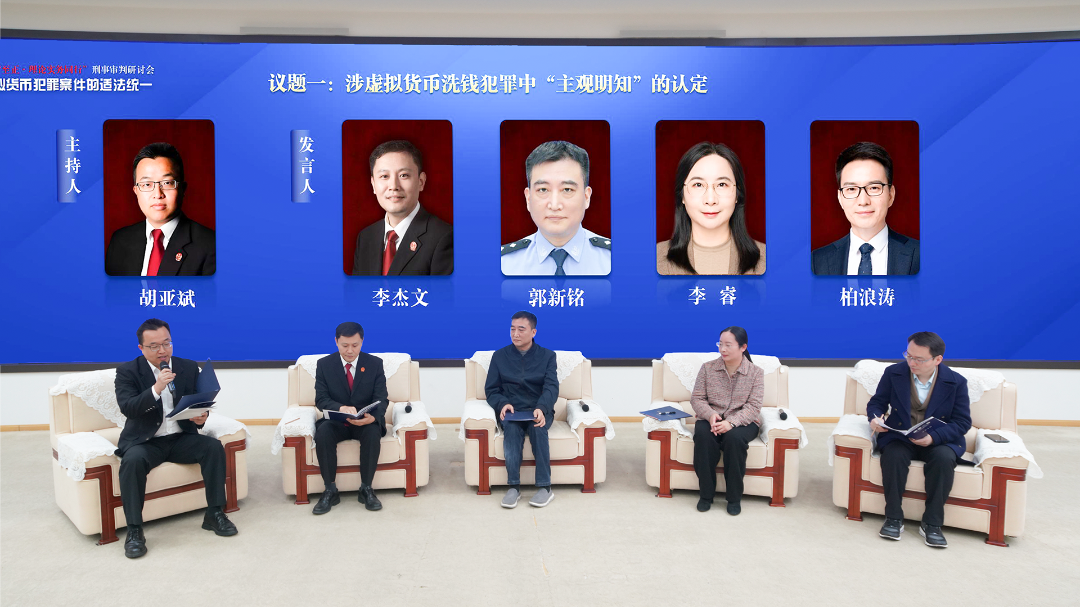
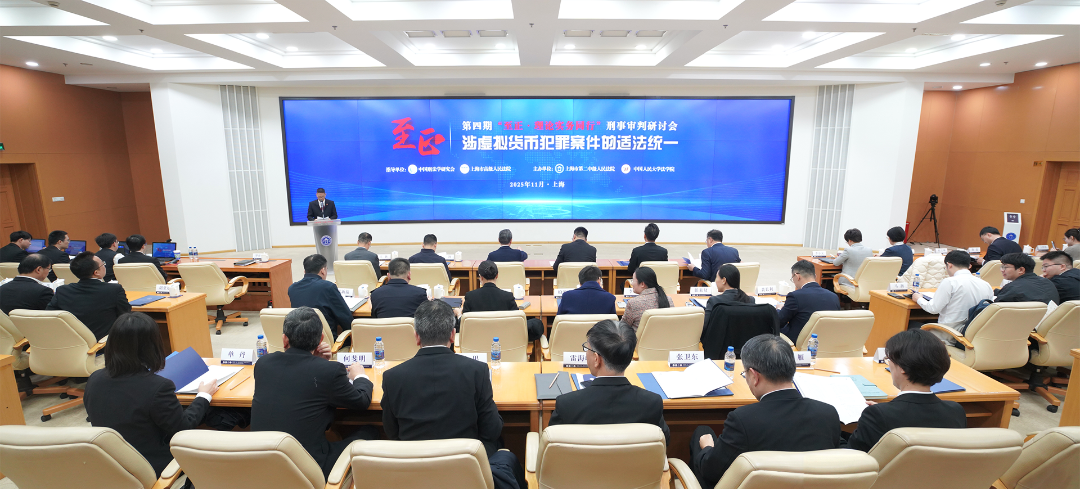
On November 25, 2025, the fourth "Zhizheng · Theory and Practice Together" Criminal Trial Seminar (click to view), guided by the Chinese Criminal Law Research Association and the Shanghai High Court, was jointly hosted by the Shanghai No. 2 Intermediate People's Court and the Law School of Renmin University of China. This seminar focused on the theme of "Legal Uniformity in Cases Involving Virtual Currency Crimes", adopting a "theory and practice 2+2" discussion format. The content of the seminar is organized as follows:
Topic 1: Determining "Subjective Knowledge" in Virtual Currency Money Laundering Crimes
Case 1:
Cai held a large amount of U coins and learned online that someone was buying U coins in bulk at a price 10% higher than the market price. He contacted the buyer and sold all his U coins, making a profit of 1 million yuan. It was later discovered that the funds used by the buyer to purchase U coins came from a fundraising fraud. Cai stated that he knew the high-priced purchase of U coins online was somewhat unusual.
Case 2:
Yang purchased U coins at a normal price on a certain platform, then searched for people needing to exchange U coins through the Telegram instant messaging software, selling each U coin at a price 5 cents higher than the market price. Within six months, Yang conducted over ten thousand U coin transactions with multiple people, earning 1.2 million yuan. It was later discovered that 4.8 million yuan of the funds Yang received from selling U coins came from loan fraud committed by others.

In practice, there is controversy over how to grasp "subjective knowledge" in virtual currency money laundering crimes. For example, regarding Case 1 and Case 2:
- The first viewpoint believes that, based on the law of subjective knowledge being reflected in objective understanding, the determination of subjective knowledge in money laundering crimes should be inferred from the objective behavior and common sense of the actor. In Case 1, Cai had a clear awareness of the abnormality of the transaction, and the premium on U coins significantly exceeded normal commercial logic; in Case 2, Yang used a high-frequency, small-amount, anonymous trading model to continuously obtain stable profits, exhibiting typical characteristics of "score running" money laundering. Combined with the quantity and frequency of U coin transactions by Cai and Yang, it can be inferred that both had subjective knowledge that the funds for U coin transactions might come from financial fraud and other upstream criminal proceeds.
- The second viewpoint argues that subjective knowledge in virtual currency money laundering crimes should be judged comprehensively. In Case 1, Cai's perception of the abnormality of the transaction does not equate to knowing that the funds came from seven specific types of upstream criminal proceeds; in Case 2, Yang's high-frequency, small-amount U coin transactions, earning a small price difference, did not significantly exceed a reasonable range, and had not reached the level of presumed knowledge. Therefore, in the absence of evidence such as prior collusion, clear warnings, specific instructions, or abnormal communications, and considering factors such as the transaction background, professional experience, relationship with upstream criminals, and whether reasonable review obligations were fulfilled, subjective knowledge should be cautiously determined to prevent objective attribution of guilt.
The focus of the aforementioned controversy is:
- First, whether "subjective knowledge" still constitutes the cognitive content of subjective intent in money laundering crimes;
- Second, how to grasp the standards and methods for determining "subjective knowledge" in virtual currency money laundering crimes. After discussion, the following tendency opinions were formed:
The "Criminal Law Amendment (XI)" that came into effect on March 1, 2021, made significant modifications to the legal provisions on money laundering, removing terms such as "knowledge" from the original criminal law text. It is generally believed that this was a textual adjustment to meet the legislative needs for criminalizing self-money laundering behavior, and did not change the structure of money laundering crimes as intentional crimes, nor did it lower the evidentiary standards for the subjective elements in the constitutive requirements of money laundering crimes. According to the general provisions of the Criminal Law regarding intentional crimes and the requirements of responsibility, subjective knowledge remains an essential element of money laundering crimes, requiring the actor to subjectively know or should know that the object they are concealing or disguising is the proceeds of the seven types of upstream crimes as stipulated by law. If the actor genuinely does not know the source and nature of their actions, they do not constitute a money laundering crime. Since money laundering crimes and the crime of concealing or disguising criminal proceeds are special provisions in relation to general provisions, when both crimes overlap, priority should be given to applying the money laundering crime. Furthermore, if it cannot be presumed that the actor should know that the object they are concealing or disguising is the proceeds of the seven types of upstream crimes, it does not constitute a money laundering crime. However, if based on abnormal behavior, it can be presumed that the actor should know that the object they are concealing or disguising is criminal proceeds, it may constitute the crime of concealing or disguising criminal proceeds.
Regarding the standards and methods for determining "subjective knowledge" in virtual currency money laundering crimes, the following four aspects need to be grasped:
- First, the subjective knowledge element of "self-money laundering" crimes does not require special proof. After the actor commits one of the seven types of upstream crimes as defined by criminal law, and further conceals or disguises the criminal proceeds and their benefits, they are deemed to know the source and nature of the money being laundered. However, for money laundering on behalf of others, it is necessary to judge based on evidentiary rules whether the actor subjectively knows or should know that the object they are concealing or disguising is the proceeds of the seven types of upstream crimes.
- Second, the subjective knowledge of "money laundering for others" includes both "knowing or should know." It does not include "possibly knowing," and subjective knowledge cannot be determined merely based on a feeling of abnormal behavior. In practice, the determination of whether the actor possesses subjective knowledge typically employs evidentiary verification methods and factual presumption methods. The "Interpretation on Several Issues Concerning the Application of Law in Handling Criminal Cases of Money Laundering" (hereinafter referred to as the "Interpretation on Money Laundering Criminal Cases") that will take effect on August 20, 2024, generally adopts the "rebuttable factual presumption" recognition model. To determine that the actor knows the source and nature of their money laundering object, it is primarily proven through direct evidence such as their statements, testimonies from co-defendants or witnesses, and communication records; to determine that the actor "should know," it relies on the "rebuttable factual presumption" method, which is based on the information the actor has been exposed to, the circumstances of handling others' criminal proceeds and their benefits, the types, amounts, transfer, and conversion methods of the criminal proceeds and their benefits, the abnormal circumstances of transaction behavior and funding accounts, combined with their professional experience, relationships with upstream criminals, and a comprehensive review of other evidence in the case.
- Third, factual presumption is not a legal fiction, but a judicial proof method that conforms to objective laws. The foundational facts for presumption are usually the "antecedent" facts and "consequential" facts of the case, which must be verified as true; foundational facts cannot rely on presumption to avoid "double presumption." Based on foundational facts and evidence, using common sense, common feelings, and common logic, presumption facts are formed. To ensure the reliability of the factual presumption method, and to prevent special or exceptional circumstances from occurring, it is necessary to accurately understand and grasp the "rebuttal exclusion" rule in the "Interpretation on Money Laundering Criminal Cases," which emphasizes giving the actor the opportunity to defend, rebut, or provide counter-evidence. If there is evidence proving that the actor is unaware of the source and nature of the object of their actions, the presumption does not hold, and they are not recognized as committing a money laundering crime. It should be noted that regardless of the recognition standards and methods used, it is only necessary to prove that the actor knows or should know that their money laundering object comes from the seven types of upstream criminal behavior. In other words, "knowing or should know" is a general understanding of upstream crimes, not requiring specific crime names to be accurate, nor requiring the level of knowledge to reach the degree of "collusion" with upstream criminals.
- Fourth, in determining subjective knowledge in virtual currency money laundering crimes, it is essential to fully consider the characteristics of virtual currencies. Virtual currencies do not have the same legal status as legal tender and do not possess legal compensation; they should not and cannot be used as currency in market circulation. Stablecoins and other virtual currencies currently cannot effectively meet customer identity verification, anti-money laundering, and other requirements. Engaging in activities such as exchanging legal tender for virtual currencies and exchanging between virtual currencies constitutes illegal financial activities. Therefore, in cases of money laundering for others involving virtual currencies, it is necessary to comprehensively consider the actor's choice to transfer or convert funds through virtual currencies, as well as the abnormal circumstances of transaction behavior, funding accounts, amounts, and frequencies, especially their professional experience, the information they have been exposed to, their relationships with upstream criminals, or communication records, to make a correct determination of whether they possess subjective knowledge.
Based on the above, in Cases 1 and 2, relying solely on the abnormality of the transaction behavior can only infer that the actor is aware of the doubts regarding the source of the funds. Further inferring that they are aware that the funds come from the seven types of upstream crimes of money laundering requires more evidence support. Therefore, the second viewpoint is more comprehensive and reasonable in judicial practice.
Topic 2: Types of Behavior in Virtual Currency Money Laundering Crimes and Determination of Completion Standards
Case 3:
Wang transferred his embezzled funds of 9 million yuan multiple times offline to purchase U coins from a currency dealer, then fled overseas. In the United States, with the help of Li, who operates a virtual currency business, he exchanged all his U coins for US dollars, with Li charging a 1.5% service fee.
Case 4:
Zhang illegally profited 50 million yuan through illegal fundraising and other means. To transfer assets abroad, he agreed with Li overseas to provide money laundering services through virtual currency, charging a 15% commission. Zhang purchased U coins worth 50 million yuan through dozens of bank cards, then transferred all the U coins in his wallet to the A account registered with an overseas virtual currency exchange provided by Li, with the transaction leaving a record on the blockchain. Li then transferred the "cleaned" U coins through multiple "mixing" and intermediaries to his B account registered with another country's virtual currency exchange, and then sold them for US dollars through OTC over-the-counter trading, depositing them into Zhang's US dollar account abroad.

In practice, there is disagreement over what type of money laundering is involved in transferring assets abroad through virtual currencies and how to determine the completion of the money laundering crime. For example, regarding Case 3 and Case 4:
- The first viewpoint believes that when Wang transferred U coins to his controlled wallet, and when Zhang transferred U coins to Li's provided A wallet, both constitute "cross-border asset transfer" and are completed. The on-chain transfer of virtual currencies is instantaneous, technical, and borderless. Once the actor exchanges the illicit funds for U coins, they effectively control and offshore the criminal proceeds, and the money laundering behavior possesses cross-border attributes from the moment of the technical transfer of U coins.
- The second viewpoint argues that Wang and Zhang's money laundering is only completed when U coins are exchanged for legal tender. Only when virtual currencies are successfully converted into universally circulating legal tender, such as US dollars, can the criminal proceeds be truly "cleaned." The previous exchange and transfer of U coins are merely intermediate steps, and only when the value of the illicit funds is realized does it represent the completion of the "cleaning." The third viewpoint suggests that the concept of physical borders should be transcended, using the actual control of funds by the actor after they have left the original judicial jurisdiction as the standard for determining the completion of "cross-border asset transfer." When Wang and Zhang transferred U coins to their controlled anonymous wallets that are not subject to China's judicial jurisdiction, the main harmful result of money laundering has already occurred, and it should be recognized as a completed crime at that time.
The focus of the aforementioned controversy is:
- First, how to grasp the essence of money laundering behavior and the standards for determining completion;
- Second, what type of behavior does money laundering through virtual currencies belong to, and how to judge the completion of the crime. After discussion, the following tendency opinions were formed:
Regarding the essence of money laundering behavior and the standards for completion, the following three aspects need to be grasped:
- First, accurately grasp the essence of the crime of "concealing and disguising the source and nature of criminal proceeds and their benefits." In practice, there is a misconception that limits money laundering to "cleaning dirty money" or "operating through financial institutions," as well as a tendency to "emphasize methods while neglecting objects." In fact, any act of transferring or converting the location or form of criminal proceeds and their benefits constitutes money laundering. The criminal law clearly evaluates self-money laundering behavior separately. If an actor engages in cleaning actions such as transferring or converting after committing an upstream crime, such as purchasing real estate or vehicles, to conceal the source and nature of the criminal proceeds and their benefits, and possesses the intent and actions of money laundering, it should be recognized as money laundering, rather than merely an extension of the upstream crime. From the perspective of the correspondence between crime and punishment, it should not only be recognized as a single crime of the upstream crime.
- Second, the acts of concealing and disguising criminal proceeds and their benefits as stipulated in the elements of the crime of money laundering constitute completion. The criminal proceeds and their benefits undergo several layers of cleaning; whether their source and nature can no longer be verified is relative and does not affect the determination of completion.
- Third, strictly combat money laundering crimes according to the law and resolutely maintain national financial security. In the face of new situations, changes, means, and characteristics of money laundering crimes, it is necessary to grasp the essential characteristics and subjective and objective elements of money laundering behavior amid complex, variable, and multilayered money laundering techniques, effectively improving the quality and effectiveness of combating money laundering crimes.
Regarding the classification and completion standards of money laundering behavior involving virtual currencies, on one hand, the crime of money laundering adopts a "listing + catch-all" legislative framework to categorize money laundering behaviors. Overall, money laundering includes two major types of behaviors: transferring and converting criminal proceeds and their benefits, along with several specific methods. In practice, since most actors transfer assets abroad through virtual currencies, some viewpoints believe this falls under "cross-border asset transfer" type money laundering behavior. However, this understanding raises questions about how to determine the "border" of cross-border activities and how to grasp the standards for completion. Article 5, Item (6) of the "Interpretation on Handling Criminal Cases of Money Laundering" clearly identifies the transfer and conversion of criminal proceeds and their benefits through "virtual asset" transactions as one of the methods of money laundering, providing answers to the aforementioned disputes and facilitating the determination of completion standards for money laundering crimes involving virtual currencies.
On the other hand, according to the provisions of the "Interpretation on Handling Criminal Cases of Money Laundering," transferring and converting criminal proceeds and their benefits through "virtual asset" transactions constitutes the completion of a money laundering crime. Although virtual currencies do not possess the status of legal tender and legal compensation, from their actual exchange value, disposability, and related practical practices, they have certain property attributes and can be classified as "virtual assets" as defined in the aforementioned interpretation. Moreover, as long as a virtual asset transaction occurs, it can result in the transfer and conversion of criminal proceeds and their benefits. Therefore, when an actor exchanges illicit funds for virtual currencies, traditional assets transform into on-chain virtual assets, completing the transfer of location and conversion of form, thus constituting the completion of the money laundering crime.
Based on the above, the three viewpoints in Cases 3 and 4 all have certain shortcomings. Wang and Zhang's actions constitute money laundering behavior by transferring and converting criminal proceeds and their benefits through "virtual asset" transactions. When the two exchanged illicit funds for virtual currencies, it can be regarded as having completed the conversion of criminal proceeds and their benefits, thus constituting the completion of the money laundering crime. If considering the actors' actions to consolidate or disperse funds across different accounts for the purpose of exchanging virtual currencies, the point of completion of the crime would be even earlier.
Topic 3: Determination of Illegal Business Crimes Involving Virtual Currencies
Case 5:
Li discovered that trading virtual currencies was profitable, so he opened domestic and foreign accounts to engage in "arbitrage" business by buying low and selling high in virtual currencies, purchasing U coins at low prices in RMB and selling them at high prices in USD, or buying U coins at low prices in USD and selling them at high prices in RMB, earning a price difference of 10 million yuan over several years.
Case 6:
Hu operated a virtual currency trading business in the United States, where some Chinese clients needed to exchange USD, and some American clients needed to exchange RMB. Therefore, Hu helped Chinese clients exchange U coins for USD and remit them to clients' designated overseas accounts, and also helped American clients exchange U coins for RMB and remit them to clients' designated domestic accounts, charging over 3 million yuan in service fees.

In practice, there is controversy over whether the behavior of using virtual currencies for cross-border two-way currency exchange constitutes "disguised foreign exchange trading." For example, regarding Cases 5 and 6:
- The first viewpoint believes that the actions of Li and Hu both constitute disguised foreign exchange trading, constituting illegal business crimes. This behavior essentially utilizes virtual currencies as a medium to complete the exchange between RMB and USD in a cross-border context, which aligns with the characteristics of disguised foreign exchange trading and severely disrupts the national foreign exchange management order.
- The second viewpoint argues that Li and Hu do not constitute illegal business crimes. The currency conversion behavior linked to U coins is not directly equivalent to foreign exchange trading, and Li did not have the subjective intent to assist others in exchanging foreign exchange; he merely caused the conversion between different currencies objectively. Hu's business activities occurred in the United States and were permitted by local laws. The objects of their transactions are virtual currencies rather than foreign exchange, so it is inappropriate to classify them as illegal business crimes; if there is evidence proving that their actions meet the constitutive requirements of money laundering crimes, they can be punished for money laundering.
The focus of the aforementioned controversy is: whether the behavior of using virtual currencies as a medium to achieve the exchange of RMB and foreign currencies constitutes disguised foreign exchange trading that violates national regulations, and whether serious cases can be convicted and punished as illegal business crimes. After discussion, the following tendency opinions were formed:
Illegal business crimes are administrative offenses. Whether the behavior of using virtual currencies as a medium to achieve the exchange of RMB and foreign currencies constitutes illegal business behavior of disguised foreign exchange trading requires attention to the following aspects in specific determinations:
- First, the business behavior in illegal business crimes has characteristics of regularity and profitability, distinguishing business behavior from non-business behavior. Regularity means that the behavior must have continuity and repetitiveness, rather than being occasional or one-time activities; profitability emphasizes that the primary purpose is to obtain economic benefits. Regarding virtual currency trading, it is necessary to distinguish whether the actor is engaged in OTC trading, currency conversion between virtual currencies, market-making, providing information intermediary and pricing services for virtual currency trading, token issuance financing, virtual currency derivatives trading, or other business behaviors, or whether they are merely holding or speculating on virtual currencies as individuals.
- Second, in conjunction with the essential characteristics of illegal business crimes, substantively judge whether the behavior in question violates national regulations and severely disrupts the financial market order to differentiate between crime and non-crime. For example, if an actor uses virtual currencies as a medium to bypass national foreign exchange supervision and provides exchange services between RMB and foreign currencies, exhibiting characteristics of business behavior such as earning service fees or exchange rate differences, it constitutes disguised foreign exchange trading outside the national prescribed trading venues, disrupting the financial market order, and if the circumstances are serious, it constitutes illegal business crimes.
- Third, comprehensively consider the actor's subjective awareness, objective behavior, and methods of profit to accurately determine whether it constitutes joint crime. In complex models of money laundering crimes involving cross-border fund transfers, multilayered transactions, and chain operations, organization and group characteristics are evident. If it is known that others are illegally trading or disguised trading foreign exchange, or if there is prior collusion with others to assist in achieving the conversion of RMB and foreign currency values through virtual currency trading, and the circumstances are serious, it should be treated as a joint crime of illegal business.
Based on the above, in Case 5, if Li's behavior does not exhibit characteristics of business behavior and is merely personal holding or speculating on currencies, it is generally not recognized as an illegal business crime. However, if he knowingly assists others in illegally trading or disguised trading foreign exchange through the exchange of virtual currencies, and the circumstances are serious, it should be recognized as a joint crime of illegal business.
In Case 6, Hu's behavior exhibits characteristics of regularity and profitability, and he is aware that others wish to achieve the exchange between RMB and USD outside the national prescribed trading venues. By providing "local currency - virtual currency - foreign currency" exchange and payment services, he is engaging in disguised foreign exchange trading, having illegally profited over 3 million yuan, which should be recognized as constituting illegal business crimes.
Summary and Comments

Huang Xiangqing, Deputy Director of the Social and Legal Affairs Committee of the Shanghai Municipal Committee of the Chinese People's Political Consultative Conference and former Vice President of the Shanghai High Court:
- First, regarding the determination of "subjective knowledge" in virtual currency money laundering crimes, subjective knowledge is an essential element of intentional crimes. There are two methods for determining subjective facts: evidentiary verification methods and factual presumption methods. When using factual presumption methods, it is important to emphasize giving the suspect or defendant the opportunity to defend and rebut.
- Second, in the determination of completion regarding "cross-border asset transfer" involving virtual currencies, the standards for determining completion should be based on the common state at the time of the specific crime occurrence as a marker of completion. Therefore, money laundering crimes should generally be recognized as conduct crimes.
- Third, in the determination of illegal business crimes involving virtual currencies, it is essential to emphasize the essential characteristics of illegal business crimes, namely the legal interests they infringe upon; secondly, when evaluating specifically, attention should be paid to the integrity of the behavior, and conclusions should not be drawn from fragmented observations; finally, the appearance of the behavior should focus on the conformity of the constitutive elements, as illegal business behavior typically has stages, repetitiveness, and illegal profit-seeking characteristics.

Yang Dong, Vice President of the China Securities Law Research Association and Dean of the Law School of Renmin University of China:
- First, regarding subjective determination, in the absence of virtual currency legislation and insufficient financial regulation in China, it is necessary to combine China's national conditions and relevant policy spirit, use presumptions cautiously, and strictly control the scope of knowledge determination.
- Second, regarding the determination of completion of money laundering crimes, it should recognize the property attributes of virtual currencies from the perspective of unified legal order and deny their financial attributes, marking the completion by the substantial transformation of the form of criminal proceeds, namely the transfer and conversion of off-chain assets or funds to on-chain assets, and strictly combat money laundering behavior.
- Third, regarding the issue of illegal business involving virtual currencies, the determination of illegal business crimes should start from the legislative constitutive elements and consider the particularities of decentralized, borderless, and highly volatile virtual currency trading, while implementing the policy spirit of the central bank to ban virtual currency trading platforms, accurately distinguishing between trading platform business behavior and personal trading behavior that meets public demand, as well as differentiating between illegal domestic trading behavior and legal overseas virtual currency business behavior, ensuring precise strikes against crime, preventing the transmission of overseas virtual currency risks to the domestic market, while considering the actual needs of the public, avoiding undue expansion of the impact on foreign-related legal construction, and allowing the people to genuinely feel the fairness and justice of the judiciary.
免责声明:本文章仅代表作者个人观点,不代表本平台的立场和观点。本文章仅供信息分享,不构成对任何人的任何投资建议。用户与作者之间的任何争议,与本平台无关。如网页中刊载的文章或图片涉及侵权,请提供相关的权利证明和身份证明发送邮件到support@aicoin.com,本平台相关工作人员将会进行核查。