撰文:Matthew Sigel
原文:《Bitcoin Long-Term Capital Market Assumptions》
Please note that VanEck may have a position(s) in the digital asset(s) described below.
Key Takeaways:
- Structural Valuation (15% CAGR): Our Base Case model has Bitcoin reaching $2.9 million by 2050 , driven by its adoption as a settlement currency for 5-10% of global trade and a reserve asset comprising 2.5% of central bank balance sheets.
- Strategic Portfolio Role: We identify a strategic allocation of 1-3% for diversified portfolios. For investors with higher risk tolerance, our analysis suggests that allocations up to 20% have historically optimized Sharpe ratios, capitalizing on Bitcoin's convex return profile.
- The Opportunity Cost: As developed markets face a sovereign debt super-cycle, the risk of zero exposure to the most established non-sovereign reserve asset may now exceed the volatility risk of the position itself.
As Bitcoin transitions from a peripheral speculative asset toward an institutionally integrated monetary instrument, the demand for a rigorous Capital Market Assumption (CMA) framework has never been higher. Investment committees require more than narrative; they require a quantifiable basis for expected returns, volatility, and correlation over a secular horizon.
Our analysis suggests that while short-term price action remains a function of global liquidity cycles and leverage, the long-term value accrual will be driven by Bitcoin’s convergence with the structural deficiencies of the sovereign debt system.
Below, we outline our formal 25-year CMAs, grounded in our 2050 Valuation Scenarios and tempered by the tactical realities of our 2026 cyclical roadmap.
Executive Summary: Bitcoin Capital Market Assumptions
For long-term allocators, our analysis suggests Bitcoin functions as a convex, low-correlation reserve asset with a 15% base-case CAGR and meaningful portfolio efficiency benefits.
| CMA Component | Assumption / Output |
| Time Horizon | 25 Years (2026–2050) |
| Base Case Expected Return | 15% CAGR (Non-linear market path characterized by volatility and re-rating cycles) |
| Bear Case Expected Return | 2% CAGR |
| Primary Return Driver | Global liquidity expansion (M2) and monetary debasement |
| Primary Risk | Regulatory constraints and barriers to global settlement-layer adoption |
| Volatility Profile | Annualized: ~40–70% (Comparable to frontier equities or early-stage tech) |
| Correlation Profile | Historically low to equities, bonds, and gold Long-term strong negative correlation to U.S. Dollar (DXY) |
| Intended Portfolio Role | Diversifier, Convex Return Enhancer, Sovereign Risk Hedge |
| Suggested Allocation | Strategic: 1–3% High Risk-Tolerant Optimization: Up to 20% |
Source: VanEck Research as of 12/31/2025. Past performance is no guarantee of future results. The information, valuation scenarios, and price targets in this blog are not intended as financial advice or any call to action, a recommendation to buy or sell, or as a projection of how bitcoin will perform in the future. Actual future performance of bitcoin is unknown, and may differ significantly from the hypothetical results depicted here. There may be risks or other factors not accounted for in the scenarios presented that may impede the performance. These are solely the results of a simulation based on our research, and are for illustrative purposes only. Please conduct your own research and draw your own conclusions.
I. CMA Framework and Scope
Capital Market Assumptions (CMAs) represent long-term expectations for asset class returns, volatility, and correlation that inform strategic asset allocation decisions. Our 25-year CMAs for Bitcoin are designed for institutional allocators evaluating its role within diversified portfolios.
Our framework separates secular valuation drivers from cyclical deployment considerations , providing both long-horizon return assumptions and near-term implementation guidance. While near-term price movements remain influenced by liquidity conditions and leveraged positions, our CMA framework is anchored in long-duration adoption and balance-sheet dynamics.
II. Secular Valuation Thesis (2026-2050)
Standard equity valuation models (DCF, P/E) fail to capture the utility of a non-sovereign reserve asset like Bitcoin. Our valuation framework instead models Bitcoin’s penetration into two specific total addressable markets (TAMs): Global Medium of Exchange (MoE) and Central Bank Reserve Assets .
In our Base Case , we project Bitcoin will reach $2.9 million per coin by 2050 , implying a 15% Compound Annual Growth Rate (CAGR) from current levels.
Bitcoin 2050 Valuation Scenarios: Key Assumptions and Price Targets
| Bear | Base | Bull | |
| Bitcoin Share of Trade (%) | ~0% | 5-10% | 20% |
| Bitcoin Share of Domestic GDP (%) | ~0% | 5% | 10% |
| Annual Trade in BTC ($ billions) | $2,750 | $13,751 | $27,503 |
| Price Per Bitcoin ($) | $130k | $2.9M | $53.4M |
| CAGR (%) | 2% | 15% | 29% |
| Percent of World Financial Assets (%) | 0.07% | 1.66% | 29.79% |
Note: Current Bitcoin price is approximately $88,000 as of 12/31/2025. This price is used solely as the baseline value for calculating the implied CAGR for the Bear, Base, and Bull scenarios shown above.
Source: VanEck Research as of 12/31/2025. Past performance is no guarantee of future results. The information, valuation scenarios, and price targets in this blog are not intended as financial advice or any call to action, a recommendation to buy or sell, or as a projection of how bitcoin will perform in the future. Actual future performance of bitcoin is unknown, and may differ significantly from the hypothetical results depicted here. There may be risks or other factors not accounted for in the scenarios presented that may impede the performance. These are solely the results of a simulation based on our research, and are for illustrative purposes only. Please conduct your own research and draw your own conclusions.
This 15% annualized return (Base Case) is predicated on two structural pivots:
- The Settlement Pivot: We project Bitcoin will settle 5-10% of global international trade and 5% of domestic trade by 2050.
- The Reserve Pivot: As trust in G7 sovereign debt erodes, we model central banks allocating capital to Bitcoin as a hedge against fiscal dominance.
Bull Case Scenario ($53.4M): In a “hyper-bitcoinization” scenario where Bitcoin captures 20% of international trade and 10% of domestic GDP, the implied value per coin could reach $53.4 million (29% CAGR) . This scenario requires Bitcoin to achieve parity with or surpass gold as a primary global reserve asset, constituting nearly 30% of world financial assets.
Current Baseline (~$88k): Our valuation model uses the current price of ~$88k as the baseline for the following projections. Notably, our “Bear Case” target ($130k, 2% CAGR) is modestly above current levels, suggesting that even in a stagnation scenario where adoption stalls, the asset has priced in significant utility.
III. CMA Inputs: Expected Returns, Volatility, and Correlation
To operationalize these findings for Mean-Variance Optimization (MVO) models, we distill our research into the following formal inputs:
- Expected Returns: We model a 15% annualized return (Base Case) driven by the monetization of the asset class. This is tempered by a Bear Case of 2% , providing a weighted probability framework for risk models.
- Volatility Assumptions: For long-term capital market assumptions, we utilize an annualized volatility range of ~40-70% . This is comparable to frontier equities, early-stage technology, or commodity-linked stocks with embedded optionality. While recent spot market realized volatility has occasionally compressed toward 27% (see Section V), valid long-term stress testing requires the more conservative 40-70% assumption.
- Correlation Assumptions: We project a low to moderate correlation to global equities, bonds, and gold overfull cycles with episodic convergence during global liquidity contractions. The single most persistent long-term relationship remains its negative correlation with the U.S. Dollar (DXY) , reinforcing its role as a hedge against monetary debasement.
IV. Correlation Drivers: Liquidity and the Dollar
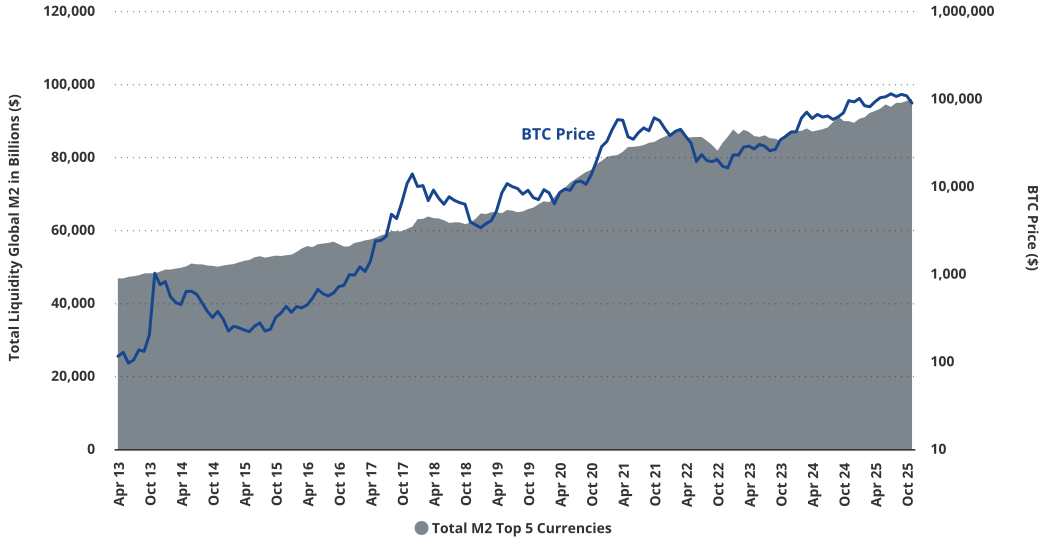
For portfolio construction, the “why” matters less than the “what”. Contrary to the popular narrative that Bitcoin is a levered tech beta, our regression analysis confirms it acts primarily as a liquidity sponge.
Global M2 vs. Bitcoin Price
Source: VanEck Research; Bloomberg as of 11/30/2025.
Changes in M2 explain over 50% of Bitcoin's Price Variance (r 2 =0.54, F=26) .
Correlation Profile:
- Global Liquidity is the Signal: Since 2014, Bitcoin’s price has demonstrated a 0.43 correlation (r 2 =0.19) with Total Global M2. When applying multivariable analysis to the top 5 currencies (USD, EUR, CNY, JPY, GBP), we find that M2 changes explain over 54% of Bitcoin’s price variance (F=26) .
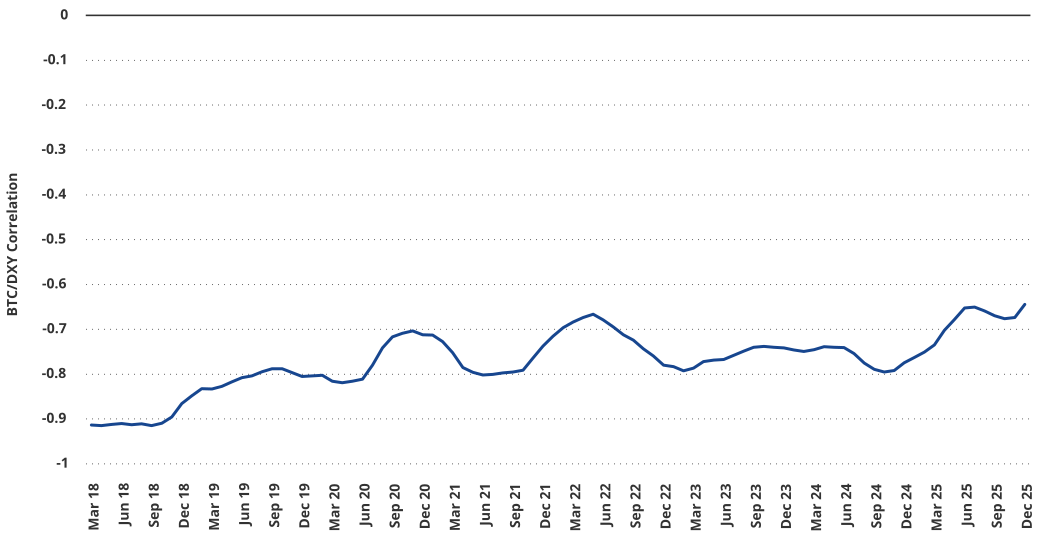
- Decoupling from the Dollar: The inverse correlation to the DXY is structurally moderating. While historically strong (r 2 =0.7 from 2014-2020), this relationship has weakened to r 2 =0.45 in the current cycle (t=-13) .
BTC Inverse Correlation with DXY Eased in 2025
Source: VanEck Research; Bloomberg as of 12/31/2025.
The inverse relationship between Bitcoin and the US Dollar (DXY) has moderated since 2020, suggesting Bitcoin is increasingly responding to global fiscal instability rather than just US currency strength.
V. Volatility and Market Structure
For institutional models, understanding the source of volatility is as important as the number itself. Data indicates that Bitcoin's volatility is increasingly structural rather than behavioral, driven by derivative leverage rather than spot selling.
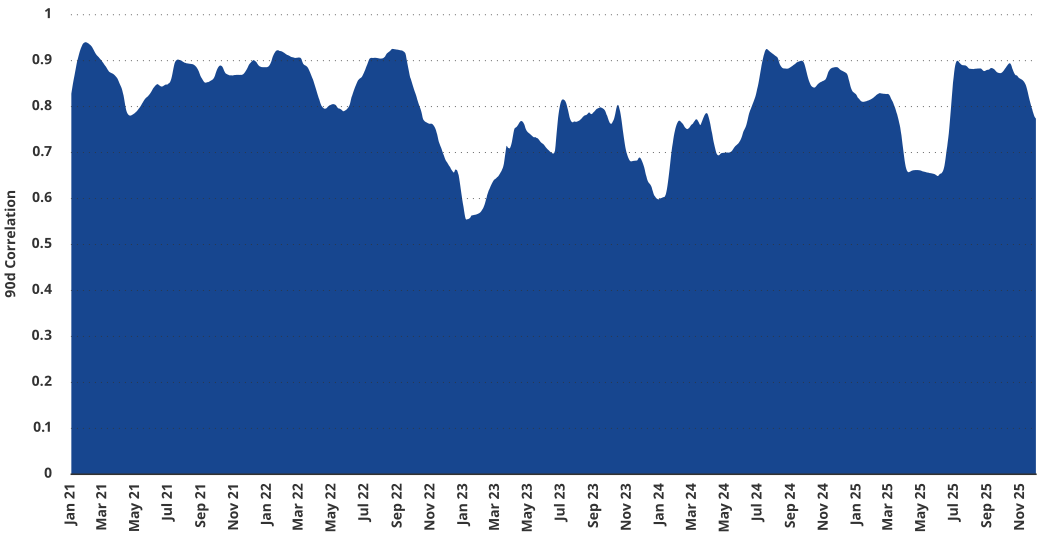
Bitcoin Futures Open Interest vs. Price
Source: VanEck Research; Bloomberg as of 12/31/2025.
Since October 2020, nearly 73% of Bitcoin price variance can be explained by changes in BTC Futures Open Interest (t=71) .
- The Leverage Factor: Changes in futures Open Interest currently impact Bitcoin price with an average beta of 0.68x , though during volatile periods this can spike to 2.0x . This “reflexivity” means volatility events are often mechanical deleveraging moments rather than fundamental thesis breaks.
- Market Maturation: Realized volatility has structurally declined, recently hitting multi-year lows near 27% .
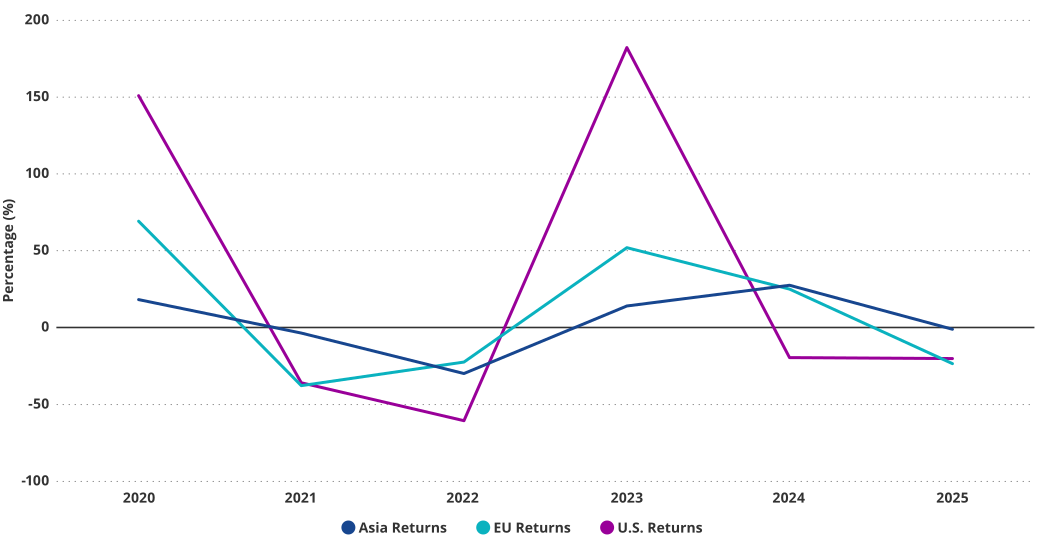
Bitcoin Annualized Average Hourly Returns by Trading Session (Asian/US/Euro)
Source: VanEck Research; Bloomberg as of 12/31/2025.
Market competition has tightened. While Asian trading hours lagged in 2021, they now lead price discovery, indicating a 24/7 mature market structure.
VI. Tactical Deployment Considerations (2026 Roadmap)
While the secular thesis is robust, the path is rarely linear. For allocators deploying capital in the 2026 window, we utilize specific onchain metrics to manage entry risk.
1. The “Overheated” Signal: Relative Unrealized Profit (RUP) We closely monitor the Relative Unrealized Profit (RUP) metric. Historically, when the 30 DMA RUP exceeds 0.70, tactical cycle tops are imminent.
We closely monitor the Relative Unrealized Profit (RUP) metric. Historically, when the 30 DMA RUP exceeds 0.70 , tactical cycle tops are imminent.
- Current Status: At 0.43 (as of 12/31/25), Bitcoin’s RUP remains within the range that historically produces the best 1-2 year returns and suggests we are mid-cycle.
High Levels of Relative Unrealized Profit (RUP) Often Signal Peak Prices
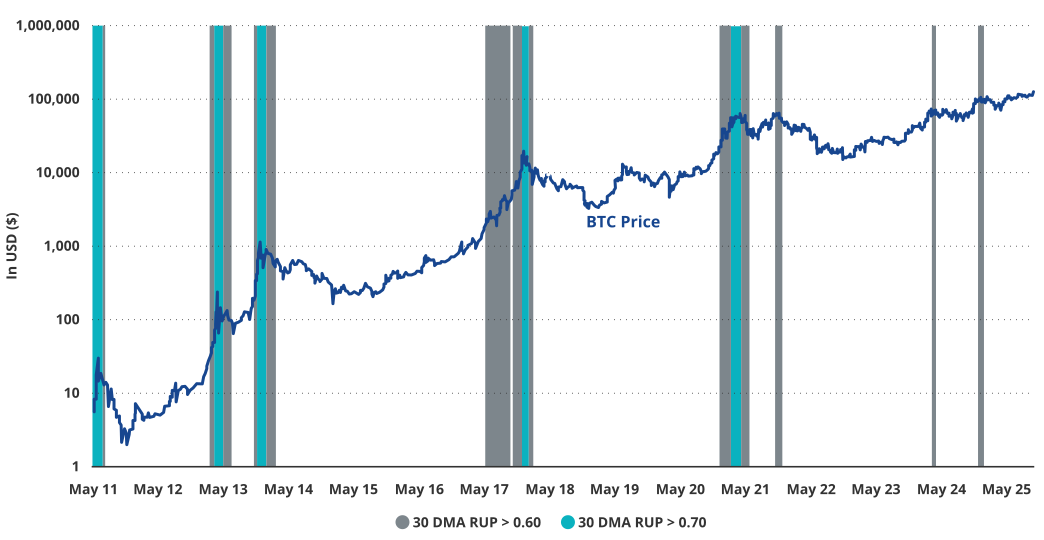
Average BTC Forward Returns by 30-Day Moving Average (MA) RUP Level

Source: VanEck Research; Bloomberg as of 12/31/2025. Relative Unrealized Profit is a blockchain metric that compares the total unrealized gains of all holders to the market cap, used to evaluate market sentiment and identify potential cycle tops. Not intended as an offer or recommendation to buy or sell any digital assets referenced herein. Digital assets are subject to significant risk and are not suitable for all investors. It is possible to lose your entire principal investment. Past performance is not guarantee of future results. Not intended as a forecast or prediction of future results.
2. Futures Funding Rates
Leverage remains the primary driver of short-term volatility. Sustained perpetual futures funding rates above 10% typically signal overly bullish sentiment that often precedes cycle tops. Current rates (~4.9%) suggest further upside potential.
VII. Role in Strategic Asset Allocation
Bitcoin is not a tactical trade in this framework; it functions as a long-duration hedge against adverse monetary regime outcomes.
- Strategic Allocation: Our updated analysis suggests a strategic allocation of 1-3% in diversified portfolios.
- Optimization: For investors with higher risk tolerance, allocations up to 20% have historically improved Sharpe ratios, capturing the asset's unique convex return profile.
Our analysis confirms that small allocations have an outsized positive impact on portfolio efficiency due to the asset's unique combination of high convexity and low correlation. While our CMAs are forward-looking, historical data validates this “efficiency” thesis.
Our research into the Impact of Bitcoin Allocations on 60/40 Portfolios demonstrates that asset - level volatility does not necessarily translate into proportionate portfolio risk when position sizing is disciplined.
Impact of Bitcoin Allocation on a Traditional 60/40 Portfolio
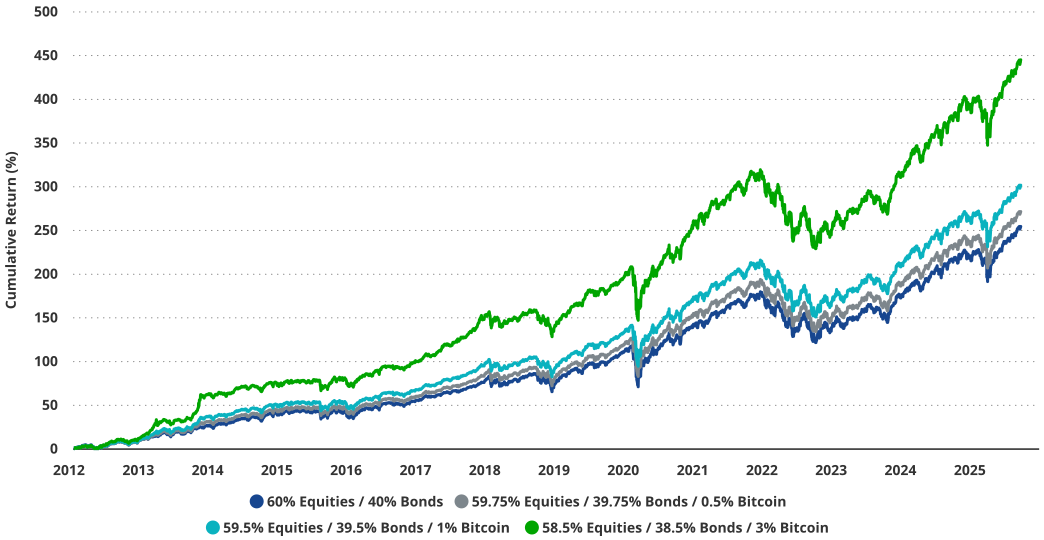
Source: Morningstar as of 12/31/2025. Equities are represented by the S&P 500 Index, Bonds are represented by the Bloomberg Barclays US Aggregate Index, Bitcoin is represented by the MarketVector Bitcoin Index. Past performance is no guarantee of future results. Not intended as a recommendation to buy or sell any securities mentioned herein, to adopt any investment strategy, or as any call to action. Index performance is not representative of fund performance. It is not possible to invest directly in an index. Please see important disclosures at the end of this commentary regarding hypothetical performance.
A 3% allocation to Bitcoin in a traditional 60/40 portfolio has historically yielded the highest return per unit of risk.
| 1 year Return | 3 year Return | 5 year Return | Since Inception Return (Annualized) | Since Inception Std Dev | Since Inception Max Drawdown | Since Inception Sharpe Ratio | |
| 60% Equities / 40% Bonds | 13.70 | 15.46 | 8.47 | 9.68 | 9.11 | -20.10 | 0.88 |
| 59.75% Equities / 39.75% Bonds / 0.5% Bitcoin | 13.23 | 15.33 | 8.40 | 10.04 | 8.83 | -19.69 | 0.95 |
| 59.5% Equities / 39.5% Bonds / 1% Bitcoin | 13.16 | 15.84 | 8.57 | 10.64 | 9.03 | -19.89 | 0.99 |
| 58.5% Equities / 38.5% Bonds / 3% Bitcoin | 12.87 | 16.89 | 9.24 | 13.05 | 10.32 | -20.70 | 1.08 |
Source: Morningstar as of 12/31/2025. Equities are represented by the S&P 500 Index, Bonds are represented by the Bloomberg Barclays US Aggregate Index, Bitcoin is represented by the MarketVector Bitcoin Index. Past performance is no guarantee of future results. Not intended as a recommendation to buy or sell any securities mentioned herein, to adopt any investment strategy, or as any call to action. Index performance is not representative of fund performance. It is not possible to invest directly in an index. Please see important disclosures at the end of this commentary regarding hypothetical performance.
- The 3% Sweet Spot: Historically, replacing small portions (1–3%) of a traditional equity/bond portfolio with Bitcoin has increased annualized returns while simultaneously improving the Sharpe Ratio .
- Asymmetric Impact: Because Bitcoin’s correlation to stocks and bonds remains historically low, its volatility tends to wash out at the portfolio level, leaving behind the pure "alpha" of its adoption curve.
Conclusion: The Allocator's Case
For the diversified allocator, the argument is one of efficiency. Historically, a small allocation to an asset with low correlation and high idiosyncratic convexity improves the portfolio's Sharpe Ratio. As we approach a sovereign debt super-cycle, the cost of zero exposure, effectively shorting a scarce non-sovereign reserve asset, may now rival – or exceed – the volatility of a modest, disciplined allocation.
To receive more Digital Assets insights, sign up in our subscription center .
免责声明:本文章仅代表作者个人观点,不代表本平台的立场和观点。本文章仅供信息分享,不构成对任何人的任何投资建议。用户与作者之间的任何争议,与本平台无关。如网页中刊载的文章或图片涉及侵权,请提供相关的权利证明和身份证明发送邮件到support@aicoin.com,本平台相关工作人员将会进行核查。


