
Author|Xu Shanzhou Yongliang, Geek Park
Editor|Zheng Xuan
Some say CES is the "Spring Festival Gala of the tech world," just for the spectacle; but in our view, it resembles a huge, chaotic, yet vibrant "future draft box." This year, the clearest line in this draft box is: AI is no longer just "ChatGPT" on screens, but is beginning to take over the real "physical world."
This year's CES can be described as a full revival, with over 4,100 exhibitors and an expected audience of more than 150,000. Beyond the numbers, we see a more significant change: an increasing number of diverse hardware are embracing AI, which is reaching, learning from, and influencing the real world through these hardware terminals, and one day will become ubiquitous.
This year, our team firmly focused on four areas: "Robotics and Embodied Intelligence," "Smart Vehicles," "AI Hardware," and "Fun Black Technology." This is not only because they occupy the largest exhibition space, but because in our eyes, these four fields constitute the clearest "innovation variables" in this year's tech world.
Among the vast array of over 4,000 exhibits, we selected 25 innovative products. These include "living" LEGO bricks, the newly unveiled Boston Dynamics Atlas, Sweekar's breathing AI pet, and Withings' weight scale that can monitor blood sugar… In these products, we see not just "parameter updates," but under the support of AI, human daily life, entertainment, travel, and education methods are welcoming the most brilliant moment of innovation since the invention of electricity a century ago.
This is a draft leading to the future, inviting you to check it out with us.
01 Robotics/Embodied Intelligence
This year's CES is destined to be a watershed moment for the robotics sector. The official opening of a dedicated exhibition hall for embodied intelligence sends a clear signal—robots are no longer just mascots in display windows; they are ready to get to work. Attendees will witness how AI-driven machines are being implemented in manufacturing, transportation, and medical scenarios. This leap from "showing off" to "practicality" is the most exciting moment for hardware enthusiasts.
If 2025 is still a "trial run" for Chinese robotics, then 2026 will definitely be a "full-scale attack." Just looking at the exhibitor directory is exhilarating, as the Chinese embodied intelligence contingent makes up more than half. Yushu will showcase the latest interactions, while Zhiyuan is bringing its entire product line to face the North American market for the first time, along with strong players like Weita Power, Galaxy General, and Yundongchu, creating an unprecedented spectacle.
Interestingly, this "expedition" will also welcome a heavyweight competitor. Boston Dynamics has brought the first public demonstration of the all-electric Atlas. On one side is a well-established powerhouse with deep technological accumulation, and on the other is a rapidly iterating Chinese contingent. This "hardcore" competition will directly open a new chapter in the commercialization of embodied intelligence.
From "Internet Celebrity" to "Factory Brother": Boston Dynamics Atlas Gets Its First Job Offer
On the stage of CES 2026, when the new generation of Boston Dynamics Atlas walks out with a lively and very "human-like" gait, the atmosphere filled with a mix of awe and slight unease is perhaps the most captivating moment in technology. Looking back over the past decade, witnessing its evolution from a stumbling, somewhat comical metal prototype to today's streamlined industrial product, this visual impact itself announces a turning point in an era—it no longer exists just to shoot parkour videos.
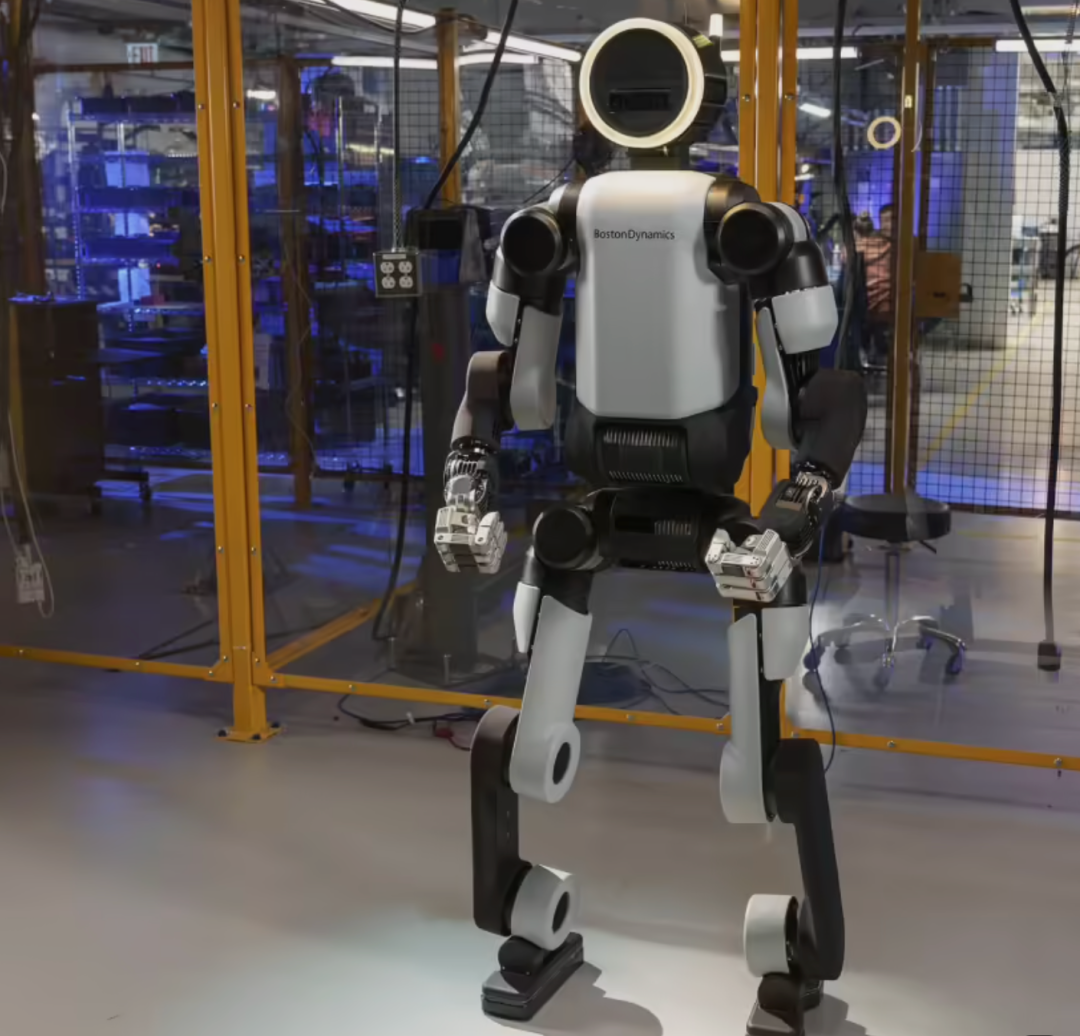
The product definition of the new Atlas is very clear: it is a "super worker bee" born to work in factories. In terms of hardware quality, 56 degrees of freedom combined with fully rotating joints give it a range of motion that surpasses humans; while its human-scale hands with sensory capabilities are designed to handle complex material sorting and assembly tasks. More importantly, it is no longer just a machine that executes rigid code, but a general workforce that can continuously learn and adapt to new positions through AI.
What is most exciting is its "job offer": it will directly enter its parent company Hyundai's factory in Georgia to undertake manufacturing tasks on a real production line. When robots begin to truly step out of the laboratory to perform those tedious, repetitive, and even dangerous tasks, this marks a true milestone in the transition of humanoid robots from "Demo" to "Product."
Opening the Consumer-Level Embodied Era! Weita Power's Vbot May Be the First Truly "Free-Ranging" AI Robot Dog
At CES 2026, the most intriguing aspect of the Vbot super robot dog is not how fast it runs, but that it has completely discarded the remote control. This is probably the world's first truly intelligent robot dog that dares to be "free-ranging" in complex environments.
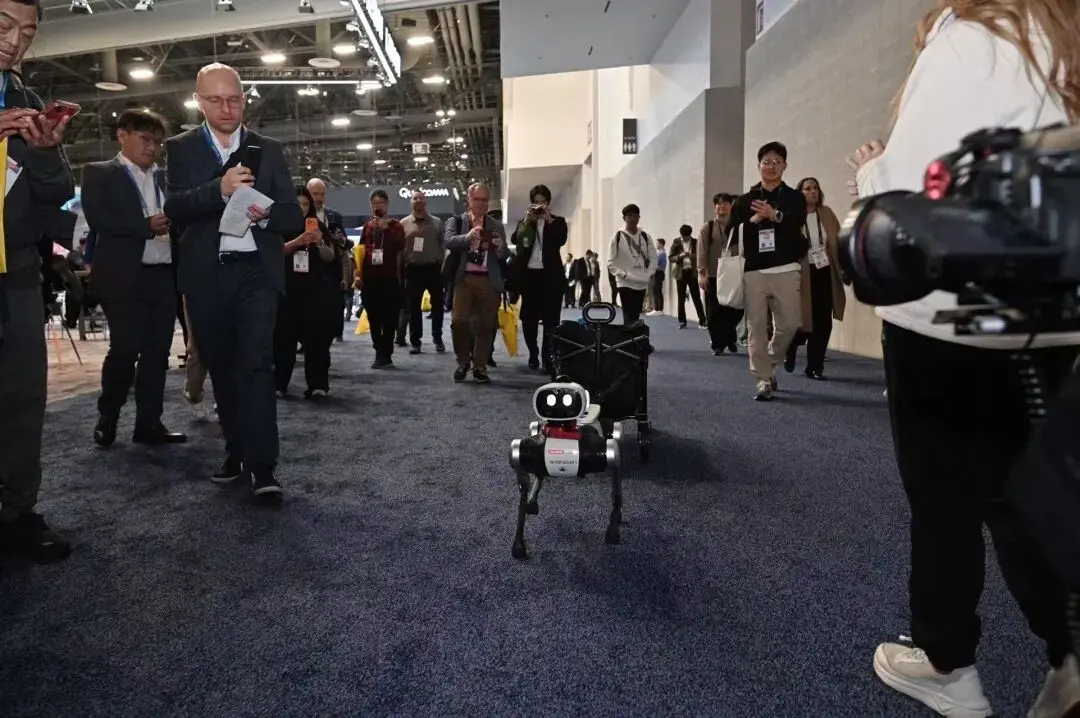
In the past, playing with robot dogs essentially meant operating an expensive high-end remote-controlled car. But Vbot, relying on its self-developed body, spatial, and Agent three-layer intelligent architecture, showcases what embodied intelligence should look like: in the extremely crowded and noisy environment of CES, it can autonomously follow, lead, and even help users carry items and take photos. This ability to make autonomous decisions after being "let go," combined with smooth English voice interaction, makes it no longer seem like a cold machine executing commands, but rather a judgment-capable super partner.
This is also directly reflected in market enthusiasm. In the pre-sale at the end of 2025, Vbot secured 1,000 orders in just 52 minutes, which is quite an astonishing speed for embodied intelligent hardware priced in the tens of thousands.
Currently, the global version of Vbot is being prepared intensively, with plans to launch in North America, Europe, and the Middle East in Q2 2026. Vbot indeed gives a sense of robots truly entering daily life.
The Real-Life "WALL-E's" Distant Cousin: ZerothW1's Retro Futurism
In an era where robots are striving to look more "human," Zeroth's W1 is a refreshing change—it directly brings the beloved WALL-E from our hearts into reality. Although it lacks Disney's official yellow paint, this $5,599 machine, with its iconic dual-track design, can instantly hit the soft spot of sci-fi fans. It is not a delicate device that can only glide on smooth floors; the tracks give it strong passability, allowing it to traverse grass, gravel roads, and even slopes.
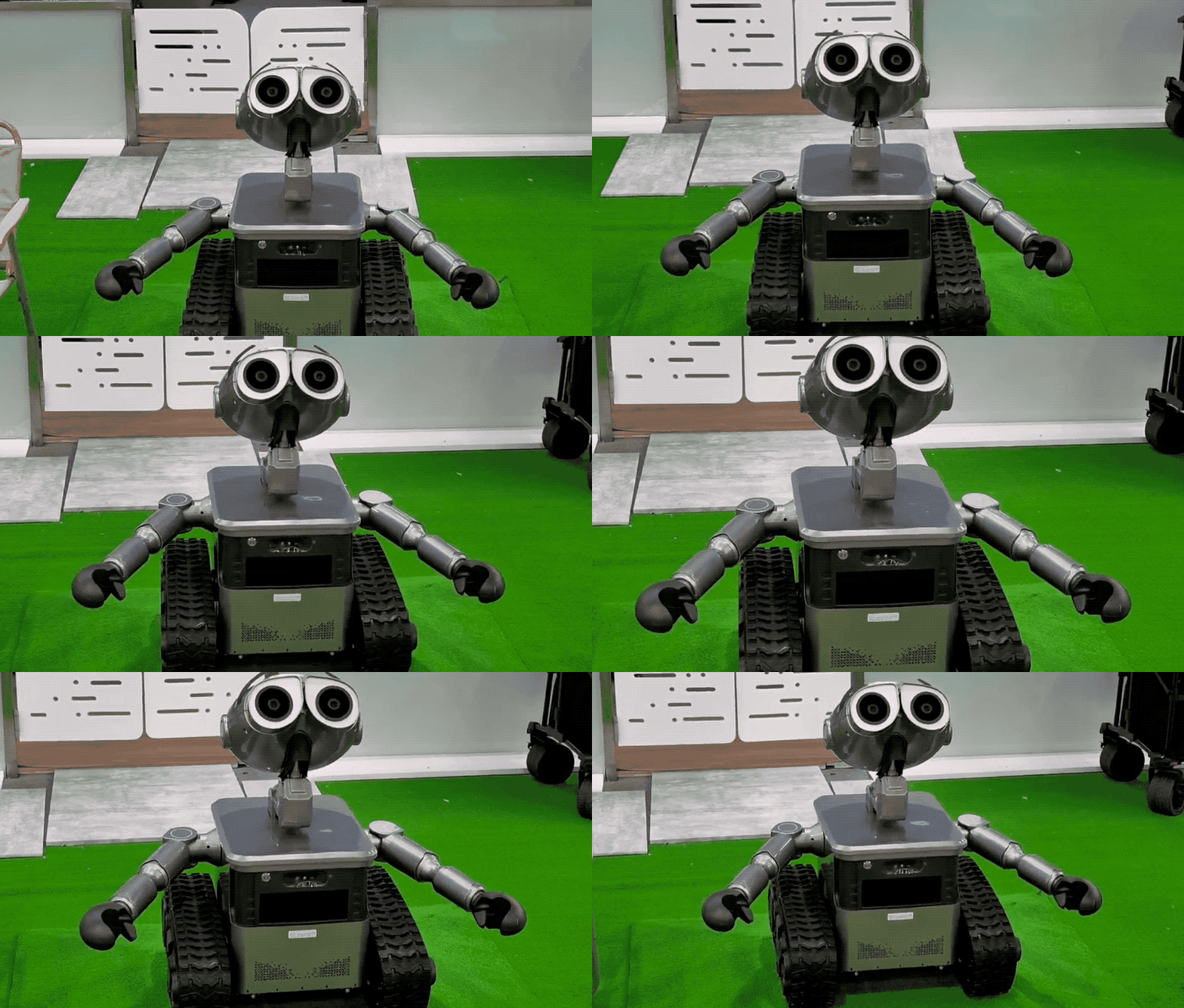
Image Source: Geek Park
From a hardware perspective, this little guy is a bona fide "strongman." Weighing only 20 kilograms, it can carry 50 kilograms of heavy objects around, achieving an impressive load ratio of over 2:1 among service robots. With laser radar and RGB cameras, it can sense the environment, follow you like a shadow, and even serve as a mobile gaming console.
Although its functions currently seem a bit of a "mixed bag"—being a mover, a photographer, and an expensive remote-controlled toy, with a speed of only 0.5 meters per second (adorably slow)—the value of W1 lies in its breaking down the boundaries between tools and pets. It does not pursue extreme efficiency but provides a sense of companionship: imagine a little guy that looks like WALL-E, puffing and panting as it helps you carry heavy items home; this emotional value may be the reason it dares to sell at a high price.
Your iPhone Suddenly Has a "Body": LoonaDeskMate's Smart Subtraction
In a CES filled with expensive, complex standalone AI robots, Loona's DeskMate played a beautiful "four ounces to move a thousand pounds." It looks like an ordinary desktop charging station, equipped with three USB-C and one USB-A ports, but the mechanical arm with MagSafe is the soul of the product. Once an iPhone is attached, it is no longer just a charger; it instantly activates applications and transforms into a moving AI desktop assistant.
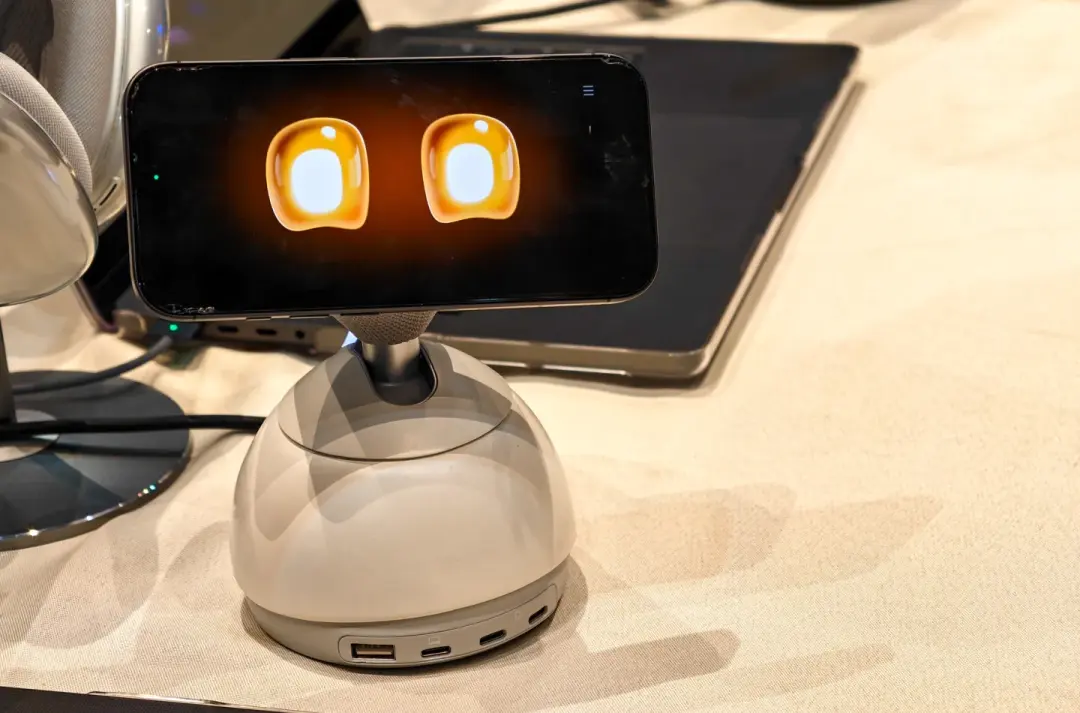
This is precisely its most charming product logic: rejecting hardware redundancy. Most robots on the market try to cram in their own screens, cameras, and computing chips, leading to high costs and poor image quality. DeskMate goes against the grain by directly "borrowing" the most powerful device in the user's hand, the iPhone. Since the phone already has a top-notch retina display, high-sensitivity camera, and microphone, why reinvent the wheel?
This design embodies a pragmatic wisdom—it is primarily a high-performance charging hub that you will use every day, and only secondarily a robot. It does not add new electronic waste to the desktop but transforms the charger that originally occupied space into a lively smart terminal. This idea of allowing existing devices to "grow a body" may be the least obtrusive and smartest path for AI companions to enter the public desktop.
Are Emoji Becoming Sentient? LGCLOiD is a "No-Bend" Desktop Management Master
LG's CLOiD presented at CES 2026 gives a first impression of "approachability." Unlike those cold industrial machines, CLOiD has a screen face that can express emotions, running around on a wheeled base, resembling a butler straight out of an animated series. It focuses on emotional interaction combined with household chores; its flexible mechanical arms can not only fold clothes and unload dishwashers but also control all household appliances based on observed user habits, truly bringing "smart home" from the cloud to the ground.
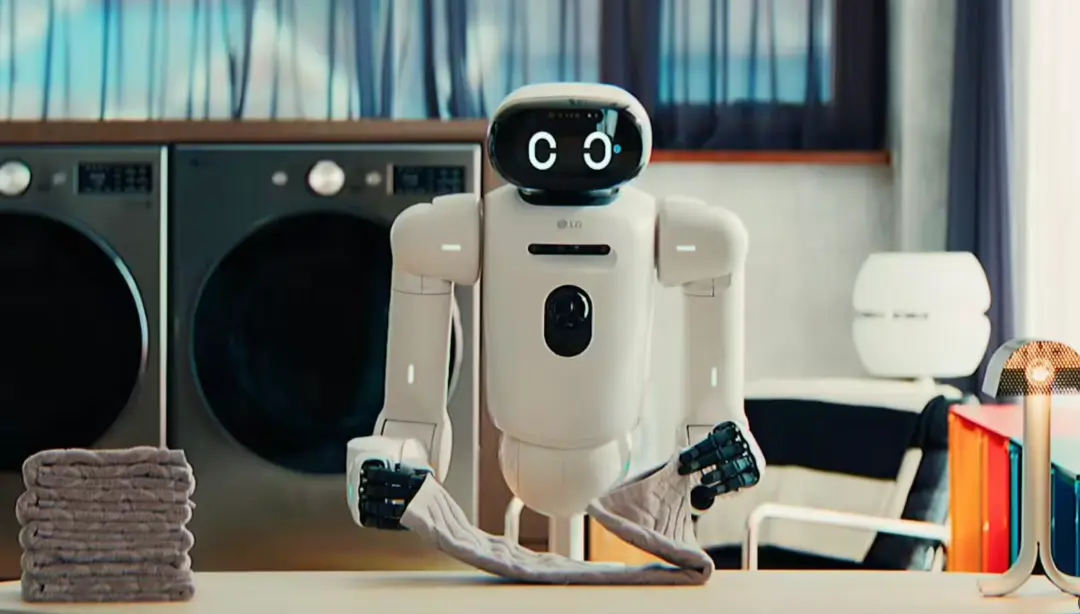
However, the most intriguing detail lies in its "waist management." Although its fingers are highly dexterous and can handle fine operations, limited by its wheeled structure, it can only manage items above knee height. This means it is an excellent "countertop cleaning master," but if you drop a sock on the floor, it may be helpless. This design choice is very typical: before bipedal walking technology is fully mature, LG chooses to excel in "half-body" refined services, allowing the robot to first become a qualified partner for "high-altitude work."
Sharpa Uses "Physical Hacks" to Teach Humans to Play Ball
Sharpa's booth was undoubtedly the focus of the event, with its autonomous ping pong robot teaching people using "physical hacks." The core lies in its outrageous 0.02-second response time—this means that the delay from visual capture to mechanical arm swing is almost erased, completely surpassing the physical limits of human neural reflexes.
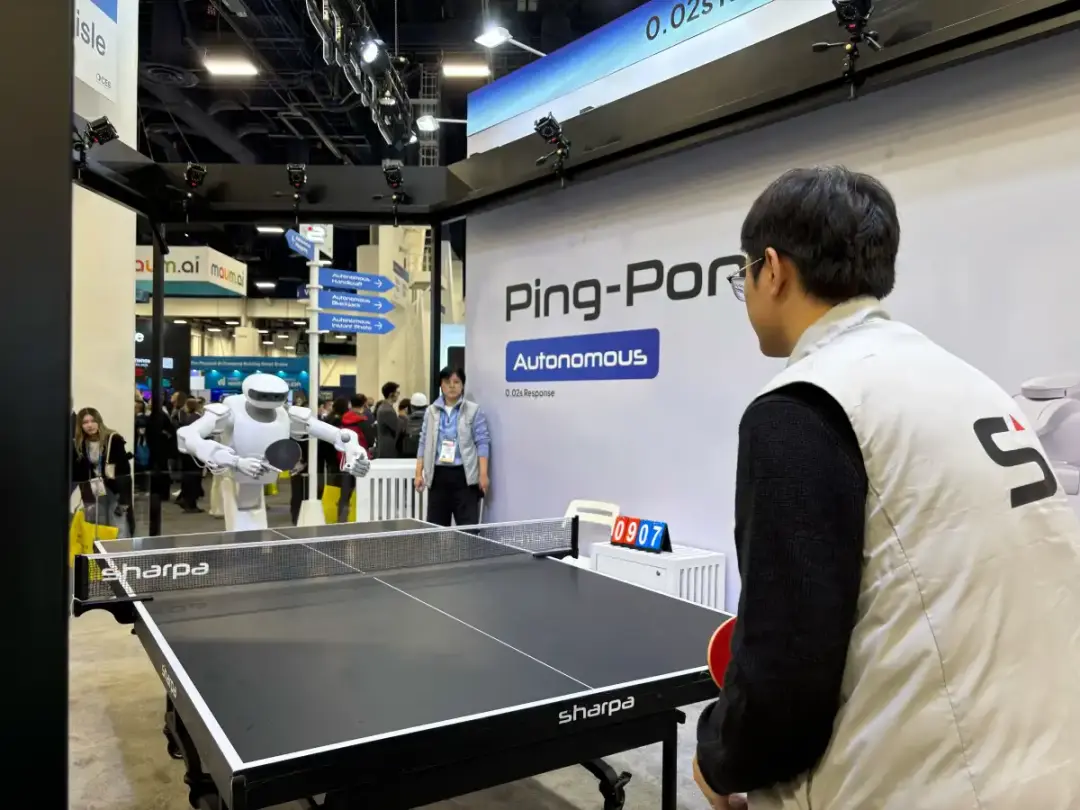
The atmosphere was incredibly intense, with human players appearing full of flaws in front of it. This machine is not just a "wall" with impenetrable defense; it even possesses "ball intelligence," returning shots with precision and cunning, often unexpectedly hitting the edges and leaving the "mortal" opponent in a state of disarray. Just look at its standard striking posture; the fluidity has completely shed the stiffness of a machine. The cheers from the audience rose and fell, with everyone excited not just about a match, but witnessing the perfect closed loop of high-speed motion control and real-time AI decision-making.
Relaxing While Lying Down: RheoFit A1 Turns Foam Rollers into "Self-Driving" Massagers
RheoFit's A1 is definitely one of those "small but beautiful" products that catch your eye and hit the pain points. Anyone who has done fascia relaxation knows that using a traditional foam roller is actually a physical task, requiring you to support your weight to roll, often leaving your arms sore before you finish relaxing. But A1 automates this process—it's not just a roller; it's more like a $380 personal massage robot.

The most interesting aspect is its "autonomy." It can use AI algorithms to plan a path, and when you lie down to relax, it acts like a compliant therapist, automatically rolling from your shoulders all the way to your toes.
The logic behind this is quite appealing: it simplifies the complex process of full-body massage into a single button press, truly freeing your hands. This approach of applying robotic technology to everyday rehabilitation scenarios is much more practical than lofty concepts; it represents a genuine hardware innovation that can enhance life satisfaction.
02 AI Hardware
Walking around the AI hardware exhibition area at CES 2026, the most intuitive feeling is that AI has finally "stepped back" and integrated into everything.
If in 2025 people were still anxious about "what AI can do," then in 2026, hardware manufacturers have clearly found their "landing points." The products we selected this year are not because they are the most heavily equipped, but because they represent four core trends happening in AI hardware:
Everything can be AI, but "stealth" has become key. This year's smart home technology is no longer just simple automation. From smart locks to lighting, AI is being widely "installed." This trend proves the maturity of small models, which are capable of providing more precise judgments without consuming astonishing computing power.
Companion products are entering a segmented phase. The AI companions showcased this year have a strong sense of boundary: those designed for children focus on personality development, those for the elderly emphasize emotional monitoring, and those for adults target stress relief. AI companionship is evolving different interaction logics based on various life stages.
The recording category is "rolling" to new heights. This is a logically consistent track, from card-style recording pens to smart rings and various applications, everyone is vying for the entry point of the "second brain." It is foreseeable that 2026 will still be the most fiercely competitive red ocean, but this competition has pushed companies like Plaud to begin segmenting their product lines and strengthening user brand recognition.
Smart glasses are experiencing a "cooling-off period." Although there are still long lines of people trying out smart glasses at the venue, the "excitement generated by curiosity" is fading. The solutions on the market are severely homogenized, and due to a lack of truly engaging interactive innovations or demonstrations, this track has shown signs of fatigue behind its bustling facade.
NotePin S: Creating a "Flash Thought Capsule" for Professionals, Plaud Aims at Instant Memory
At CES 2026, Plaud showcased a small hardware device called NotePin S. It resembles a minimalist capsule that you can wear as a brooch, necklace, or even clip onto a wristband, recording and organizing everything you hear around the clock.
Compared to its predecessor, NotePin S has added a key physical button. During the recording process, when you hear truly important information—like a deadline set by your boss or a sudden burst of inspiration—pressing the button will tag that audio with a "key" label using its built-in AI. This means it no longer records blindly but learns to capture the highlights amid a sea of chatter. It supports transcription in 112 languages and can automatically distinguish between different speakers, ultimately generating mind maps or meeting summaries using over 10,000 templates.

However, Plaud's most impressive move this year is shifting its focus from hardware to launching a desktop application that allows you to record and summarize with just one click, without disturbing anyone. Previous AI tools sought "presence," eager to announce to everyone, "I'm helping you take notes"; whereas Plaud aims for "stealth." It seamlessly switches between face-to-face conversations, phone calls, and screen meetings, while passing stringent security certifications like GDPR and ISO27001, attempting to alleviate fears of privacy breaches. Over the past year, the evolution of recording products—from smart recording pens to recording rings and apps—has been rapid, essentially providing precise solutions to different segmented scenario needs.
Sweekar: Cyber "Q-Pet," a Breathing AI Pet
Each generation has its own electronic pet; for those born in the '90s, it was the black-and-white ink screen sprite egg, and for those born in the 2000s, it will be a fluffy AI pet. TakwayAI showcased a hardware called Sweekar, which takes a digital pet that originally existed only on screens and puts it into a physical shell that breathes and has body warmth.
The core logic of Sweekar lies in the "embodiment of companionship." This little gadget, weighing only 89 grams, simulates a slight breathing rhythm and body temperature. Its growth path is designed to be very compact, divided into four stages: egg, cub, juvenile, and adult. This is not a predetermined playback process; rather, it is based on an experience value system where the frequency of feeding, cleaning, and interaction determines its growth speed.
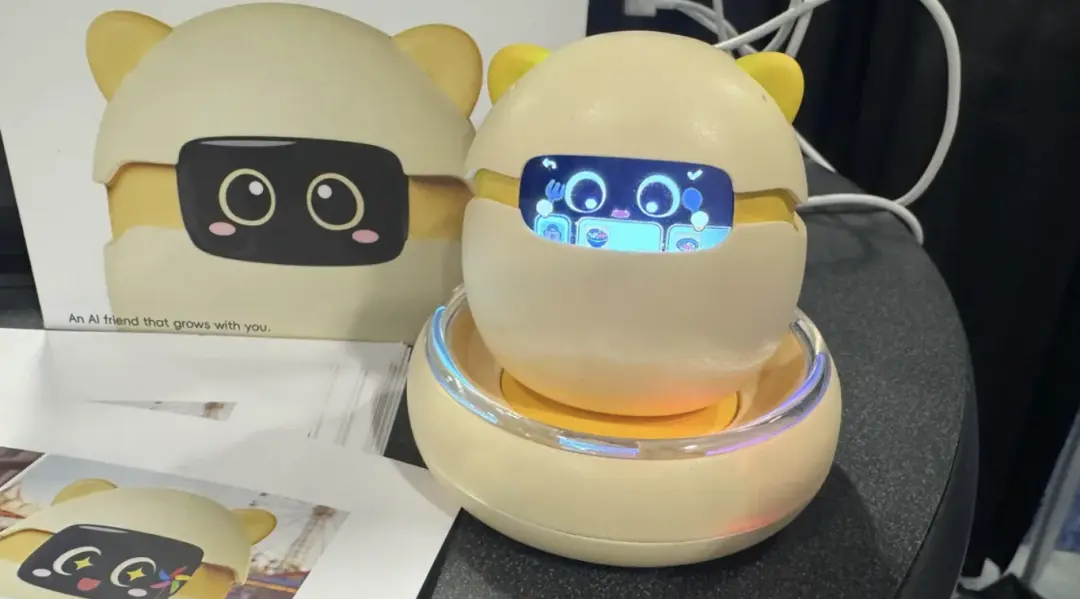
The involvement of AI adds some uncertainty to this nurturing process. It connects to multimodal models like GeminiFlash and introduces a personality system based on MBTI. This means that as it evolves from a juvenile stage that can only make simple sounds to an adult stage capable of conversation, it will develop a unique personality based on your daily communication habits. It even has "long-term memory," able to remember your past emotions and conversations, and when you ignore it, it will "explore" and "learn" in the background, sharing these experiences with you the next time you meet. It supports NFC-based "friend tapping" social interactions, allowing two pets to become friends through physical contact, while also retaining classic nurturing game mechanics like changing outfits and modifying habitats.
Although its functions sound quite hardcore, it essentially does one thing: using modern AI's learning capabilities to fill the emotional feedback gap in electronic pets. It doesn't require you to fuss over it like a complex electronic device; it can run with minimal daily interaction. For those who are obsessed with nurturing games from the '90s and hope for a slightly "smarter" AI, this $150 cyber life might be an interesting attempt.
Does the Giant Panda Have "Mind Reading" Abilities? An An: Let AI Rediscover the Lost "Warmth"
Among a crowd of robots emphasizing efficiency and computing power, the panda robot An An from Shenzhen Wuxin Technology stands out as a stark contrast and is quite popular on-site. It adopts an extremely gentle form, attempting to address the emotional desolation of the elderly.
Hidden beneath a soft and cute exterior is a "senior monitoring station." Aimed at the elderly population experiencing memory decline, An An can accurately execute task reminders and serve as an emotional link between caregivers and the elderly, synchronizing health status. Although its appearance is highly approachable and "healing," An An is filled with over 10 high-precision sensors. Its feedback to touch is no longer a mechanical preset program but a real-time interaction based on emotional AI. Its core competitive advantage lies in its learning ability; it can deeply remember users' voice characteristics, behavior patterns, and interaction preferences. The longer you spend time with this panda, the more it resembles a customized "companion."
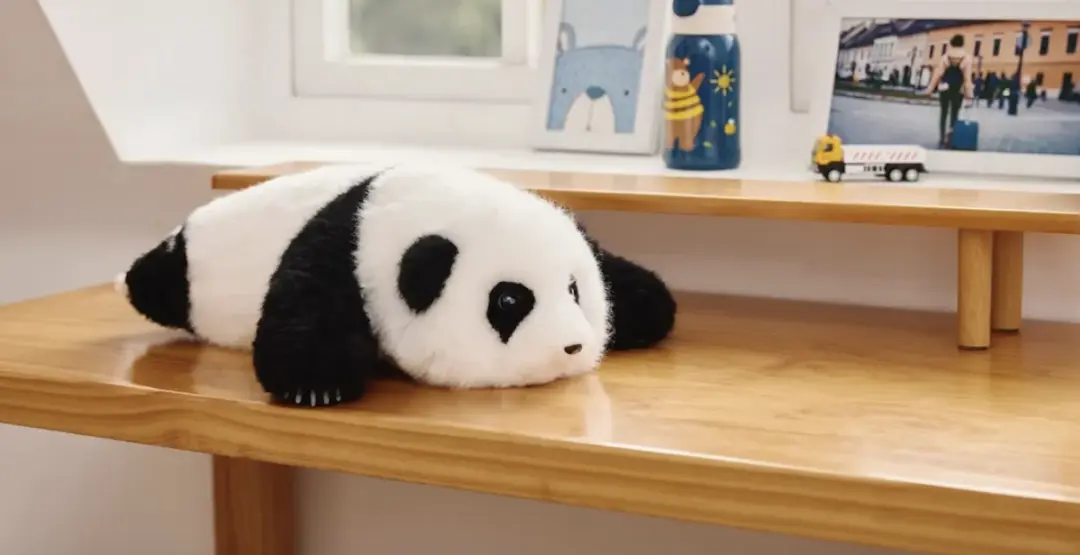
Image Source: Techcrunch
An An proves that AI doesn't have to be confined to screens; it can also take the form of a warm entity that perceives touch and combats loneliness. This "dimensionality reduction strike" that hides B2B-level medical monitoring is a sincere annotation of the technology's move towards humanization in 2026.
Smart Feeding and Drinking Station AI-Tails: Understanding Cat Health, Anyone Can Be a Veterinarian
If you have a cat, you know that small animals are natural "pain hiders," and by the time they show signs of illness, the best treatment period is often missed. At CES 2026, a Swiss startup called AI-Tails aims to solve all this with a $499 smart feeding and drinking station.
It is an "all-in-one health check station for cats" hidden in the corner of the living room. Using cameras and complex pattern recognition capabilities, it can capture micro-expressions and behavioral signals that are imperceptible to the human eye within seconds while the cat is focused on eating. In addition to accurately measuring food and water intake, it can even remotely scan the cat's temperature.
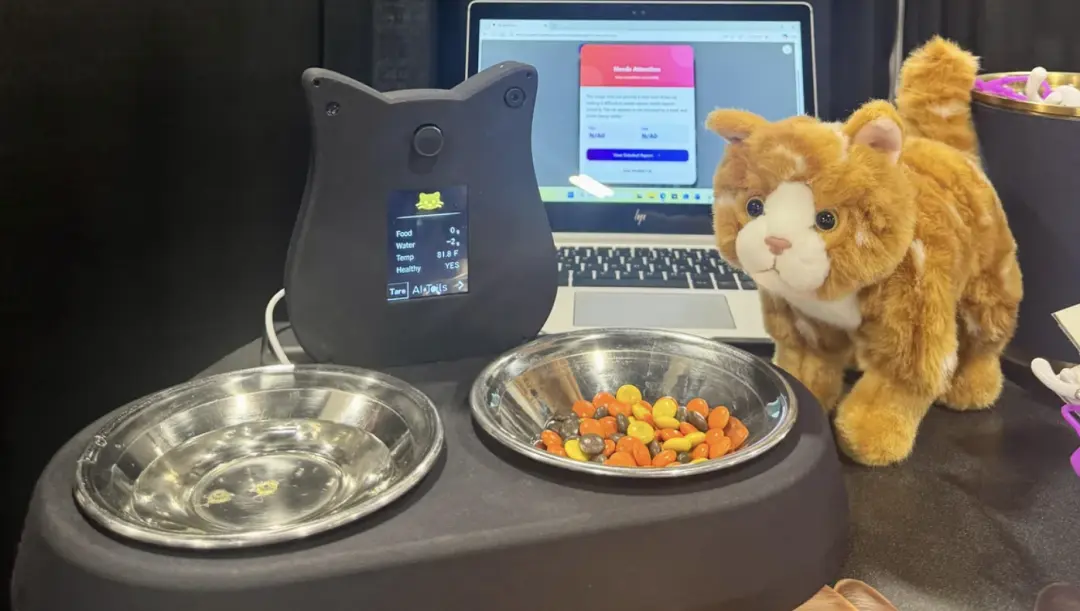
Image Source: Techcrunch
According to on-site information, AI-Tails founder Angelica was deeply pained by the sudden illness of her beloved cat, leading her to wonder why humans can track steps and heart rates with smartwatches but cannot provide the same life assurance for pets. In my view, this product is more like "luxury medical care" for pets. The $499 hardware, combined with a $421 application, creates a nearly thousand-dollar combo that precisely targets those willing to spend anything for their cats. Although expensive, AI is evolving from "understanding humans" to "understanding life." When cameras are no longer just for monitoring theft but begin to learn to interpret the sorrow and pain on a cat's face.
03 Smart Mobility
The automotive hall at CES 2026 is undoubtedly a fantastical "ice and fire" spectacle, with a stark contrast that is even more intriguing than the products themselves.
On one side is the fervor of technological celebration. The transition to new energy is diving into deep waters, and AI is infiltrating the cockpit in every possible way. You can clearly feel that cars are no longer just transportation tools; they have transformed into walking "super terminals." Chinese automakers like Great Wall and Geely have come with the momentum to "blow up" the venue, alongside established players like BMW and Mercedes-Benz, all desperately showcasing their best skills—from core power to intelligent driving ecosystems, the future of mobility has never been so clear.
But on the other side, the American local camp, as the host, appeared unusually quiet and even somewhat desolate. Affected by the contraction of policies from the Trump administration, the electric vehicle boom has receded, forcing the giants in Detroit to reassess their strategies, with many absent or hitting the pause button. This sense of "thriving away games while home games are subdued" is precisely what makes this year particularly intriguing. This is not just a product showcase; it is a microcosm of the dramatic reshuffling of the global automotive landscape: as local giants hesitate, Chinese power and AI technology are accelerating to fill the vacuum and reshape the rules of the game.
At the same time, fields such as electric wheelchairs, electric motorcycles, and electric autonomous vehicles also brought some surprises.
Physical Intelligence Will Welcome Its "ChatGPT Moment": NVIDIA's Alpamayo Teaches Cars to "Think"
Jensen Huang made a bold statement at CES, declaring it the "ChatGPT moment for physical intelligence," and Alpamayo indeed has the credentials to back it up.
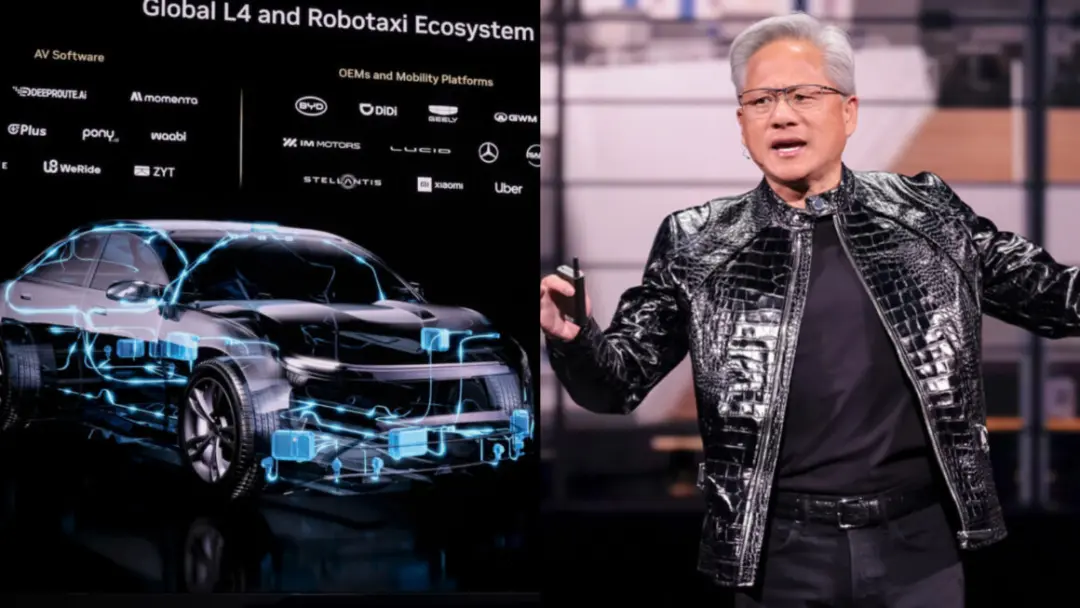
Previous autonomous driving was more like "conditioned reflex"—stop at a red light; whereas Alpamayo introduces "logical reasoning." It can handle unprecedented situations, like a broken traffic light, by breaking down steps and deducing consequences to ultimately plan a safe route. This ability based on a Chain-of-Thought directly upgrades autonomous driving from "answering a question bank" to "testing IQ."
Even more interesting is its positioning as a "teacher model." This open-source package, which includes a 10 billion parameter model, AlpaSim simulation environment, and 1,700 hours of real data, is not meant to be directly installed in cars but to allow automakers to "distill" and train their lightweight models. NVIDIA's strategy is quite clever, defining the next generation of development standards—not only teaching how to run fast but also how to run intelligently.
According to NVIDIA's announced plans, Alpamayo will first be introduced into the production model of the Mercedes CLA through the DriveAV software system, expected to launch in the North American market in the first quarter of 2026, and then gradually expand to European and Asian markets.
Does a Wheelchair Have "Autonomous Driving"? Strutt Ev1 Puts "Tesla" into a Wheelchair
Strutt's Ev1, unveiled at CES, is not an ordinary electric mobility tool but a smart electric wheelchair designed to reshape user independence. It addresses a long-ignored pain point: for wheelchair users, navigating through narrow doorways or crowded areas often comes with significant psychological stress. The arrival of Ev1 is akin to equipping a wheelchair with a "veteran driver’s brain," upgrading assisted mobility from mere "transportation" to "intelligent navigation."
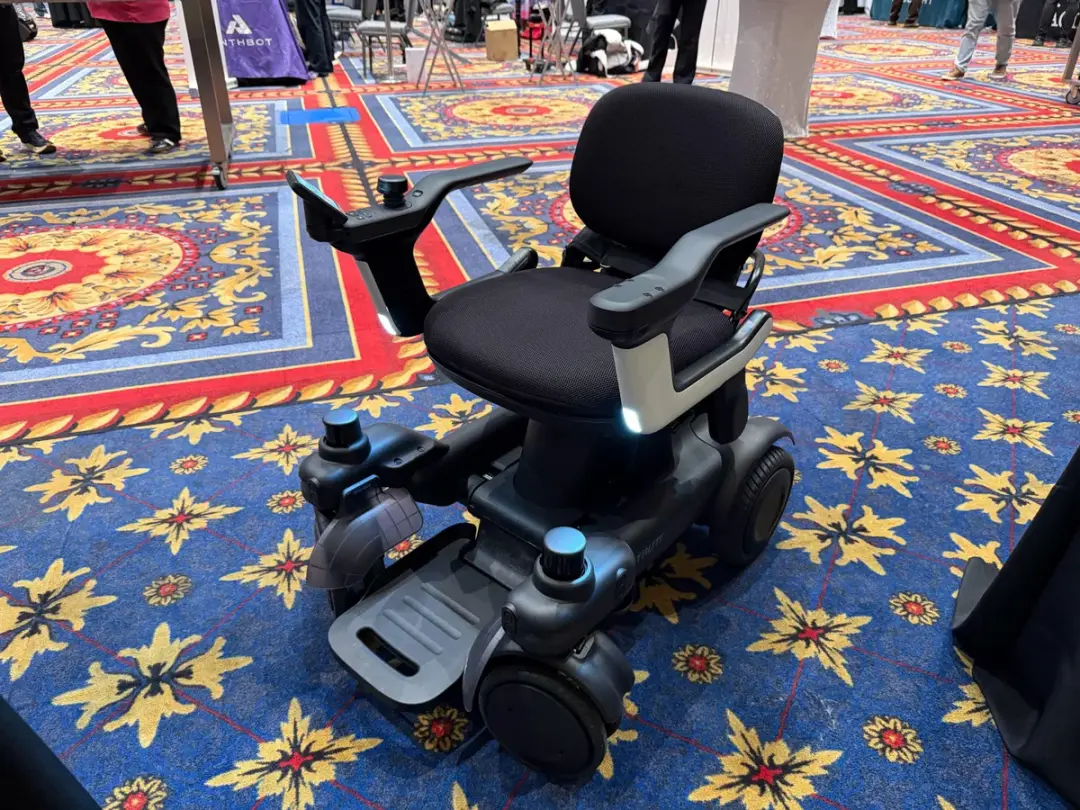
The core of this product lies in the Co-Pilot Plus intelligent co-pilot technology. In complex indoor environments, users no longer need to finely adjust the joystick to avoid walls or furniture. You only need to give a general command to move forward, and Ev1's four-motor intelligent steering system will automatically take over the fine control, correcting the path to ensure smooth passage even in tight spaces. This "human-machine co-driving" model significantly lowers the operational threshold, allowing users to navigate confidently and comfortably to any destination.
To achieve this sense of safety, Strutt is equipped with robust hardware: two LiDARs, ten time-of-flight sensors, six ultrasonic sensors, and two cameras. This sensor array, typically found in L4-level autonomous vehicles, is integrated into a chair, creating a 360-degree perception network. Although the price of $7,499 (with a CES launch price of $5,299) is steep, for users requiring high safety assurance, this is not just about purchasing a device but about buying a sense of "no wall collisions, no human contact" dignity in mobility.
Finally, No More Gimmicks! Segway Returns to CES with Serious and Powerful New Vehicles
Segway's appearance at CES sent a very clear signal: it is no longer satisfied with just making quirky balance scooters or large toys. Backed by Ninebot's strong supply chain, Segway is completing a stunning transformation from "tech toys" to "essential mobility." This year's core strategy is very pragmatic—using high technology to capture the daily commuting and entertainment market.
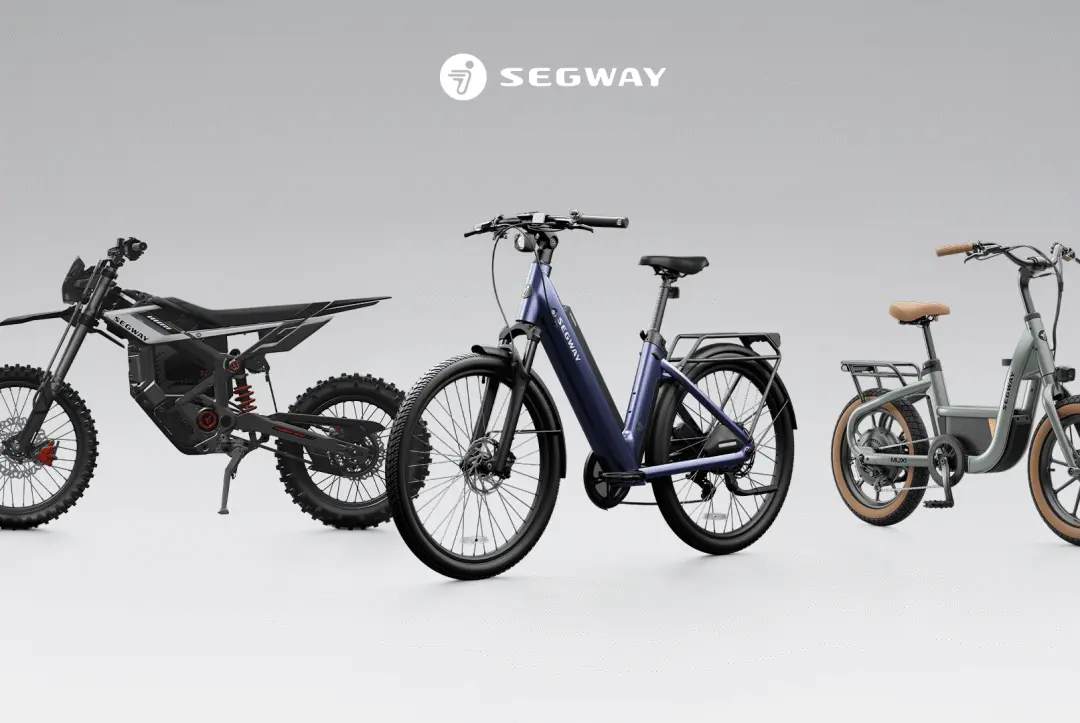
Last year's Xyber and Xafari have already proven that Segway is serious about electric vehicles, and this year’s release of three new products further enhances its product matrix. These are no longer experimental products for geeks but exclusive vehicles designed for ordinary consumers that can be highly customized according to lifestyle.
Not Just Hubless Black Technology: Verge Takes the First Shot at Solid-State Battery Mass Production
Verge has forcefully pulled "the future" into the present. While the entire industry is still dreaming about solid-state batteries with PowerPoint presentations, Verge directly unveiled a mass production timeline at CES 2026—within "the next few months." This is not just a victory of parameters; it is a mockery of physical limits.
Look at this terrifying data: a range of 370 miles (about 595 kilometers). This is no longer about eliminating range anxiety; it is creating "bladder anxiety," as it can travel farther than many gasoline motorcycles. Even more outrageous is the refueling efficiency, adding 186 miles of range in just 10 minutes, meaning that while you enjoy a concentrated coffee on the roadside, the vehicle is already ready for the next long-distance journey.
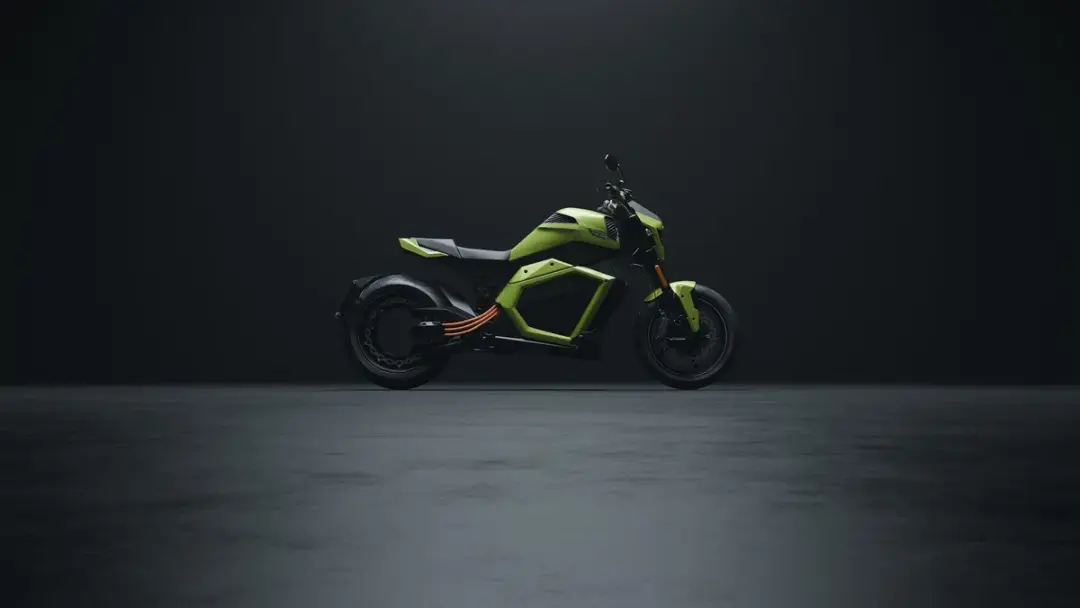
Moreover, they haven't forgotten the iconic "hollow wheel." The new generation DonutLab hubless motor reduces weight by 50% while still retaining a monstrous torque of 1,000 Nm, with an acceleration of 0 to 60 mph in just 3.5 seconds, likely leaving your soul behind. An energy density of 400 Wh/kg means it has thrown heavy liquid electrolytes into the trash, achieving extreme lightweight and brutal aesthetics.
04, Creative Product Showcase
If at CES you only focus on popular tracks or major company booths, you might only see the tip of the technological iceberg. Many imaginative and innovative ideas are often hidden in small booths of just a few dozen square meters. As CES leader Gary Shapiro famously said, "Innovation knows no size; it can come from anywhere." The entrepreneurs tinkering with small gadgets in the corners today may very well stand at the center stage in a few years with products that completely change the industry.
This year, Geek Park deliberately avoided the grandiose press conferences and dove deep into the exhibition area to uncover those truly imaginative "wild paths," discovering that many startup products are just as impressive as those from major companies. They may not be perfect and might even be somewhat "absurd," but that kind of limitless imagination truly represents humanity's primal impulse to explore the future of technology.
The following products are the most imaginative creations we "dug up" from the depths of the exhibition hall this year that we want to share with you:
LEGO "Powered Up"! No Screen, Bricks Can Come to Life
Among the many "cyber" booths at CES 2026, LEGO's "SmartPlay" system is a refreshing stream. What excites me the most is that LEGO has completely avoided putting screens on the bricks, instead preserving the soul of the bricks—the tactile experience of assembly. This system consists of smart bricks, smart minifigures, and bricks with digital IDs, creating a combination that is both "retro and avant-garde," instantly rekindling my playful spirit. Currently, LEGO's first batch of smart brick products includes two Star Wars-themed sets, expected to be released in March.
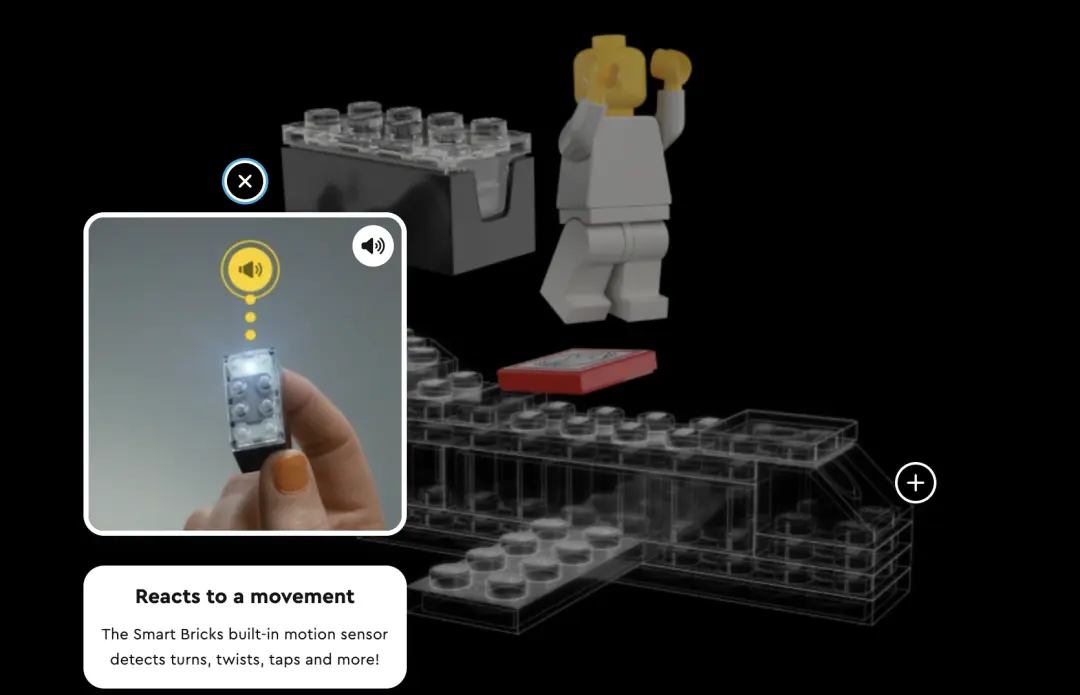
The most remarkable aspect of this kit system is the experience brought by "instant response." When your minifigure approaches a specific tagged brick, it suddenly seems to have "eyes," instantly understanding the other's identity and starting to interact. If you insert a smart brick into a completed helicopter, when I perform a dive or flip with the airplane brick, the sound of the propeller changes accordingly, and the LED light effects also change rhythmically in real-time. Although I am still holding familiar plastic bricks, at that moment, they seem to truly come to life!
LEGO's "hardcore operation" is actually achieved by embedding a tiny ASIC chip in the bricks, utilizing magnetic positioning recognition and their self-developed BrickNet protocol to enable collaborative responses between bricks. This approach of thoroughly integrating cutting-edge technology into traditional toys reflects LEGO's contemplation of the AI era: true intelligence should not strip away human perception but should enhance the real experience of the physical world.
Clicks Keyboard Phone Case: The Disappearing Physical Keys Are Returning in a New Way
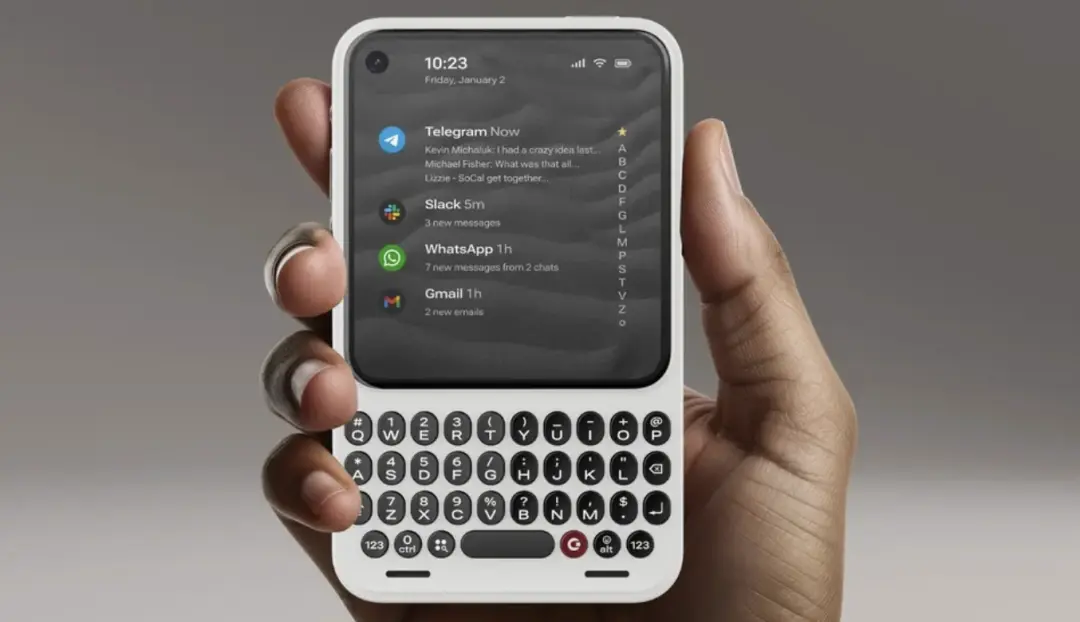
There is a strange phenomenon in the tech world: when a classic design completely disappears, many people start to nostalgically reminisce. Around the Clicks booth, I found that many people were genuinely captivated by this retro trend. This year, they brought not only the smart communicator but also a PowerKeyboard, each like a nostalgic love letter to the full-keyboard era.
This $499 device has a very "BlackBerry" look, and its core logic is to serve as an extension of the main phone while maintaining a commitment to some retro design details. It features tactile physical keys, a long-lost 3.5mm headphone jack, a physical SIM card slot, and even a physical flight mode switch. It also supports touch operations, allowing you to scroll through information without touching the screen. This approach of connecting a "full-keyboard phone" as an independent communication tool to the main phone is not only about nostalgia but also about drawing a hardcore boundary for focused communication in the fragmented information age.
If you think the $499 price point is too high, Clicks' other product, the PowerKeyboard, is definitely the crowd favorite at the event. Priced at just $79, it magnetically attaches to your phone via MagSafe, instantly giving your ordinary phone a BlackBerry-style lower half. It features a sliding cover design that can adapt to various sizes, allowing for horizontal or vertical typing, and even accommodating AR/VR environments or smart TVs. This tangible physical key feedback is something that no tactile feedback motor can replicate and is something many users long for.
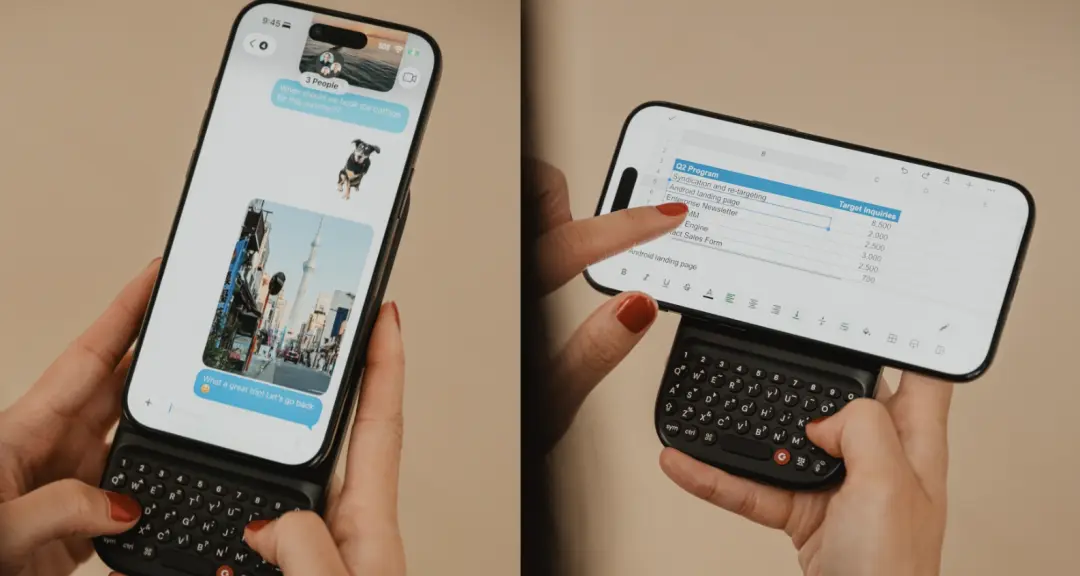
From Clicks, I see designs that were once abandoned by the times returning in a smarter, more value-added way. Perhaps true progress does not necessarily require a complete abandonment of the past; sometimes, reminiscing about "old friends" is about regaining the real sense of control that screens have taken away in the physical world. Of course, all of this comes with the premise that you are willing to pay for nostalgia. After all, the cost of regaining that first love feeling might be equivalent to a decent new Android phone.
When OLED Meets Vinyl Records, Samsung is Reviving Classics with "Emotional Canvas"
This wave of nostalgia at CES this year has even affected giants like Samsung. They have surprisingly "stitched" OLED display technology with retro items that should be in a museum. The most eye-catching products on site were two concept items: the "AIOLED Cassette" and the "AIOLED Turntable."
The "cassette," with its tiny 1.5-inch round screen, is as exquisite as a piece of art, making it hard to resist the urge to pick it up and play with it. The 13.4-inch "turntable" seamlessly combines the elegance of analog design from vinyl records with the high-tech feel brought by OLED screens.
This is not just about stacking buffs; it’s about creating an atmosphere with screens, turning digital products into works of art. In the past, listening to music with a Bluetooth speaker required looking down at your phone, but these screen-equipped devices allow you to receive AI music recommendations directly on the body. Even better, they can use flowing light and visual effects to "skin" the room, transforming music from an auditory experience into a fully immersive sensory atmosphere.
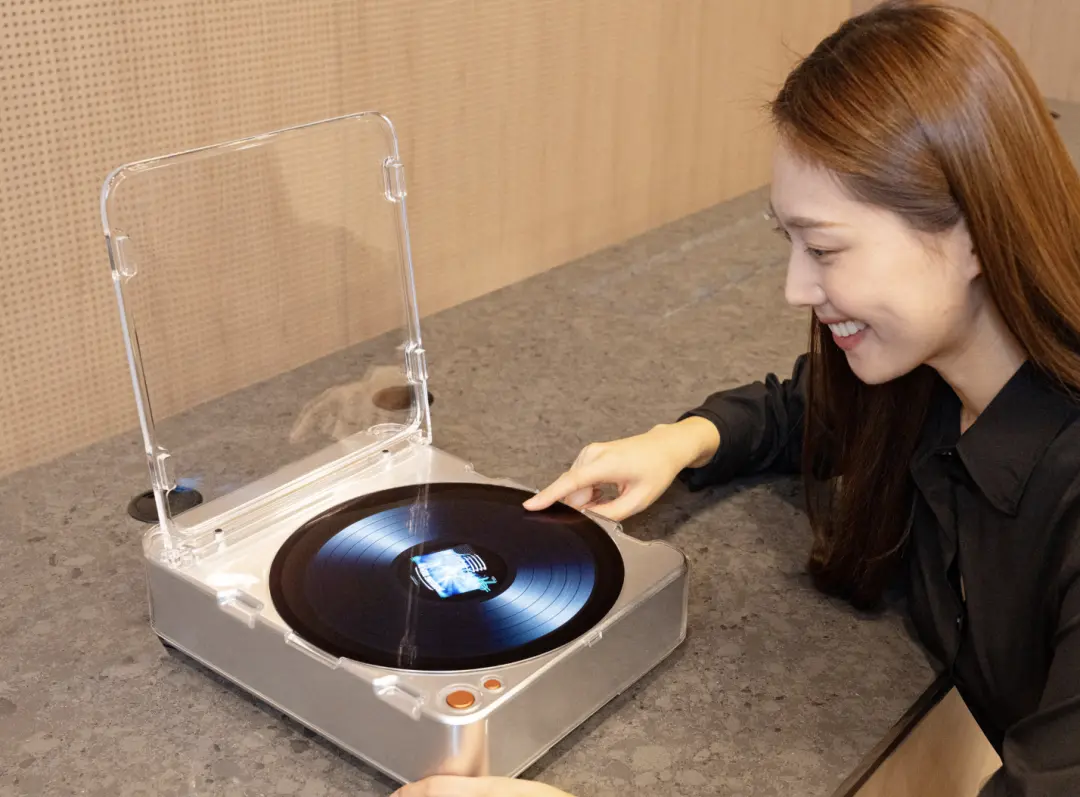
After taking a look around, you'll find that this idea is particularly popular at CES this year. Whether it's Samsung's OLED or the e-ink screens at various booths, they are essentially conveying a signal: screens are no longer cold carriers of information; they are becoming a warm "emotional canvas." They are reviving those classic forms that were about to be forgotten, thanks to the support of AI and display technology. This operation of awakening retro nostalgia with extreme technology is undoubtedly one of the trends at CES this year.
"Magic Mirror" Becomes Reality: Staring at the Mirror for 30 Seconds Can Predict Your Health Trajectory 20 Years Later
"Mirror, mirror, tell me how long I can live?" In front of the "Longevity Mirror" at the NuraLogix booth at CES 2026, everyone standing in front of it is likely unconsciously reciting this incantation. This is not just a fairy tale; it is a real, even somewhat "hardcore" home digital health terminal.
Compared to last year's prototype that was only for viewing, this officially released mirror this year is clearly more confident. It doesn't require you to roll up your sleeves for a blood draw or wear any sensors; you just need to stand still in front of the mirror for 30 seconds. Using "transdermal optical imaging" technology, it can capture subtle blood flow patterns in your face and instantly analyze cardiovascular risks, metabolic indices, and even your physiological age based on an AI model trained on hundreds of thousands of patient records. It even dares to claim it can predict your health risks 20 years in advance.
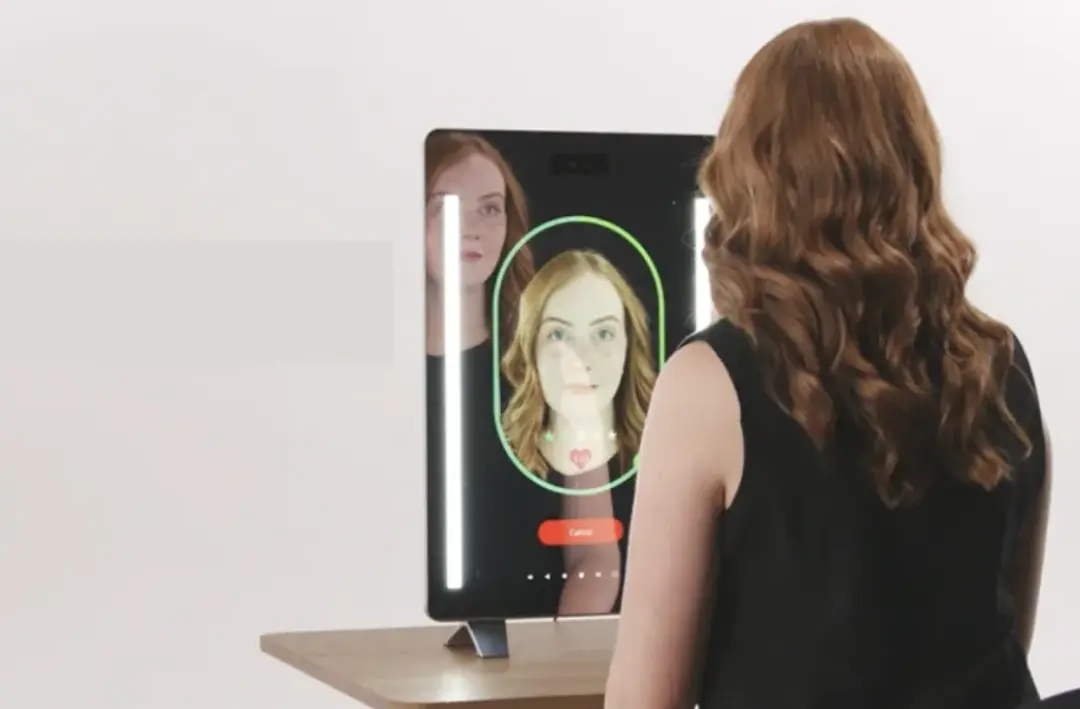
This longevity mirror represents a shift from "passive healthcare" to "active defense." In the past, our understanding of health often lagged behind medical examination reports, while the longevity mirror integrates monitoring into the daily routine of washing up. It no longer waits for you to "fix the barn after the sheep are lost" when you get sick; instead, it makes real-time corrections every day as you age. The AI assistant it comes with acts more like a 24/7 health steward, transforming dull parameters into actionable suggestions for sleep, nutrition, and stress.
Although the $899 price tag and subsequent annual fees are not exactly budget-friendly, if those 30 seconds spent brushing your teeth each day can help you accurately avoid health pitfalls for decades to come, this "longevity investment" is clearly more practical than any expensive anti-aging supplement. When the whole family can gather around this mirror to "calculate" their health, the presence of AI not only extends lifespan but also improves the quality of life.
Withings Smart Scale: Step On It for a "Deep Scan" of Your Body
If NuraLogix's longevity mirror is about "facial analysis," then Withings' BodyScan2, released at CES 2026, aims to "scan" your body inside and out. Withings defines it as a "home longevity monitoring station."
The scale has a ceremonial appearance: a tempered glass panel connected to a pull rod resembling a pull-up bar. When you stand on it and pull the rod to hip level for about 90 seconds, not only are the eight electrodes in the base working, but the four stainless steel electrodes on the handle also engage simultaneously. This setup is not for measuring weight but for capturing over 60 biological markers. What surprised me the most is that it can assess hypertension risk without a blood pressure cuff, and even capture early signals of blood sugar regulation disorders.
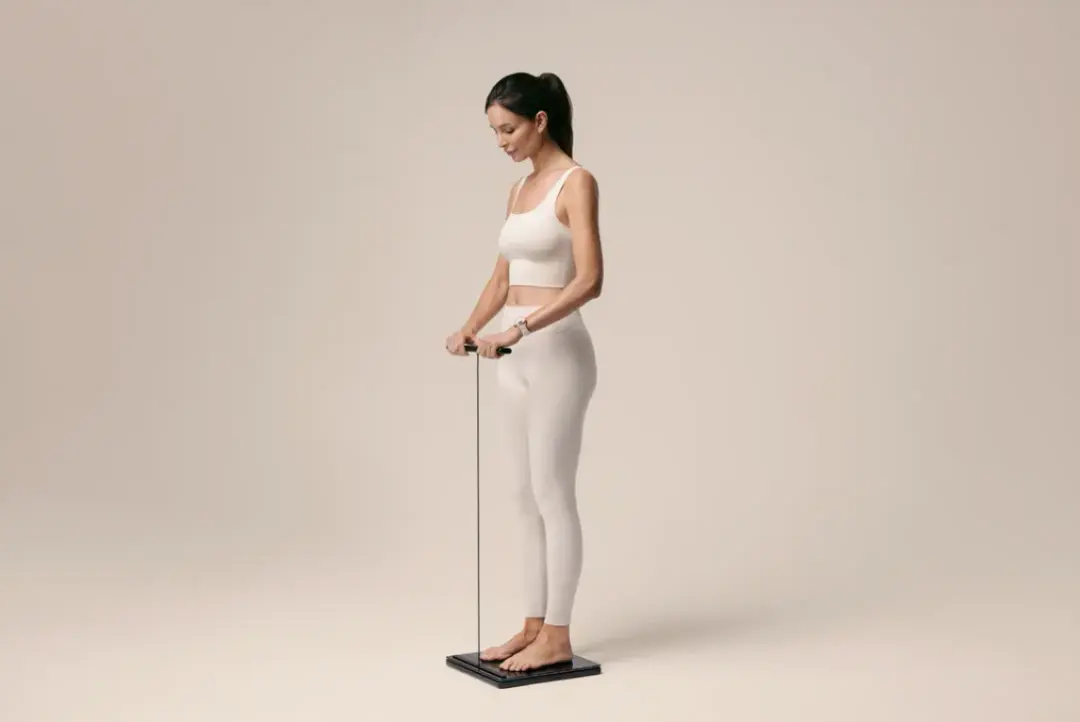
It incorporates five medical-grade technologies that were previously exclusive to clinical laboratories, and the product is awaiting FDA certification. It breaks down your body data into three major dimensions: cardiovascular elasticity, cellular metabolic efficiency, and, most importantly, blood sugar regulation. What’s clever about Withings is that it doesn’t focus on your current weight; it cares about the elasticity of your blood vessels, the efficiency of your cellular metabolism, and those subtle but "reversible" physiological changes. Withings is not just throwing a pile of dull numbers at you; it’s drawing a long-term "health trajectory" for you in the app.
I think this is one of the truly captivating aspects of CES 2026; it is breaking down the heavy term "health check" into a 90-second daily routine after you brush your teeth each morning. The purpose of such a product is to point you in the direction of lifestyle corrections before chronic diseases have a chance to knock on your door. Although you have to shell out $600 for this "precise pitfall avoidance guide," compared to the enormous expenses and physical suffering that come after falling ill, this device that can predict the future may become an essential "life preservation tool" for everyone.
MuiBoardGen2: Can a "Breathing" Piece of Wood on Your Nightstand Monitor Sleep?
Amidst the dazzling array of 8K screens at CES, MuiLab's simple wooden board is a refreshing change. It’s called MuiBoardGen2, resembling wood that has been taken from an old furniture store in Kyoto, feeling warm and delicate to the touch, completely devoid of that cold electronic vibe. Only when you slide your finger across the surface does a warm orange LED dot matrix emerge from the wood grain, creating a truly soothing sensation.
This year, they have hidden a millimeter-wave radar inside this piece of wood, creating their new MuiCalm sleep monitoring platform. What’s impressive about this device? You don’t need to wear a watch, a ring, or even stick any sensors on your body while you sleep; as long as this piece of wood is hung at your bedside, it can "see" your breathing rate and turning movements from a distance, knowing how well you sleep just by sensing your "energy field."
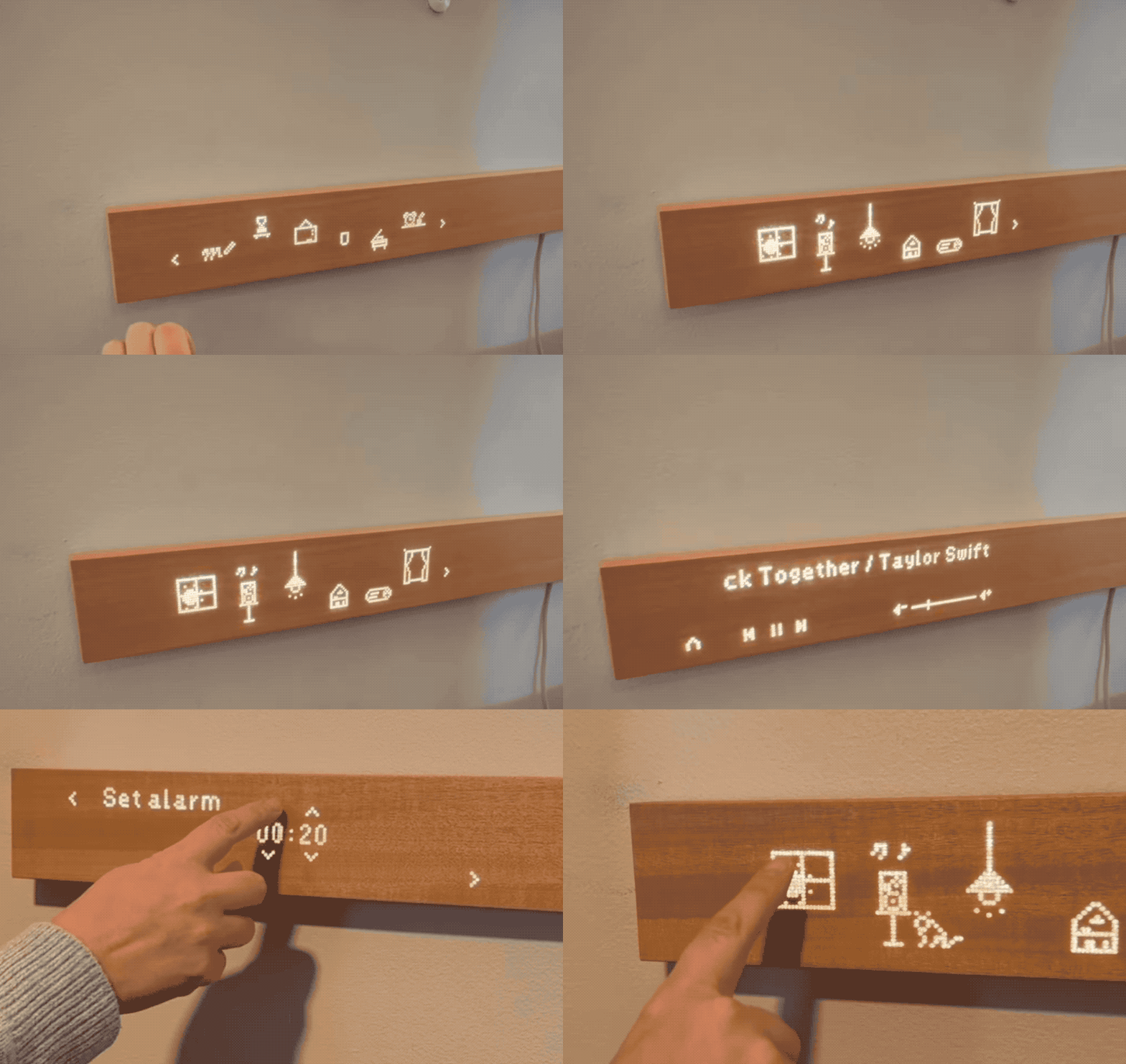
Many people ask, since the screen has been removed for quietness, how do you control the lights and speakers at home? Although it lacks a screen, it retains a very interesting LED dot matrix interaction. You can slide across the wood like striking a match to dim the lights, or tap twice to start playing white noise on the speaker. You can set it up in the way that suits you best, making it both fun and intuitive.
After visiting this booth, my most profound feeling is that AI has finally learned to "be quiet." Previous smart home devices always tried to assert their presence with pop-ups and voice reminders. But MuiBoard tells us that true top-tier intelligence actually "disappears" into your life scenes. It exists there, like air, only lighting up when you need it. Although spending a few hundred dollars on a piece of wood may sound a bit extravagant, for anyone wanting to enjoy the convenience of AI while reclaiming "bedroom tranquility" in 2026, it will certainly be appealing.
Is Teacher Tony Going to Be Out of a Job? This "Automatic" Clipper Can Turn Clumsy Hands into Masters in Seconds
The wind of AI has finally reached your scalp. At CES, I also spotted this GLYDE smart hair clipper, which is sure to make barbers collectively anxious. Its most explosive feature is making the most esoteric "layered hairstyles" in the hairdressing world as simple as putting on a selfie filter.
The biggest fear of cutting your own hair is shaky hands; one wrong move can turn you from "handsome guy" to "balding." But GLYDE is like having an "obstacle avoidance system" built into the clipper: it has internal sensors that monitor your movements and angles in real-time. The most outrageous part is that its blades "autopilot"; if you push too fast, the blades retract automatically; if the angle is off, it reduces the trimming amount. This "foolproof design," combined with a specially marked gradient tape, feels like having a master guiding you as you draw lines on your head, making it incredibly stable.
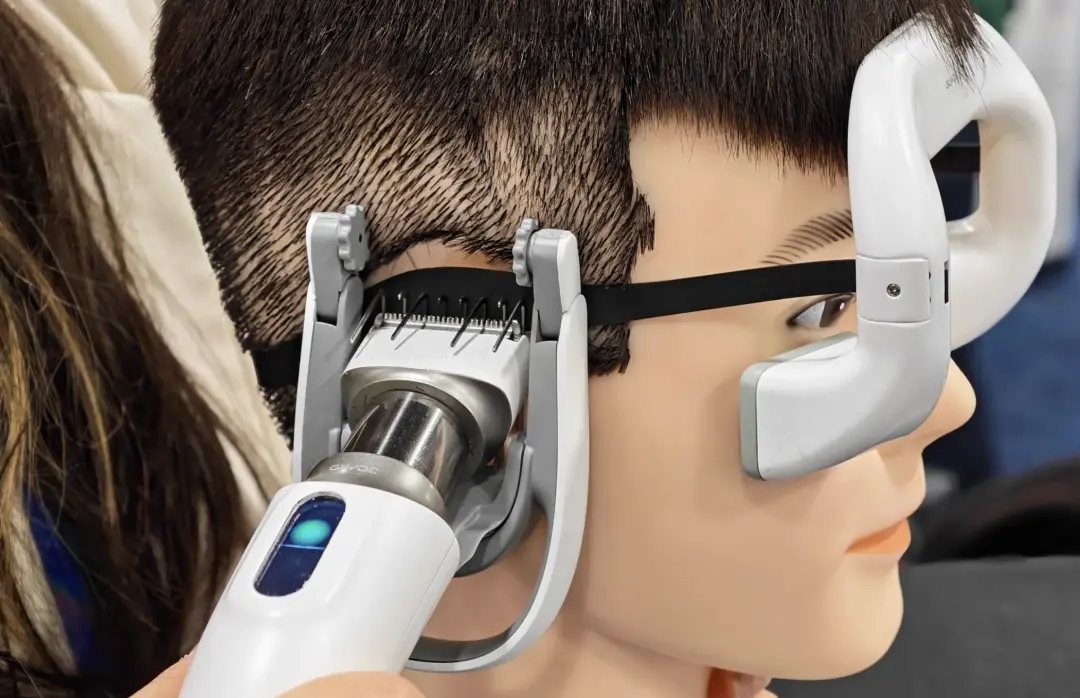
Once you choose a hairstyle and attach the tape, all that’s left is to close your eyes and "glide." In just 10 minutes, you save the time spent on appointments, waiting in line, and the sunk cost of dozens of dollars each time at the barber. From a geek's perspective, GLYDE is a violent dismantling of the "traditional craftsmanship barrier." It returns the freedom of haircuts to men who pursue neatness, giving users a stronger sense of control. Of course, for women with high aesthetic demands, if AI has not yet evolved to understand complex semantics like "just a little shorter," I would suggest not trying it lightly; otherwise, it could turn out to be not just "interesting," but a large-scale disaster.
Cyber Kitchen Gadget: An Ultrasonic Knife That Vibrates 30,000 Times Per Second Cuts Without Resistance?
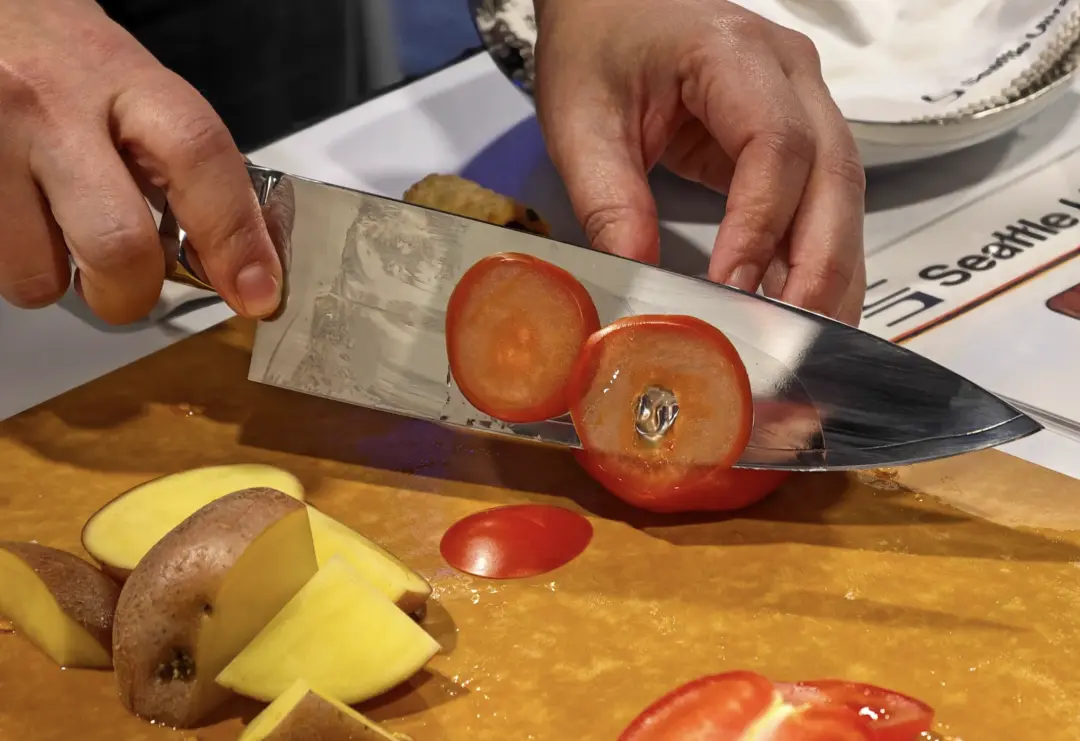
At CES, I discovered a gadget that can instantly transform all culinary novices into "top chefs"—the C-200 ultrasonic kitchen knife from Seattle Ultrasonics. The name sounds hardcore, and using it gives a sense of breaking through physical common sense. It looks like an ordinary 8-inch chef's knife, made from Japanese AUS-10 steel, and even without activating the ultrasonic function, it is a high-hardness top chef's knife. But when we press the orange button on the handle, the blade is invisible in motion, there is no noise, and the handle doesn’t even feel any vibration. However, due to the built-in piezoelectric ceramic crystal, the blade vibrates over 30,000 times per second, transforming it into a "cutting monster" on a microscopic level.
I tried cutting a tomato with it, and the feeling is truly indescribable; there is almost no resistance, and the blade glides through as if it is directly penetrating the air, leaving a cut surface as smooth as a mirror. The official claim is that it saves 50% of the effort, and because of the high-frequency vibrations, food does not stick to the blade at all, cleaning off easily with just a rinse of water.
This "ultrasonic attachment" makes cutting actions incredibly light, no longer requiring force to "saw" through food; you just need to gently slide down with gravity. It even supports USB-C charging and comes with a wireless charging pad, making it a fully equipped digital product. When technology makes chopping vegetables so smooth, are we really falling in love with cooking, or are we simply enamored with the "cutting through everything" sensation of ultrasonic technology? After visiting the booth, I looked at my old kitchen knife at home and recalled the painful moments of chopping ribs, already feeling like it was a relic from the last century.
Bone Conduction Lollipop: Hiding a Speaker in Your Mouth
If you see a group of people at the CES booth sucking on lollipops with expressions of "pupil shaking," don't doubt it; they are not overwhelmed by sweetness but rather by the LollipopStar. Since there are already music toothbrushes, why not have a lollipop that can play IceSpice in your mind?

It incorporates bone conduction technology into a colorful candy. After unwrapping it, I put the lollipop in my mouth and gently bit down. In that moment, the subtle vibrations that were concentrated in the handle instantly transformed into music echoing in my ears. Although in the bustling crowd of the CES hall, the soft sound made it hard for me to hear exactly what was being sung, the sensation of audio vibrations passing through my teeth and skull to reach my inner ear was truly magical.
Although to passersby it looks like you are quietly licking candy, your brain actually has a private speaker built in, making it a perfect tool for slacking off. LollipopStar also gives these candies a "flavor logic" that is very much in line with Gen Z. Three flavors correspond to three musical artists, with each lollipop containing three songs: IceSpice is peach-flavored, Akon is blueberry-flavored, and ArmaniWhite is lime-flavored. And to be honest, the candy itself is surprisingly delicious; at least the peach flavor I tried did not disappoint.
In my view, this is the most amusing "useless utility" at CES this year. This product is not about pursuing high-fidelity sound quality; it is purely about breaking the serious and cold stereotype of technology. It playfully tells us that technology can not only change the world but can also make the mundane act of "eating candy" come alive.
Even Sanitary Napkins Need Built-in Chips? Vivoo Wants to Turn Menstruation into a "Data Experiment"
Among the bizarre health products at CES 2026, Vivoo's FlowPad is undoubtedly the most controversial. It transforms sanitary napkins into a home hormone testing device, attempting to extract secrets about ovulation and fertility from menstrual blood.
From a product logic perspective, it embeds microfluidic channels into sanitary napkins costing $4 to $5, allowing you to display your follicle-stimulating hormone (FSH) levels through a small window simply by using it normally. Vivoo's intention is to eliminate the hassle of going to a clinic for blood tests, enabling women to monitor their fertility in the restroom.
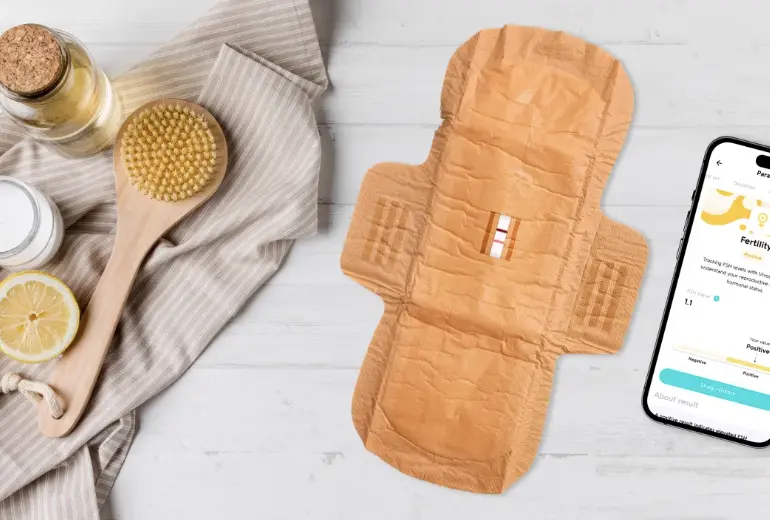
But to be honest, standing in front of the booth, the sense of "boundary-less collection" feels more oppressive than technological. Do we really need to datafy every drop of human excretion? The medical community has long discussed that hormone levels fluctuate every hour, and a single FSH monitoring cannot definitively conclude fertility or menopausal status. If users become trapped in endless "data anxiety" based solely on a color change in a sanitary napkin, it feels more like a commercial harvest of women's health fears rather than genuine medical accessibility.
In my view, this product is more like a microcosm of the "crazy fluid data" trend in health technology for 2026. As blood, urine, sweat, and even menstrual blood become data collection tools, we indeed obtain what looks like a perfect "human manual." But let’s not forget, the human body is not a precisely operating machine; over-interpreting those subtle physiological indicators often distances us from true health. Rather than saying FlowPad is an innovative medical device, it is more of a thought-provoking slice, questioning whether we are in control of our bodies or being hijacked by data as technology begins to invade our most private boundaries. Perhaps, before promoting boundary-less monitoring, respecting privacy and dignity as humans is far more important than fluctuating values.
05. When "The Future" Steps Out of the Draft Box
As I walked out of the Las Vegas Convention Center, flashes of that breathing AI pet, the invisible recording pin, and the comical moment of measuring heart rate with a cat mask kept replaying in my mind. These seemingly scattered, even somewhat "absurd" fragments pieced together the most authentic side of the tech world in 2026. We are witnessing a large-scale "species migration," with AI technology descending from the cloud to the soil, poised to reshape everything like electricity.
This year, industrial-grade, medical-grade, and laboratory-grade products are entering the consumer market with an unprecedented softness. The cat health monitoring bowl, the medical-compliant recording pin, and the bedroom steward equipped with millimeter-wave technology are essentially "dimensional reductions" of industrial-grade precision. This means that AI is no longer a computational race in laboratories but has become a "daily tool" accessible to everyone.
Moreover, the evolution of AI companionship is the most impressive change at CES this year. If last year's companionship products were merely selling "novelty," this year, companionship has completely evolved into a "segmented service." Technology no longer tries to provide a one-size-fits-all answer but begins to learn how to be a competent old friend and a considerate assistant. From Sweekar to Anan, this evolution based on emotion, memory, and physical interaction transforms AI from a "useful program" into a "warm companion."
Of course, behind the excitement, there are also shadows. We have observed that as AI becomes a "cure-all," the issue of product homogenization follows. The uniformity of smart glasses and the awkwardness of some smart home devices forcibly piling on AI remind us: if innovation is merely to add an "AI" label, it will soon be drowned in a sea of products.
The direction that CES 2026 has blown into the industry is already very clear; the second half of technology is not just about the strength of model capabilities but also about how to seamlessly embed this intelligence into human daily life.
We have completed the draft leading to the future. What remains is to see how these ideas step out of the exhibition hall and truly change our tomorrow.
If CES 2025 was the year of generative AI, then CES 2026 marks the official explosion of AI hardware.
免责声明:本文章仅代表作者个人观点,不代表本平台的立场和观点。本文章仅供信息分享,不构成对任何人的任何投资建议。用户与作者之间的任何争议,与本平台无关。如网页中刊载的文章或图片涉及侵权,请提供相关的权利证明和身份证明发送邮件到support@aicoin.com,本平台相关工作人员将会进行核查。


