The annual loss of tens of millions in revenue has sparked governance controversies, with Aave Labs being accused of "betraying" the DAO.

CN
PANews
Follow
2 hours ago

Author: Ignas, Crypto KOL

Compiled by: Felix, PANews

Recently, a debate arose between Aave Labs and Aave DAO regarding the fee distribution issue surrounding the CoWSwap integration, which the community views as a potential crisis in DeFi governance. The author of this article interprets the debate from a neutral perspective, with the following details.

On December 4, the lending protocol Aave Labs migrated the default exchange integration of its front-end interface aave.com from ParaSwap to CoWSwap. While this may seem like a minor product update, it actually exposes long-standing deep-seated contradictions within Aave.

This conflict is not about CowSwap, fees, or even user experience, but rather about ownership. Specifically, who controls Aave, who decides the distribution, and who benefits from the value created around the protocol.

In the old setup, the exchange function primarily served to retain users:

Users could reorganize or exchange assets without leaving the Aave interface. Importantly, all referral fees or positive slippage surplus fees were redistributed as income to the Aave DAO treasury.

The integration of CowSwap changed this situation.

According to Aave documentation, exchanges now incur a fee of approximately 15 to 25 basis points. Orbit, representing EzR3aL (note: a senior governance participant and independent delegate of Aave DAO), investigated the destination of these fees and concluded: these fees no longer enter the DAO treasury but flow into an address controlled by Aave Labs.

"Assuming only $200,000 is transferred weekly, the DAO would lose at least $10 million a year." —EzR3aL

Did Aave Labs unilaterally cut off the DAO's revenue source and transfer it to a private company?

Aave has operated smoothly for years because, although the division of responsibilities is vague, the interests of all parties have remained aligned.

  • DAO governance protocol
  • Aave Labs builds the front-end interface

Most funds flowed in the same direction, so no one paid much attention to the definition issues.

Now, this tacit coordination seems to have broken down.

As Aave founder and CEO Stani.eth wrote:

  • “At that time, Aave Labs decided to donate to Aave DAO in those cases (these funds could have been returned to users).”

Aave Labs' response: "Protocols and products are different concepts."

From Aave Labs' response in the forum:

  • “The front-end interface is operated by Aave Labs, completely independent of the management of the protocol and DAO.”
  • “The front-end interface is a product, not a component of the protocol.”

From their perspective, this is reasonable. Running a front end requires funding, security requires funding, and support also requires funding.

The surplus from Paraswap flowing to the DAO is not a permanent rule. There is no precedent to follow.

ACI (the service provider for Aave DAO) and its founder Marc Zeller believe this is a fiduciary responsibility issue.

"Every service provider on the Aave DAO payroll has a mandatory fiduciary duty to the DAO, and thus is responsible for the best interests of AAVE token holders." —Marc Zeller in a forum comment.

He believes there is a tacit understanding: the DAO lends its brand and intellectual property, and the profits from the front end should also belong to the DAO. "It seems we have been kept in the dark, thinking this was taken for granted."

Marc Zeller also claimed that the DAO lost revenue, and routing decisions could push trading volume to competitors, resulting in Aave DAO losing about 10% of potential revenue.

Protocol vs. Product

Aave Labs has drawn a clear line between the protocol and the product.

The DAO manages the protocol and its on-chain economics. Aave Labs operates the front-end interface as a separate product with its own philosophy.

As the Aave founder explained in this tweet:

  • Aave Labs' front-end interface is a product entirely based on our own philosophy, which we have developed for over 8 years, similar to other interfaces utilizing the Aave protocol, such as DeFi Saver.
  • It is entirely reasonable for Aave Labs to profit from its products, especially since it does not touch the protocol itself, and given the ByBit security incident, this ensures secure access to the protocol.

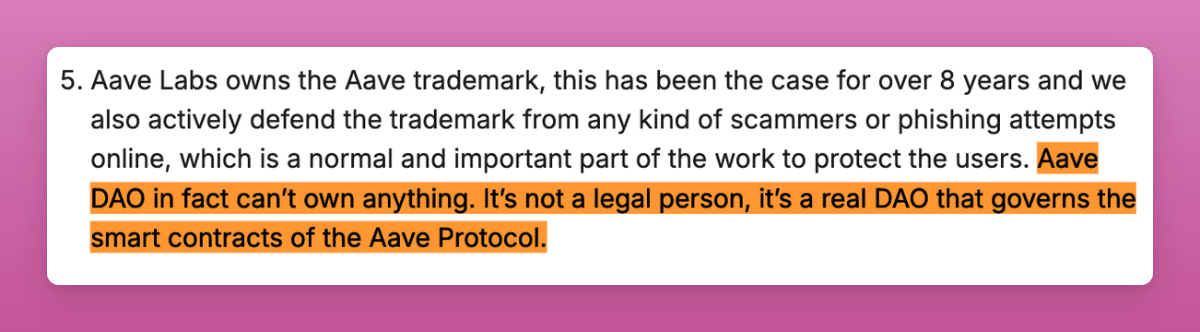
The Aave DAO does not own the intellectual property because the DAO is not a legal entity and cannot hold trademarks or enforce trademark rights in court.

The DAO manages the smart contracts and on-chain parameters of the Aave protocol but does not manage the brand itself.

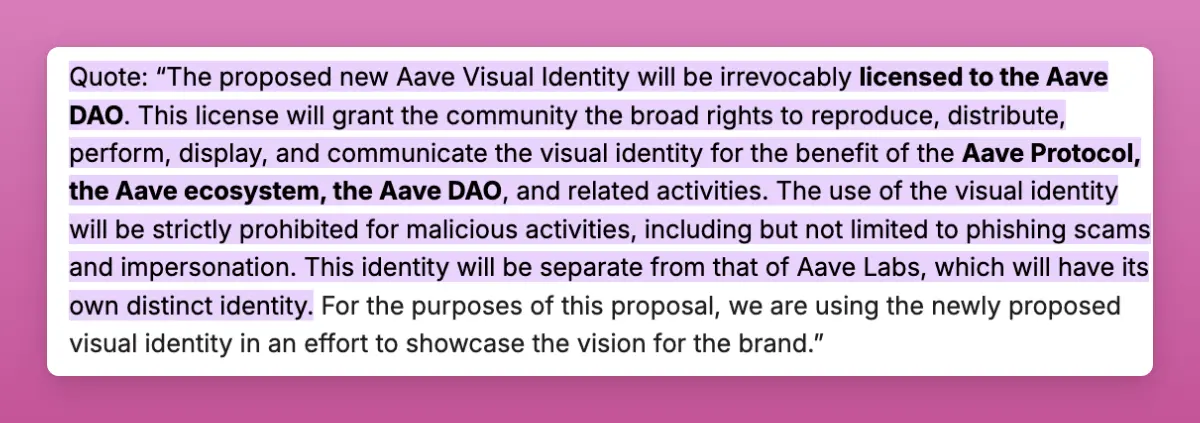
However, the DAO has obtained the right to use the Aave brand and visual identity for purposes related to the protocol. Past governance proposals have explicitly granted the DAO broad rights to use the visual identity "for the benefit of the Aave protocol, Aave ecosystem, and Aave DAO."

Source: Aave

As EzR3aL stated:

  • “The reason for charging this fee is that the Aave brand is well-known and accepted in the ecosystem. This is a brand that Aave DAO has paid for.”

The value of the Aave brand does not come from a logo.

Its value comes from:

  • The DAO's prudent risk management
  • Token holders bearing the protocol's risks
  • The DAO paying service providers
  • The DAO surviving multiple crises without collapsing
  • The protocol earning a reputation for safety and reliability

This is what EzR3aL refers to as "the brand that the DAO has paid for."

Not in a legal sense, but in an economic sense, having invested funds, governance, risk, and time.

Does this sound familiar?

It brings us back to the similar issues between Uniswap Labs and the foundation regarding Uniswap front-end fees. Ultimately, Uniswap readjusted equity and token holder rights, completely eliminating front-end fees.

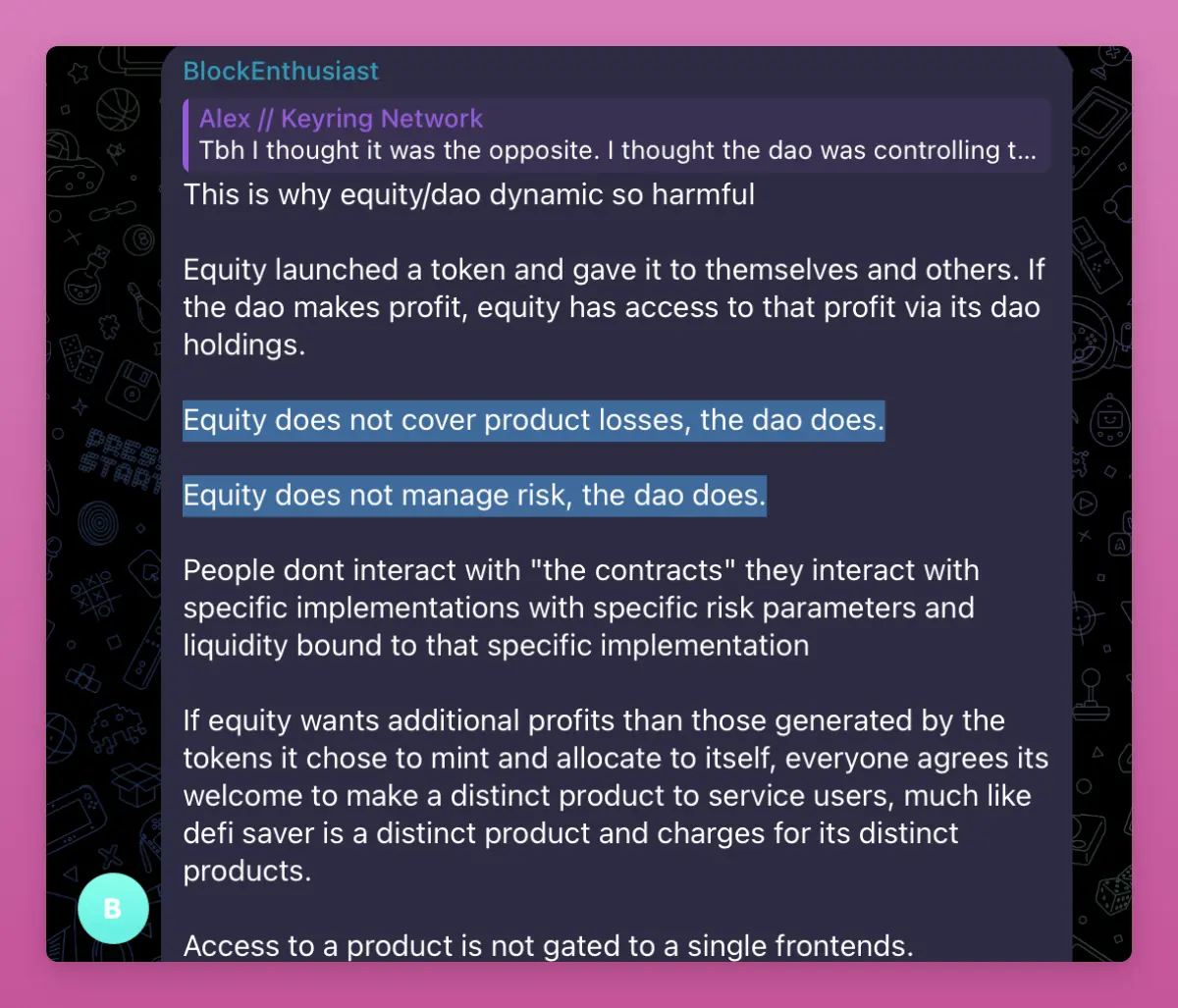
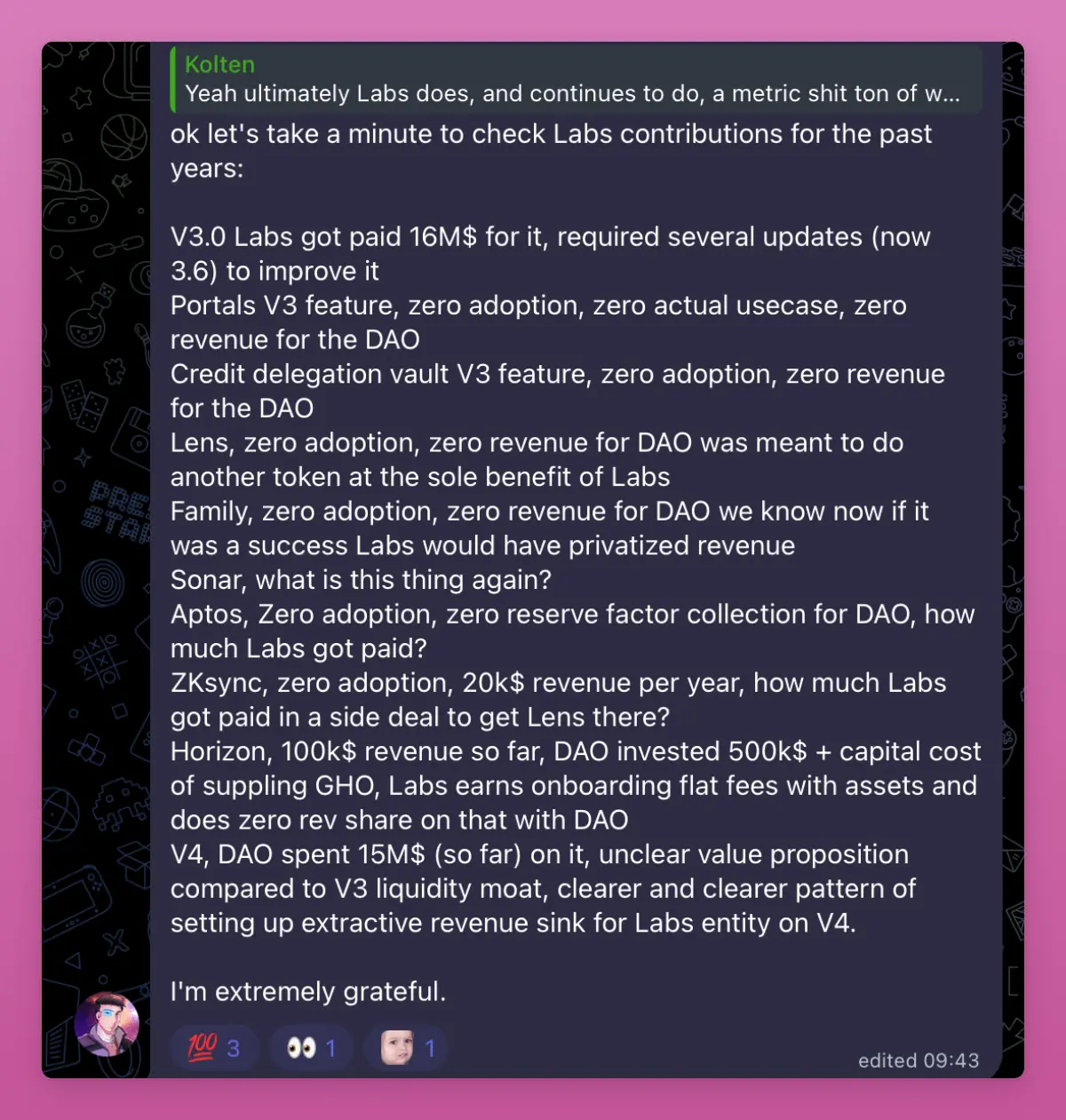
This is why equity/DAO dynamics can cause harm (as I discovered from the TG group chat).

The content of the above image is as follows:

“Equity issued a token and allocated these tokens to itself and others. If the DAO generates profits, Equity can profit from its share of tokens held in the DAO.

  • But Equity does not bear the losses of the product; those losses are borne by the DAO.
  • Equity also does not manage risks; risk management is the responsibility of the DAO.

Users do not interact directly with the 'contract' but with specific implementation versions that have specific risk parameters and liquidity tied to that specific implementation.

If Equity wants to gain additional profits beyond those generated by the tokens it initially minted and allocated to itself, everyone agrees it can develop an independent product to serve users, just like DeFi Saver is an independent product that charges for its unique services.

Access to a product should not be restricted to a single front end.”

As of the time of writing, Aave Labs only agrees with critics on the communication aspect.

  • The real reasonable criticism here is communication. Or rather, the lack of communication.

Things were already complicated enough, and now it’s worse.

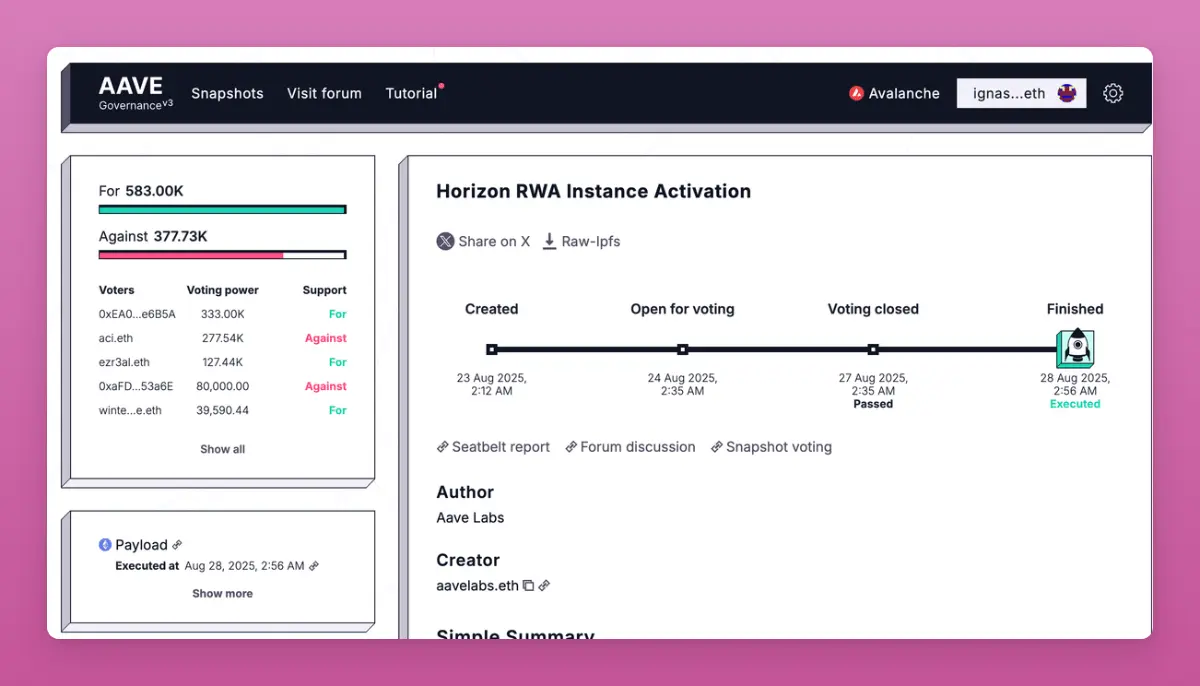
Aave Labs proposed Horizon as a dedicated RWA instance.

Initially, the proposal included a content that immediately alerted the DAO: a new token with diminishing revenue shares.

Representatives from various factions strongly opposed (including the author), arguing that introducing an independent token would dilute AAVE's value proposition and undermine consistency.

The DAO ultimately won, and Aave Labs was forced to concede. The new token plan was canceled.

But this sparked greater divisions.

Despite numerous concerns (one of which explicitly pointed out the clear responsibilities of Aave Labs and the DAO), Horizon still went live. This was the most controversial vote victory.

I voted against the deployment, advocating for a friendly agreement to prevent future conflicts from escalating. And that is the current situation. Economic issues quickly became the focal point of the conflict.

According to data cited by Marc Zeller, Horizon has generated approximately $100,000 in total revenue so far, while Aave DAO has invested $500,000 in incentive funds, resulting in a net asset of about -$400,000 on its books.

And this does not account for other factors.

Marc also pointed out that tens of millions of GHO have been invested in Horizon, but its returns are lower than the costs required to maintain the GHO peg.

When considering these opportunity costs, the DAO's true economic situation may be even worse.

This prompted ACI to raise a question that goes beyond Horizon itself:

If a project funded by the DAO has poor direct economic benefits, is that the whole story?

Or are there additional benefits, integration fees, or off-chain arrangements that token holders cannot see?

Over the years, multiple deployments and plans proposed by various Labs have ultimately led to the DAO's costs exceeding its revenues.

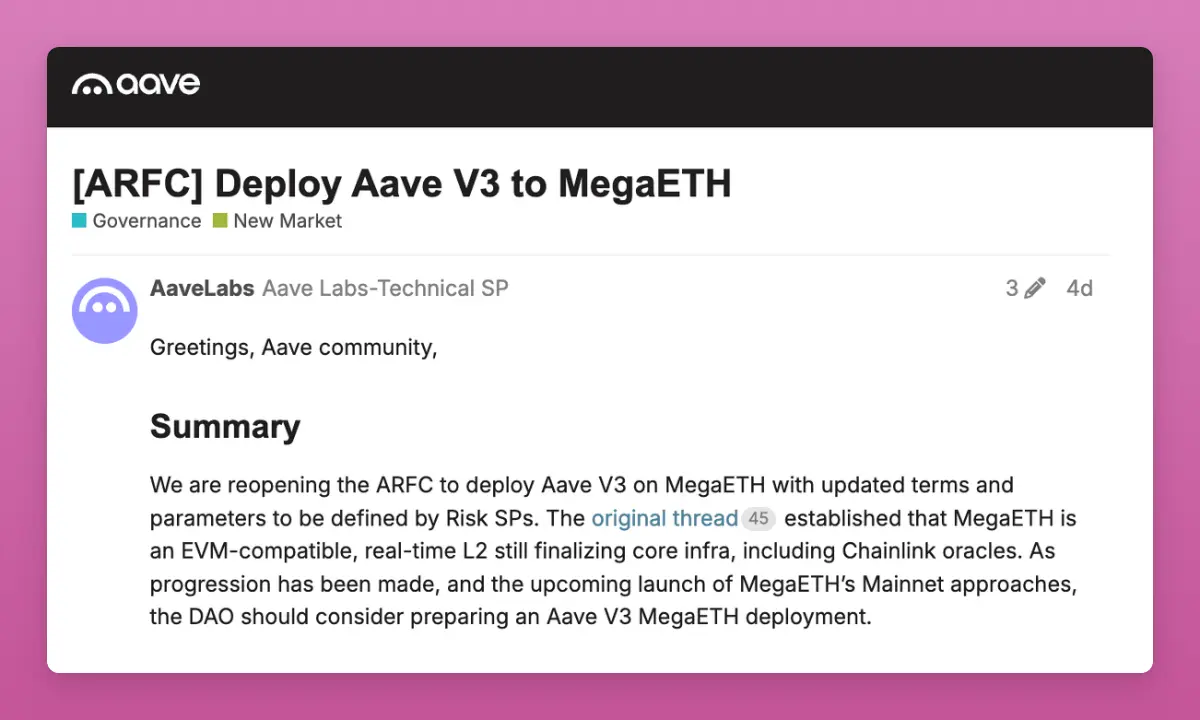
A few days after Aave Labs proposed a DAO proposal to deploy Aave V3 on MegaETH, relevant discussions immediately began.

In return, "Aave Labs will receive 30 million points from MegaETH."

Then, "these points may be distributed as incentives in the Aave V3 MegaETH market according to Aave DAO's GTM strategy."

The issue is that when a product is operated by a private entity using DAO-supported assets, transparency is crucial, and it must be ensured that incentives are distributed as agreed.

Source: Aave

Another surprising reason for this proposal is:

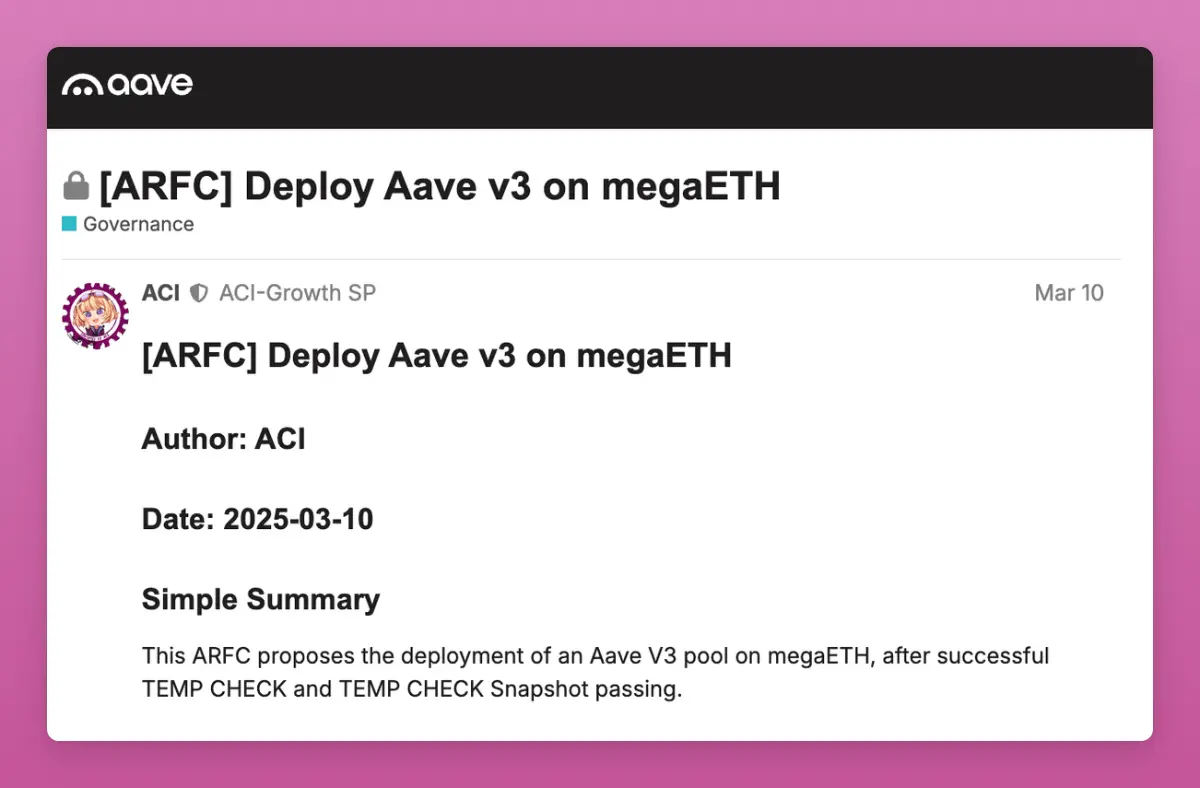
Aave DAO had already proposed deploying on MegaETH in collaboration with several service providers, especially ACI, as early as March. Relevant discussions are still ongoing.

Source: Aave

As Marc commented in the forum:

  • “During the discussions, we were very surprised to find that Aave Labs decided to bypass all precedents, abandon all ongoing progress, and contact MegaETH directly. We only learned about this when the proposal was published on the forum.”

Treasury

Another part of this debate concerns the Aave treasury.

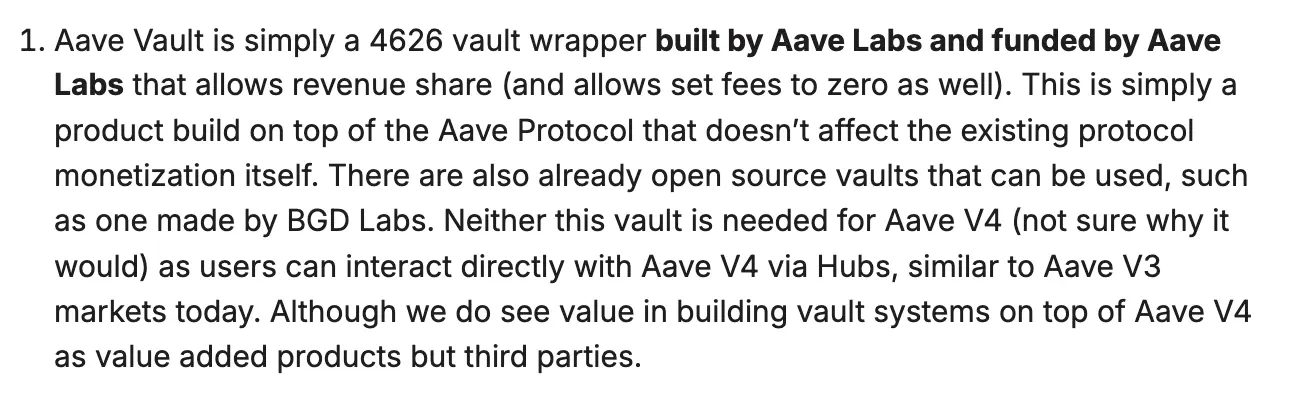
The Aave treasury is an application-level product built and funded by Aave Labs. Technically, they are ERC-4626 treasury wrappers built on the Aave protocol, abstracting position management for users.

Stani explained this very clearly:

  • “The Aave treasury is simply a 4626 treasury wrapper built and funded by Aave Labs.”

From Aave Labs' perspective, this should not be controversial.

The treasury is not a component of the protocol. They do not affect the protocol's profitability.

They are optional, and users can always interact directly with the Aave market or use third-party treasuries.

  • “For Aave V4, this treasury is not necessary… Users can interact directly with Aave V4 through Hubs.”

Moreover, since the treasury is a product, Aave Labs believes they have the right to profit from it.

  • “It is completely fine for Aave Labs to profit from its products, especially since they do not involve the protocol itself.”

So why is the treasury involved in this dispute?

The reason lies in the distribution channel.

If the treasury becomes the default user experience for Aave V4, then a Labs-owned product branded with Aave could become a bridge between users and the protocol, charging transaction fees while relying on the reputation, liquidity, and trust accumulated by the DAO.

Despite the increased adoption of Aave products, the AAVE token would still be affected.

Again, the author believes this issue falls within the same category as the debate between Uniswap Labs and the foundation regarding front-end products.

In summary, CowSwap, Horizon, MegaETH, and Aave Vaults all face the same issue.

Aave Labs sees itself as an independent builder operating a product with subjective opinions on top of a neutral protocol.

The DAO increasingly believes that the value of the protocol is being monetized outside of its direct control.

Aave DAO does not own the intellectual property, but it has been authorized to use the Aave brand and visual identity for purposes related to the protocol.

This debate is crucial because the upcoming Aave v4 version is explicitly designed to shift complexity from the user side to the abstraction layer.

More routing, more automation, and more products located between users and the core protocol.

More abstraction means more control over user experience, and control over user experience is key to value creation/extraction.

This article aims to remain neutral. However, it is hoped that a consensus can be reached regarding the value capture for $AAVE token holders.

The consensus the author hopes to achieve would not only benefit Aave itself but also because Aave sets an important precedent for how equity and tokens can coexist.

Uniswap Labs has completed this process and ultimately made the outcome favorable for $UNI holders.

Aave should do the same.

Related reading: Uniswap Protocol Fee Distribution Proposal Ignites Market, What Impact Will It Have on the Future of DeFi?

免责声明:本文章仅代表作者个人观点,不代表本平台的立场和观点。本文章仅供信息分享,不构成对任何人的任何投资建议。用户与作者之间的任何争议,与本平台无关。如网页中刊载的文章或图片涉及侵权,请提供相关的权利证明和身份证明发送邮件到support@aicoin.com,本平台相关工作人员将会进行核查。

Share To
APP

X

Telegram

Facebook

Reddit

CopyLink