Why RMP is Not Equivalent to QE?
Author: Alex Krüger
Translation: Deep Tide TechFlow
The Federal Reserve has just committed to purchasing $40 billion in U.S. Treasury securities each month, and the market has begun to shout "Quantitative Easing (QE)!"
While this figure may seem like a signal to stimulate the economy on the surface, the mechanisms behind it tell a different story. Powell's actions are not aimed at stimulating the economy but rather at preventing issues in the functioning of the financial system.
Here is an analysis of how the Federal Reserve's Reserve Management Purchases (RMP) structurally differ from Quantitative Easing (QE) and their potential impacts.
What is Quantitative Easing (QE)?
To strictly define Quantitative Easing and distinguish it from standard open market operations, the following conditions must be met:
Three Mechanical Conditions
Mechanism (Asset Purchases): The central bank purchases assets by creating new reserve funds, typically government bonds.
Scale (Large Scale): The amount purchased is significant relative to the total market size, aimed at injecting substantial liquidity into the system rather than making fine adjustments.
Objective (Quantity over Price): Standard policy adjusts supply to achieve specific interest rate (price) targets, while Quantitative Easing commits to purchasing a specific quantity of assets (quantity), regardless of how interest rates ultimately change.
Functional Condition
- Positive Net Liquidity (QE): The speed of asset purchases must exceed the growth rate of non-reserve liabilities (such as currency and Treasury General Accounts). The goal is to forcibly inject excess liquidity into the system, not just to provide the liquidity needed.
What is Reserve Management Purchases (RMP)?
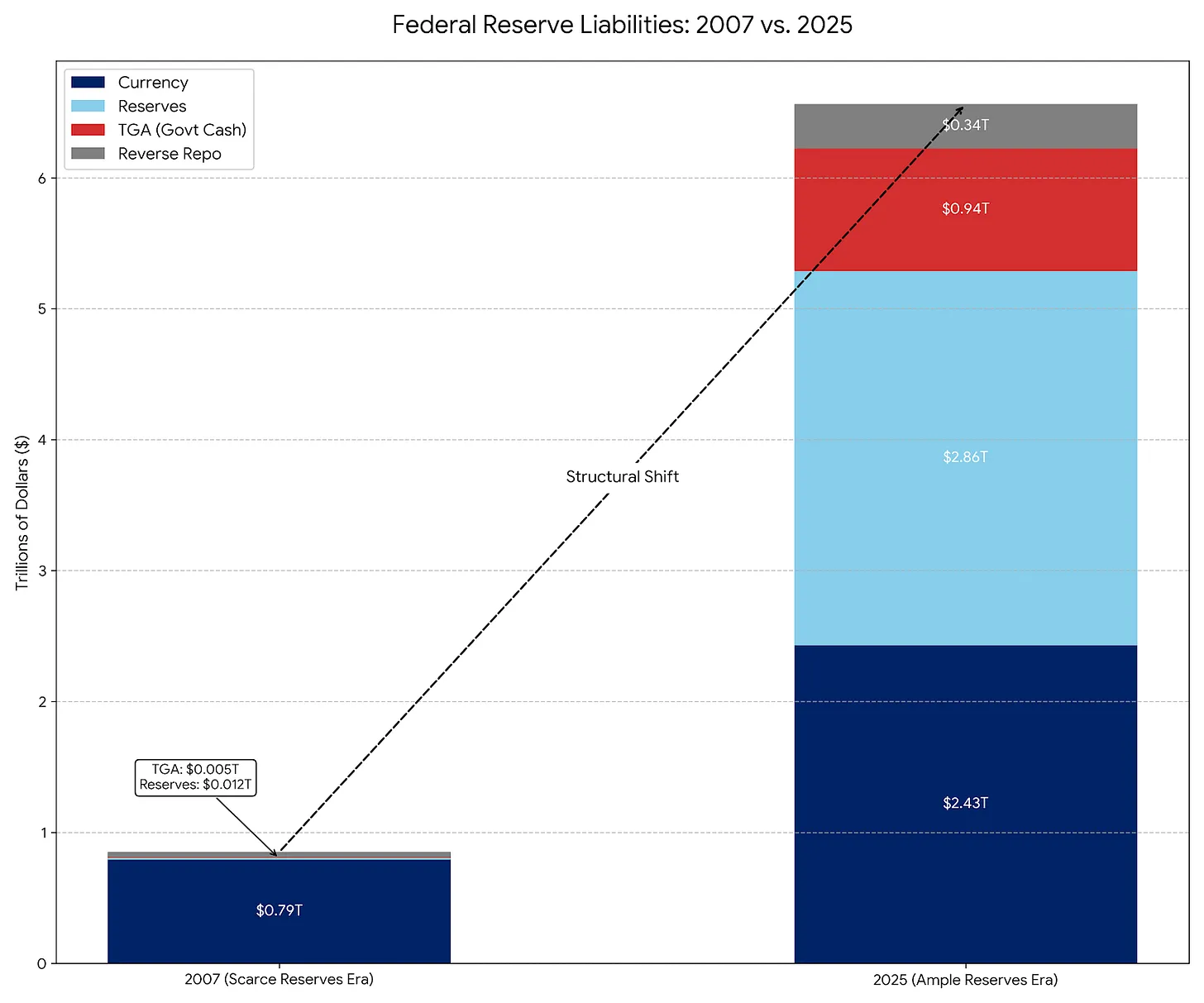
RMP is essentially the modern successor to Permanent Open Market Operations (POMO), which was the standard operating procedure from the 1920s until 2007. However, since 2007, the composition of the Federal Reserve's liabilities has changed significantly, necessitating an adjustment in operational scope.
POMO (Scarce Reserves Era)
Before 2008, the Federal Reserve's main liabilities were physical currency in circulation; other liabilities were fewer and more predictable. Under POMO, the Fed purchased securities merely to meet the gradual demand for physical cash from the public. These operations were calibrated to be liquidity neutral and were small in scale, not distorting market prices or suppressing yields.
RMP (Abundant Reserves Era)
Today, physical currency accounts for only a small portion of the Federal Reserve's liabilities, which are primarily dominated by large and volatile accounts such as the Treasury General Account (TGA) and bank reserves. Under RMP, the Fed purchases short-term Treasury bills (T-Bills) to buffer these fluctuations and "maintain a sufficient supply of reserves." Similar to POMO, RMP is also designed to be liquidity neutral.

Why Start RMP Now: The Impact of TGA and Tax Season
Powell implemented the Reserve Management Purchases (RMP) to address a specific issue in the financial system—the liquidity drain from the TGA (Treasury General Account).
How it Works: When individuals and businesses pay taxes (especially during the major tax deadlines in December and April), cash (reserves) is transferred from their bank accounts to the Federal Reserve's government checking account (TGA), which is outside the commercial banking system.
Impact: This transfer of funds drains liquidity from the banking system. If reserves fall too low, banks will stop lending to each other, potentially triggering a crisis in the repo market (similar to the situation in September 2019).
Solution: The Federal Reserve is now initiating RMP to offset this liquidity drain. They create $40 billion in new reserves to replace the liquidity that will soon be locked in the TGA.
Without RMP: Tax payments would tighten financial conditions (bearish). With RMP: The impact of tax payments is neutralized (neutral).
Is RMP Actually QE?
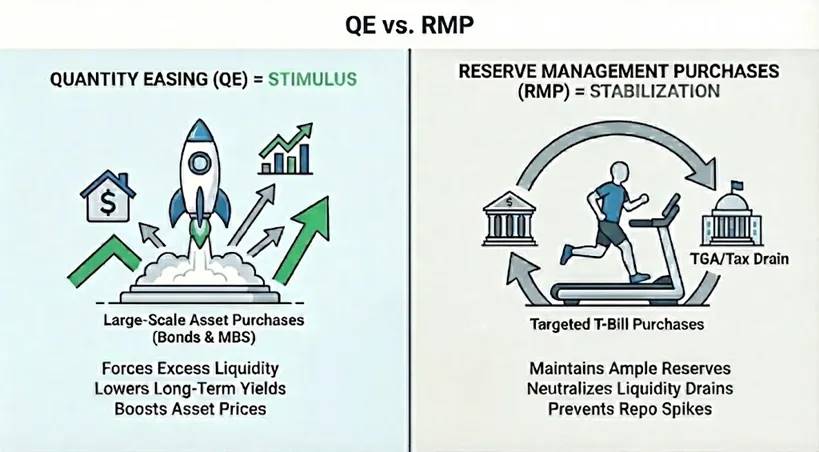
Technically: Yes. If you are a strict monetarist, RMP fits the definition of QE. It meets the three mechanical conditions: large-scale asset purchases through new reserves ($40 billion per month), with a focus on quantity rather than price.
Functionally: No. The role of RMP is stabilization, while the role of QE is stimulation. RMP does not significantly loosen financial conditions; rather, it prevents further tightening during events like TGA replenishments. Since the economy itself will naturally withdraw liquidity, RMP must continue to operate to maintain the status quo.

When Will RMP Transition to True QE?
RMP will transition to full QE if one of the following two variables changes:
A. Change in Duration: If RMP begins purchasing long-term Treasury bonds or mortgage-backed securities (MBS), it will become QE. By doing so, the Fed removes interest rate (duration) risk from the market, lowers yields, and forces investors to shift to higher-risk assets, thereby pushing up asset prices.
B. Change in Quantity: If the natural demand for reserves slows (e.g., TGA stops growing), but the Fed continues to purchase $40 billion per month, RMP will become QE. At this point, the Fed is injecting liquidity into the financial system beyond demand, which will inevitably flow into financial asset markets.
Conclusion: Market Impact
RMP is designed to prevent the liquidity drain during tax season from affecting asset prices. Although it is technically neutral, its reintroduction sends a psychological signal to the market: "The Fed Put has been activated." This announcement is a net positive for risk assets, providing a "gentle tailwind." By committing to $40 billion in purchases each month, the Fed effectively provides a floor for liquidity in the banking system. This eliminates the tail risk of a repo crisis and enhances market leverage confidence.
It is important to note that RMP is a stabilizer, not a stimulator. Since RMP merely replaces the liquidity drained by the TGA rather than expanding the net monetary base, it should not be mistaken for systemic easing akin to true QE.
免责声明:本文章仅代表作者个人观点,不代表本平台的立场和观点。本文章仅供信息分享,不构成对任何人的任何投资建议。用户与作者之间的任何争议,与本平台无关。如网页中刊载的文章或图片涉及侵权,请提供相关的权利证明和身份证明发送邮件到support@aicoin.com,本平台相关工作人员将会进行核查。