Gnosis panoramic analysis: A dark horse in DeFi?

CN
PANews
Follow
1 year ago

In the increasingly robust ecosystem of Web3, Gnosis, as one of the pioneers of blockchain technology, has undergone significant development and evolution since its initial application launch on Ethereum in 2016. As a sidechain of Ethereum, Gnosis ($GNO) exhibits characteristics of a sidechain, but its functionality and performance are more similar to a Layer1 (L1) blockchain. Gnosis has achieved a staggering fully diluted market value of 7.78 billion USD, with 86% of its tokens already in circulation in the market, and its on-chain total value locked (TVL) reaching as high as 286 million USD.

On the Gnosis chain, major decentralized finance (DeFi) applications such as Aave, Maker's sub-protocol Spark, and Balancer are active, particularly the RealT project, which has a TVL of 104 million USD, demonstrating Gnosis's strong potential in the tokenization of real-world assets (RWA). With the launch of Gnosis 3.0, its ecosystem has begun to focus on payments and financial infrastructure. In the following sections, we will briefly introduce some information about Gnosis.

Gnosis Panorama Analysis: A Dark Horse in DeFi?

Gnosis Chain

Gnosis Chain, originally named xDai Chain, was officially launched in October 2018 as an important sidechain based on Ethereum. After merging with Gnosis, this chain was officially renamed Gnosis Chain in December 2021 according to the GIP16 proposal. As an EVM (Ethereum Virtual Machine) compatible chain, Gnosis Chain allows Ethereum developers to migrate and deploy smart contracts at extremely low cost, greatly reducing the development threshold and cost.

Gnosis Chain adopts a unique dual-token model, consisting of the stablecoin XDAI and the governance token GNO (formerly STAKE). XDAI is a stablecoin pegged 1:1 to the US dollar, used for trading and paying transaction fees, while GNO supports the underlying POSDAO consensus mechanism. This model not only maintains the stability of the network but also provides an efficient governance method. When users convert DAI to XDAI through a cross-chain bridge, the DAI will be locked, and Gnosis Chain will generate an equivalent amount of XDAI to send to the user. Conversely, XDAI will be destroyed, and DAI will be sent to the user's Ethereum wallet.

The cross-chain bridging methods supported by Gnosis Chain include xDai Bridge and Omni Bridge, the former designed specifically for XDAI, while the latter can support token cross-chain transfers between multiple chains. In addition, GNO token holders can directly participate in on-chain governance by initiating proposals and voting. Users can also participate in block production and on-chain security maintenance by running full nodes and staking GNO as validators.

In terms of consensus mechanism, Gnosis Chain adopts a proof-of-stake (PoS) consensus algorithm called POSDAO, which is based on a Byzantine Fault Tolerance (BFT) consensus protocol, ensuring the decentralization, fairness, and energy efficiency of the network. This consensus mechanism has been effective since April 2020 and continued until the Ethereum network upgrade merge. In December 2022, Gnosis Chain successfully merged with Gnosis Beacon Chain, becoming one of its shards, further integrating the Gnosis network and optimizing its role in the Ethereum ecosystem.

Through innovative technology and forward-looking strategies, Gnosis Chain not only plays an important role in the Ethereum ecosystem but also provides crucial infrastructure for developing decentralized applications (dApps), driving the development and transparent governance decision-making of the entire ecosystem.

GNO: Core Token and Future Prospects in the Gnosis Ecosystem

GNO, as the native token of the Gnosis ecosystem, plays multiple critical roles. It serves as both the staking token for Gnosis and the governance token for GnosisDAO, giving it a central position within the entire Gnosis ecosystem. Built on the Ethereum protocol, Gnosis is a decentralized prediction platform that utilizes a PoS mechanism, providing users with an open and flexible environment to participate in and create customizable prediction markets.

The market positioning of GNO is unique. As one of the earliest sidechains of Ethereum, Gnosis Chain stands out for its independence and EVM compatibility, enabling it to support smart contracts and dApps while maintaining operational independence and autonomy. This structure allows Gnosis Chain to ensure transaction security while enabling rapid asset transfers through specific mechanisms.

In today's competitive crypto market, GNO faces competition from other sidechains and Layer2 solutions (such as Optimism). Sidechains like Gnosis operate as independent blockchains with their own consensus mechanisms and security models, while Layer2 solutions operate under the security framework of the Ethereum main chain, providing a more lightweight transaction processing solution. Although sidechains may not match the security level of Layer2 solutions relying on the Ethereum main chain, Gnosis provides unique value through its independence, especially in asset interoperability and diverse application scenarios.

In terms of data security and market performance, GNO demonstrates strong potential. While code security has always been a focus for the development team, the Gnosis ecosystem has received positive responses from the capital market. Gnosis's high total value locked (TVL) of 286 million USD is a key indicator of its success. Looking ahead, the management approach of the Gnosis team and community indicates a commitment to robust operation, suggesting the potential for significant growth in the upcoming bull market cycle.

Taking into account the design advantages and market performance of Gnosis Chain and GNO token, as well as their practical applications in the DeFi and prediction market fields, they emerge as strong competitors in blockchain investment and development. Despite challenges, such as the need for further code auditing and security enhancements, the Gnosis ecosystem demonstrates significant growth potential and market appeal, making its future development worth anticipating.

Gnosis 3.0: Bridging Blockchain Technology and Everyday Applications

Gnosis Panorama Analysis: A Dark Horse in DeFi?

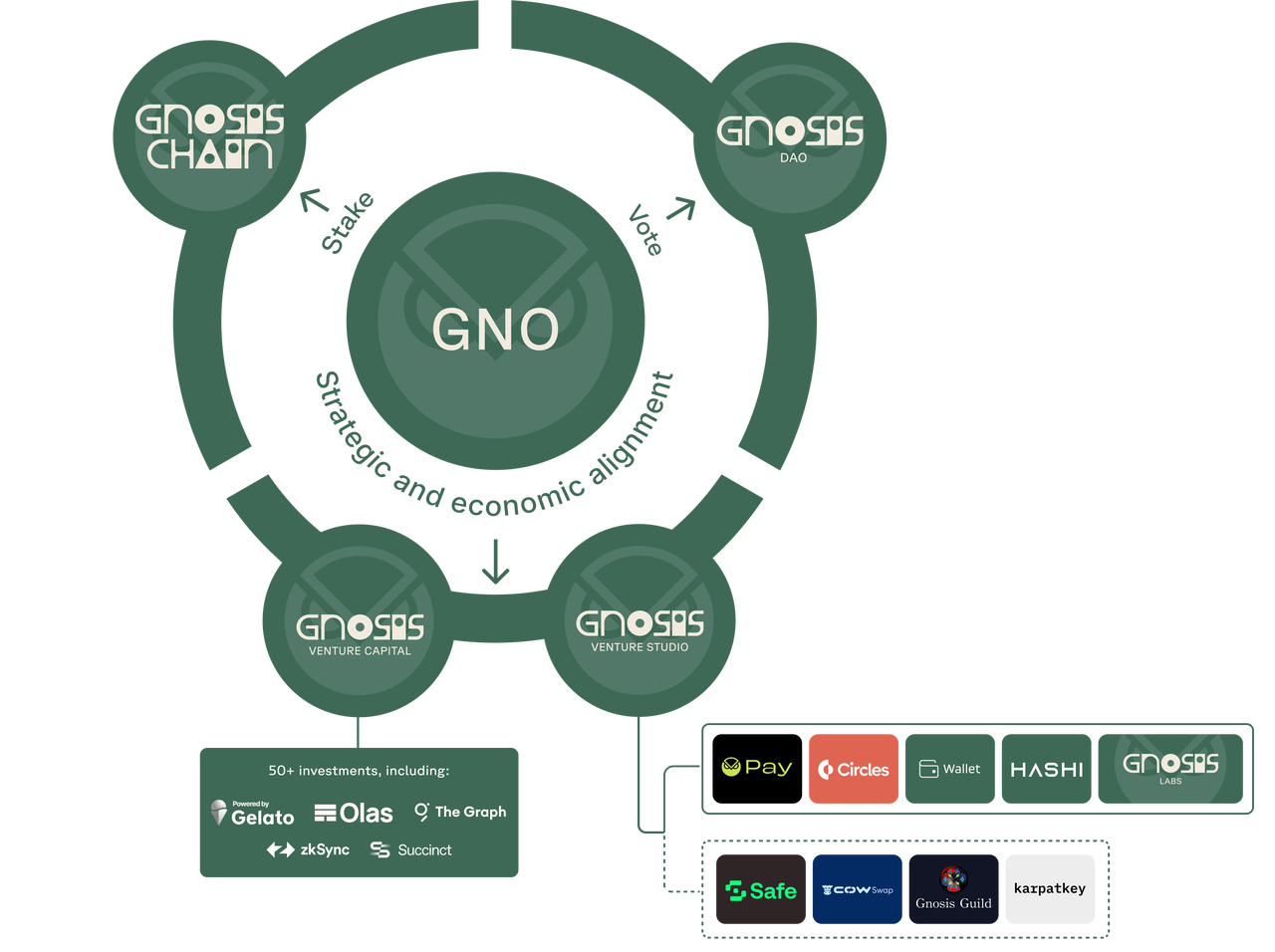
Since its launch as an Ethereum-based prediction market platform in 2015, Gnosis has transitioned from a prediction market platform (Gnosis 1.0) to Ethereum's core infrastructure (Gnosis 2.0), and has now entered its most ambitious development stage: Gnosis 3.0. In this stage, Gnosis is no longer just a provider of infrastructure but is focusing on innovating payments and financial infrastructure through a series of projects connected by the GNO token, aiming to bridge the gap between blockchain technology and everyday use cases for the general public.

At the core of Gnosis 3.0 is a strategic shift towards open financial tracks through applications such as Gnosis Pay and Gnosis Wallet, aiming to popularize DeFi tools. These applications not only accelerate the democratization of financial services but also provide users with more secure and transparent payment and financial service solutions. Additionally, Gnosis 3.0 emphasizes reforming existing traditional finance, aiming to replace certain businesses in traditional financial systems with blockchain infrastructure.

Gnosis Panorama Analysis: A Dark Horse in DeFi?

In terms of technology and governance structure, Gnosis Chain continues to serve as the core of Gnosis 2.0 and 3.0, ensuring network security through the validator mechanism of staking GNO. Gnosis DAO, as the governance infrastructure for GNO token holders, controls Gnosis's treasury and other key assets, such as ENS domains, indirectly strengthening its influence on the Gnosis ecosystem. Additionally, Gnosis Ventures not only supports and incubates early-stage projects but also provides extensive support to the Gnosis ecosystem through investments in third-party startups.

During this phase, Gnosis Ventures has invested in several ecosystem projects with significant economic potential, successful cases including Safe and CoW DAO. This strategy not only enhances the economic vitality within the Gnosis ecosystem but also contributes to the overall prosperity of the blockchain industry.

The future outlook for Gnosis 3.0 focuses on integrating the practical application of blockchain technology with the everyday needs of ordinary users, driving the popularization and acceptance of blockchain technology by providing more flexible and user-friendly solutions. In this way, Gnosis hopes to lead the transformation of blockchain technology from a primarily technology infrastructure-focused field to a practical technology platform that truly meets the needs of ordinary users.

Conclusion

Through continuous technological innovation and community-driven governance, Gnosis is shaping a more open and fair digital economic future. As blockchain technology becomes more widely integrated into daily life, Gnosis's journey sets a benchmark for the entire industry, demonstrating the importance of continuous innovation and adaptation to change.

免责声明:本文章仅代表作者个人观点,不代表本平台的立场和观点。本文章仅供信息分享,不构成对任何人的任何投资建议。用户与作者之间的任何争议,与本平台无关。如网页中刊载的文章或图片涉及侵权,请提供相关的权利证明和身份证明发送邮件到support@aicoin.com,本平台相关工作人员将会进行核查。

Share To
APP

X

Telegram

Facebook

Reddit

CopyLink