How far is Bitcoin from the $16 trillion market value of gold?
Author: Mu Mu / Plain Language Blockchain
"It's rising again! The price of gold has soared to over 700 yuan/gram." People from all walks of life around the world have been discussing the "craziness" of gold prices since the beginning of this year. However, many people may not know that the "digital gold" Bitcoin, which is also named after "gold," has surpassed 500,000 yuan per coin. Some people may say that it's difficult to compare due to different units, but you can refer to the following numbers:
10 years ago (2014), gold was 250 yuan/gram, and 10 years later, it's 700 yuan/gram, an increase of 2.8 times in 10 years.
10 years ago (2014), Bitcoin was $500 per coin, and 10 years later, it's $70,000 per coin, an increase of 140 times in 10 years.
A few years ago, when someone first proposed the concept of "digital gold," almost everyone would look at the person with suspicion. However, ten years have passed in the blink of an eye, and Bitcoin is growing at an astonishing rate, to the point where today, Bitcoin has finally begun to shake the unbreakable position of gold over thousands of years…
01
Gold VS Digital Gold Bitcoin
The reason why Bitcoin is called digital gold is because it shares some characteristics with gold. However, many people still find it difficult to associate physical and virtual assets. Perhaps this should start with the background of Bitcoin's birth…
1) Background of Bitcoin's Birth
Thousands of years ago (the exact date is not certain), gold was already "hard currency." It was first recorded as currency more than 2,000 years ago during the Spring and Autumn Period and the Warring States Period, and has been in use ever since. People holding and using gold are not restricted by anyone, institution, or even country, truly achieving "private property is inviolable."
Historical records show that in 1717, Newton of England first proposed the gold standard (a monetary system based on gold, where the country's gold holdings determine the amount of currency issued and its exchange value), which was subsequently adopted by various countries around the world. It wasn't until 1971, when U.S. Secretary of State Kissinger announced plans to abandon the gold standard, that the currency of the United States and other countries was no longer subject to the control of gold, allowing the value of currency to no longer be limited by gold reserves.
This means that the modern monetary system can control devaluation and inflation as needed.
Later, in the 2008 global financial crisis, the United States printed a large amount of money to rescue banks. People found that the money in their pockets was being diluted, leading to strong dissatisfaction and distrust of the financial system, leaving some textual clues to the background of Satoshi Nakamoto's original intention to create Bitcoin.
This is also why Satoshi Nakamoto left the message on the genesis block of Bitcoin before suddenly disappearing, "The Times 03/Jan/2009 Chancellor on brink of second bailout for banks."
Satoshi Nakamoto left traces of messages before his sudden disappearance, leading many to believe that Bitcoin was a response to the events of the 2007-2008 financial crisis. On the P2P Foundation's message board, Satoshi Nakamoto wrote an article in February 2009 introducing Bitcoin.
In the article, they showed distrust of reserve banks and concern for assets:
"We must trust the banks to hold our money and transfer it electronically, but they lend it out in waves of credit bubbles with barely a fraction in reserve. We have to trust them with our privacy, trust them not to let identity thieves drain our accounts. Their massive overhead costs make micropayments impossible."
2) Specific similarities between gold and Bitcoin
A. Decentralization
Gold: A natural resource spread across the earth, anyone could potentially mine gold from some corner.
Bitcoin: A public blockchain with network nodes spread across the globe, making it a resource that anyone can participate in mining.
B. Mining
Gold: Gold mining requires workers, mining sites, equipment, and electricity.
Bitcoin: Bitcoin mining also requires block producers, mining sites, equipment, and electricity.
C. Scarcity
Gold: A non-renewable natural resource.
Bitcoin: Limited to 21 million coins.
D. Durability
Gold: Physically stable, never rusts.
Bitcoin: Robust and secure network, with data on the chain never being erased.
E. Anti-counterfeiting
Gold: Real gold is not afraid of being refined by fire.
Bitcoin: No amount of investment can tamper with it.
Returning to the point, in some respects, they are very similar, but digital gold still has many advantages that physical gold cannot reach, such as:
Bitcoin is very convenient to carry, requiring only a string of words to remember, while physical gold is particularly heavy.
Bitcoin can be verified for authenticity anytime, anywhere, while physical gold is easily counterfeited with metals of similar density (there have been frequent cases of gold jewelry adulteration in recent years).
Bitcoin is easier to divide for transactions, while gold is the opposite.
Even though on-chain transfers of Bitcoin often amount to hundreds of millions of dollars, the transaction fees are only a dozen or so dollars, something that gold and even modern banking systems find it difficult to achieve in terms of truly low-cost and rapid asset transfer.
02
Bitcoin has opened up the corner of gold
1) Grayscale has repeatedly advertised to suggest that Bitcoin replace gold
In May 2019, Grayscale launched the first Drop Gold campaign, releasing ads with the theme "Drop Gold," reminding people that it's time to replace gold with Bitcoin.
In 2020, Grayscale and the blockchain venture capital company DCG's founder Barry Silbert tweeted that Grayscale had re-released the anti-gold ad "Drop Gold," which is now being broadcast on all major networks in the United States. This is a marketing campaign for Bitcoin, with the video suggesting that "digital currencies like Bitcoin are the future trend," aiming to make Bitcoin a tool for storing value in the 21st century.
In fact, several years ago, most people, including some financial institutions, did not take Grayscale's ads seriously. At that time, some financial tycoons even sneered at them, such as the famous BlackRock CEO Larry Fink, who once bluntly stated that Bitcoin was worthless! However, not long ago, Larry Fink changed his mind, saying that BTC will disrupt traditional finance.
Today, BlackRock has become a Bitcoin whale holding nearly 30,000 BTC.
2) Rapid inflow of spot ETF funds
As early as 2020, JPMorgan Chase, the bank with the largest total assets on the U.S. balance sheet, released a report studying the success of the Grayscale Bitcoin Trust (GBTC). The bank was once one of the biggest critics of Bitcoin, but the report acknowledged that the demand for Bitcoin even affects mature markets.
JPMorgan pointed out that the demand for Bitcoin may erode the demand for gold ETFs. According to this research, the number of people flowing into the Grayscale Bitcoin Trust in October 2023 was significantly higher than that of gold ETFs. Therefore, this U.S. bank concluded that GBTC might be able to capture some market share of gold ETFs.
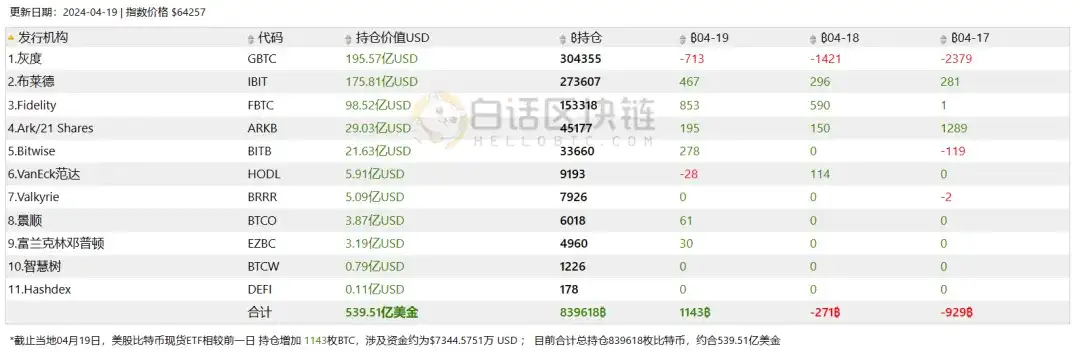
Overview of changes in holdings of Bitcoin spot ETFs in the U.S. stock market, source: https://www.hellobtc.com/etf/
As expected, after the launch of Bitcoin spot ETF, it has received a large influx of funds, while the funds of gold ETF have flowed out significantly. Many financial commentators have pointed out that this is not a coincidence, as the Bitcoin spot ETF has attracted a large amount of "gold" funds, with a significant portion coming from the gold ETF.
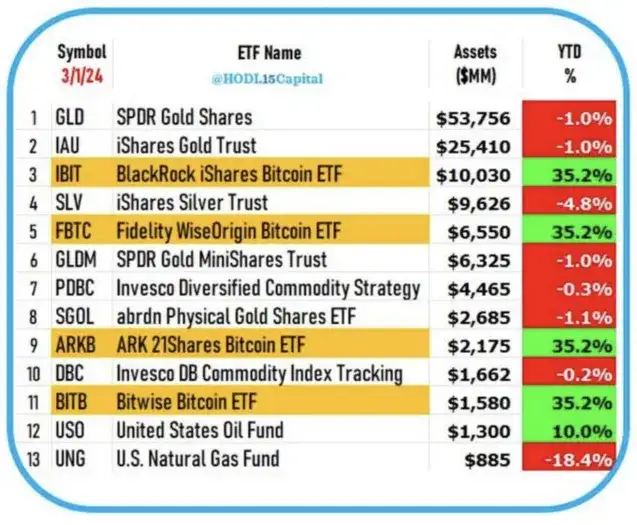
Some time ago, it was reported by the media that the scale of BlackRock's IBIT asset management has surpassed the largest silver ETF, ranking third among all major commodity ETFs (the figure below shows historical data). Currently, there are 11 Bitcoin spot ETFs in the U.S. stock market with a total holding of approximately 840,000 Bitcoins, with a market value close to $60 billion.
3) Bitcoin ranks among the top 10 global asset market values
As of April 23, according to the global asset ranking list from Companiesmarketcap, Bitcoin's market value of $1.35 trillion ranks ninth in the global asset market value, second only to silver. Currently, Bitcoin's market value has also surpassed the total market value of the world's four largest banks.
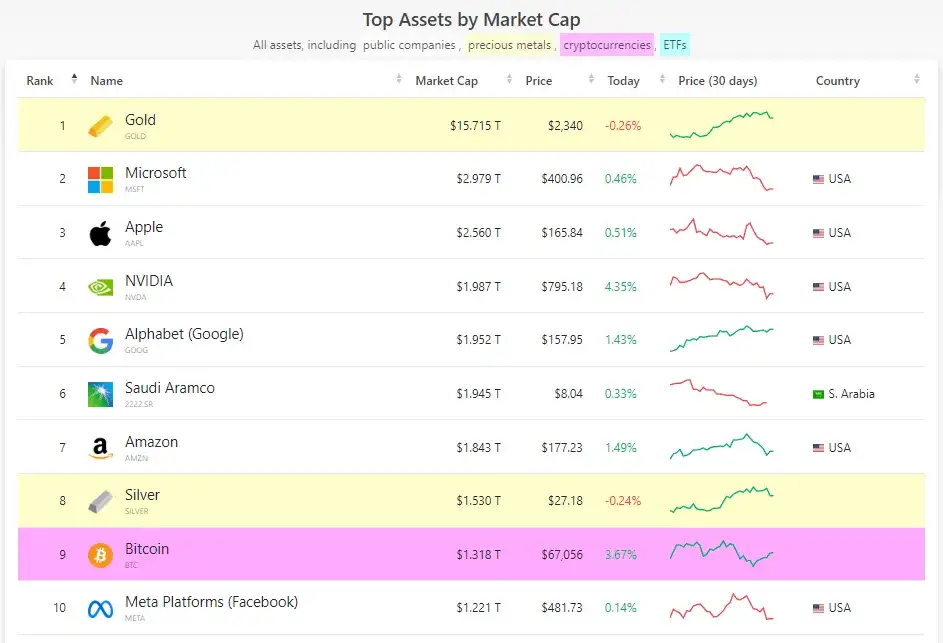
Global asset ranking Top 10, source: Companiesmarketcap
Bitcoin is still more than 10 times away from the market value of gold, which is over $15 trillion. Perhaps for many people in the cryptocurrency circle, this may not be a very difficult task for Bitcoin, which has grown 140 times in 10 years.
Recently, Anthony Scaramucci, CEO of SkyBridge Capital and a senior hedge fund manager, stated that the market value of Bitcoin will eventually surpass the $16 trillion market value of gold. In an interview with CNBC, the founder of SkyBridge Capital stated that Bitcoin is a high-quality asset that has never been seen in the history of humanity in the past 5,000 years.
Scaramucci stated that Bitcoin still has a long way to go to reach the $16 trillion market value of gold, but he believes that with the approval of BTC ETFs by regulatory agencies, the distance will shrink over time.
4) Bitcoin is playing a "safe haven" role
Most of the time, gold in many people's portfolios is actually used as a hedge against inflation, which can also be seen as a safe-haven asset. However, the fact is that gold has not outperformed inflation for most of the time. But Bitcoin, which has consistently broken new highs, has a fixed supply limit, and undergoes halving every 4 years, seems to have never let anyone down in this regard.
Due to the widespread consensus, gold has very low volatility, while Bitcoin is quite the opposite. Therefore, while Bitcoin has higher growth potential, it also carries higher risks. However, the volatility of Bitcoin is gradually decreasing, and Bitcoin is truly becoming an "alternative safe-haven tool" for high-inflation countries…
Recently, a new report from the International Monetary Fund (IMF) titled "A Primer on Bitcoin Cross-Border Flows" pointed out that BTC has become a necessary financial tool for preserving wealth in times of financial instability. The analysis also indicated that on-chain Bitcoin transactions recorded on the blockchain and providing higher security are often larger than off-chain transactions. This indicates that the powerful security features of blockchain technology often protect larger financial interests.
The report's authors stated that Bitcoin transactions provide individuals in high-inflation countries with a stable way to save and participate in global commerce in a way that local currencies cannot achieve.
From another perspective, when staying on the sidelines is also seen as a "risk," the "alternative asset" Bitcoin is added to the portfolios of many investors, often with the hope of hedging the risk of not being able to enter the future Web3 technology and staying on the sidelines of encrypted assets.
In a downturn in the cryptocurrency market, some people choose to exchange high-risk altcoins for more stable, lower-risk Bitcoin, effectively reducing risk without the risk of staying on the sidelines. Therefore, Bitcoin is often used to hedge the high risk brought by altcoin assets.
Conclusion
In fact, it is not surprising that Bitcoin is gradually eroding the market share of gold. The relationship between "digital gold" and "gold" is like that of "digital payments" and "paper money". As the times progress, the use of paper money is decreasing, and the ancient gold may not necessarily meet everyone's needs, so Bitcoin has filled this gap. As for whether Bitcoin can gradually surpass gold, that will have to be verified by time.
Source: https://mp.weixin.qq.com/s/Hr5TrhO_Sqn5B-oEtpRG_w
免责声明:本文章仅代表作者个人观点,不代表本平台的立场和观点。本文章仅供信息分享,不构成对任何人的任何投资建议。用户与作者之间的任何争议,与本平台无关。如网页中刊载的文章或图片涉及侵权,请提供相关的权利证明和身份证明发送邮件到support@aicoin.com,本平台相关工作人员将会进行核查。


