Author: Jaleel, BlockBeats
Bitcoin halving is approaching, and another group of people are making a fortune.
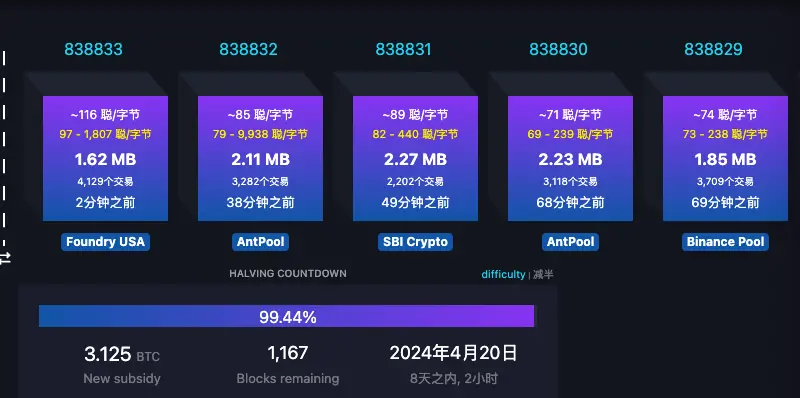
With only over a thousand blocks left until Bitcoin halving, the Bitcoin ecosystem in April has undoubtedly become the focus of the market. Among them, the hottest topic is undoubtedly the concept of Runes, especially Runestone, with a market value of 640 million US dollars, which has pushed its floor price to 0.074 BTC, surpassing BAYC and becoming the second largest project in the NFT market.
Not only Runestone, but also on the magiceden market, 8 of the top 25 NFTs with the largest trading volume are related to the concept of Runes. Since April, the trading volume of NFTs in the Bitcoin ecosystem has far exceeded that of Ethereum and Solana, with the concept of Runes NFTs accounting for the largest proportion.
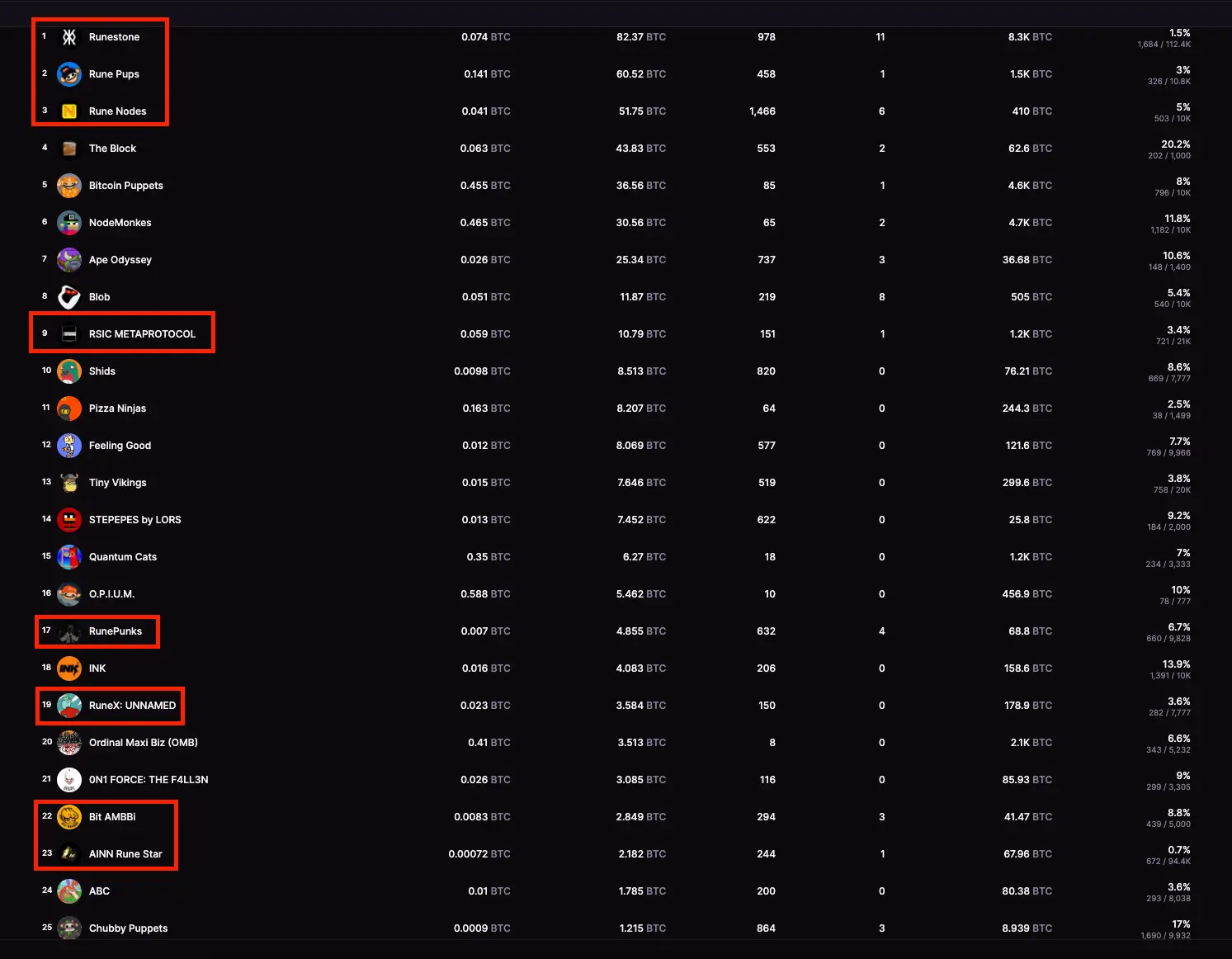
Behind these trading volumes is the fact that these "early bird" Runes projects, like "mining machines," will calculate the airdrop of Runes tokens based on the holding time and quantity after the halving time.
RSIC is one of the earliest projects with "mining machine" attributes, and it has been over two months since its tokens were airdropped to wallets. With about a week left until the completion of Bitcoin halving, how much can early investors who laid out their positions two months ago expect to earn?
Because Runestone has not yet announced specific airdrop rules, and RSIC, which has more detailed airdrop rules, has already had a trading market on the OTC platform whales.market, making it easier to calculate returns. Therefore, the following discussion mainly focuses on RSIC to calculate and discuss "how much can the earliest participants in Runes pre-mining expect to earn?"
Earnings Forecast: Using RSIC as an Example
Before calculating the returns, BlockBeats first provides a brief introduction to the RSIC project for new users.
RSIC is a Bitcoin-based peer-to-peer runic allocation system, with its core built as a digital interactive game. On this platform, players obtain runes by managing and operating RSIC tokens, which are expected to be officially "engraved" on the Bitcoin network at some point in the future. Currently, the trading price of RSIC is 0.06 BTC. Regarding RSIC Metaprotocol, the total issuance of NFTs is 21,000, and the total issuance of FT (tokens) is approximately 21 billion, with the project reserving 10% of the NFT share.
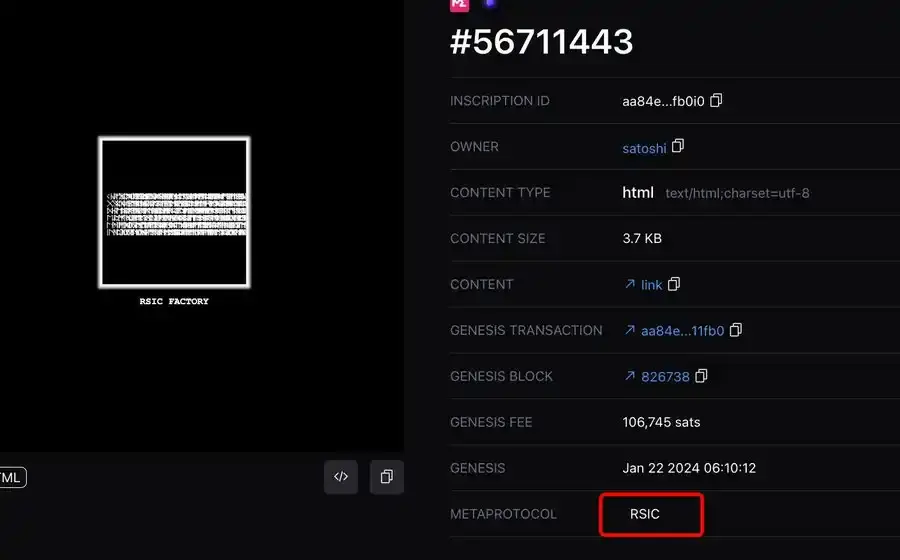
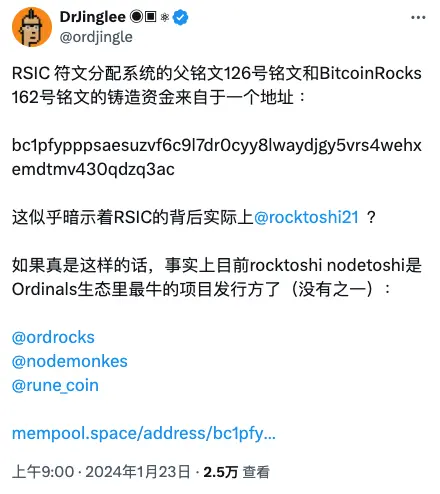
In addition, when mentioning RSIC, the most commonly discussed topic is the mysterious issuer of the project. Initially, there were rumors that this might be the work of Casey, the founder of ordinals, but this speculation was quickly refuted as Casey was deeply involved in the game world of "The Gate of Bod." The currently widely accepted view is that RSIC may have been deployed by Rocktoshi, the founder of Node Monkey, based on the fact that all parent inscriptions' casting funds come from the same address. See Dr. Jingo's relevant analysis on Twitter for more details.
Tricks to Maximize Earnings
The token airdrop rules of RSIC are very clear and consist of 4 variables.
The first variable is "Flat Normal": This variable involves the number of blocks held, stipulating that each block can receive 21 RSIC tokens, totaling no more than 30% of the total airdrop amount.
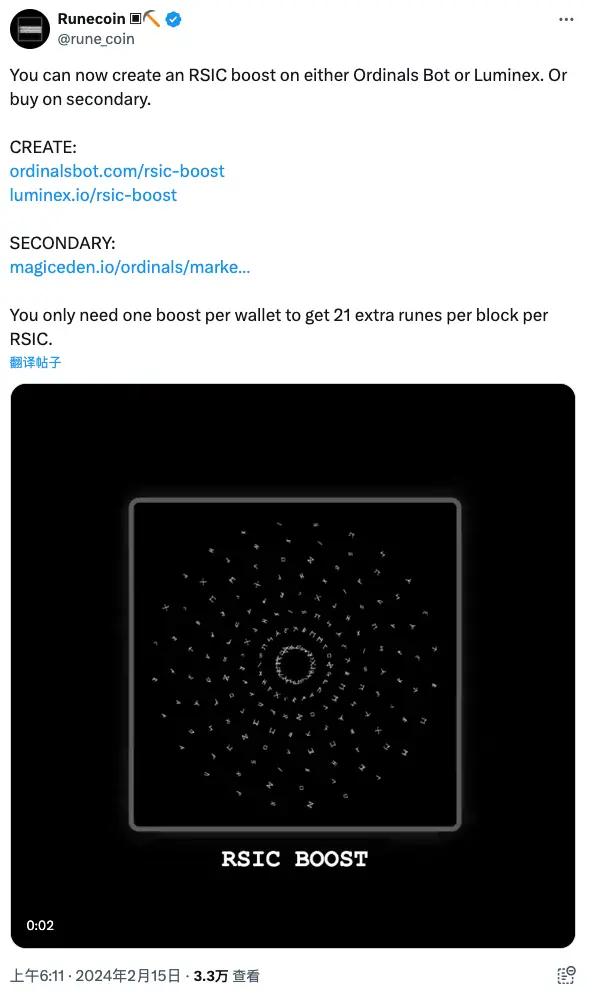
The second variable is "Boosted Accelerated": Users holding Boost accelerators can double their mining efficiency, which is a boost logic Easter egg carved into the 4703400000000th Satoshi.
The third variable is "Random Allocation": It accounts for 25% of the total airdrop plus the unallocated portions of Flat and Boost. Each RSIC corresponds to a specific type code symbol. When the last digit of a block's hash value matches the user's RSIC symbol, the user can receive 336 RS tokens. Considering the 16 possibilities of the last digit of the hash value, theoretically, there is a chance of success every 16 blocks, equivalent to an average of 21 tokens per block.
The fourth variable is "Halfening Lottery": At the specific halving block 840,000, the project will randomly select 5 addresses holding RSIC Metaprotocol NFTs and distribute 15% of the total tokens (allocation ratio of 5%, 4%, 3%, 2%, and 1%). Users holding from block 830,000 to 840,000 will receive one lottery ticket for each block held; if sold before the halving, they will lose the qualification for the lottery.
Users holding both RSIC and Boost are expected to mine a total of 63 tokens per block, while users holding only RSIC are expected to mine a total of 42 tokens per block. It is worth noting that even if you have sold RSIC, the quotas accumulated during your holding period are still recorded in your wallet address.
It is also important to note that only activated RSIC addresses are eligible to receive the airdrop. Any RSIC that has been transferred or traded on the market is considered activated, aiming to ensure that only active wallets can participate in the token distribution, excluding any dormant wallets, ensuring the fairness and activity of the airdrop.
Easily Earn $10,000 Before Halving
Currently, on the OTC platform whales.market, the buyer price of RSIC runic tokens is mainly concentrated at 0.01u, corresponding to a total market value of 2.1 billion US dollars. Recent transaction records show the highest unit prices to be 0.025, 0.0349, and 0.0374 USD, corresponding to market values of 500 million, 730 million, and 780 million USD, close to the 6.4 billion USD market value of Runestone.
However, compared to the continuous rise of Runestone, the NFT market performance of RSIC has shown a downward trend. Optimistically, compared to the peak price of 0.13 BTC, although the market value of RSIC has decreased, in reality, some of the value and market value are more reflected in the tokens.
According to BlockBeats' analysis, currently purchasing an RSIC at a price of 0.06 BTC and paying an additional 0.005 BTC to purchase a boost accelerator, the total cost is approximately 4,700 USD. As of the time of writing, there are still 1167 blocks left until halving, and it is estimated that 63 tokens can be obtained per block, totaling 73,521 tokens. This means that the token cost at the halving point is approximately 0.0639 USD. This price is much higher than the off-market price on whales.market.
If we do not consider the potential value of RSIC after the airdrop of Runes tokens, and only consider the cost and price of obtaining tokens, it is obviously more appropriate to directly buy off-market points now.
According to information obtained by BlockBeats from early users, the price of RSIC when it first went online on the magiceden market was 0.02 BTC. At that time, purchasing an RSIC and holding it until the halving period, without using boost, is expected to yield 520,000 points. Calculated at a conservative price of $0.01, the earnings are approximately $5,200, plus the potential increase in the value of RSIC itself, the purchase price of 0.02 BTC could bring an additional 0.04 BTC in earnings, equivalent to $2,800. Taking into account other projects such as Rune Mania Mine's airdrop to RSIC Boost holders, the conservative estimated overall earnings are about $10,000. If holding boost, the expected points would reach 700,000, with corresponding earnings estimated at about $13,000.
From a non-conservative perspective, if RSIC is obtained entirely through airdrops, it is equivalent to directly obtaining an NFT worth 0.06 BTC, resulting in earnings of approximately $4,260. Assuming 700,000 points are valued at $0.035, the earnings would be $24,500. Adding the $2,000 in earnings from airdrops from other projects, the total profit is estimated at about $30,000.
In the short term, the Bitcoin halving and the official launch of Runes may trigger strong market emotions (FOMO). From a longer-term perspective, the influence of the Runes protocol, issued by Casey specifically for the community, may be no less than that of Ordinals. The market value of the leading project of the Runes protocol and the brc20 may be comparable, or even have a certain impact on it.
Considering the current market situation, the market value of Ordinals is $15 billion, Sats is $9.9 billion, and the current market value of Runestone is $6.4 billion. Therefore, it is inferred that early participants in the pre-mining of Runes may still have some room for profit growth.
免责声明:本文章仅代表作者个人观点,不代表本平台的立场和观点。本文章仅供信息分享,不构成对任何人的任何投资建议。用户与作者之间的任何争议,与本平台无关。如网页中刊载的文章或图片涉及侵权,请提供相关的权利证明和身份证明发送邮件到support@aicoin.com,本平台相关工作人员将会进行核查。


