Quick look at 5 potential fully homomorphic encryption projects

CN
1 year ago

ZKP can be used to generate private proofs, while FHE can handle data processing in smart contracts.

Author: Degen Maker

Translation: Luffy, Foresight News

Fully Homomorphic Encryption (FHE) is quickly becoming a popular term, do you know why?

FHE allows for computations on encrypted data without revealing any information, opening up various possibilities for Web3, including but not limited to:

  • Confidentiality of RWA tokenization

  • On-chain identity

  • MEV protection

  • Privacy-preserving on-chain medical data

  • Making DeFi compliant with data protection and privacy laws

In addition, FHE can also play a role in the combination of Web3 with artificial intelligence and zero-knowledge proofs.

Artificial intelligence models can now utilize data and generate results without accessing the actual input data, ensuring the privacy and security of user queries. This also means that data training can be conducted without direct access to the data.

While the debate about the proprietary nature of major language models companies continues, FHE has become a potential game changer in the field of artificial intelligence.

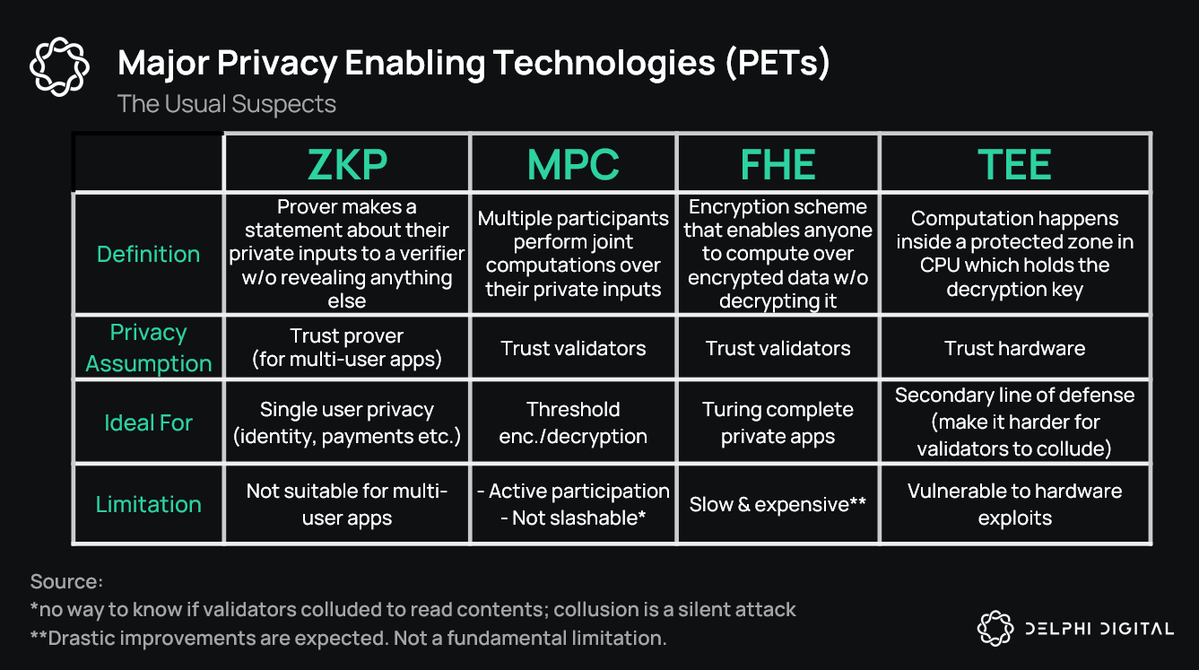
Many are debating whether FHE will replace zero-knowledge proofs (ZKP); however, they can coexist. ZKP can be used to generate private proofs, while FHE can handle data processing in smart contracts.

FHE is still in the early stages of development, and I will briefly introduce 5 potential FHE projects.

1) Inco

Inco is a modular confidentiality-as-a-service blockchain that is EVM-compatible L1, fully supported by FHE.

Inco previously completed a $4.5 million seed round led by 1kx.

Catalysts and highlights:

  • Providing privacy at the base layer is a strong value proposition that can attract numerous privacy-focused DApps.

  • The introduction of a data availability layer fundamentally changes ecosystems like Celestia and other modular projects. The confidentiality layer is expected to generate similar, if not greater, appeal.

  • Collaborating with Zama, with a co-founder of Polygon as an advisor, will borrow the security of Ethereum through EigenLayer (actually AVS).

2) Mind Network

Mind provides a secure and data privacy zero-trust layer, aimed at promoting true CrossFi expansion.

Mind completed a $2.5 million seed round led by Binance Labs.

Catalysts and highlights:

  • Building internet infrastructure that allows global citizens to control their own data.

  • The testnet is live and may have incentives for the testnet.

  • Supported by Zama.

  • The first use case is MindLake, which is a groundbreaking data storage Rollup designed to compute encrypted data on decentralized platforms.

3) Fhenix

Fhenix is the first Rollup-based FHE architecture aimed at addressing the challenges of executing FHE computations on L1 due to extensive execution requirements and scalability limitations.

Catalysts and highlights:

  • Optimistic FHE Rollup can be built on Ethereum without modifying the base layer, meaning that every smart contract in Ethereum can enhance privacy through the FHE Rollup solution.

  • Collaborating with Zama to launch the fhEVM infrastructure.

  • The testnet is about to go live.

  • In my opinion, Fhenix simplifies the deployment of confidential smart contracts, which is crucial for developer adoption.

4) Privasea

Privasea is a network that uses FHE to ensure privacy and security during AI computations.

Privasea completed a $5 million seed round led by Binance Labs.

Catalysts and highlights:

  • Details of the Genesis NFT will be announced soon, and holders will be eligible for airdrops.

  • Providing a privacy computing FHE solution for DePIN+AI, combining all hotspots into a legitimate and promising project, with project tokens potentially yielding high returns.

  • Developing another DApp for secure and private user verification, ensuring privacy in the KYC process without exposing personal details, but remaining auditable when necessary.

  • Supported by Zama.

5) Optalysys

Optalysys is building the next generation of computing power, which I believe is a very promising project and a "shovel" in the FHE field.

Optalysys focuses on the DePIN project, which has a cloud-native technology stack tailored for high-intensity FHE workloads, aiding in FHE expansion in the computing layer.

Catalysts and highlights:

  • Potential as a shovel.

  • Coprocessors (GPU, CPU) address fundamental limitations of electronic systems.

  • Optalysys has developed a unique optical computing system that provides processing power and energy efficiency from data centers to edge computing, supporting all major FHE libraries.

免责声明:本文章仅代表作者个人观点,不代表本平台的立场和观点。本文章仅供信息分享,不构成对任何人的任何投资建议。用户与作者之间的任何争议,与本平台无关。如网页中刊载的文章或图片涉及侵权,请提供相关的权利证明和身份证明发送邮件到support@aicoin.com,本平台相关工作人员将会进行核查。

Share To
APP

X

Telegram

Facebook

Reddit

CopyLink