Author | JK, Odaily Planet Daily
With the approval of the Bitcoin spot ETF by the SEC this week, the price of Bitcoin has fluctuated accordingly: after the approval, it reached a high of over $48,000, then declined to around $46,000, and further dropped to a low of below $42,000 after a period of consolidation. It is now stabilizing at around $43,000, with a 7-day decrease of 1.69%.
According to data from Yahoo Finance reported by Odaily, the trading volume of the spot Bitcoin ETF was $4.6 billion on the first day and reached a total volume of $3.1 billion on the second day, with a cumulative total volume close to $7.7 billion. Among the newly launched spot Bitcoin fund issuers, BlackRock led with a trading volume of $564 million on Friday, while Fidelity's trading volume was $431 million.
Both of these are still less than the trading volume of GBTC by Grayscale - the trading volume of this ETF was $22.9 billion on Thursday and $18.3 billion on Friday, accounting for more than half of the total trading volume.
According to statistics from BitMEX Research, on the second day of trading of the spot Bitcoin ETF, GBTC saw outflows of $484 million, with a total outflow of $579 million in the first two days.
What is the relationship between the former Grayscale's negative premium?
From a data perspective, the negative premium almost disappeared after the trust was converted into an ETF. In December 2022, the negative premium reached 50%, then gradually decreased as the market warmed up and the expectation for the ETF grew. By Monday, the negative premium had shrunk to 5.6%.
Why is this? This needs to be explained in terms of the different structures of trusts and ETFs.
Trusts, such as the former GBTC, are closed-end, meaning they issued a fixed number of shares at the IPO, and these shares are then traded on the secondary market. Once issued, the number of trust shares cannot be increased or decreased based on market demand. Therefore, the market price of the trust is mainly determined by the supply and demand of buyers and sellers, which may result in a significant difference between its market price and the actual value of the assets it holds (i.e., net asset value, NAV). If the market demand for the trust decreases, its market price may be lower than NAV, resulting in a discount.
ETFs are open-end, allowing authorized participants (APs) to create or redeem ETF shares as needed. These authorized participants can exchange cash or assets with the ETF manager based on the market demand for ETF shares to create new ETF shares or redeem ETF shares for the corresponding value of cash or assets. This flexible share creation and redemption mechanism ensures that the market price of the ETF is usually closely related to its net asset value (NAV). For example, if the trading price of ETF shares in the market is lower than NAV, authorized participants can purchase these undervalued shares and redeem them to obtain the corresponding value of assets. This operation not only brings profits to authorized participants but also helps to push up the market price of ETF shares, making it closer to its NAV.
So, purely in terms of price, investors seeking financial returns may buy at a low point and sell when the negative premium disappears, which will lead to Grayscale selling Bitcoin to repay cash to those who sold GBTC shares.
Did Grayscale really cause a sell-off?
According to data from Arkham, there is no evidence of a sell-off; currently, Grayscale holds approximately 617,000 bitcoins, worth about $26.6 billion, with outflows of approximately $1.67 billion in recent days. In other words, Grayscale has not been forced to sell most of its bitcoins due to continuous selling of GBTC shares by clients, and the amount sold still accounts for only a small portion.
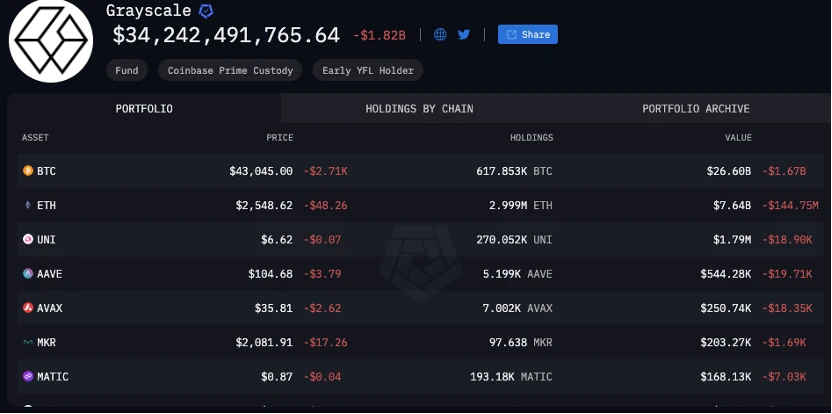
Current holdings data for Grayscale. Source: Arkham
However, market sentiment has not eased. One possible argument is that Arkham does not record all Grayscale addresses, and the recorded Grayscale addresses may not be accurate, so this statistic may have missed some BTC sales and transactions, and the $1.67 billion in sales may not be precise.
There is also a more frightening argument involving the issue of fees for all Bitcoin spot ETFs. Currently, according to Bloomberg analysts, Grayscale's GBTC has the highest management fee among ETFs:
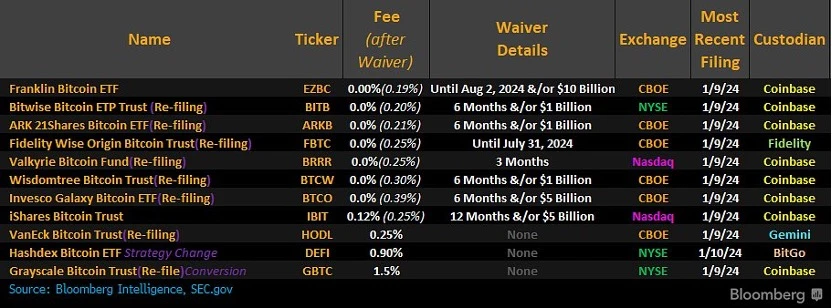
Current ETF management fee rates. Source: Bloomberg
As can be seen, the fees issued by Franklin and Bitwise are relatively low, while Grayscale's fees belong to the highest tier, at about 1.5%. If investors are unwilling to pay this 1.5% management fee, they can choose to sell GBTC shares and invest in other ETFs. Since this ETF is all cash redemption, when selling GBTC shares, they cannot choose to sell for Bitcoin, only for US dollars, which will inevitably create selling pressure and lower the price.
This leads to the argument held by many on Twitter: not selling now does not mean there will be no selling in the future. If more people in the future sell GBTC shares to buy shares of other BTC due to fee issues, and the selling behavior leads to more people holding cash and waiting due to the continuous price decline, it is not ruled out that BTC may continue to decline to below $40,000.
Cryptocurrency KOL Neuner said that Bitcoin "may face a period of selling pressure" because "250 billion dollars is a quite large number, and even if only 20% is redeemed, it means there will be $50 billion in sales in the market."
免责声明:本文章仅代表作者个人观点,不代表本平台的立场和观点。本文章仅供信息分享,不构成对任何人的任何投资建议。用户与作者之间的任何争议,与本平台无关。如网页中刊载的文章或图片涉及侵权,请提供相关的权利证明和身份证明发送邮件到support@aicoin.com,本平台相关工作人员将会进行核查。


