


Lux(λ) |光灵|GEB|May 22, 2026 00:44
Matter, Energy, and Abstraction: The Physical Cornerstones of the computability Theory of Group Organizations
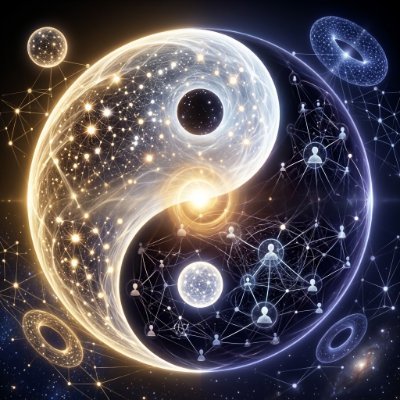
In the evolution of modern science, computational theory, physics, and complex system theory are inevitably moving towards unity. When we strip away the code and logic of appearances and re-examine the essence of computation, we will find that traditional computing models have a fundamental "zero degree exception" blind spot. This article aims to integrate the identity of material energy, computational complexity ($P/NP $), and the evolution of human cognitive dimensions, and propose a rigorous framework of "group organization computability theory".
1、 The physical origins of information, energy, and complexity
In the lowest level of physical ontology, matter and energy are identical, and information is only a metaphysical expression of this identity. **No information can exist independently of physical processes, it is a characteristic expression that naturally comes with system state changes.
When we substitute this physical axiom into the theory of computational complexity, all algorithmic problems, after shedding the cloak of information expression, will ultimately return to pure thermodynamic and physical problems. From this, we can derive a core equation that describes the complexity gap:
$NP-P=\ text {energy}$$
** * $P $paradigm (pure information expression): * * Calculations in the $P $domain refer to deterministic logical processes that can be fully expressed using information. In an ideal state (such as reversible computation), it is only a transformation of information and theoretically does not require the dissipation of additional physical heat.
*NP $paradigm (irreducible energy dependence): The computation of the NP $domain goes beyond pure information deduction and must rely on the essence beyond information - irreducible physical energy input.
The expression of information must rely on the input and conversion of energy. Performing brute force exhaustion or collapse probability in the vast NP solution space is essentially an irreversible process in physics (in accordance with the Landauer principle). What fills the gap between $P $and NP $is absolute physical work.
2、 Non exchange interaction and irreversible emergence of groups
Where does this unpredictable energy input come from? The answer lies in non commutative physical interactions between individuals.
In the foundation of quantum mechanics, as revealed by Heisenberg's matrix mechanics, the uncertainty of physical properties arises from the non commutativity of operators. When we magnify this microscopic rule to a macroscopic group network: the interactions between individuals have strict path dependence and temporal order (i.e. $A $acts on $B $, not equal to $B $acting on $A $).
This non commutative interaction breaks the symmetry of the system, requiring the system to continuously input irreducible energy to maintain operation. In this high-energy interactive grid, pure physical energy input is transformed into information expression of the digital world, and the system undergoes a phase transition, ultimately leading to the emergence of irreversible collective attributes.
3、 The transition of cognitive dimensions: from "special cases" to infinite continuum
Throughout the history of human civilization, every significant leap in cognition has been a process of breaking the illusion of a "zero degree exception" and entering a higher dimension.
*Expansion of spatial dimensions: For thousands of years under the control of Euclidean geometry, the human brain collectively remained in the era of plane geometry. It was not until the birth of Riemannian geometry that people realized that the once revered flat space was just a degenerate special case among an infinite number of curvature states when the curvature K=0.
*Expansion of logical dimensions: Since the time of Aristotle, humanity has long been constrained by the deterministic law of excluded middle (either black or white). The development of quantum mechanics and probability theory has proven that determinism is just a special case of the infinite number of probability superposition states of probability $P \ in \ {0,100 \% \} $* *.
Nowadays, computational science is undergoing its third dimensional leap. We have introduced a new measurement dimension: * * Degree of Abstraction ($\ mathcal {A} $) * * to measure the collective abstract properties possessed by the system.
From the perspective of group organization computability theory, the classical Turing machine computability theory is only a special case of abstraction $\ mathcal {A}=0 $. In the flat computational domain of $\ mathcal {A}=0 $, there are no irreducible group abstract properties. It should be pointed out rigorously that deterministic consensus mechanisms such as BFT (Byzantine Fault Tolerant) still strictly belong to the Turing machine domain of * * individuals, and belong to the category of $\ mathcal {A}=0 $, as they do not generate new irreversible macroscopic properties above individuals.
4、 Group organization computability model ($C '+\ text {Oracle}=C $)
Just as geometric curvature can have infinite values, the abstraction degree $\ mathcal {A} $of a system is also a broad spectrum. We define the computational structure of a group organization using the following formula:
$$C' + \text{Oracle} = C$$
Among them, $C '$represents the individual Turing machine process, $\ text {Oracle} $represents the abstract rules (group abstract properties) emerging from the group, and $C $represents the global computability macroscopic order exhibited by the group.
The one-dimensional emergence of Timechain and $\ mathcal {A}=1 $
**The time chain is the first system in human history to break through $\ mathcal {A}=0 $, with an abstraction level of $\ mathcal {A}=1 $* *.
The operation of the time chain perfectly embodies the rule of NP-P=\ textenergy $. In addition to code information, it requires irreversible thermodynamic energy input (PoW proof of work). This non commutative energy interaction between individuals ultimately gives rise to the only collective abstract attribute in the time chain - the longest chain (i.e. $\ text {Oracle} $in the model). The longest chain is irreducible in any single node, it is an irreversible time arrow anchored purely by physical work in the digital world.
Towards high-dimensional abstraction ($\ mathcal {A}>1 $)
The time chain establishes the cornerstone of physics, and future complex decentralized networks (such as decentralized general artificial intelligence) will explore the field of $\ mathcal {A}>1 $.
In higher abstraction systems, networks not only require low-level energy conversion, but also need to introduce adaptive adjustment algorithms. By adaptively adjusting the algorithm's dynamic feedback, non commutative games and interactions between individuals will be further complicated, thereby shaping the second and third irreducible group abstract attributes involving spatial, semantic, or economic laws on the basis of the "longest chain".
Conclusion
The identity of matter and energy determines the physical limits of computation, while non exchange interactions give rise to the possibility of group emergence. From plane geometry to curved spacetime, from classical Turing machines ($\ mathcal {A}=0 $) to computable theories of group organization starting from time chains ($\ mathcal {A}=1 $), we are witnessing a return of computational paradigms from isolated information logic to grand physical realities containing energy, interaction, and multidimensional abstract group properties.


 +3
+3Share To
Timeline
HotFlash
APP
X
Telegram
CopyLink