


Lux(λ) |光灵|GEB|Mar 15, 2026 12:58
Turing machines, mental uncertainty, and Bitcoin: how intelligence emerges?
There have long been two important theoretical paths in the modern intellectual community regarding whether machines can generate true intelligence. One path comes from the computationalist tradition, which believes that intelligence is essentially a computational process. As long as the algorithm is complex enough, the data scale is large enough, and the computing power continues to grow, intelligence will naturally emerge from the computing system. Another path suggests that human consciousness may contain non computational components, and pure algorithmic systems cannot explain the creativity and comprehension abilities of human thinking.
These two viewpoints may seem contradictory, but from a deeper perspective of computational philosophy, they actually reveal a part of the problem for each.
Computationalism emphasizes the importance of structure. The Turing machine model indicates that any computable process can be described through explicit rules and algorithms. In this framework, the computing system forms complex behavior through the continuous execution of rules. The development of modern artificial intelligence has to some extent validated this idea: through massive data training and powerful computing power, machines can exhibit increasingly complex abilities.
However, pure Turing machine systems have an important characteristic: * * determinacy * *. Given the program and input, the output is completely deterministic. A completely closed algorithmic system whose behavior is, in principle, predictable. Such a system can be very complex, but it itself does not generate true uncertainty.
Another way of thinking emphasizes the sources of uncertainty. Some people believe that human thinking may involve non computational mechanisms such as randomness, quantum effects, or other physical processes that are not yet fully understood. This viewpoint suggests that human creativity and intuition do not seem to be fully reduced to algorithmic execution.
But pure randomness cannot explain intelligence. Although random behavior is unpredictable, randomness itself does not automatically form meaningful structures. A completely random system will not generate a sustained and stable order.
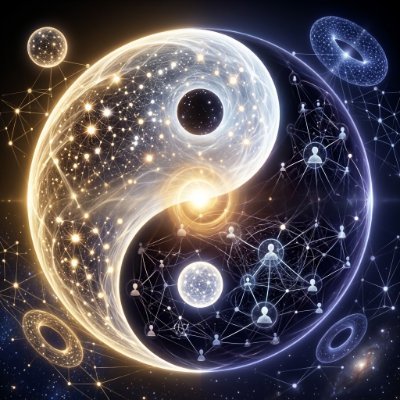
Therefore, a more comprehensive perspective is that intelligence comes from the combination of structure and uncertainty. **
Structure provides stable rules and organizational forms, while uncertainty provides a source of exploration, change, and innovation. When the two are combined, the system may exhibit complex and unpredictable behavior. This pattern can be observed in many natural systems, such as ecosystems, evolutionary processes, and economic markets.
In modern technological systems, the Bitcoin network provides a very interesting example.
The underlying protocol of Bitcoin has strict calculation rules: transaction verification, block structure, consensus mechanism, node synchronization, etc. are all executed by deterministic programs. From a technical perspective, it constitutes a globally distributed computing system. All nodes validate data according to the same rules to maintain system consistency.
But the behavior of the entire network is not entirely certain, as the system contains a large number of human participants. Whether miners participate in mining, when users trade, how investors form price expectations, and how the market plays games all come from human subjects. These behaviors cannot be fully predicted by algorithms.
The key innovation of Bitcoin is that it organizes human uncertain behavior with a deterministic computing structure. **
In this system, human behavior generates competition and games, economic incentives drive participant actions, proof of work mechanisms transform competition into block generation, and node networks validate results through algorithmic rules and reach consensus. Ultimately, a global scale network forms a stable but unpredictable evolutionary process in continuous operation.
From the perspective of computational philosophy, this structure can be summarized as:
**Deterministic computing structure+human uncertainty=emerging macro intelligence. **
Therefore, the Turing machine itself does not generate intelligence, but it can serve as a framework for organizing intelligence. The human mind provides uncertainty and creativity, while computational rules provide order and verification mechanisms. When these two elements are combined, a complex and continuously evolving system may be formed.
In this sense, Bitcoin is not just a digital currency, but more like a new computing paradigm: organizing human games through algorithmic structures to form an evolving consensus network on a global scale.


 +4
+4Share To
Timeline
HotFlash
APP
X
Telegram
CopyLink