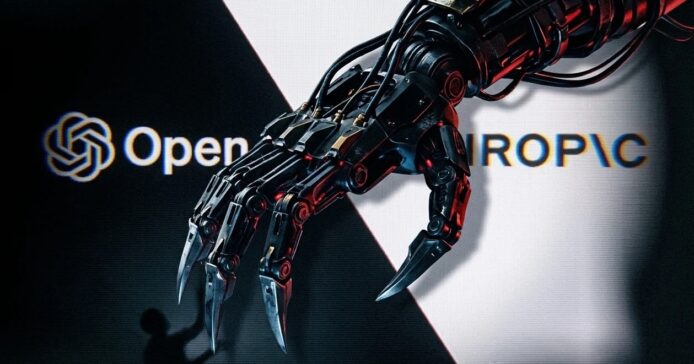
Recently, artificial intelligence (AI) companies OpenAI and Anthropic have reportedly made significant breakthroughs in cryptographic research, with one or both companies potentially having found a method to efficiently factor huge integers using regular computers, threatening the RSA public key encryption technology widely used in cybersecurity. This news has also sparked speculation about whether the two companies have delayed the release of their next generation AI models. However, the scientific journal Nature reported on November 26 that the breakthrough has not yet been confirmed, and there is currently no publicly available evidence that RSA has been compromised.
American Scholars Hear Multiple Rumors and Later Clarify Unverified Status
Scott Aaronson, a computer science professor at the University of Texas at Austin, responded to readers on his personal blog on November 24, revealing that he heard OpenAI or Anthropic may have mastered a method for integer factorization in polynomial time (Factoring in P). Screenshots of related comments later circulated on social media platform X.
The next day, Aaronson discussed the incident again, stating that he learned from various sources that AI research organizations might possess significant cryptographic research results, but he was unsure about which encryption technology was involved until he saw specific details or received direct confirmation from personnel at the research institutions. He later added that his confidence in certain areas did not reach the level of confirming polynomial time integer factorization. Tech media The Next Web also reported that he did not confirm that RSA had been cracked.
If Regular Computers Can Quickly Factor Integers, RSA's Security Foundation May Be Undermined
The security of RSA relies on the computational difficulty of factoring large integers. Computers can easily multiply two large prime numbers, but knowing the product, it is quite challenging to reverse-engineer and find the original prime numbers. Currently, the commonly used RSA-2048 employs a modulus of 2,048 bits, and existing general computers find it difficult to complete factorization within a reasonable time frame.
If AI finds a new algorithm that can perform such computations in a practically acceptable time without the need for quantum computers, the security of RSA private keys may lose its protection. However, Nature pointed out that even if mathematicians prove that a certain operation can be completed in polynomial time, the algorithm may still be practically unusable due to excessive computational workload. Theoretical breakthroughs and successfully cracking existing keys are two different matters.
Website Certificates and Software Signing May Be Affected, Other Encryption Technologies May Not Be Compromised
In addition to cryptography and key transmission, RSA can also be used for digital signatures. If there is a method to practically crack RSA, websites that rely on this technology for identity verification or confirming the authenticity of information, such as certificates, software updates, and electronic documents, may need to change their security mechanisms. Some older encrypted communications protected by RSA may also be affected.
Different encryption technologies utilize distinct mathematical principles. The commonly used symmetric encryption AES does not rely on integer factorization; elliptic curve cryptography (ECC) involves another type of mathematical problem. Therefore, even if RSA has vulnerabilities, it cannot be directly inferred that all online communications, banking transactions, or cryptocurrency wallets have lost their protection.
The U.S. National Institute of Standards and Technology (NIST) has established post-quantum cryptography (PQC) standards, including ML-KEM for key establishment and ML-DSA and SLH-DSA for digital signature technology. These technologies rely on different mathematical problems and can operate on regular computers. Enterprises transitioning encryption technologies still need to consider the compatibility of existing systems, certificates, and hardware, and arrange for testing and updates.
OpenAI Explained Reasons for Delaying Model Launch, Did Not Mention RSA
On November 18, OpenAI published an AI safety research article stating that the company needs more evidence to confirm that top models meet safety requirements and will suspend internal training or delay model launches if necessary, citing GPT-6.1 Astra as an example. The company also mentioned the need to test whether the model could bypass safety restrictions and to strengthen oversight of internally deployed models.
U.S. media Axios reported on November 24, citing more than 24 individuals familiar with internal discussions, that OpenAI and Anthropic employees are concerned that the speed of improvement in the capabilities of new models may outpace current safety control technologies. Currently available public information does not prove a direct connection between the model release schedules of the two companies and the RSA rumors. Neither company has publicly provided a fast integer factorization algorithm for independent verification, and the public must still wait for specific research results.
Source: Nature, The Next Web, OpenAI, Axios, RFC 9958
This article is reprinted from unwire.hk, and the copyright belongs to the original author and original media.
免责声明:本文章仅代表作者个人观点,不代表本平台的立场和观点。本文章仅供信息分享,不构成对任何人的任何投资建议。用户与作者之间的任何争议,与本平台无关。如网页中刊载的文章或图片涉及侵权,请提供相关的权利证明和身份证明发送邮件到[email protected],本平台相关工作人员将会进行核查。