Original | Odaily Planet Daily (@OdailyChina)
Author|jk
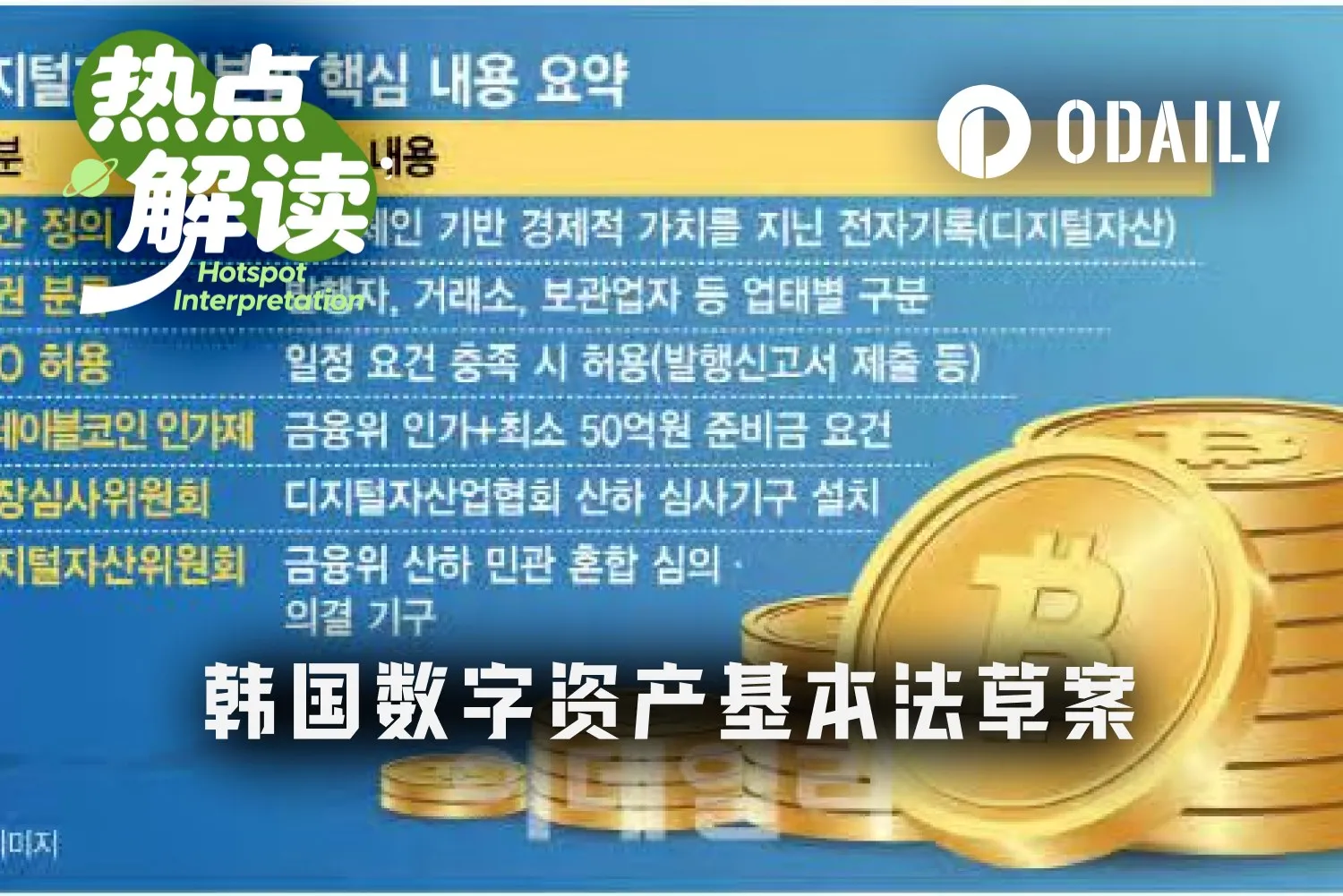
The South Korean Financial Services Commission (FSC) announced the draft of the “Law on Innovation and User Protection in Digital Assets” at the virtual asset committee on November 24 at 3 PM, which is referred to externally as the “Basic Law on Digital Assets” government draft.
This marks the second phase of legislation for virtual assets in South Korea, one year and ten months after the discussions related to this began in January 2025. The legal terminology has changed from “virtual assets” to “digital assets.” According to previous reports from foreign media, the draft has about 135 articles (which was previously stated by FSC Chairman Lee Ik-young, and the final number of clauses may be higher), covering business licenses, exchange governance, stablecoins, token listings, ICOs, and user protection; it is the first industry basic law to include these contents in the same legislation.
This draft does three things: First, it changes the regulatory logic by replacing the original declaration system with a licensing and registration system based on business type; exchanges will transition from “operations can commence upon declaration” to “operations can only commence with a license” in financial infrastructure. Second, it writes two contentious matters into law: the shareholding limit for major shareholders of exchanges and the issuance arrangements for Korean won stablecoins led by banks. Third, it upgrades matters such as token listings and user compensation from being based on industry self-regulation to statutory responsibilities, while also lifting the ban on domestic ICOs.
This is still just a government draft and is not yet a law. It will be proposed by the Chairman of the National Assembly’s Political Affairs Committee, combined with existing member proposals for review, with many details such as capital requirements to be determined by implementation orders. Therefore, every item mentioned below should be understood as “draft proposals” rather than already effective provisions.
Business Classification and Licensing: Declaration System Changed to Licensing by Business, Custody Listed Separately
The draft replaces the previous single “virtual asset service provider” declaration with four categories of business. Trading, intermediation, and custody businesses need to obtain FSC licenses, while asset management businesses only need registration. The premise for registration is that these companies do not directly hold or transfer user assets, which leads to lighter supervision. Exchanges in the draft are referred to as “digital asset platform operators,” requiring them to hold three core licenses simultaneously and meet other requirements.
Regarding capital, reported figures indicate that the own capital for trading, intermediation, and custody must not be less than 2 billion won, while businesses handling stablecoins have a requirement of 1 billion won, and asset management businesses have a requirement of 500 million won, with specific amounts set by presidential orders. South Korean media Blockmedia reported the same amounts, but the final figures will depend on presidential orders. More reports suggest that the draft will differentiate capital, personnel, security, and internal control requirements by business type.
In the past, custody essentially belonged to the exchanges’ own business; now, custody and management of client assets are independently regulated, requiring user assets to be isolated from being seized or offset, and subject to regular external audits. An informal summary also indicated that this leaves room for banks and securities firms to enter custody and prime brokerage services.
The report suggests that by transitioning from a declaration system to a licensing system, exchanges have essentially obtained a normalized operation qualification, and thus the regulatory authority requires that their governance structure and major shareholders also raise standards accordingly. Order matching, token listings, and monitoring of unusual trading activities, which were previously self-regulated, have now become legal responsibilities. This also explains why the limitation on major shareholders appears alongside the licensing system in the next section.
Limitations on Major Shareholders of Exchanges: 20% as Principle, 34% Requires Approval, Excess Shares Have No Voting Rights
The limitation on major shareholders is the most noteworthy clause in this draft.
According to reports, no single major shareholder can hold more than 20% in an exchange; financial companies approved by the FSC can hold up to 34%, with specific rules to be determined by implementation orders. Shares exceeding the limit will no longer hold voting rights, rather than being subject to mandatory sale; South Korean media quoted FSC officials stating that the FSC would not order forced sales, but corrections to violations must be made when applying for other licenses. The limit is derived from the 15% holding restriction for alternative trading systems (ATS) under the Capital Markets Act: the FSC views exchanges as similar financial infrastructures and believes that a small number of founders and shareholders should not have absolute control over them. Earlier information had set the range at “15-20%”, so the final draft is more lenient than this rumor.
The South Korean FSC, equivalent to the Securities and Exchange Commission. Source: LinkedIn
Since the exchange was designated, there will be a three-year transition period, during which small and medium exchanges can receive up to three additional years. This regulation applies equally to domestic and foreign shareholders.
In reality, the largest shareholders of the five major won exchanges have all exceeded 20% ownership. According to consolidations of various reports, the largest shareholder of Upbit operator Dunamu, Song Zhitong, holds about 25.5%, Bithumb's parent company Bithumb Holdings holds about 73.5%, Gopax's parent company Binance holds about 67.4%, and the numbers for Coinone and Korbit vary (Coinone from approximately 30% to 53%, Korbit from about 92% to 97%), subject to each company's own disclosures. Another affected aspect is the merger of Naver and Dunamu: the currently planned scheme is for Naver Pay to hold 100% of Dunamu, which is incompatible with the limit and requires a redesign of the shareholding structure.
The exchange alliance DAXA and the industry have consistently opposed this limitation, arguing that it would weaken competitiveness, undermine major shareholders' sense of responsibility for user assets, and possibly infringe upon property rights. The Legislative Investigative Office of the National Assembly has also pointed out the possible unconstitutionality of this limitation. So, it is most likely to be modified during the National Assembly’s review.
The Issuers of Korean Won Stablecoins: Banks Must Hold a Majority
The draft officially incorporates stablecoins into the licensing system, defining them as “digital payment tokens,” aimed at being pegged to a single legal currency, primarily for payment purposes. Issuers need to obtain FSC licenses, having an own capital of at least 5 billion won, as well as a feasible business plan, sufficient personnel and systems, qualified major shareholders and executives, and mechanisms for managing conflicts of interest.
As for the issuing bodies, initially only a consortium of banks holding more than half (50% + 1 share) can issue Korean won stablecoins, but fintech or technology companies can still serve as the largest single shareholder in the consortium. This is actually a compromise: the Bank of Korea (BOK) advocates for “bank prioritization,” worrying that private stablecoins could affect monetary policy, capital flows, and financial stability; the FSC and BOK previously had differing opinions on the requirement of bank holdings being more than 50%, and the ruling party and government reached a consensus on a majority-banking consortium scheme by December 2025, although the FSC indicated that the scheme was not yet finalized; the draft allows technology companies to be the largest single shareholders to make room for internet platforms. The word “initially” does not correspond to a specific time frame, implying that there may be discussion space for future relaxations, but the current draft does not provide a timeline.
An example of the actual consortium structure in the reports shows: four banks each holding 15% (totalling 60%), one fintech or technology company holding 30%, and other participants holding 10%. The need for multiple banks arises from the limit set by the Banking Act on single bank investments (15%), and how this limit will apply to stablecoin consortiums is still under discussion.
Issuers must first submit an issuance plan, detailing the total issuance amount, management of reserves, and redemption methods, and must obtain FSC approval before issuing. Exchanges and licensed institutions cannot list, trade, mediate, or hold stablecoins for which issuance plans have not been approved or filed. This means that after the law takes effect, the timing of the first Korean won stablecoin's appearance will depend on the progress of the license and issuance plan approval, as there are currently no circulating Korean won stablecoins in South Korea.
Reserve Requirements for Stablecoins, Redemption, Important Stablecoins, and Overseas Issuers
Regarding the protection of holders, the draft’s approach is to manage stablecoins as “payment instruments similar to currency” rather than as financial products that can generate returns. Issuers must hold reserves of no less than 100% of the circulation, deposited in banks or held in trust, and undergo monthly audits of the reserves. Reserves can only be invested in highly liquid assets such as deposits and government bonds, and must use the same pegged currency. Issuers cannot pay interest or similar returns to holders, which is also a key distinction of the draft from “interest-bearing tokens.”
The legal protection of reserves is another focus. Reserves cannot be seized or offset; if the issuer’s license is revoked or it goes bankrupt, or if operations cannot continue due to a hacking attack, the reserve custodian prioritizes payments to holders. Holders can redeem cash at any time at par value, and issuers cannot delay.
For larger stablecoins, the draft sets additional requirements. Stablecoins with circulation exceeding 1 trillion won may be designated by the FSC as “important stablecoins,” requiring extra capital, stricter liquidity management for reserves, and the Bank of Korea may also participate in joint inspections. The FSC's documents reference the standards of the European Union (500 million euros) and the United States (1 billion dollars) as references for strengthening regulation.
For overseas Korean won stablecoins, overseas issuers that are adequately regulated by their home country's regulatory agencies can establish a branch in Korea, hold operating funds within the territory, register with the FSC, and complete foreign exchange declarations to issue and redeem in Korea. Tokens not registered in Korea find it hard to gain support for listing on South Korean exchanges. The Ministry of Finance may also consider revising the Foreign Exchange Act to regulate cross-border trading of Korean won stablecoins.
No-Fault Compensation and IT Security Obligations
A core requirement for exchanges and all licensed institutions in the draft is that compensation must be borne regardless of fault when user losses are caused by hacking attacks or system failures. This is called “no-fault compensation.” South Korean media added that if losses are caused by the user’s willful misconduct or gross negligence, or if contractual terms specify otherwise, the institution can be exempted. This means that users no longer need to prove negligence on the platform’s part to receive compensation.
Corresponding to compensation responsibilities are stricter IT security requirements, with licensed institutions needing to meet IT security standards equivalent to those of financial companies; if an accident's cause is due to their violation of information system security obligations, the FSC can impose a punitive fine (과징금) of up to 10% of their turnover. User assets need to be isolated for custody, free from seizure or offset, and institutions must also undergo regular external audits. These provisions will transform internal controls and computer system security of exchanges from “industry self-regulation” into “legal obligations.”
The background for this regulation is the Bithumb Bitcoin erroneous payment incident that occurred on February 6, 2026. Following the event, the FSC, the Financial Intelligence Analysis Institute, the Financial Supervisory Service, and the exchanges alliance formed an emergency response team, and during a meeting on March 4 this year, discussed no-fault compensation responsibilities, internal controls, and electronic security standards, at one point believing they could first improve with self-regulatory standards, and then implement with the basic law. Now, this part has been included in the draft. The scope and limits of compensation and other details still need to be determined in future clarifications.
Token Listings, Ongoing Disclosure, and Market Manipulation Rules
Currently, the listing and delisting on South Korean exchanges largely rely on each institution's own standards and the self-regulatory provisions of the exchange alliance DAXA. The draft transforms order matching, token listings, and monitoring of unusual trading activities—originally self-regulatory functions—into legal responsibilities, meaning exchanges are no longer just platforms for matching buys and sells but must also bear responsibility for reviewing and disclosing their listed tokens.
Specifically, exchanges must submit and publicly share a token listing report for each listed token, detailing the issuer, supply, project, and risks. After listing, exchanges are also required to continuously disclose significant developments that may impact listed assets; media such as ZDNet Korea have also reported requirements for the listing report and immediate disclosure of significant matters, including hacking attacks, system failures, and changes in supply and circulation. This turns listing from a one-off business decision into an ongoing compliance obligation.
Market manipulation rules have also been expanded. Prohibitions on insider trading and manipulation extend to tokens under review for listing; Decrypt reports the draft intends to extend market manipulation rules to trading between cryptocurrencies (i.e., token-to-token trading). This part is still pending National Assembly approval and is not yet effective.
Restoration of ICOs and Whitepaper System
South Korea has prohibited domestic ICOs since 2017, a ban that has lasted for nine years. The approach of the draft is to allow domestic token issuance, but to bring issuance under disclosure regulation. Some analyses suggest this could change a reality where project parties often released tokens abroad first and then listed them in Korea to bypass the administrative ban of 2017.
The specific procedure is that issuers or responsible sales dealers and intermediaries must first submit a digital asset whitepaper to the FSC, explaining the responsible parties for issuance, the use of funds, the token supply, project specifications, and investment risks, and provide a concise brochure to investors. The FSC can require issuers to correct information that has been disclosed. The whitepaper must be accepted and made public, and the statutory waiting period must expire before external sales can occur. The length of the waiting period has not yet been disclosed.
The legal responsibilities are the constraints of this system. If there are misleading statements or significant omissions in the whitepaper, issuers may face civil liability, fines, or even criminal prosecution.
Registration in Consulting Business and Trading Rules for Practitioners
After the draft was released, two previously less mentioned proposed items were disclosed. The first is the establishment of a new “digital asset consulting business.” Those engaged in marketing recommendations for virtual assets need to register, including services like paid chatroom consulting, as well as possibly directing users to a particular exchange on YouTube or social media and sharing from transaction fees. Consultants must not conceal the economic benefits obtained from related exchange operators; those wishing to provide consulting services must complete training stipulated by the FSC, with registration valid for five years from receipt.
The second is trading rules for exchange practitioners. The draft intends to require practitioners in the digital asset industry to principally only use one real-name account in one exchange when trading in their own name. Exchange employees must trade through their employing exchange; they can only use other exchanges if their respective platform does not list the relevant assets. Related employees need to report transaction details to their company quarterly, and the company must establish internal systems to prevent insider trading and conflicts of interest, while regularly reviewing employees' trading records. This differs from the current implementation details of the Specific Financial Information Act, which prohibits exchange employees from buying, selling, or exchanging digital assets on their respective platforms. The new rules draw from the Capital Markets Act’s supervision methods for financial investment industry practitioners, and which personnel and specific operational details apply will be clarified by subsequent implementation regulations.
Legislative Timeline
- December 3 at 10 AM (Korean time): The National Assembly Political Affairs Committee will hold a public hearing on the “Law on Innovation and User Protection in Digital Assets” to hear reactions to the government proposal from various sectors.
- Proposal method: Political Affairs Chairman Yoo Dong-soo will represent the proposal, blending it with existing member proposals for review.
- Article 59 of the National Assembly Act: After a legislative proposal is submitted to the Permanent Committee, it must generally go through 20 days before proceedings can begin; subsequently, it will be reviewed by both the Political Affairs Committee and the Legal and Judicial Committee before being voted on in a plenary session.
- Voting goal: The ruling Democratic Party aims to handle this in January next year; multiple South Korean media outlets report that the goal is to vote before the U.S. “GENIUS Act” takes effect on January 18, 2027; the regular National Assembly session ends on December 9, making it basically impossible to process within the year.
- Effective date: Reports suggest that the law will take effect one year after announcement, with details such as capital requirements and major shareholder stipulations to be determined by implementation orders, with full implementation likely taking more than a year.
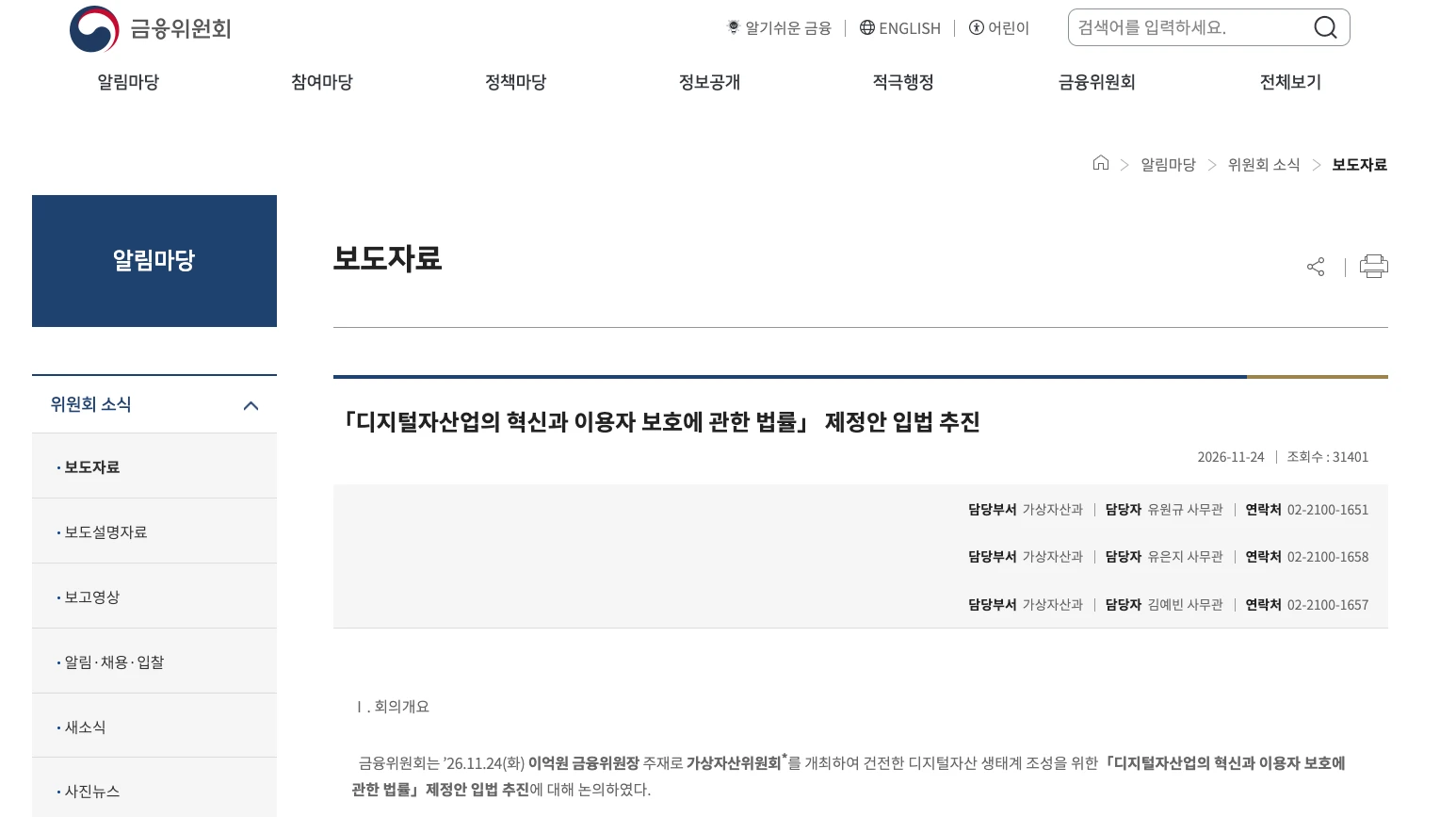
Press release from the South Korean Financial Services Commission, source: official website
Conclusion
This draft brings South Korea’s virtual asset industry from an “operations can commence upon declaration” era into one of licensed operations: separate custody regulations, stablecoins included in licensing, lifting of the ICO ban, no-fault compensation — all these expand the compliance landscape while also raising the thresholds for entry and compensation. However, it is still just a government draft; the ultimate decision-making power lies with the National Assembly.
In terms of timing, the ruling party hopes to vote before the U.S. “GENIUS Act” takes effect on January 18, 2027, but the bill still needs to go through the Political Affairs Committee, Legal and Judicial Committee, and plenary session, with separate implementation orders needed, thus full realization may take more than a year. Therefore, each item mentioned above should be seen as “draft proposals,” and the final version will only be determined after the National Assembly votes.
免责声明:本文章仅代表作者个人观点,不代表本平台的立场和观点。本文章仅供信息分享,不构成对任何人的任何投资建议。用户与作者之间的任何争议,与本平台无关。如网页中刊载的文章或图片涉及侵权,请提供相关的权利证明和身份证明发送邮件到[email protected],本平台相关工作人员将会进行核查。