M365 failure highlights the risks of companies' excessive reliance on cloud platforms
Companies should strengthen data governance to address AI security challenges
Enhance data visibility and establish a sound governance structure
The recent issues with Microsoft 365 (M365) and data breaches serve as a warning for global businesses. As AI increasingly integrates into daily operations, how companies manage data flow, reduce risks, and ensure business continuity has become a critical issue.
The earlier service disruptions with Microsoft 365 (M365) prompted significant reactions from businesses worldwide, reflecting the growing dependence on a single cloud platform. As email, document management, team collaboration, and AI applications become more concentrated within the same ecosystem, interruptions to services not only hinder communication but can also impact access to critical data, business processes, and even decision-making efficiency.
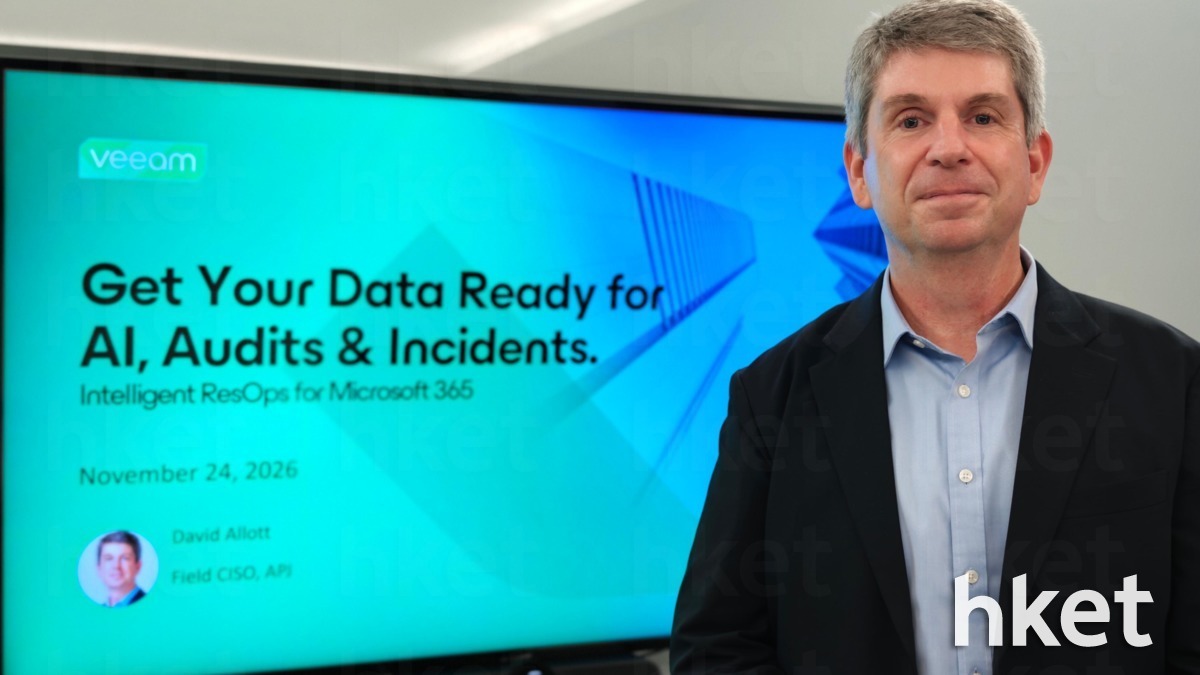
In response, David Allott, Chief Information Security Officer of Veeam Asia Pacific and Japan, recently visited Hong Kong and stated in an interview that the incidents indicate that companies need to rethink their definitions of digital resilience. In the past, organizations focused more on the availability of systems and infrastructure. Coupled with recent trends where many companies have been emphasizing AI models and the deployment of new technologies, Allott noted, “The biggest barrier is not the model but the data itself.” The recent M365 incident serves as a reminder for companies that when workflows and knowledge management increasingly rely on a single platform, the real challenge is not just managing system availability but also ensuring the visibility, control, and recoverability of data.
Allott emphasized that companies first need to understand the status of their data assets. He candidly stated that many organizations, while actively deploying AI and cloud services, often overlook the foundational work of data governance, such as data inventory, classification, and access management, leading to risks compounding as data scales grow.
Moreover, many enterprise environments still contain a significant amount of unmanaged “Dark Data” that has been neglected for years, including duplicated, expired, or ownerless information. However, when AI tools begin to access and analyze business content, this data can also become a source of risk. Allott added that many companies maintain a “keep it for the sake of it” mentality, but with increasingly strict privacy and regulatory requirements, excessive data retention itself may pose risks.
Thus, he reiterated that before driving AI projects, companies should first grasp the status of their data assets and understand which information is sensitive, as well as which AI agents are accessing the relevant contents. He therefore cautioned that organizations not only need to know which agents are interacting with data but also must ensure that when errors occur, they can quickly restore the affected information instead of having to revert the entire system each time an incident happens.
When asked about the increasingly frequent data breach incidents, Allott noted that in many cases, when companies suffer attacks or data breaches, the management’s first question is often, “What data was taken?” However, the reality is that many organizations cannot provide immediate answers.
He pointed out that data has become one of the most valuable targets for hackers, who may even understand the value of such information better than the companies themselves. Once attackers successfully obtain data, they often classify, analyze, and even resell it, while the victimized companies may not precisely know which data involves sensitive information or is impacted.
He believes this also reflects the need for businesses to establish better data visibility. It's not just about knowing where data is stored; it is also crucial to understand who owns the data, the access rights, and its sensitivity levels to quickly assess the impact and formulate responses after an incident occurs.
In response to this situation, Veeam also offers the Veeam Intelligent ResOps solution, which can inventory, classify, and label data assets such as SharePoint and OneDrive within the Microsoft 365 environment, helping to ascertain the location of sensitive data, data access status, and compliance risks, while also reducing unnecessary data retention and related risks.
Beyond the technical aspects, Allott also stressed that AI governance is no longer solely the responsibility of the IT department. Since AI involves data privacy, regulatory compliance, information security, and business risks, accountability has also become more complex. He suggested that when companies plan their AI strategies, they should not focus solely on who drives the projects, but should first consider who will bear the consequences when risks occur, and then establish a corresponding governance structure by setting up a dedicated AI governance committee.
This article is reprinted from Hong Kong Economic Journal, with copyright belonging to the original author and media.
免责声明:本文章仅代表作者个人观点,不代表本平台的立场和观点。本文章仅供信息分享,不构成对任何人的任何投资建议。用户与作者之间的任何争议,与本平台无关。如网页中刊载的文章或图片涉及侵权,请提供相关的权利证明和身份证明发送邮件到[email protected],本平台相关工作人员将会进行核查。