The comparison of cryptocurrency wallets has never been lacking. But the vast majority are written for ordinary users. The wealthy individuals or family offices that hold six, seven, or even eight-figure assets prefer completely different options. At this level, what holders focus on is not just an app, but a set of operational modes that manage a significant portion of their balance sheet.
This report rates ten non-custodial wallets based on twelve criteria: Bron, Ledger, MetaMask, MPC Vault, Phantom, Safe, Tangem, Trezor, Trust Wallet, and Zengo, with data as of November 2026. Every factual conclusion is traced back to official documentation and help centers from the manufacturers, and cross-referenced with practical tests—the customer service of each manufacturer received the same group of questions about recovery, inheritance, team permissions, and limits. The scoring methods are fully disclosed, and readers who have different views on the weights can recalculate the total scores themselves.
Overall Results
Total Score (out of 100)
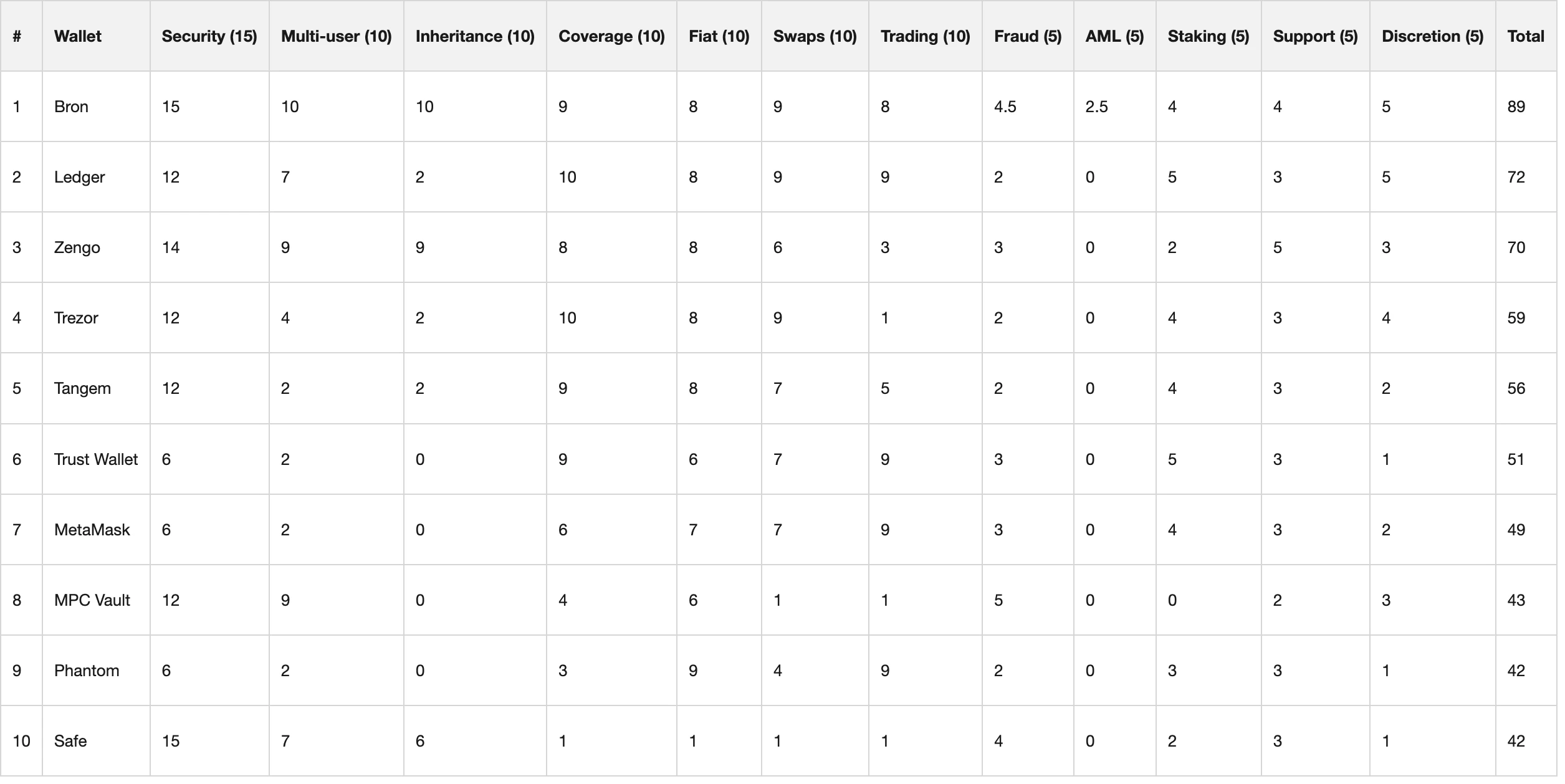
Total scores of ten non-custodial wallets and twelve individual scores
How many points did each wallet get and why?
Bron (89) leads the pack, and its individual score structure better explains the reasons for this. It scored full marks in four categories: security, multi-user management, inheritance, and holding privacy. It is the only wallet in this group that provides on-chain confidentiality for mainstream tokens according to Zama standards while also offering PIN hidden accounts, where resets take 24 hours to take effect. The deduction points are clearly listed: 1 point each for asset coverage, cross-chain exchange, staking, and customer service; 0.5 points deducted for anti-fraud tools; 2 points off for fiat due to lack of card support; and 2 points off for transactions—tokenized US stocks and ETFs are open to all users, but crypto, stocks, and commodity perpetual contracts on Hyperliquid require users to actively apply for access; the most significant loss was in anti-money laundering, with a 2.5 point deduction. Bron is the only wallet in this group that conducts screening for incoming and outgoing transfers (via Hypernative), but it also requires users to apply for this capability. Holders wanting these two capabilities must individually request Bron to enable them for their accounts.
Zengo (70) is two points behind Ledger, placing third, and is the strongest consumer-level MPC product available to this demographic: it nearly achieves full points in safety, multi-user roles, and inheritance. It is the only vendor in this group that publicly guarantees customer service response time, with a dedicated service desk for large fiat purchases, and it performs strongly in holding privacy. Remaining issues include that the inheritance process follows a timer, staking categories are thin, there are no perpetual contracts or tokenized stocks, and it lacks card support; the anti-fraud tools lack whitelists and in-app revocation.
Ledger (72), Trezor (59), and Tangem (56) represent the best state of hardware wallets and their ceilings. Ledger, second place, is two points higher than Zengo, with coverage and staking both among the top in the group; it features a complete transaction stack in the app, and cross-chain exchanges are nearly fully covered, requiring physical confirmation for each transaction—but for this demographic, limitations arise as the consumer-level app only supports single users, with almost no inheritance options and the device itself may expose users when crossing borders. Trezor ties with Ledger in coverage and cross-chain, offering open-source firmware and dedicated consultants for large fiat transactions but lacks native multi-signature, in-app trading, and has weak anti-fraud tools. Tangem's card bypasses visibility issues; from October 2026, the app added tokenized stocks and ETFs and supports two-way transfers with US banks via Tangem Pay; however, it is also limited by a single-user cap, where a transferred card is seen as a transferred key, making inheritance impossible, offers no in-app revocation of authorizations, and for users who refuse optional mnemonic backups, the recovery model is extremely harsh.
Trust Wallet (51), MetaMask (49), and Phantom (42) are all excellent retail products—Trust’s staking and financial product categories are the most comprehensive in the group, while all three have trading scores close to full points for perpetual and tokenized stocks in the app—but all three fail in the areas that private wealth cares about most: one device, one factor, no second user, no inheritance. They do well in retail but are not suitable as custodial carriers for affluent and high-net-worth customers.
MPC Vault (43) and Safe (42) are serious infrastructures but poorly designed. MPC Vault has a true strategy engine, the most comprehensive anti-fraud tools in the group, and a confidential vault, but lacks any inheritance functionality; private key export is only available to top-tier plans, and there is neither staking nor trading. Safe remains the strongest signature architecture, achieving full points in security, but more than half its points are lost due to structural issues: it does not support Bitcoin, fiat can only be bought with a card and lacks withdrawal channels, customer service has no SLA, there are no derivatives in the app, and the operation experience presumes you have an engineer nearby.
Scoring Method: How are these twelve items calculated?
The method itself is quite simple: each criterion is assigned a score based on its importance for large private holdings, and each wallet is directly scored against these values. Full scores require that the capability be native and documented. Deductions are clearly listed—every time a point is lost, the table explicitly states how many points and where. A score of 0 means that capability is completely absent. If a product does indeed offer a certain capability but requires user application to enable it, rather than it being available by default to all users, it is only counted as half of the earned points, and the specific items will be noted in the table. Since every individual score is itself a value, adding the twelve items results in a total score on a hundred-point scale.
The table below lists the twelve criteria from high to low based on their score, with the order of sections matching this.
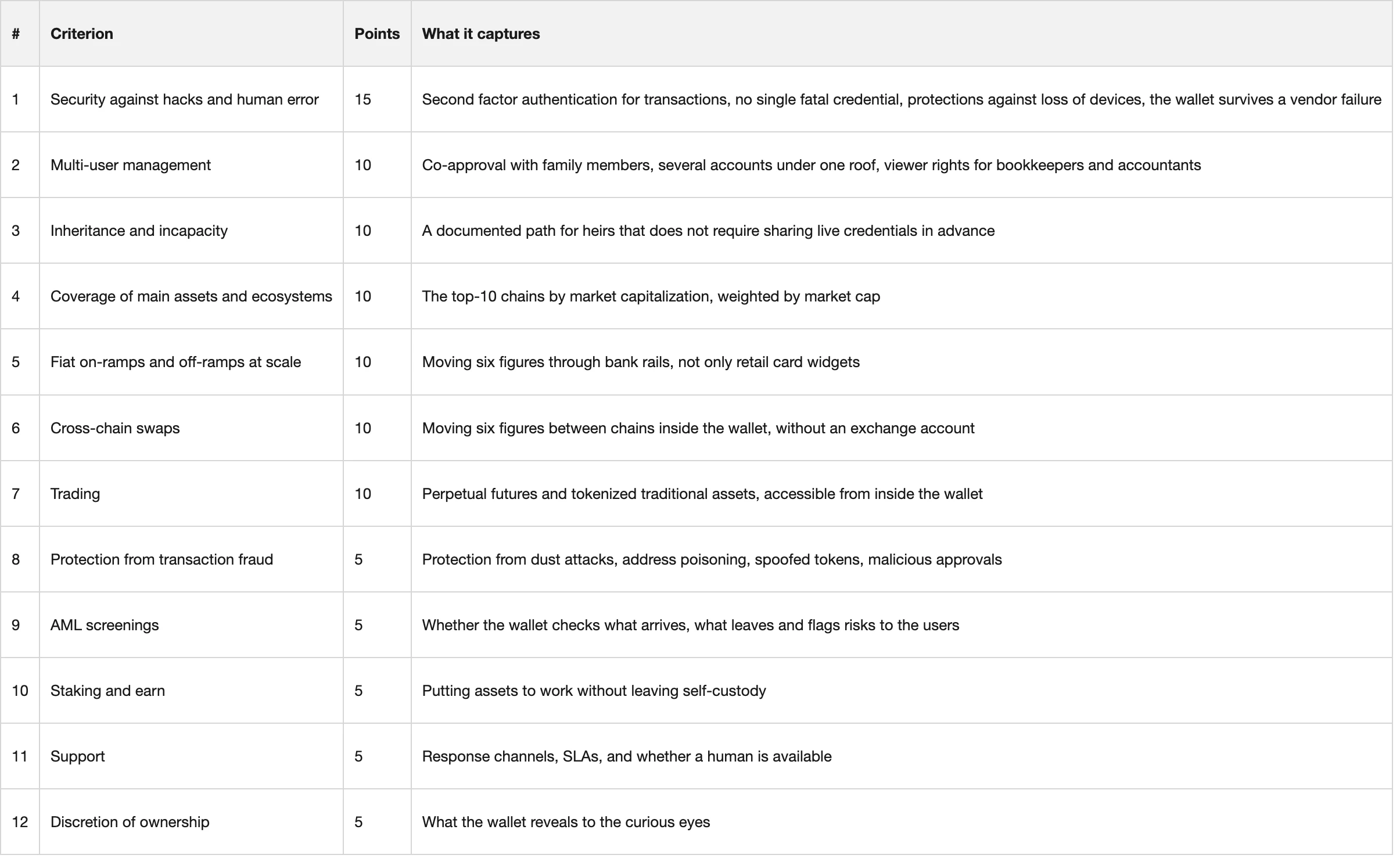
Scoring criteria and points for the twelve items
1. Security Capabilities Against Hacking and Human Error (15 points)
What we evaluated:
(a) Does every transaction require a second independent authorization—hardware confirmation, biometric gate, or co-signer;
(b) Is there a single credential in the design that, once lost, cannot be recovered;
(c) If all devices and credentials are lost, is there a documented recovery path;
(d) What happens to the holder’s access if the provider ceases operation.
The first test provides very clear distinctions. Ledger, Trezor, and Tangem's card wallets require physical confirmation for every signature—via buttons, touch screens, or NFC; thus, pure remote attacks are ineffective; Tangem's cashless mobile wallet is excluded from this evaluation. Zengo Pro’s Theft Guard adds biometric verification for withdrawals that exceed user-defined thresholds. Multi-party designs go even further: Safe's on-chain M-of-N signatures, Bron and MPC Vault's strategy engine impose approval thresholds—which Bron can additionally configure for security delays—mean that theft of phones or coercion of signers is insufficient to transfer funds. Software wallets with mnemonics like Trust, MetaMask, and Phantom complete authorization using passwords or biometrics on the same device, effectively providing only one factor; Phantom's newer Google and Apple login changes the wallet to use its own server-side key for off-chain signing.
The second and third tests have some reversed rankings. For mnemonic products, mnemonics are uniquely lethal credentials: When directly questioned, Trust customer service responded, "Cannot recover wallet or funds... even with identity verification or third parties"; Phantom's customer service gave the same reply to users who simultaneously lost their mnemonics and social logins. MetaMask’s optional Google and Apple login removes mnemonics from the user, replacing them with a password that MetaMask claims cannot be recovered. The current generation of MPC eliminates this failure mode: Bron allows recovery access via a code provided by two guardians or FaceScan, both set with a 48-hour delay, and can also restore access via a 30-day self-service option; Zengo offers recovery via email, biometric, and cloud-stored recovery files; MPC Vault relies on users needing to back up their personal key certificate. Ledger provides its recovery service as a subscription—Ledger Recover, provided by Coincover, first month free, then €9.99 monthly, with identity verification required against government-issued ID. Trezor does not sell recovery services, but its Multi-share Backup can split mnemonics into up to 16 shares, where any single share is not lethal.
The fourth test—vendor bankruptcy—requires the most due diligence because the nature of the answers differs significantly. The BIP-39 mnemonic design does not rely on the vendor: Trust, MetaMask, Phantom (mnemonic wallets), Ledger, Trezor, and Tangem holdings can be restored to any compatible wallet without vendor cooperation. Safe's contract is on-chain and can be driven by any interface, but the custodial Safe{Wallet} interface itself is still a single point of failure (in 2025, a compromised Safe developer machine led to the theft of about $1.5 billion from Bybit). MPC wallets must achieve the same guarantees through engineering means, and each does so differently: Bron has open-sourced its MPC library, audited by Trail of Bits, and published emergency key reconstruction paths—users’ devices with a third party Qrypt holding a third key shard can reconstruct the signing key without Bron; Zengo relies on separately operated recovery systems by software hosting companies and trustees, allowing recovery to be triggered through a public GitHub repository when the company ceases operation; MPC Vault provides key shard export, but only for annual Scale and Enterprise customers, and must be initiated manually via account managers.
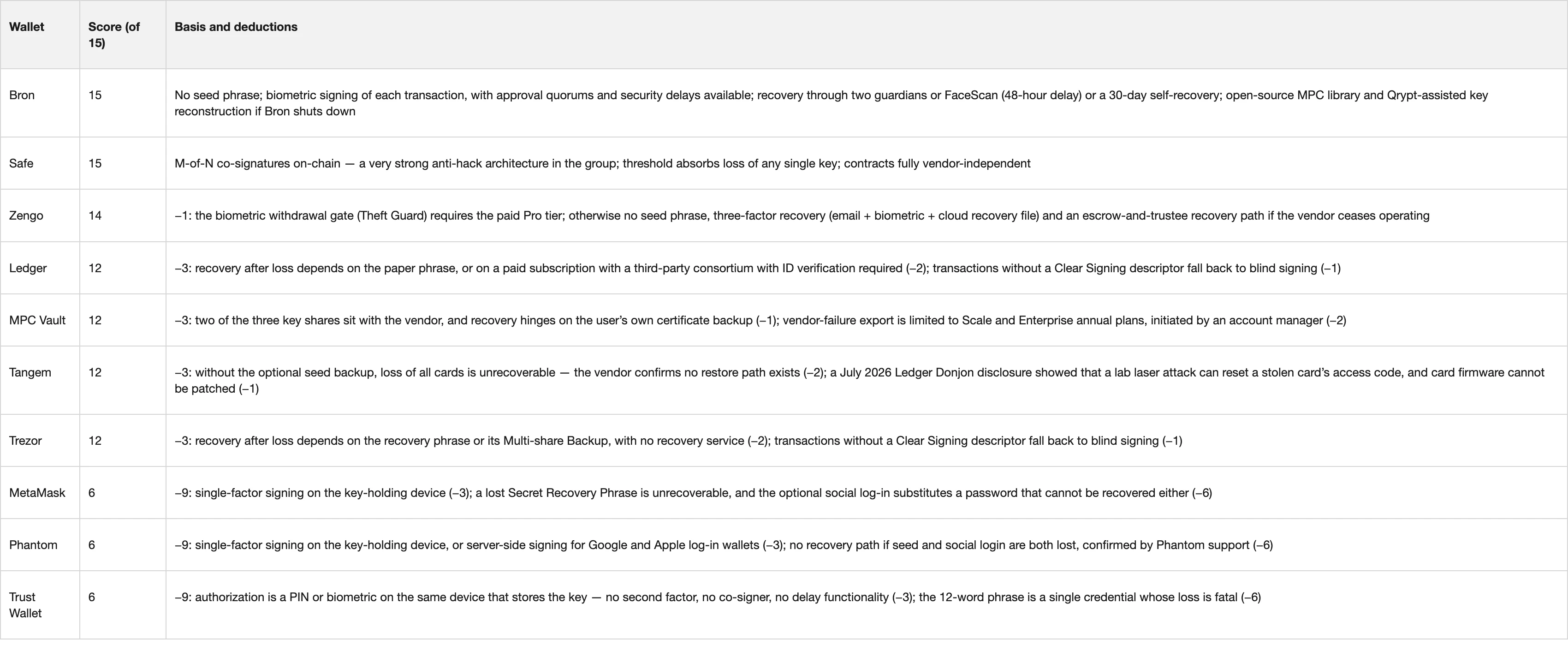
First item “security” score
2. Multi-User Management (10 points)
What we evaluated:
(a) Are roles separated—at least one co-signer and one observer who can only view;
(b) Does the transaction support multi-party approval with thresholds and limits;
(c) Can multiple accounts or vaults be managed under the same entity;
(d) Are these capabilities found in products that private buyers can genuinely purchase, rather than separate institutional versions.
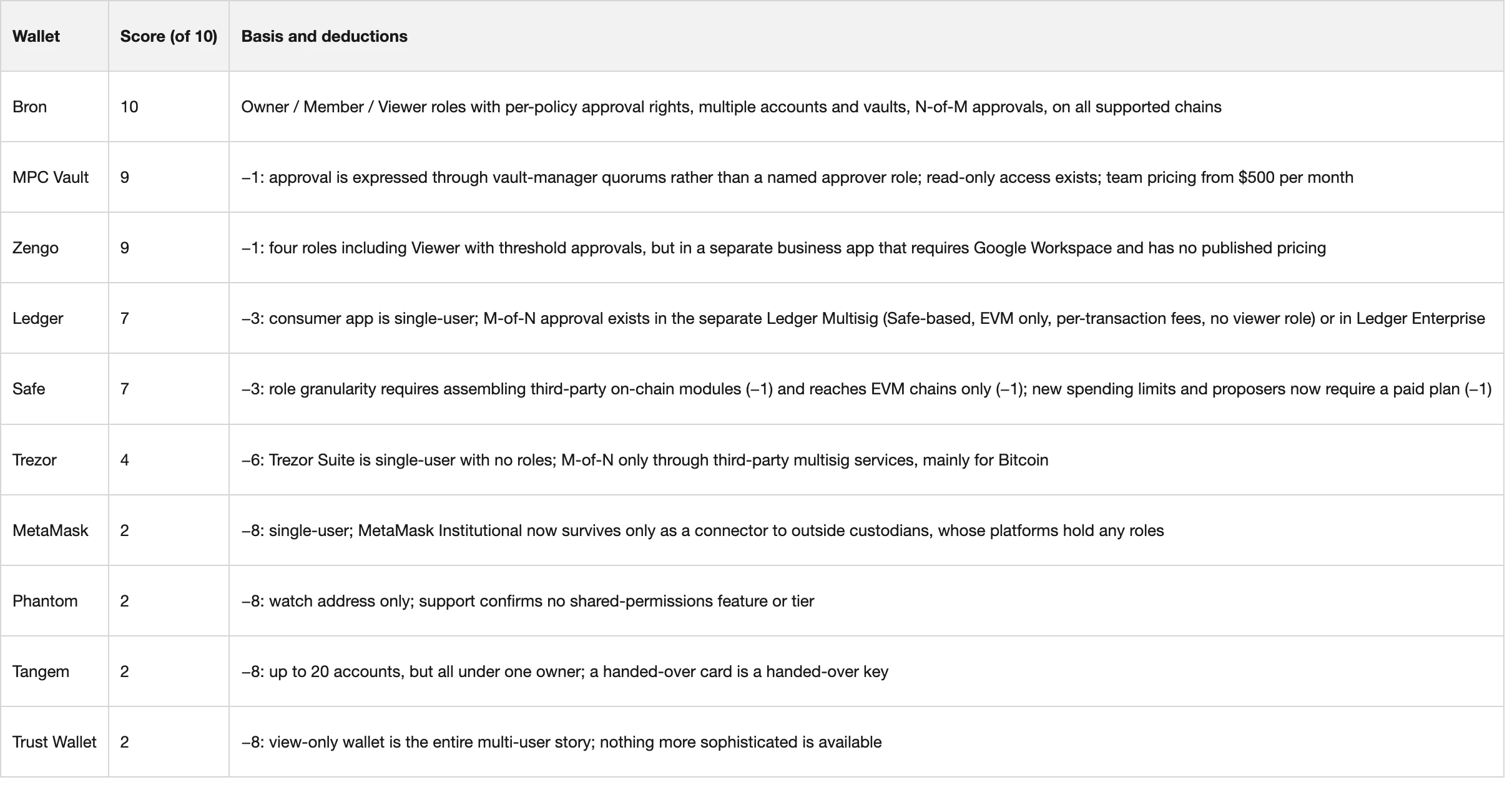
Family offices operate on duty separation: the individual approves, the spouse or advisor co-signs, and the accountant sees everything but cannot touch anything. Six out of ten cannot fully express this relationship. Trust, MetaMask, Phantom, Tangem, Trezor, and Ledger's consumer apps are single-user products; directly asking their customer service reveals that the only way to share control is by sharing the key itself—which is precisely what wealthy families cannot do. The read-only mode (Trust’s View-Only Wallet, Phantom’s Watch Address) provides visibility rather than governance, only earning the visibility-corresponding 2 points; MetaMask also scores 2 points because its institutional connector hands over roles to external custodians.
Four products have truly satisfactory answers. Bron offers three roles: Owner, Member, Viewer, with approval permissions assigned by strategy (Viewer can also serve as an approver), allowing multi-party coverage that includes Bitcoin and TRON across all chains. Zengo Business provides four roles: Admin, Approver, Controller, Viewer, with configurable multi-signature thresholds; it is an independent enterprise application aimed at organizations, thus losing 1 point. MPC Vault has an organizational owner, administrator, and members, with vault managers and members constrained by transaction strategies; accountants can access read-only. Safe expresses roles via a set of signers and proposers on-chain, and more granular permissions rely on the third-party Zodiac Roles module—being the best in the group, it only supports EVM and requires assembly like an engineering project, not as a simple switch; from October 2026, new spend limits and proposers that require payment will be available under the Safe Pro package.
Ledger’s consistency merits special mention, as the difference in its score relative to Zengo is justified. Zengo’s roles are self-activated enterprise applications under the same brand; Ledger’s consumer app has no roles; M-of-N approval exists only in Ledger Multisig—a separate community-focused application based on Safe, covering five EVM chains, with owners and proposers but no observer roles, charging $10 per transaction or 5 basis points—and Ledger Enterprise, an institutional platform requiring contact with sales. We acknowledge these pathways exist, but they are not friendly to family scenarios. Trezor scores even lower: Trezor Suite has no multi-signature or roles, and M-of-N can only be used in conjunction with an external third-party multi-signature service, primarily limited to Bitcoin.
Second item “multi-user management” score
3. Inheritance and Disability (10 points)
What we evaluated:
(a) Is there a named, functioning inheritance feature, and is it independent of third-party vendors;
(b) Does the claimant have mechanisms to prevent premature or fraudulent execution;
(c) Does this arrangement require a valid credential to be handed to the heir prior to execution (which equates to turning inheritance into a long-lasting security vulnerability).
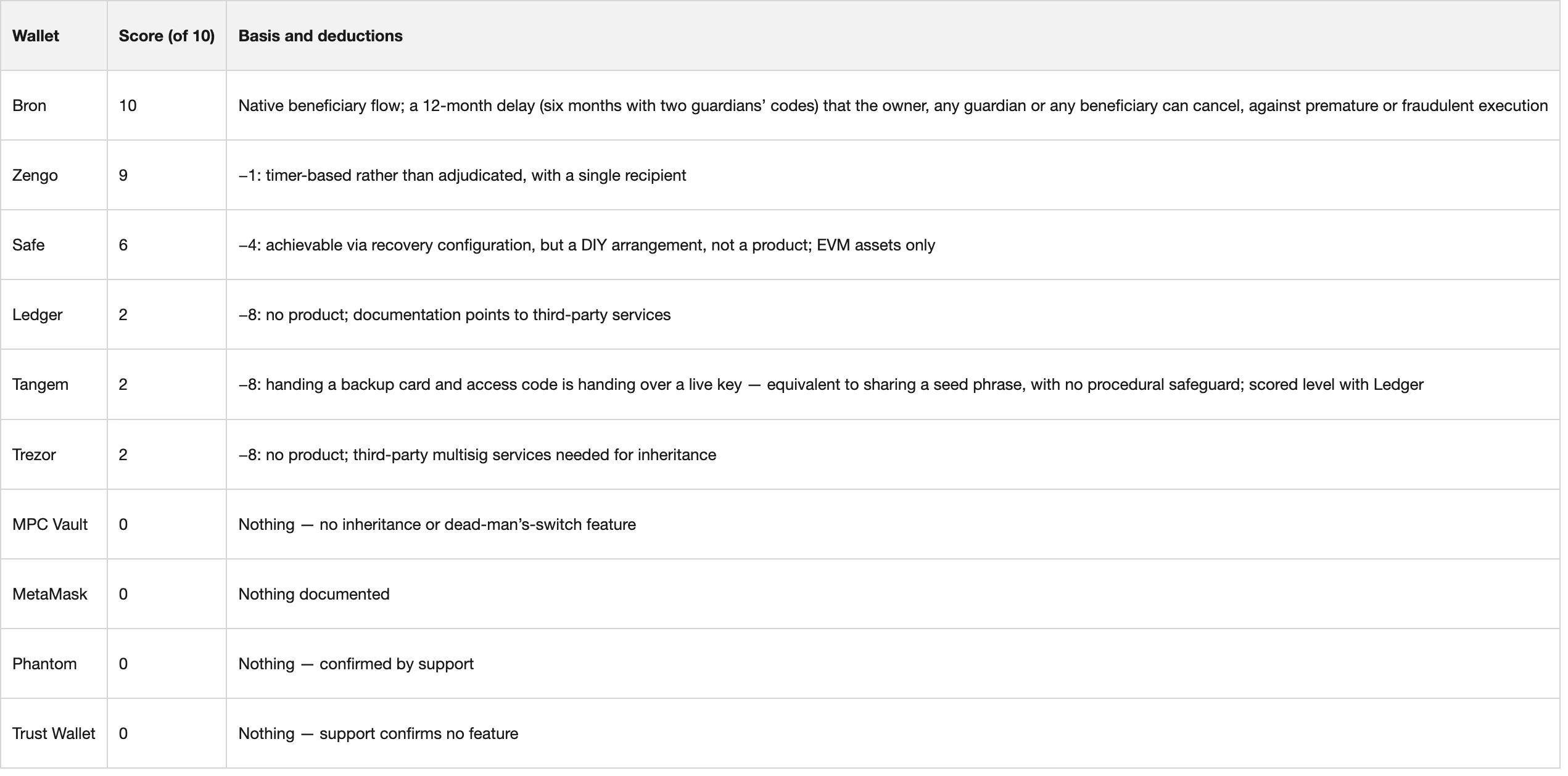
This item represents the most thorough failure across the industry and is particularly crucial for readers concerned with private wealth. Out of the ten, four products—Trust, Phantom, MetaMask, and MPC Vault—offer nothing: no functions, no beneficiaries designated, no dormancy mechanisms. Their customer service confirms that heirs without independently held credentials inherit nothing.
Two products have named functionality. Bron's Digital Inheritance is process-designed: only designated beneficiaries can initiate claims, entering a 12-month delay; if the beneficiary enters the verification code of two guardians, this can be shortened to 6 months. The holder, any guardian, or any beneficiary can cancel at any time—this is intentionally designed to block premature theft and forged claims, rather than a simple dead-man switch. Zengo's Legacy Transfer belongs to the Zengo Pro feature, releasing access to a uniquely designated recipient after a stationary timer of 3 to 24 months (reset every time the holder opens the wallet); it shares inheritance files using a Dropbox account, with the same file simultaneously stored in iCloud or Google Drive.
Two more support "no dedicated functionality but still viable" arrangements. Safe can be configured to replace a signer with a designated recuperator after a period of review delay (default 28 days, optional 7, 14, or 56 days), during which the existing signers can veto—effective but requires manual effort and only supports EVM. Tangem's answer lies in a physical arrangement: hand over backup cards to trusted individuals, lawyers, or safety deposit boxes, keeping access codes separately—this equates to prematurely handing over an effective key, functionally indistinguishable from sharing mnemonics, therefore earning no more than "guideline" level points. Ledger's inheritance guide updated in October 2026 does not offer Ledger's own products but directs users to third-party services or Ledger Multisig for inheritance solutions outside the app. Trezor similarly lacks inheritance products, guiding users to its multi-signature partners for inheritance arrangements outside the app.
Third item “inheritance and disability” score
4. Coverage of Major Assets and Ecosystem (10 points)
What we evaluated:
(a) Support for the top ten public chains by market capitalization, weighted by their proportion on each chain (Bitcoin alone accounts for 72.1% of the top ten total, and the top ten collectively account for about 83% of the entire market);
(b) The depth beyond the top ten, described but not scored.
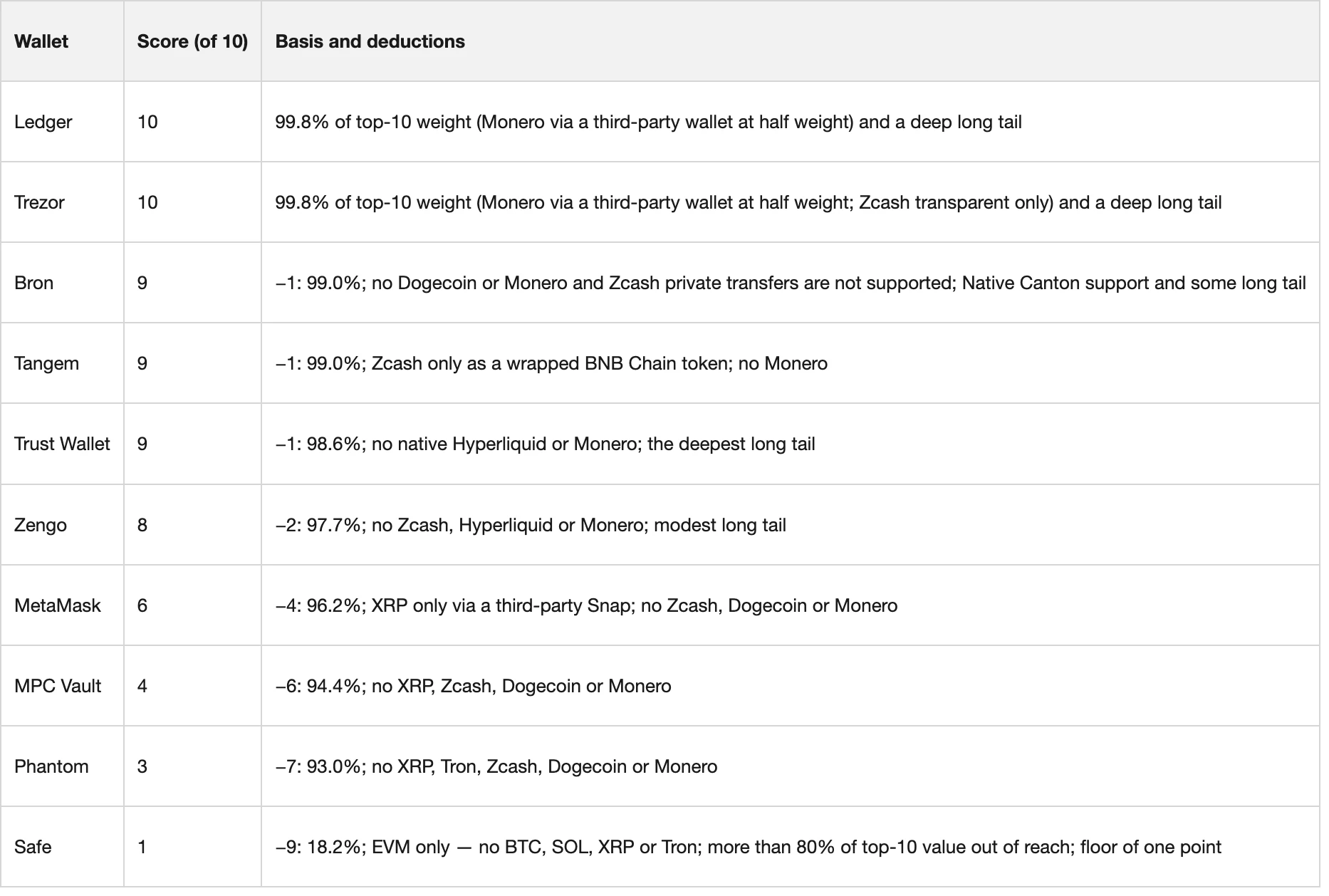
After excluding stablecoins and tokens, the top ten on CoinMarketCap as of October 23, 2026, are Bitcoin, Ethereum, BNB Chain, XRP, Solana, TRON, Zcash, Hyperliquid, Dogecoin, and Monero. Native support counts as full points; plug-in, cross-chain bridges, intended or wrapped token support count as half scores. Each point deducted for weightings that the wallet cannot reach is rounded off, and any wallet that covers at least one top-ten public chain secures a base score of 1 point.
Based on this weighting, leaders converge: both Ledger and Trezor score 99.8%, the highest in the group, each only missing native Monero, but both can reach it through third-party wallets; Bron and Tangem are at 99.0%, Trust at 98.6%, Zengo at 97.7%. Bron and Ledger since August 2026 are the only two wallets that natively support Canton, which happens to be just outside the top ten. MetaMask scores 96.2% (XRP counts as half points through a third-party Snap), MPC Vault at 94.4%, hindered by the absence of XRP. Phantom’s 93.0% reflects its deliberate focus on Solana: BNB Chain was only connected in October 2026, while XRP, TRON, Zcash, and Dogecoin remain unsupported. Safe’s score of 18.2% is by design: it only supports an EVM architecture, making it unable to accommodate Bitcoin and other non-EVM chains. The long tail beyond the top ten belongs to first-generation products—Trust supported over 100 networks before going offline in September 2026, and Ledger lists a substantial network count, while Bron accommodates 27 chains.
Fourth item “asset coverage” score
5. Large Fiat Deposit and Withdrawal (10 points)
What we evaluated:
(a) Does it have channels capable of handling six-figure amounts—bank transfers in and out, rather than small card tool transactions;
(b) The breadth and quality of deposit service providers;
(c) Can funds be withdrawn to the holder's own bank account;
(d) Is it open to private individuals rather than being limited to KYB-verified businesses;
(e) Are spending cards provided within the wallet.
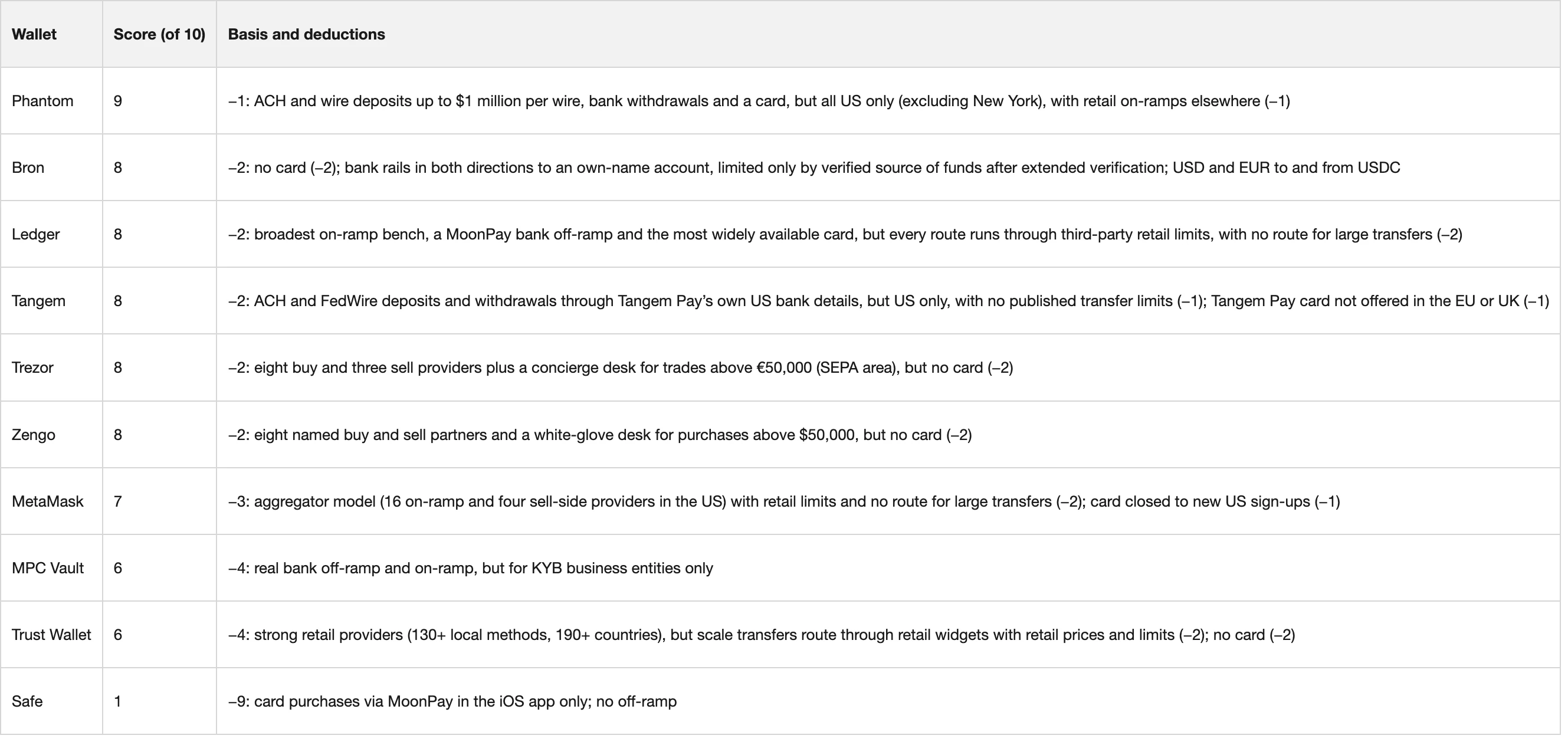
Lack of card support deducts 2 points; only retail limits without large-scale channels deduct 2 points; if the channels only cover a single country or if cards have stopped accepting new users or are unavailable in primary markets, deduct 1 to 2 points; if only open to businesses, deduct 4 points.
Each consumer wallet can swipe a card to sell $500 worth of Bitcoin, but almost none can handle a single payment from a property sale. Bron goes for a direct connection—no card and no retail aggregators—completing two-way transfers between USDC and a self-named account through regulated third-party service providers (SEPA, SWIFT, ACH, and Fedwire); after thorough verification, transaction volumes are determined by verified sources of funds, unhindered by retail limits. Phantom offers comparable channels within one country: ACH and domestic wire transfers up to $1 million per transaction, supporting bank withdrawals, limited to US residents outside New York. Tangem provides a similar US-exclusive channel through Tangem Pay—an in-app payment account—where each verified user receives banking information for ACH and FedWire deposits, and from October 2026 can withdraw to US bank accounts via ACH or wire transfer; however, Tangem has not published transfer limits, and Tangem Pay is also not available in the EU and UK.
Ledger's deposit service provider lineup is the broadest in this comparison (aggregators connecting more than 50, including MoonPay, Coinify, PayPal), allowing sellers to withdraw funds to bank accounts via MoonPay, with the CL Card covering the EEA, UK, US, Canada, Switzerland, Colombia, Mexico, and Brazil, yet large withdrawals are still restrained by retail limits from service providers. MPC Vault can make withdrawals via SWIFT, ACH, and wire in six currencies but only for KYB-verified corporate entities, effectively excluding the private individuals this report is concerned with. Trezor Suite facilitates deposits through eight service providers and payouts to banks through three; it provides dedicated consultancy for transactions exceeding €50,000 for SEPA region through BTC Direct. Zengo connects with eight named partners and provides a dedicated service desk for purchases over $50,000. The remaining products shove large fiat into the same retail tools they use for small amounts, with limits and pricing all at retail levels. Ledger, Phantom, MetaMask, and Tangem also offer spending cards; Bron, Zengo, Trezor, and Trust do not. Safe only supports card purchases through MoonPay in the iOS app, with no withdrawal channels available.
Fifth item “fiat deposit and withdrawal” score
6. Cross-Chain Exchange (10 points)
What we evaluated: Executing seven reference transfers end-to-end within the wallet that reflect how a multi-ecosystem array can be rebalanced:
- BTC↔USDT-ERC20;
- BTC↔USDT-TRC20;
- USDT ERC20↔TRC20;
- USDT ERC20↔HYPE;
- USDT ERC20↔Canton;
- USDC ERC20↔SOL;
- USDT ERC20↔ZEC.
Scores are given based on the proportion of successful transactions completed within the wallet (10 × log ÷ 7, rounded). Only when the wallet's own documentation shows that exchanges can complete on both described networks are they counted; no practical routing tests are conducted for each pair. Fees and slippage are not scored.
Bron successfully completes 6 out of the 7 pairs through BronIntents—this is a self-built open cross-chain protocol, justified by the need for existing routing to service complex trading pairs, with independent solvers determining bid pricing; any wallet can access this protocol and gain the same functionality. It is also the only wallet that attempts a pair for Canton but currently cannot convert USDT into Zcash. Ledger also accomplishes six pairs through third-party aggregators within Ledger Wallet, including Zcash, but lacks the Canton pair (Canton can only send and receive there). Trezor Suite similarly handles six pairs using CEX providers like Changelly and ChangeNOW, potentially requiring identity verification, along with 1inch and LI.FI for EVM DEX routing, missing the Canton pair. MetaMask’s built-in cross-chain exchange reaches Bitcoin, Solana, TRON, and HyperEVM, covering five pairs, lacking Canton and Zcash. Tangem’s CEX and DEX providers added Bitcoin and TRON routing in July and August 2026, similarly reaching five pairs, missing Canton and native Zcash; Trust Wallet covers five pairs through its cross-chain providers, missing Hyperliquid and Canton. Zengo completes four pairs via liquidity from partners (Changelly and Swaps.xyz), which may sometimes require identity verification. Phantom has BTC↔EVM, EVM↔Solana, and HyperEVM routes but has no TRON or Zcash pathways; MPC Vault only exchanges between EVM chains, Solana, and Sui, leaving just one pair; Safe can only bridge EVM to EVM.
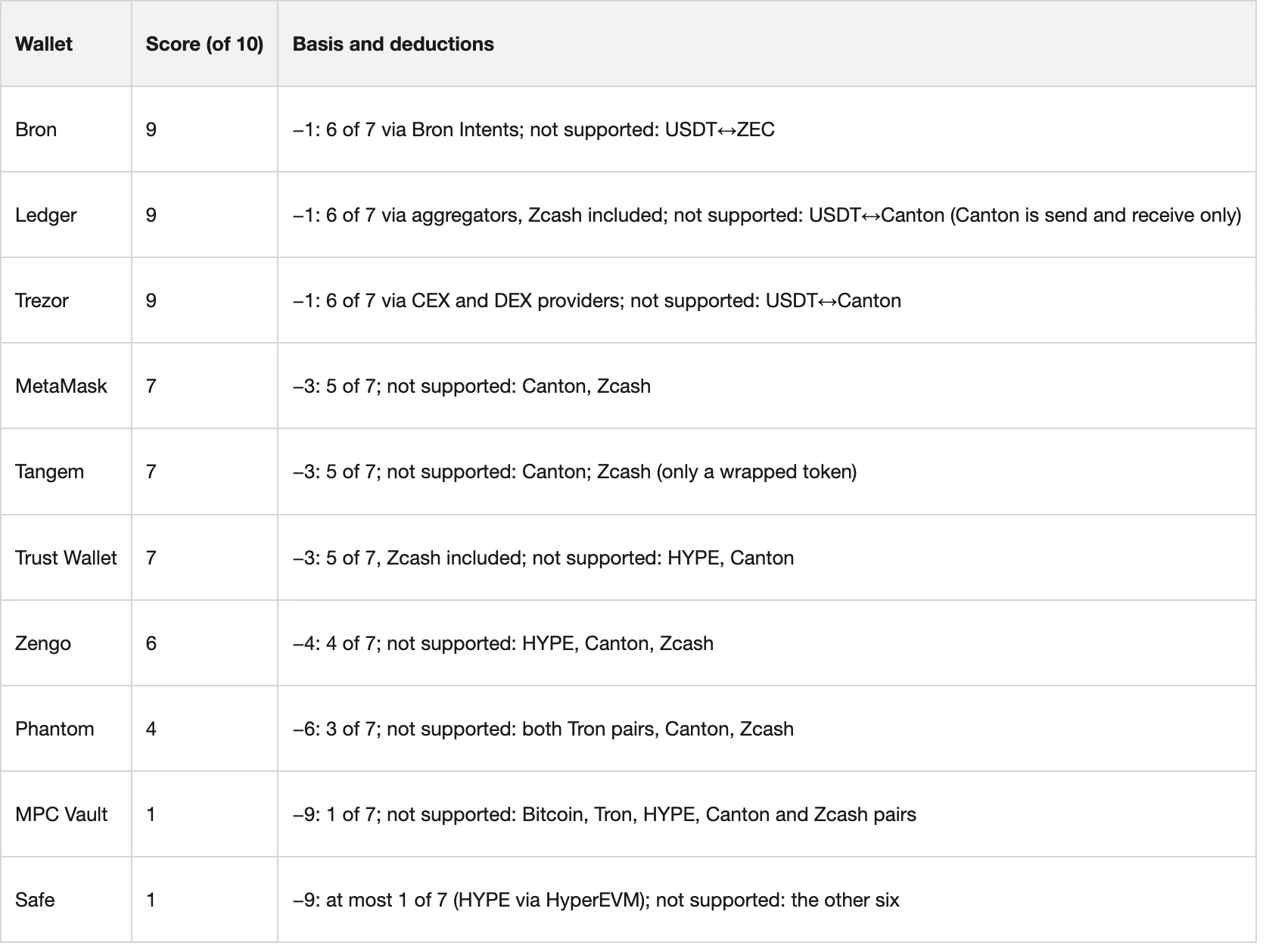
Sixth item “cross-chain exchange” score
7. Trading (10 points)
What we evaluated:
(a) Can perpetual contracts for crypto assets be traded within the wallet;
(b) Can traditional financial assets be accessed—tokenized stocks, perpetual stocks, and index products;
(c) Is this access native or does it require the wallet to connect to an external venue;
(d) How are tokenized stocks priced: determined quotes or routes with slippage tolerance.
Native in-app perpetual earns up to 5 points (those only accessible through dApps earn 1 point). Native tokenized stocks score up to 5 points, with a deduction of 1 point for routes that provide slippage tolerance rather than determined quotes; if only prediction markets exist in-app, that leg earns 2 points. Each leg available only upon user application counts as half of the potential score. This criterion measures if the wallet can provide holders with trading exposure beyond crypto spot.
Slippage is also a factor: If liquidity only comes from AMMs, native support for tokenized securities is of little significance for large private holders, as even a $10,000 transaction could push prices several percentage points, making execution unfeasible.
Currently, four wallets have both legs natively available. Phantom runs Hyperliquid perpetual on crypto assets (up to 40x), stocks, indices, and commodities (stock perpetuals up to 10x), and also offers spot tokenized stocks through xStocks, Ondo, and PreStocks. MetaMask provides Hyperliquid perpetual covering crypto, commodities, stocks, and currencies, along with hundreds of Ondo tokenized stocks, ETFs, and commodities. Trust Wallet integrated Hyperliquid perpetual on April 29, 2026, alongside Aster DEX, and offers Ondo tokenized stocks and ETFs. Ledger added Hyperliquid perpetual (provided by Yield.xyz) in May 2026 within Ledger Wallet and utilizes 1inch to exchange for Ondo tokenized US stocks and ETFs. All four impose regional restrictions on these products, typically excluding the U.S. and the U.K.; all four rely on on-chain exchange liquidity with slippage rather than guaranteed quotes for tokenized stocks.
Bron has both legs, one of which requires application: Tokenized US stocks and ETFs issued by Ondo Global Markets can be traded within the wallet via BronIntents, utilizing competitive solver RFQ quotes with no slippage, individual trades up to $500,000, with company fundamentals displayed on the stock page; these products are unavailable in the U.S. and U.K. and have constraints in other regions as well. Hyperliquid perpetual—covering all markets where it has listed crypto, stocks, and commodities—can also be traded from the Bron wallet outside the U.S. and U.K., but this feature is activated upon user application rather than being default for all accounts, therefore this leg counts only half a point. Tangem added a Real assets section to the app in October 2026, allowing xStocks, Ondo tokenized stocks, ETFs, bonds, and commodities to be exchanged through its providers and held like ordinary tokens (excluding the U.S. and U.K.); it does not have perpetuals.
The remaining products quickly fall behind. Zengo joined the prediction market via Polymarket in June 2026, earning 2 points, but has neither perpetuals nor tokenized stocks. Tangem and Trezor can only reach perpetuals and other derivatives by serving as signature parties for external dApps, and Trezor has to go through third-party wallets like MetaMask and Rabby; MPC Vault connects to dApps via browser plugins and WalletConnect. Safe's native execution only involves spot trading, utilizing CoW Swap and LI.FI; Safe is deployed on HyperEVM, but there’s no perpetual entry in the app, and most perpetual front ends do not accept smart contract wallet signatures.
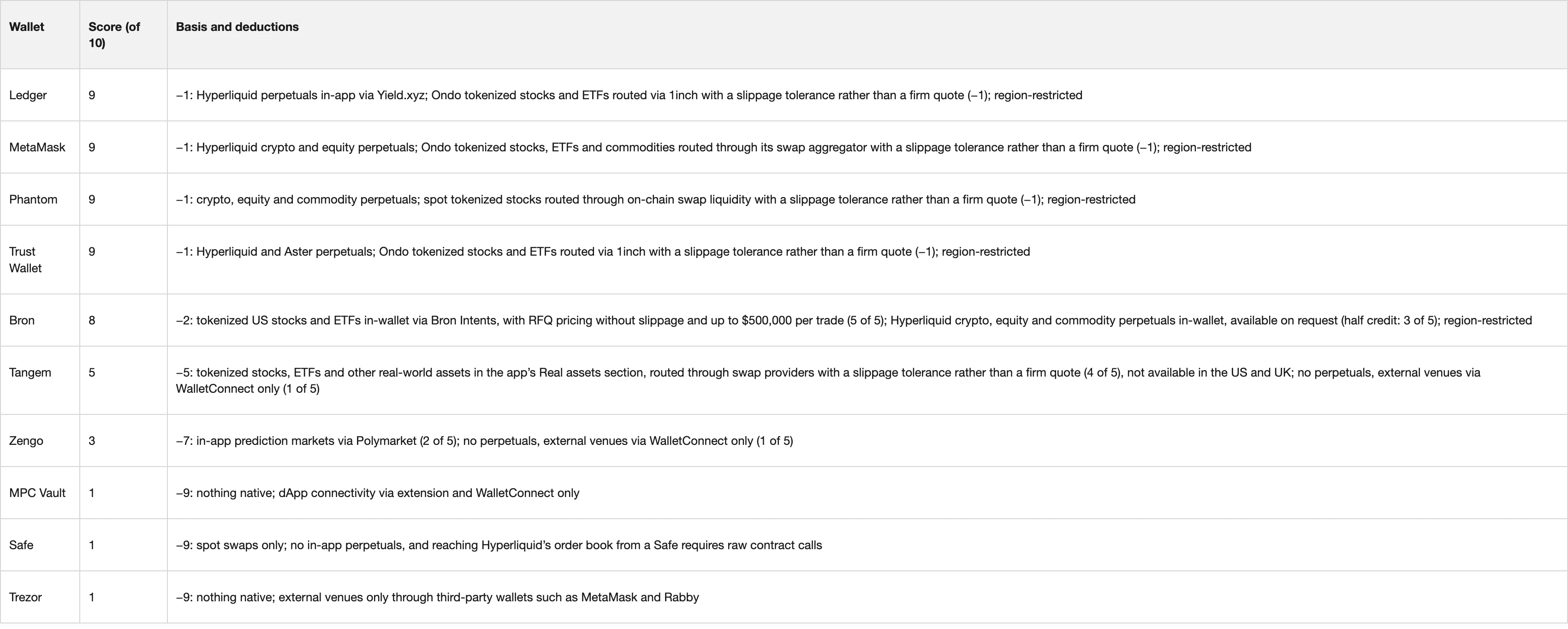
Seventh item “trading” score
8. Fraud Protection in Transactions (5 points)
What we evaluated:
(a) Can it hard control fraudulent transfers at the mechanism level—address whitelists, spending limits, delays;
(b) Soft controls to identify scams before signing—transaction simulations, risk scores, readable signatures;
(c) In-app revocation of token authorizations;
(d) Cleanup capabilities for dust and fake tokens.
Address whitelist earns 1 point, limits or delays 1 point; transaction simulation 1 point, risk scores for addresses, contracts, and tokens (including dust and fake token identification) 1 point; in-app revocation 1 point. Wallets that offer readable signatures on devices earn only 1 point.
Wallets with strategy engines can hard block fraud: Bron's whitelisted vaults, MPC Vault's whitelist-only mode, or limited-safe models that cannot forward funds to attacker addresses. MPC Vault's stack is the most comprehensive in the group, adding tiered approval limits by amount, transaction simulations with contract decoding, address book risk prompts, dust tagging, and in-console token authorization revocation. Bron applies a 48-hour lock for withdrawals to new addresses, implements transaction limits and security delays, simulates dApp transactions before signing, and allows in-app revocation of authorizations; however, the latter requires user application. Safe combines guardians and spending limits with Tenderly simulation, Blockaid scanning (the complete check has now been added to the paid Safe Pro), and optional Hypernative guarding, but revocation requires external tools. Zengo’s Web3 Firewall is a Pro feature that classifies sensitive transactions into three tiers of risk, verifies contracts and simulates transactions; its Theft Guard adds biometric gates for large withdrawals, but it has no address whitelists and cannot revoke in-app. Trust provides a security scanner, simulates transactions, cross-references fraud databases to screen recipients, marks malicious tokens, and supports in-app revocation but lacks hard controls. MetaMask relies on alerts and simulations supported by Blockaid, optional paid Transaction Shield (loss compensation), and revocation tools in its web-based Portfolio. Ledger's Clear Signing decodes invocation data on device screens—truly effective against blind signing—while Transaction Check adds simulation on Ledger Flex and Stax, but consumer-level apps lack native revocation or whitelisting. Phantom’s previews powered by Blowfish and Tangem's Blockaid screening can both identify scams before signing, but both require external tools for revocation and lack hard controls. Trezor added Clear Signing in September 2026, decoding supported EVM contract calls on-device, and in November 2026 added “Warnings before transferring to never-before-transacted addresses,” targeting address poisoning; however, it lacks transaction simulation, whitelisting, or in-app revocation.
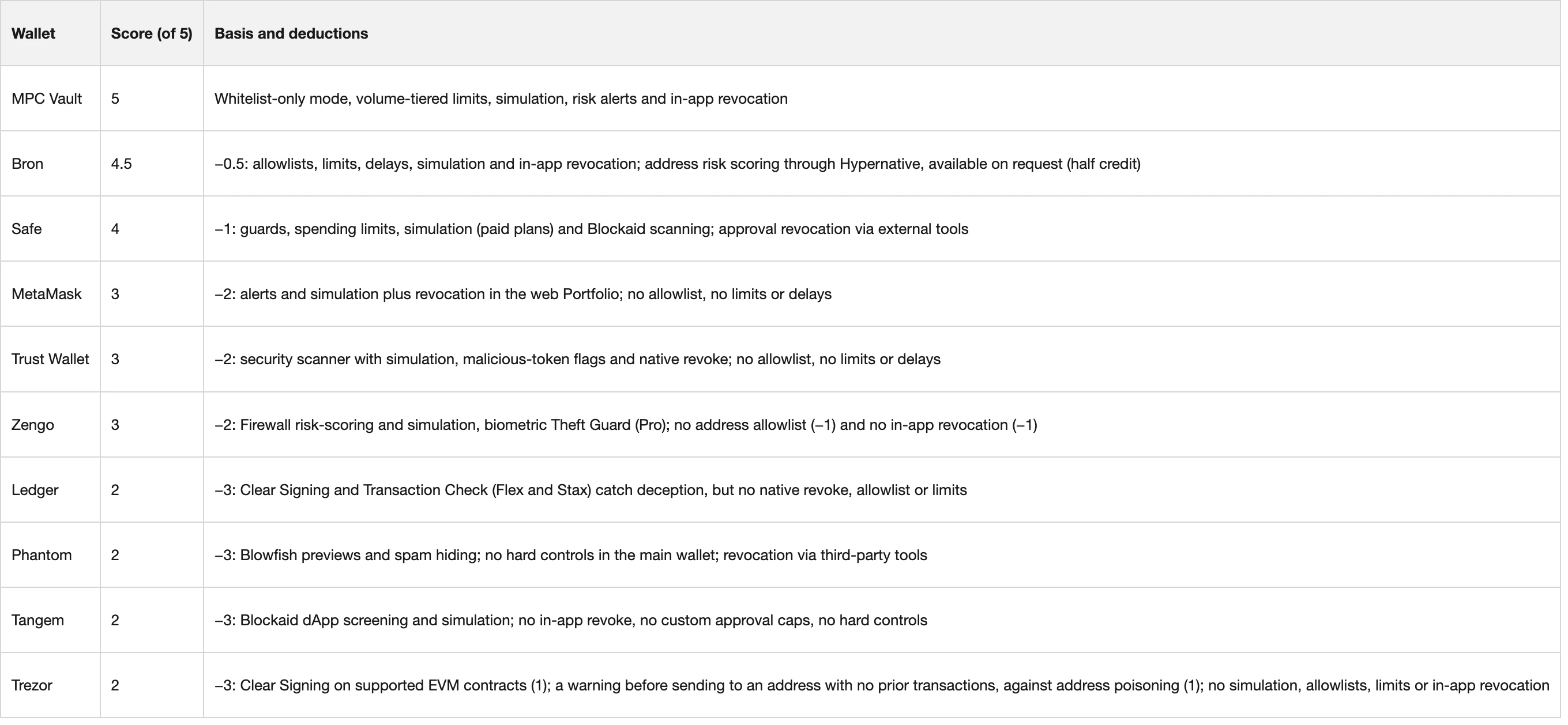
Eighth item “fraud protection” score
9. AML Screening for Deposits (5 points)
What we evaluated: Does the wallet conduct sanctions and illegal funds risk screening for incoming transactions—this "Know Your Transaction" capability allows holders to know that a receiving address has previously been tainted with dirty money before such funds contaminate their account's transaction records with exchanges or banks.
For affluent holders, this is not a theoretical issue: just a tiny bit of dust from sanctioned sources can complicate every subsequent withdrawal communication with banks or exchange compliance departments. This capability exists in the market—institutional custodial platforms integrate screening services like Chainalysis for this very reason—but it has virtually not been adopted in consumer-level non-custodial wallets. Among the ten, only Bron conducts AML risk screening for incoming and outgoing transfers via Hypernative integration; it can also score any wallet address, including the holder's own; this feature requires users to apply to enable it, not being automatically available for all accounts, thus only half a point is awarded. The existing security tools in the other nine (Blockaid, fake token filtering, Web3 firewalls) are outward-facing, focusing on what users are about to sign rather than what has just come in. The remaining nine must rely on third-party tools to conduct AML scoring for their wallets, scoring 0 points in this area. Aside from Bron, this has been found to be the most apparent gap in this assessment.

Ninth item “AML screening” score
10. Staking and Investment Products (5 points)
What we evaluated:
(a) The wallet's native staking capabilities and the breadth of supported assets;
(b) Earnings or “investment” products beyond staking, including stablecoin earnings and tokenized real-world assets.
Trust and Ledger lead in breadth. Trust supports native staking for over 20 assets, additionally having non-custodial stablecoin investment (via Morpho, Aave, Compound, etc., with floating rates) and Ondo tokenized government bonds. Ledger natively supports staking for mainstream coins post-hardware signers—ETH (Lido, Kiln), SOL, DOT, ATOM, AVAX, TRX, POL, and BNB. Bron stakes ten assets (ETH, SOL, GRAM (original TON), TRX (supports energy staking), HYPE, HBAR, ZAMA, MON, TAO, and SUI), which means staking positions fall under the same strategy engine as other assets, and it also provides exposure to US Treasury yields via mTBILL integration. Tangem supports staking for eight assets, recently adding ETH, plus offers Yield Mode (Aave stablecoin supply, with a 15% fee on earnings). MetaMask’s ETH menu is the most comprehensive (pooling, validator, and liquid staking), while mobile also added native TRX staking, stablecoin lending, and mUSD currency accounts; Phantom only stakes SOL (native and liquid staking); Safe natively stakes ETH in multiples of 32 ETH via Kiln; Zengo supports ETH and XTZ; Trezor supports ETH, SOL, and TRX while providing stablecoin yields for USDC, USDT via Morpho vault, and MPC Vault’s staking page still states “coming soon.”
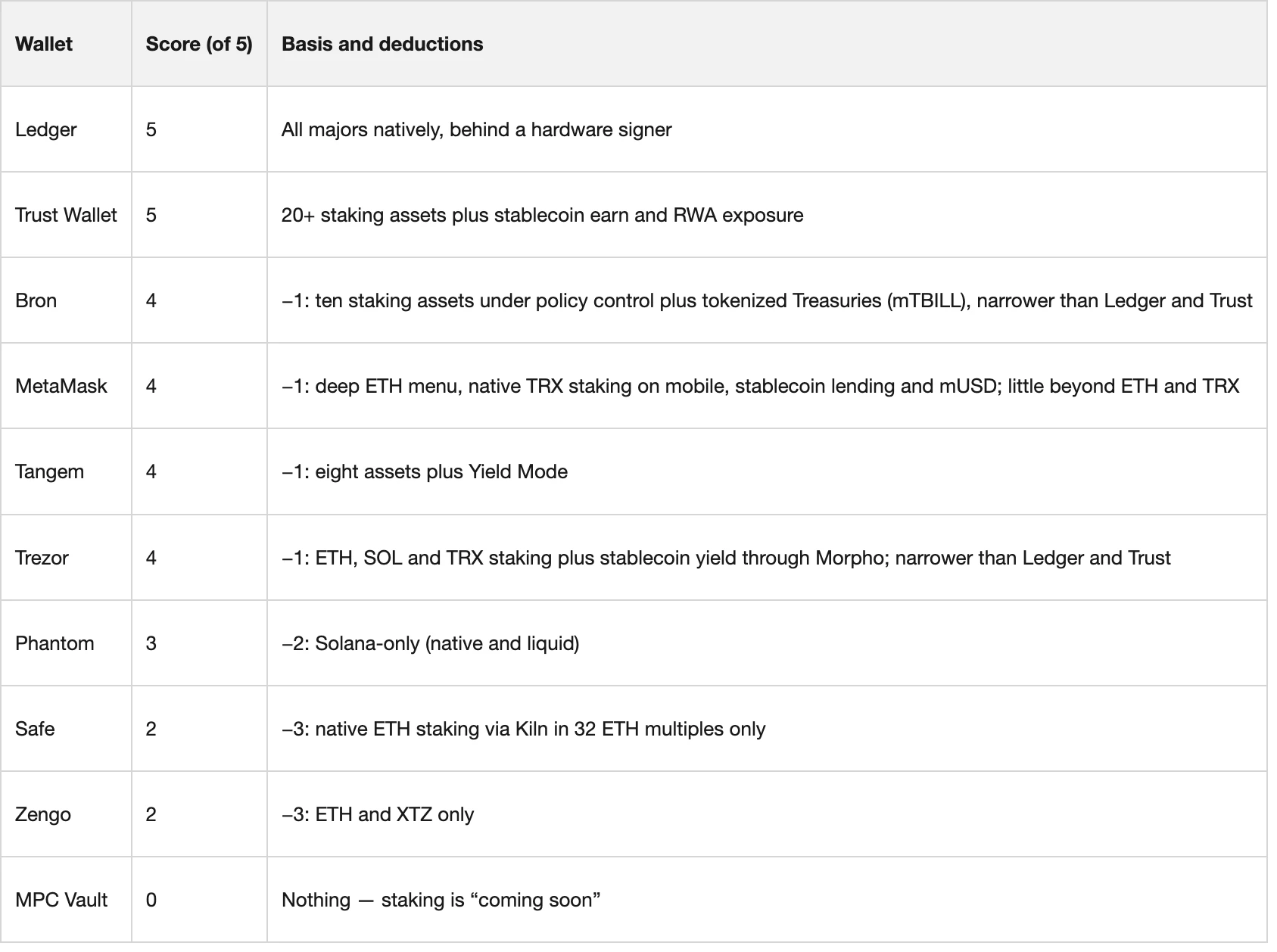
Tenth item “staking and investment” score
11. Customer Service (5 points)
What we evaluated:
(a) Channels—live chat, email, phone;
(b) Publicly stated SLA;
(c) Results we tested: the same set of questions sent to each company's front-line customer service.
For holders with seven-figure portfolios, customer service determines whether a fraud attempt is interrupted or completed. Zengo stands out in the group: 24/7 live chat covering over 180 countries, average first response under 2 minutes for Pro subscribers, and publicly commited to responding within one hour for paid tiers—this is the only vendor that publicly guarantees response times in the group. Bron also provides 24/7 chat support, with Premium tiers receiving priority chat and Private tiers getting dedicated account managers, though responses are slower than Zengo. Tangem offers 24/7 support via email and web forms, claiming a goal of responding within 24 hours. Ledger and Trust's customer support is adequate but starts with bots and lacks publicly stated SLAs; Trust promises a response within 24 hours for holders locking over 50 TWT; Phantom’s chatbot addressed seven of our eight questions on the spot, passing the eighth to email. MetaMask’s chatbot starts with an automated system, upgrading to human support when necessary; Transaction Shield subscribers receive prioritized assistance; MPC Vault has a publicly listed email contact; Trezor provides a service form and community forum but does not disclose service hours or SLA; Safe offers email and online chat, with professional support available under the paid Safe Pro package.
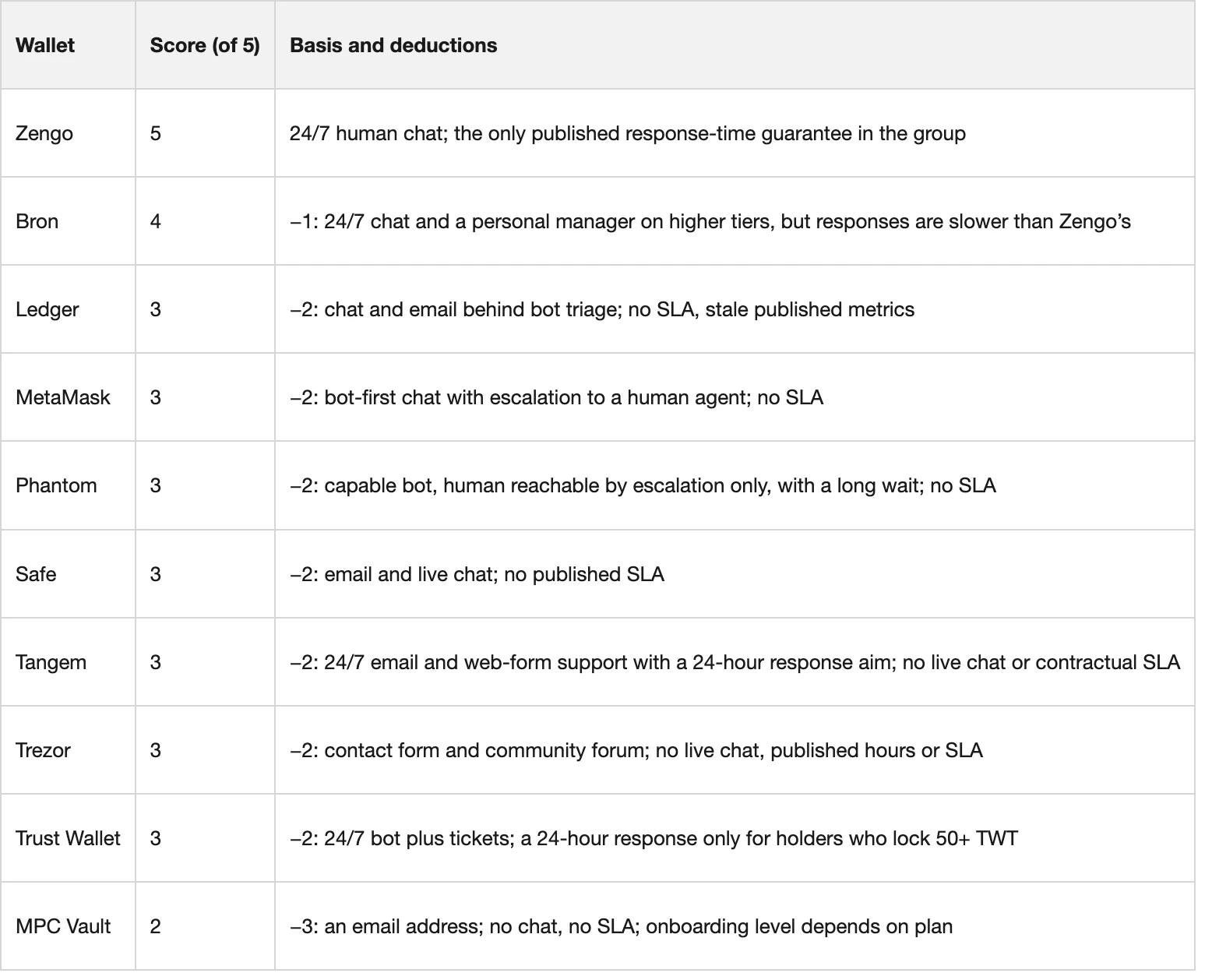
Eleventh item “customer service” score
12. Holding Privacy (5 points)
What we evaluated:
(a) What is physically exposed by the wallet when holders cross borders;
(b) Can accounts be hidden within the interface—even under coercion;
(c) Can holdings remain confidential on-chain, keeping balances and transaction amounts hidden from block explorers.
Physical anonymity earns 1 point (recognizable hardware devices will be recorded but not deducted), hidden accounts behind PIN or biometric gates earn 2 points (interface-only hiding earns 1 point), and on-chain confidentiality scores 2 points.
The third test is the most distinct as it is the hardest: public chains expose every balance and every transaction to anyone who ties addresses together, which is a security risk for large holders in itself due to this transparency.
Bron is the only wallet in this group that addresses the problem from both layers with mainstream assets. On the interface level, it offers hidden accounts, each protected by an independent six-digit PIN: once hidden, the account disappears from the list, holdings, history, and notifications until the PIN is entered; resetting the PIN requires two-factor authentication and takes 24 hours to take effect, during which it can be revoked—this is a rational delay mechanism intentionally designed for coercive scenarios. On the on-chain level, Bron integrates Zama's confidential token standard, which is based on fully homomorphic encryption: nine tokens (including USDC, USDT, WETH, and XAUt) on Ethereum can be converted into confidential forms on both web and desktop, after which the transaction amounts are encrypted on-chain and hidden from block explorers, while sending and receiving addresses remain public. Ledger has implemented hidden Zcash on the desktop, allowing Zcash transfers to be hidden; to our knowledge, no other wallet in this comparison provides on-chain confidentiality for mainstream tokens.
The remaining products compete primarily on the first two items: Zengo's Bitcoin Vault keeps holdings concealed behind biometric gates, while Private Transaction Mode rotates Bitcoin and Dogecoin receiving addresses to counteract chain analysis; MPC Vault's confidential vault is visible only to designated members; Trezor's passphrase can create hidden wallets on every Safe model, but the device can still be recognized; Tangem's card looks like a regular payment card, only offering passphrase support when importing existing mnemonics, allowing accounts to be archived from the main screen; Ledger's optional passphrase generates hidden accounts, somewhat mitigating the device recognition issue. MetaMask offers interface-enhanced account hiding via its plugin; Phantom and Trust lack documented account hiding; Safe is invisible in the bag but entirely public on-chain.
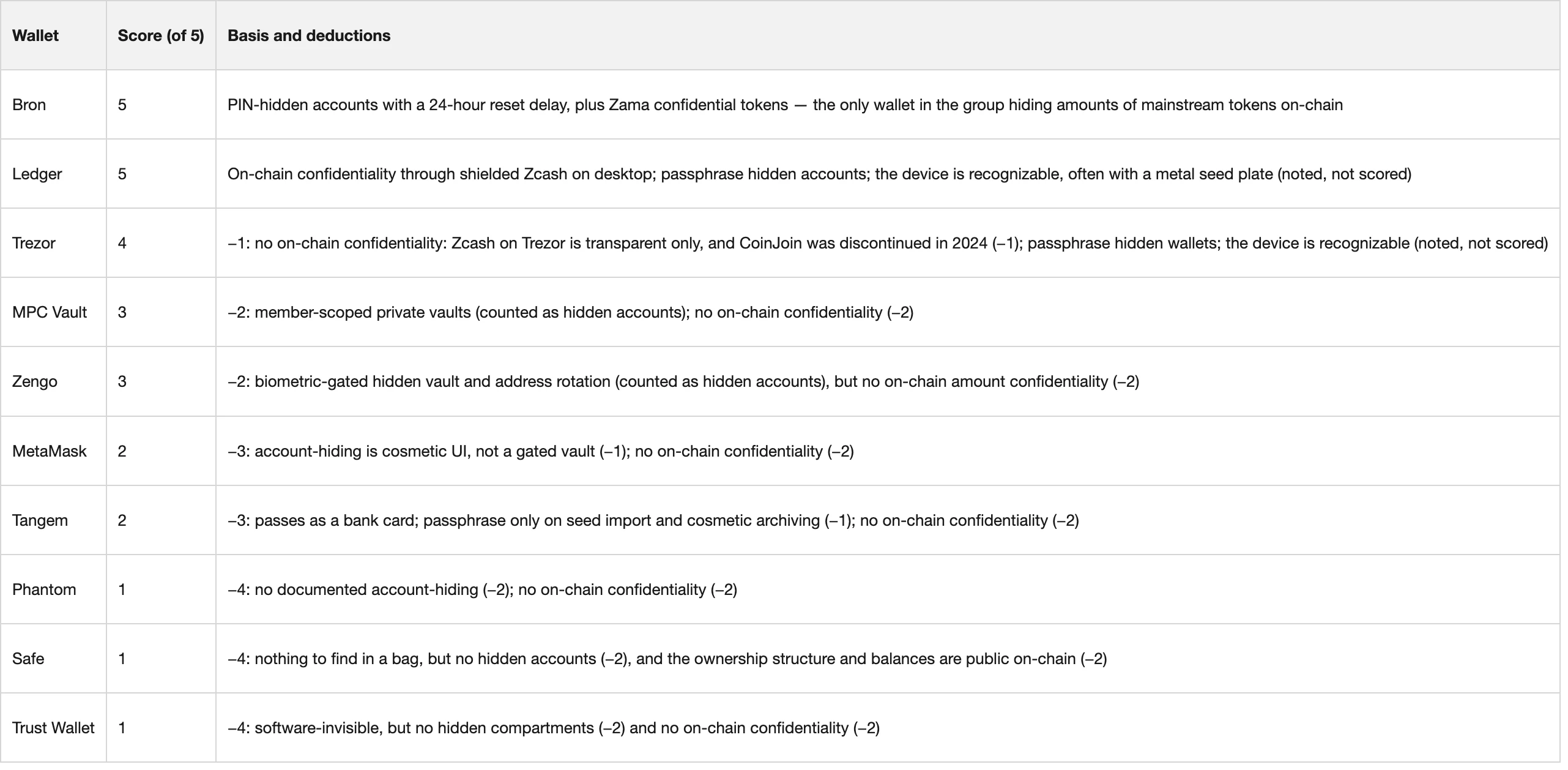
Twelfth item “holding privacy” score
免责声明:本文章仅代表作者个人观点,不代表本平台的立场和观点。本文章仅供信息分享,不构成对任何人的任何投资建议。用户与作者之间的任何争议,与本平台无关。如网页中刊载的文章或图片涉及侵权,请提供相关的权利证明和身份证明发送邮件到[email protected],本平台相关工作人员将会进行核查。