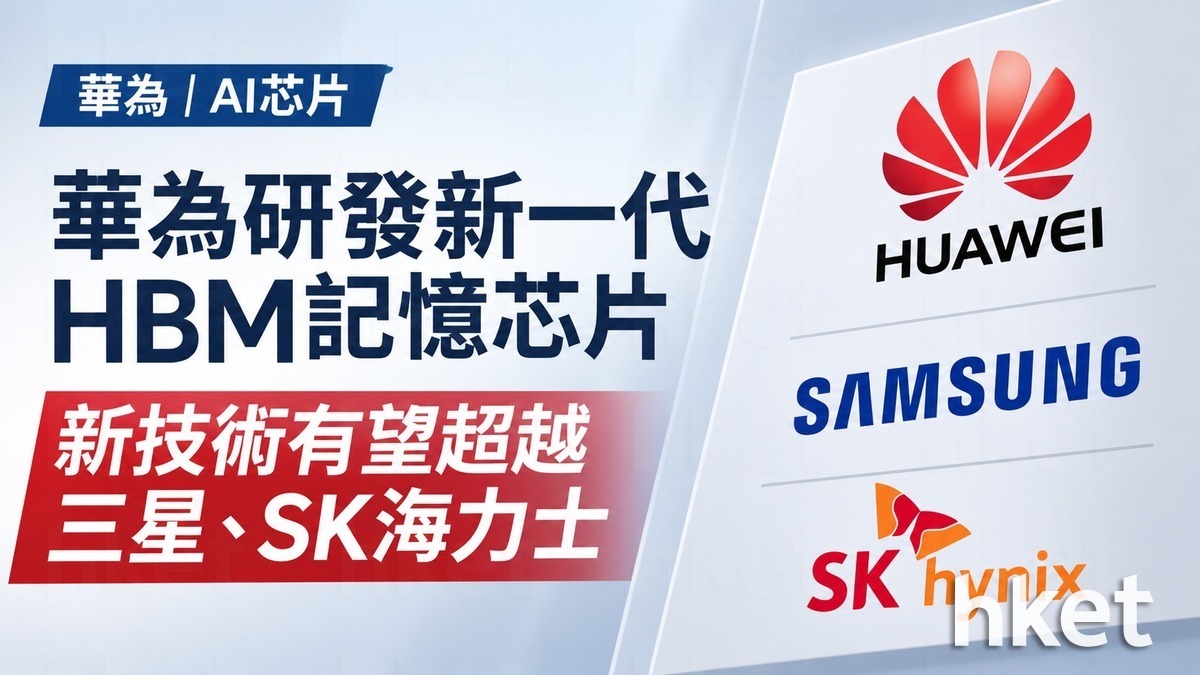
Huawei is developing a new generation of high bandwidth memory (HBM) chips, with some technical specifications surpassing those of South Korean memory chip giants Samsung Electronics (KR:005930) and SK Hynix (KR:000660) currently in mass production. The research results are expected to be announced at the International Solid-State Circuits Conference (ISSCC) to be held in San Francisco, USA, in February next year.
According to Bloomberg's report on Thursday (26th), the title of the paper submitted by Huawei researchers indicates that the data pin density of the new generation HBM is twice as high as that of its South Korean competitors' products currently in mass production, meaning that more data transmission channels can be accommodated in the same area, theoretically significantly increasing memory bandwidth and accelerating data transmission for AI processors.
Currently, the global HBM market is mainly dominated by Samsung, SK Hynix, and Micron (US: MU), all of which are affected by US export restrictions on HBM to China.
As the overseas HBM inventory previously reserved by Chinese companies gradually decreases, if Huawei successfully achieves independent mass production, it will help resolve a significant problem in the supply of AI chips in China.
Since the US restricted the export of advanced AI chips from Nvidia (US: NVDA) to China, Huawei's Ascend series has become the most widely used domestic AI acceleration chip in China. Huawei plans to launch at least one new AI chip each year until 2029 to meet the increasing computing power demands of Chinese AI companies such as DeepSeek and The Dark Side of the Moon.
In addition to Huawei, Chinese memory chip manufacturer Changxin Memory Technology is also developing a new generation of chip architecture, having announced progress with its 4F² technology last month, which is planned to be applied to upcoming server memory products.
This article is reproduced from the Hong Kong Economic Journal, and the copyright belongs to the original author and original media.
免责声明:本文章仅代表作者个人观点,不代表本平台的立场和观点。本文章仅供信息分享,不构成对任何人的任何投资建议。用户与作者之间的任何争议,与本平台无关。如网页中刊载的文章或图片涉及侵权,请提供相关的权利证明和身份证明发送邮件到[email protected],本平台相关工作人员将会进行核查。