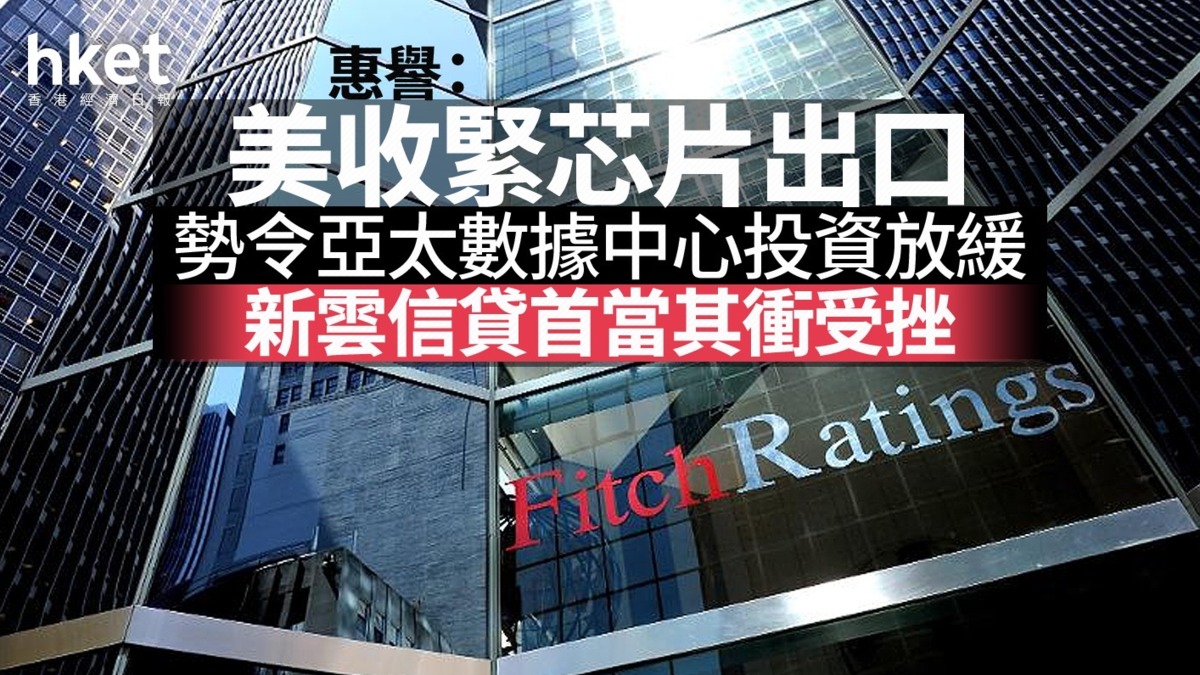
The rating agency Fitch Ratings published a report stating that as the United States further tightens export controls on artificial intelligence (AI) chips, the pace of data center investment in the Asia-Pacific region will slow, with a more cautious approach emerging. Cloud service providers (Neocloud operators) that rely on Chinese customers and advanced semiconductors from the United States will face greater credit pressure.
Policy Uncertainty Slows Hardware Delivery Progress
Fitch indicated that the latest regulations from the U.S. Department of Commerce's Bureau of Industry and Security (BIS) require obtaining additional licenses before exporting chips to four countries: Malaysia, Singapore, Indonesia, and Thailand. Overseas data centers that provide substantial computing power to Chinese enterprises are also included in the regulations. Reports indicate that Nvidia (NVDA) and its manufacturers have suspended shipments of some servers to the aforementioned four markets, reflecting that policy uncertainty is slowing hardware delivery, production, and financing progress.
Fitch pointed out that the credit financing for new cloud service providers will be the most affected. The cash flow of major new cloud service providers highly depends on the utilization rate of their graphics processing units (GPUs) by customers. Under the new U.S. regulations, some highly leveraged new cloud operators with a significant market share in China may need to lower prices or continue using existing Nvidia chips without upgrades, which will hinder their sales, profits, and competitiveness.
Regarding regional development, Fitch believes that projects in Southeast Asia will show differentiation based on customers and workloads. Taking Johor, Malaysia, as an example, where major U.S. hyperscalers, Chinese-related projects, and wholesale data centers converge, it is anticipated that projects more deeply affected by Chinese capital and related computing power will slow down in the future.
Future AI Project Financing Will Tighten Further, Domestic Chips Hard to Replace in the Short Term
Under unclear policies and doubts about customer eligibility, Fitch believes that financing conditions for future AI projects will tighten further. Large physical data centers with long-term contract revenue have significantly lower credit risk compared to GPU or new cloud projects that rely on a single customer group for repayment.
The agency also indicated that domestic chips from companies like Huawei may help alleviate supply constraints in the long run, but in the short term, it is difficult to replace Nvidia's chips. It is believed that this action by the United States will accelerate China's investment in domestic chips and AI infrastructure.
This article is reproduced from Hong Kong Economic Daily, and the copyright belongs to the original author and original media.
免责声明:本文章仅代表作者个人观点,不代表本平台的立场和观点。本文章仅供信息分享,不构成对任何人的任何投资建议。用户与作者之间的任何争议,与本平台无关。如网页中刊载的文章或图片涉及侵权,请提供相关的权利证明和身份证明发送邮件到[email protected],本平台相关工作人员将会进行核查。