Original|Odaily Planet Daily (@OdailyChina)
Author|Wenser (@wenser 2010)

Who decides the price of AI computing power? Previously, the answer to this question might have been chip giants like Nvidia and AMD and AI giants like OpenAI and Anthropic, but now, prediction market platforms are choosing to enter this field with a financialized pricing approach.
In the early hours of today, on the third day of Nvidia founder Jensen Huang's return, Polymarket founder and CEO Shayne Coplanannounced that the platform has launched an AI computing power market, supporting public pricing for the on-demand rental prices of three mainstream GPUs: Nvidia H100, B200, and B300, with contract terms extending as far as 2 years into the future, to December 2028. Shayne Coplan likened it to the "return on cost of computing power" and stated: "The entire AI economy is built on these prices, and previously there was no public market to see their future trends."
In fact, Kalshi launched GPU rental price prediction contracts back in March 2026, covering H100, H200, B200, A100, RTX 5090, etc., settling with the Ornn index, and in July released market-implied forward curves based on these contracts.
Prediction markets are targeting the business of "financialization of computing power," systematically entering the heavy asset field of A1 computing power, attempting to turn what was previously a highly opaque GPU rental into tradable and hedgable financial price signals with their own data. Here, the price of computing power itself has become a tradable investment asset.
The Backstory Behind PolyMarket's "Computing Power Market": From Binary Predictions to Computing Power Forward Curves
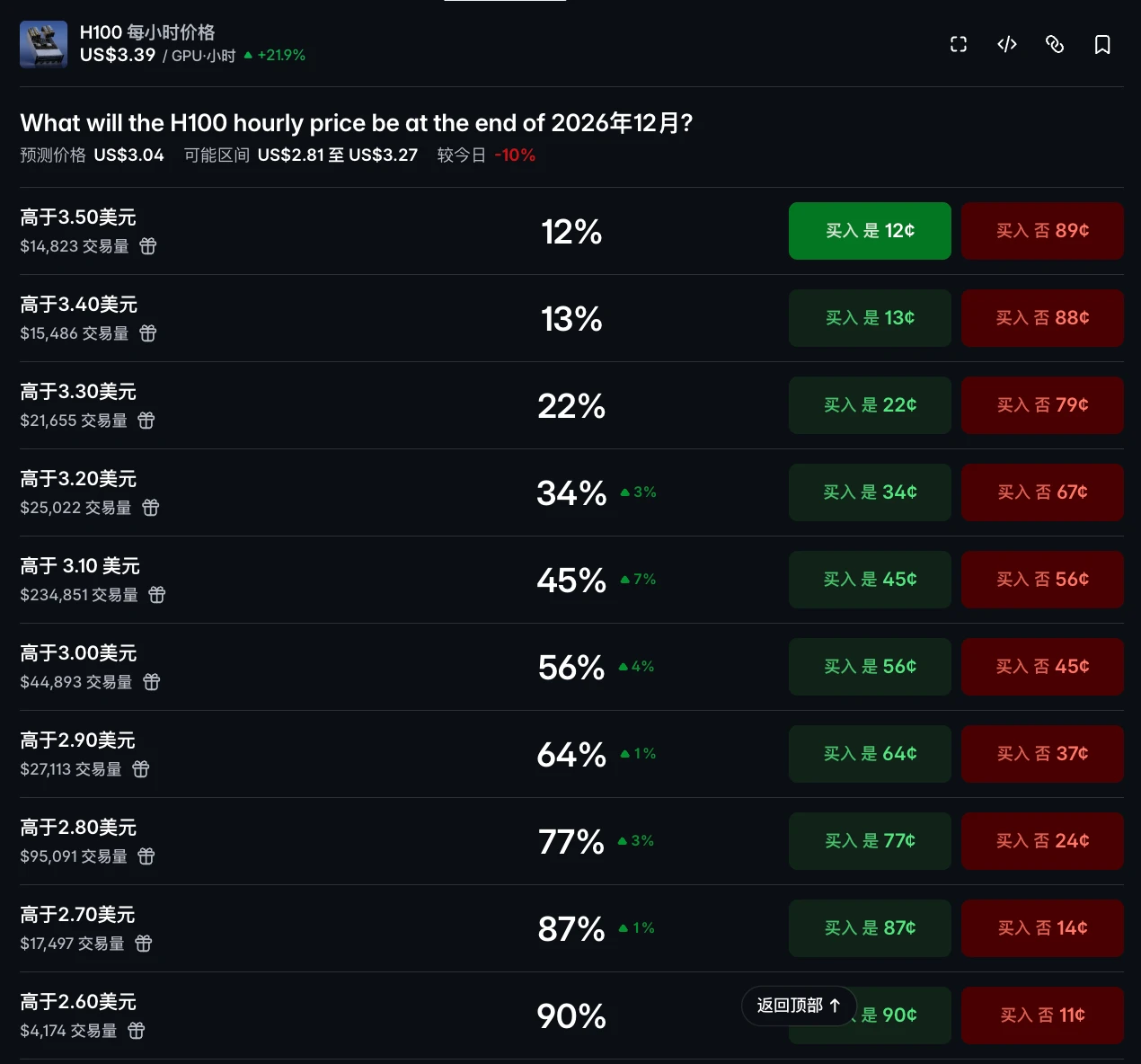
According to the platform's introduction, the main offerings on PolyMarket are cash-settled binary prediction markets: traders can buy or sell whether the monthly average rental price of a specific chip in a specific month is above a certain threshold. For example, "Will the average rental price of H100 in December 2026 exceed $3 per GPU·hour?"
The platform then reverse-engineers the implied rental price for that month based on the market probability of different thresholds, thus forming a forward price curve extending from now to 2028. The settlement benchmark adopts the OCPI index, compiled from actual on-demand rental transactions rather than the listed prices of cloud vendors, which can be queried on Bloomberg terminals.
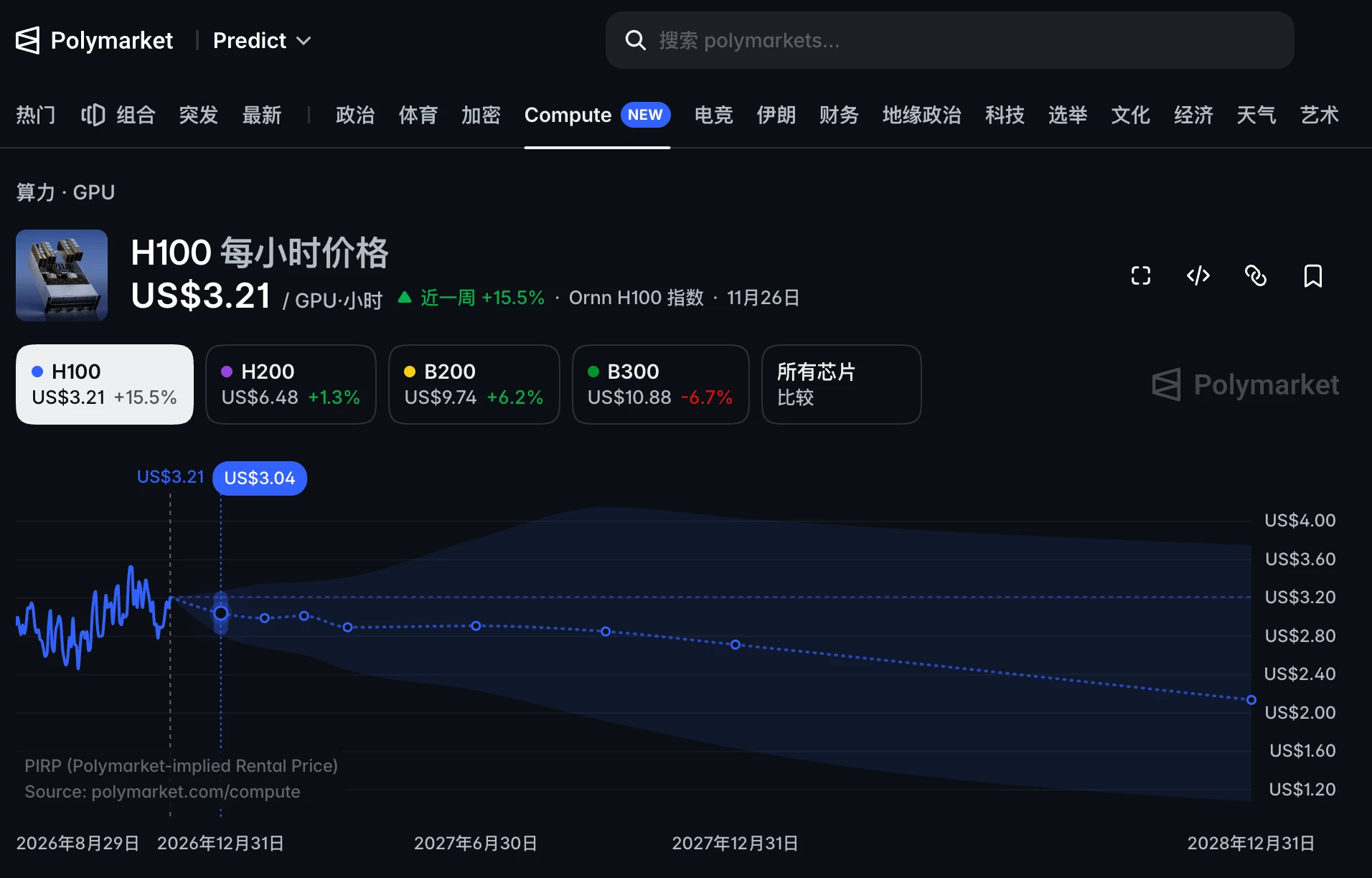
As of the time of writing, the Ornn index shows H100 at approximately $3.21 per GPU hour, H200 at about $6.48 per GPU hour, B200 at around $9.74 per GPU hour, and B300 at approximately $10.88 per GPU hour.
Early implied price curves from Polymarket show that the market generally expects GPU rental prices to decline in the medium to long term, with H100 potentially dropping to about $2.14 by the end of 2028, a decrease of over 30%.
It is noteworthy that the computing power contracts on the PolyMarket platform do not involve the actual delivery of computing power; traders earn cash returns from price fluctuations rather than locking in the corresponding GPU usage rights. Additionally, PolyMarket will later open related perpetual products, but trading has not yet been opened.
The price prediction probabilities from the PolyMarket platform itself also serve as one of the price references. Although the trading volume of individual price predictions remains at the tens of thousands of dollars level, with even the H200 related price prediction trading volume only at a few hundred dollars, the subsequent real-time price changes can still to some extent reflect price fluctuations in the computing power market.
Lastly, in comparison, the actual rental prices given by Bittensor's GPU computing power rental platform lium.io are significantly lower than the corresponding prices shown on the PolyMarket platform based on the OCPI index, indicating that the current supply of computing power is not so scarce as to be "priced but not traded," and that there is still some idle capacity being bid at lower prices, while stable available computing power remains at a high price level.
It is important to note that this is not the first time Polymarket has touched on computing power pricing.
As early as June this year, PolyMarket completed its first institutional-grade bulk transaction with digital asset prime broker FalconX and AneraLabs, with a transaction size reaching six figures in dollars, using the Ornn H100 index as the settlement benchmark to hedge AI computing cost risks.
Coplan emphasized in the announcement that several hundred billion dollars' worth of computing power procurement and financing commitments have been locked in for several years, and these transactions are essentially leveraged bets on future GPU rental prices. "As AI financing gradually returns to rationality, laboratories buying computing power, cloud vendors selling computing power, and financial institutions lending against computing power all need tools to hedge this risk." He stated that Polymarket aims to make computing power one of the largest financial markets globally, and the launch is just the first step, actively inviting institutions with real buying, selling, or financing needs to privately negotiate large, tiered, or cross-month combination transactions.
PolyMarket Launches AI Computing Power Market, Stirring Up Price, Risk, and Financing Dynamics in the AI Industry
For the AI industry, the launch of the AI computing power market on PolyMarket fills market gaps in at least three areas:
First, it is price discovery for computing power. In the past, GPU rental prices heavily relied on private negotiations and long-term agreements, with buyers, sellers, and financiers often lacking a unified reference price anchor. Now, based on the publicly disclosed pricing trends of GPUs from PolyMarket, all parties in business negotiations have an additional layer of market consensus born from real monetary transactions.
Second, it is risk hedging for computing power assets. Many new cloud firms heavily borrow to acquire GPU assets, and banks also lend against GPUs as collateral. If future rental prices fall sharply, both asset value and cash flow will come under pressure. Public price signals assist all parties in identifying risks earlier and reducing related risks through controlling debt scale and increasing collateral asset diversity.
Third, it is the pricing of financing in the computing power industry. As GPU-related computing resources gradually shift from "purchasing equipment" to "investing in future cash flows," public forward prices are expected to become one of the important reference bases for valuation and credit assessment, similar to the influence of futures prices on spot prices in commodity markets.
Previously, CME Group had planned to launch H100 and B200 futures based on the Silicon Data index, and ICE Group is also advancing contracts linked to the Ornn index. Thanks to the flexibility and trading characteristics of prediction market platforms, Polymarket has launched a computing power pricing market with a lower participation threshold, but still exhibits significant differences in liquidity depth, regulatory status, and product standardization when compared to compliant futures exchanges.
It is important to note that the relevant indices cover the on-demand rental market, while a large part of the revenue in the AI industry comes from long-term reserved contracts, leading to a basis between the two. Thus, the data from PolyMarket should be viewed as price signals and not as industry tools for locking in actual costs. Additionally, as AI computing power chips evolve rapidly, real monetary predictions and transactions do not guarantee that the future will unfold as expected; whether the price curve can consistently progress is another matter.
The Initial Form of Financialization of Computing Power Takes Shape, Further Enhancing Transparency of Key Resources in the AI Industry
The greatest significance of PolyMarket launching the AI computing power market lies in publicizing and transparently showcasing the previously internal question of "how much is one hour of GPU worth." On one hand, with the development of the AI industry, AI computing power as a key resource has shown obvious commercialization characteristics; on the other hand, the existing financing and procurement system still struggles to provide transparent pricing for AI computing power, which is the value of the PolyMarket pricing curve.
Whether it can truly sustain the business of financializing computing power in the future depends on continued liquidity accumulation, the credibility of the index gaining industry recognition, and competitive performance with traditional compliant exchanges.
What we can affirm is that, at least starting now, AI computing power has for the first time had a publicly visible, tradable, and quotable forward price curve, providing another indicator for identifying whether the "AI bubble is about to burst."
免责声明:本文章仅代表作者个人观点,不代表本平台的立场和观点。本文章仅供信息分享,不构成对任何人的任何投资建议。用户与作者之间的任何争议,与本平台无关。如网页中刊载的文章或图片涉及侵权,请提供相关的权利证明和身份证明发送邮件到[email protected],本平台相关工作人员将会进行核查。