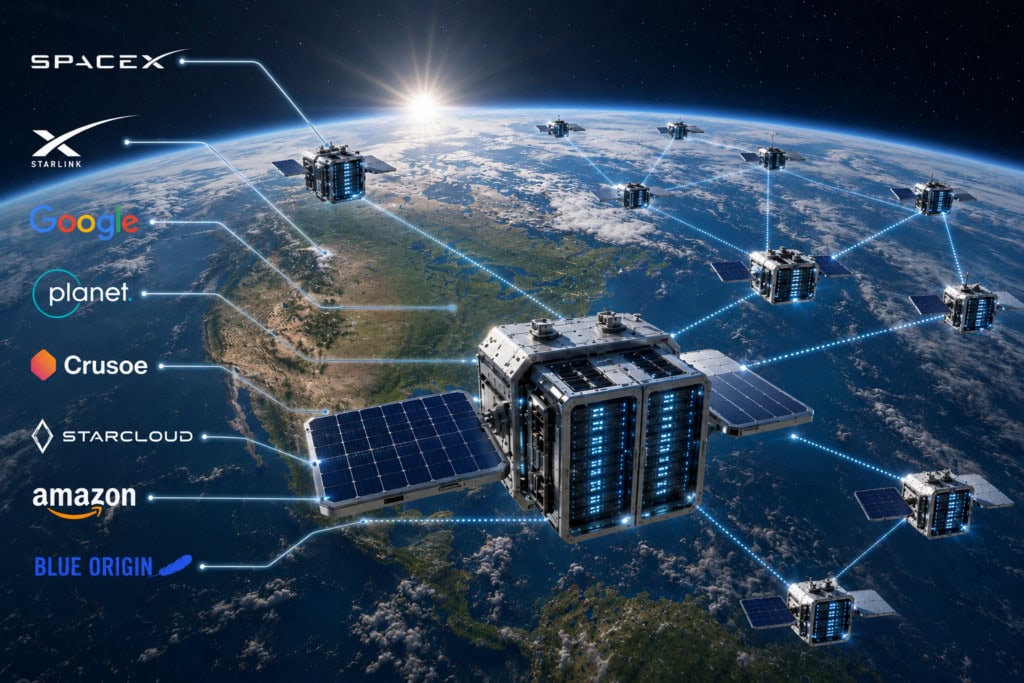
The Federal Communications Commission (FCC) of the United States conditionally approved on November 25 the deployment of up to 1 million computing satellites by SpaceX to establish a space AI data center network called Starmind. According to the FCC approval document, the satellites will be distributed in orbits ranging from 500 to 1,002 kilometers above the ground, and SpaceX must activate the first satellite by 2033 at the latest and complete the entire network deployment by 2040 to maintain the current full license.

SpaceX submitted the application on January 30 this year, originally suggesting to deploy the satellites at altitudes of 500 to 2,000 kilometers, but the final approved range was narrowed down to 1,002 kilometers. The FCC stipulated that SpaceX must deploy and activate 100,000 satellites by November 25, 2035, increase it to 500,000 by the same date in 2038, and complete the deployment of all 1 million satellites by the same date in 2040. The license is valid for 15 years from the date the first satellite is officially put into operation and certified to the FCC.
Starmind primarily uses lasers for high-speed communication between satellites and connects to SpaceX’s existing Starlink satellite network. The FCC also approved limited use of radio frequency bands for backup telemetry, tracking, and control in case of optical communication failures. FCC Chairman Brendan Carr stated that extending computing power beyond Earth will help the United States develop new generations of AI computing infrastructure.
Solar Power Supply Cooling in a Vacuum Environment Remains Challenging
SpaceX's space data center concept is to use solar energy in orbit to power computing devices, reducing reliance on ground power grids and cooling water. However, the cold of space does not mean that heat dissipation is easy. Heating control data from the National Aeronautics and Space Administration (NASA) indicates that a vacuum environment lacks air convection, so devices need to conduct heat generated by chips to heat dissipation surfaces and then release it outward through thermal radiation.
Whether large-scale AI computing can effectively dissipate heat within the limited volume and weight of the satellites, as well as whether power supply, data transmission, and launch costs can support commercial operations, remains to be verified. Regulatory approval itself does not imply that the technology or cost-effectiveness has been validated.
Astronomers Worry About Satellite Collisions and Observational Interference
The American Astronomical Society (AAS), Amazon Leo, and satellite communications provider Viasat previously submitted objections to the FCC. FCC documents recorded the concerns of various parties regarding orbital congestion, collisions, space debris, and astronomical observations. The American Astronomical Society also pointed out that a large number of computing satellites emitting waste heat could increase the infrared background radiation of the sky, affecting scientific observations.
The FCC requires SpaceX to submit a modified permit application that includes a final space debris mitigation plan before deploying satellites operating at altitudes above 600 kilometers. SpaceX is also required to report satellite deployment, near-collision events, and re-entry data every six months. The FCC believes that SpaceX's commitment to coordinate with the National Science Foundation is sufficient to address the concerns related to optical astronomical observations in the documents, and no additional conditions were imposed.
This article is reprinted from unwire.hk, with all copyrights belonging to the original author and original media.
免责声明:本文章仅代表作者个人观点,不代表本平台的立场和观点。本文章仅供信息分享,不构成对任何人的任何投资建议。用户与作者之间的任何争议,与本平台无关。如网页中刊载的文章或图片涉及侵权,请提供相关的权利证明和身份证明发送邮件到[email protected],本平台相关工作人员将会进行核查。