On November 24, the US stock market gave the AI server industry a rather typical lesson in financial reporting.
On the evening of the previous trading day, HPE announced better-than-expected quarterly results and significantly raised its revenue growth guidance for the fiscal year 2027, but the next day, its stock price plummeted by 16.31%; on the same day, Dell was affected by weakness in the tech hardware sector and fell by 11.83% ahead of its earnings report, but after closing, it also disclosed a strong earnings report, leading to a rebound in its stock price.
If we only look at revenue, orders, and performance guidance, both companies are positioned to benefit from the expansion of AI infrastructure, but the market has clearly become dissatisfied with merely seeing orders reach new highs, focusing more on how much profit they can retain from those orders.
This may be one of the changes in the AI hardware supply chain that deserves close attention in the coming quarters.
1. Two better-than-expected earnings reports, why did the market react so differently?
Looking at the current figures alone, both companies have solid performances without obvious flaws.
HPE's revenue for the fourth quarter of fiscal year 2026 reached $14.5 billion, a year-on-year increase of 50%; Non-GAAP EPS was $1.43, up 131% year-on-year, with Cloud & AI revenue at $11.3 billion, growing 68.6%, and server business revenue of $8.8 billion, up 94.7% year-on-year.
More importantly, the company raised its revenue growth guidance for fiscal year 2027 from the previous range of 13% to 17% to a new range of 27% to 35%, with an expected free cash flow of at least $5.5 billion for the year.
Dell’s third quarter for fiscal year 2027 also showed strong performance, with quarterly revenue of $54.9 billion, a year-on-year increase of 103%; Non-GAAP EPS reached $9.45, a 265% increase, with backlogged orders for AI servers reaching $132.3 billion, and revenue guidance for AI servers raised from $74 billion to $78 billion, with an additional $25 billion in stock buyback authorization.
Since both performances are solid, the distinction in market pricing actually comes from expectations of future profit margins.
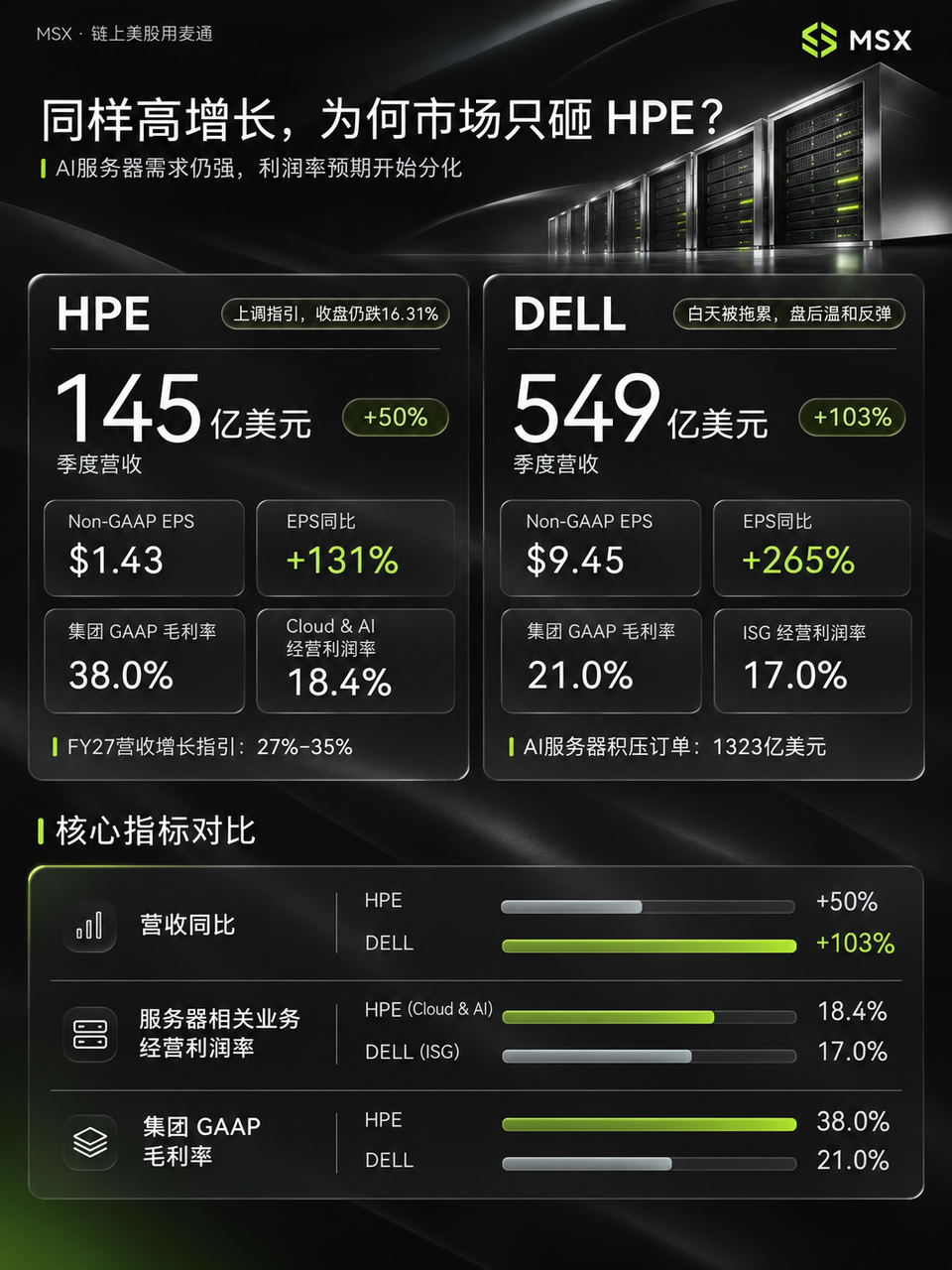
HPE's pressure is first revealed in its profit margin guidance. Over the past year, the operating margin of HPE's Cloud & AI business rose from 9.3% in the same period last year to 18.4% in the latest quarter, but this rise included temporary benefits from component shortages, product price increases, and cost control. Management expects that the operating margin for this business in the first quarter of fiscal year 2027 will fall back to 16% to 17%, further reducing to around 14% for the full year.
There are two main explanations: on one hand, the space for product price increases will gradually narrow entering fiscal year 2027, while purchasing cost pressures will not immediately dissipate; on the other hand, the rising proportion of relatively lower-margin AI servers will naturally dilute the overall profit margin.
Dell, however, demonstrated another solution, primarily by leveraging economies of scale and business structure to hedge against the profit margin pressure brought on by AI servers.
Its Infrastructure Solutions Group (ISG) revenue reached $42 billion, a year-on-year increase of 198%; broken down, AI-optimized server revenue was $22 billion (up 291% year-on-year), traditional server and networking business revenue was $15 billion (up 235% year-on-year), and storage business revenue was $4.9 billion (up 24% year-on-year), with ISG operating profit reaching $7.1 billion, a year-on-year increase of 308%, and operating margin rising to 17%, a significant increase of 460 basis points year-on-year.
However, looking deeper, it can be found that Dell's overall GAAP gross margin is about 21%, which shows very limited improvement compared to last year's 20.7%. The significant leap in profitability is primarily due to the operating leverage released after revenue doubled—the group's Non-GAAP operating expenses as a percentage of revenue have been compressed to 7%, down 4.8 percentage points year-on-year; at the same time, traditional servers and proprietary storage businesses contributed substantial profits, helping to offset some of the structural pressure from AI servers.
Even so, Dell is not without concerns. Management expects that as the temporary benefits brought by the North American business structure return to normal, ISG operating margin will see a sequential decline; tight memory supply and rising procurement costs are expected to continue into 2027, though the rate of increase may be lower than in 2026.
It can be said that both earnings reports point to the same industry reality: that the demand growth for AI servers is already quite clear, and the true test for manufacturers going forward is whether they can maintain profit margins while continuing to expand.
2. Profit margin cycle and inventory dark line: Who is benefiting from price hikes?
Many may not understand why, with the prices of memory chips and key components continually rising, server manufacturers' profit margins have instead been increasing over the past few quarters.
This involves an important factor, namely the time lag of cost transmission.
Assuming a server manufacturer initially has a production cost of $800,000 and a selling price of $1,000,000, resulting in a gross margin of 20%. When memory and other key components become scarce, the manufacturer can raise the selling price to $1,200,000, but since they had previously purchased a batch of low-cost components, the short-term production cost remains at $800,000, causing the gross margin to jump to 33.3%.
However, once that batch of low-cost inventory is exhausted, the manufacturer has to replenish at high market prices, the production cost rises to $1,000,000, and if the selling price remains capped at $1,200,000 due to customer acceptance, the gross margin would drop back to 16.7%.
In other words, the overall selling price remains high, revenue continues to grow, but the actual profit that can be retained per machine has thinned out. Although in real operations, factors such as long-term procurement contracts, customer price locks, inventory turnover, and internal cost control are also layered, this time lag in transmission is sufficient to explain the turning point pressure currently facing HPE.
Over the past year, supply shortages have given server manufacturers strong pricing power, but as low-cost inventory is gradually consumed and procurement costs are re-priced, the original profit margin advantage may gradually vanish. Moreover, in this round of AI infrastructure expansion, the growing demand for HBM has led to more DRAM wafer capacity being allocated to HBM production, further squeezing the supply of traditional server memory.
HPE's management expects that the supply tightness of memory, NAND, and other key components will last at least until the second half of 2028; Dell’s management also believes that the tight supply of server memory will continue into 2027, although the rate of price increase may slow down, overall costs will still face upward pressure.
This means that in the short term, server manufacturers still have the opportunity to maintain revenue through price increases, but whether they can continually pass costs onto downstream will be key to the changes in profit margins.
In addition to profit margins, the inventory and cash flow dark lines on the balance sheet should not be ignored.
Dell's latest quarter showed operating cash flow of about $4.46 billion (up 280% year-on-year) and free cash flow of about $3.47 billion. While this indicates strong cash generation capability, the company's inventory has surged from $10.4 billion at the beginning of this fiscal year to $29.4 billion, and accounts payable have also expanded from $33.6 billion to $57.8 billion. If downstream data center construction delays or if power and cooling support face bottlenecks, inventory buildup and capital occupation will swiftly turn into real risks.
In response to this, Dell's management addressed it specifically during the conference call, stating that the $132.3 billion in backlogged AI server orders have all undergone strict reviews, covering customer financial capabilities, end-user contracts, land, power supply, and trade compliance requirements, and will undergo a second review before production begins, but passing the review does not equal zero履约 risk.
Especially since many emerging AI cloud service providers are still highly reliant on external financing to establish data centers, once financing conditions tighten or infrastructure construction delays occur, the delivery pace of complete machine manufacturers still faces uncertainties.
3. Which segments are concentrating profits in the AI supply chain?
From this perspective, when investing in the AI supply chain, determining what the most scarce resources in the entire chain are and who possesses greater pricing power is actually a more effective entry point.
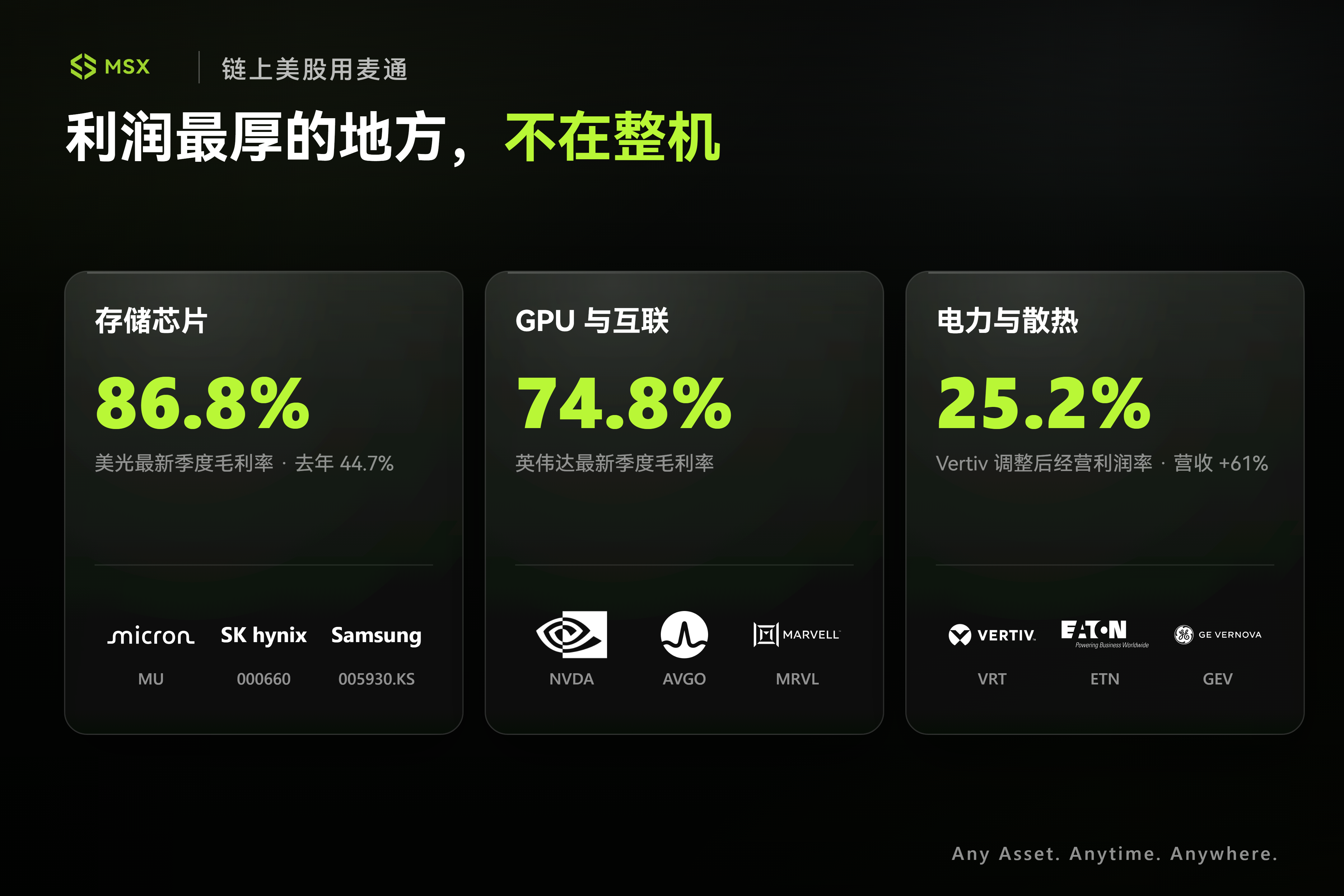
From the latest earnings reports, significant disparities in profitability have already emerged across different segments of the supply chain. For example, looking at the latest quarterly GAAP gross margins of several representative companies:
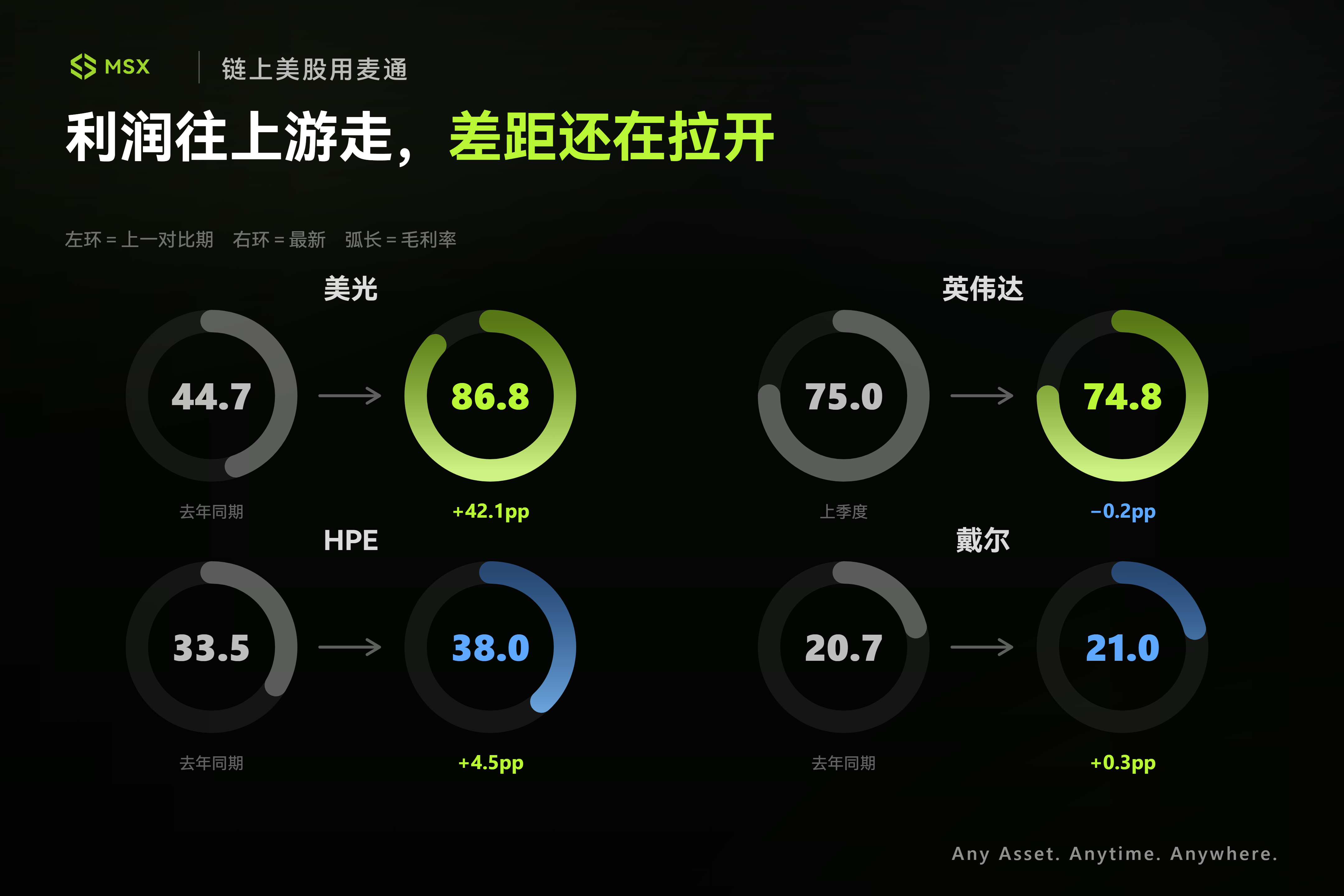
Following this gross margin ladder down, the three core sectors of the supply chain exhibit distinctly different profit logic.
1. Memory Chips: The cyclical bonus is being released rapidly, but one must be cautious of profit peaks.
Micron’s latest quarterly GAAP gross margin soared to 86.8% (up from 44.7% year-on-year), intuitively confirming the explosive demand for HBM alongside the supply squeeze of traditional DRAM, marking the most direct beneficiaries of this round of AI infrastructure expansion for Micron, SK Hynix, and Samsung.
However, memory is ultimately a strongly cyclical industry—when gross margins reach historical highs, the market must consider how long these super profits can be sustained. Even if the forward P/E ratio looks low, it does not necessarily mean it is cheap; once the current profit forecast is based on the assumption of continuous price hikes, any slowdown in price increases or release of new supply will quickly elevate the risk of downward revisions in profit expectations and valuations.
Therefore, the biggest risk in the memory sector is precisely that the market has already priced in a substantial portion of future profits too early.
2. GPUs: Technological barriers and pricing power remain the core moat.
NVIDIA’s latest quarterly GAAP gross margin was 74.8%, slightly down from 75.0% the previous quarter, still solidly at the top of the pyramid. Compared to the complete machine manufacturers squeezed between upstream and downstream, NVIDIA has built substantial customer switching costs through its CUDA ecosystem, chip performance, high-speed interconnects, and complete rack system solutions.
Despite facing the same pressures from rising prices of HBM, increased costs of advanced packaging, and competition from custom chips like Google's TPU, as long as the demand for AI training and inference continues to expand, GPUs remain the segment with the thickest technological barriers and the strongest bargaining power in the entire hardware chain.
3. Power and Cooling: Another hard constraint for the realization of AI data centers.
When Dell reviewed its hundreds of billions of dollars in orders, it placed land, power, and cooling on par with funding in terms of importance because even if customers have the funds to buy GPUs and servers, if the data center cannot secure enough power or resolve cooling issues, the computing equipment will remain idle.
As the power consumption per rack continues to climb, liquid cooling, transformers, power supply and distribution equipment, and data center infrastructure are becoming hard constraints. For example, Vertiv (VRT) saw its revenue grow 61% year-on-year in the third quarter of 2026, with adjusted operating margin reaching 25.2%, a year-on-year increase of 2.9 percentage points, demonstrating a rare case of simultaneous revenue and margin expansion.
Aside from Vertiv, other leaders in power infrastructure such as Eaton (ETN) and GE Vernova (GEV) are also worth long-term tracking. However, this sector generally faces common risks such as high valuations, expansion investments, and delays in customer data center construction.
Combining the signals released by HPE and Dell in these two reports, in the coming quarters, we can focus on four indicators:
- Contract prices for memory chips: Focus on the slope of contract prices for DRAM, HBM, and NAND, observing whether the rate of price increases begins to consistently slow down, and when new capacity will substantially ease supply tightness;
- The profit margin quality of server manufacturers: Closely monitor the evolution of Dell's ISG and HPE Cloud & AI operating margins, as well as management’s latest insights on procurement costs, product pricing, and business structure;
- The speed of fulfilling backlog orders: If there are new highs in backlog orders but simultaneous growth in inventory and accounts receivable, alongside weakening operating cash flow, vigilance is required regarding the risks of elongated order fulfillment periods and deteriorating capital occupancy;
- Capital expenditure and implementation progress of cloud giants: Whether Microsoft, Google, Amazon, and Meta maintain their intensity in AI capital expenditures will directly determine the demand ceiling for the supply chain;
In conclusion
Returning to the initial question: Has the profit margin turning point for AI servers arrived?
From HPE's latest guidance, at least some server businesses are showing signs of returning to normal from high margins; however, Dell's performance similarly indicates that, with larger economies of scale, profits from traditional servers and storage business providing a bottom line, and stronger supply chain management capabilities, top manufacturers can still hedge against the gross margin pressure of AI servers to a certain extent.
Therefore, these two earnings reports do not imply that the demand for AI infrastructure has peaked, nor do they indicate that the entire AI hardware supply chain will slide into a profit decline cycle.
The tide has not receded; it is just that the entire AI hardware chain is no longer rising and falling together, and it remains to be seen who can truly convert paper orders into profits and free cash flow.
免责声明:本文章仅代表作者个人观点,不代表本平台的立场和观点。本文章仅供信息分享,不构成对任何人的任何投资建议。用户与作者之间的任何争议,与本平台无关。如网页中刊载的文章或图片涉及侵权,请提供相关的权利证明和身份证明发送邮件到[email protected],本平台相关工作人员将会进行核查。