In the second half of 2026, Hong Kong saw news of major information security incidents involving large organizations almost every few days. From the urban ticketing platform (URBTIX) for citizens buying concert tickets, SOGO department store for shopping, OneDegree and Zurich Insurance for purchasing insurance, Cathay Pacific for flying, to public hospitals and university teaching platforms, none were spared.
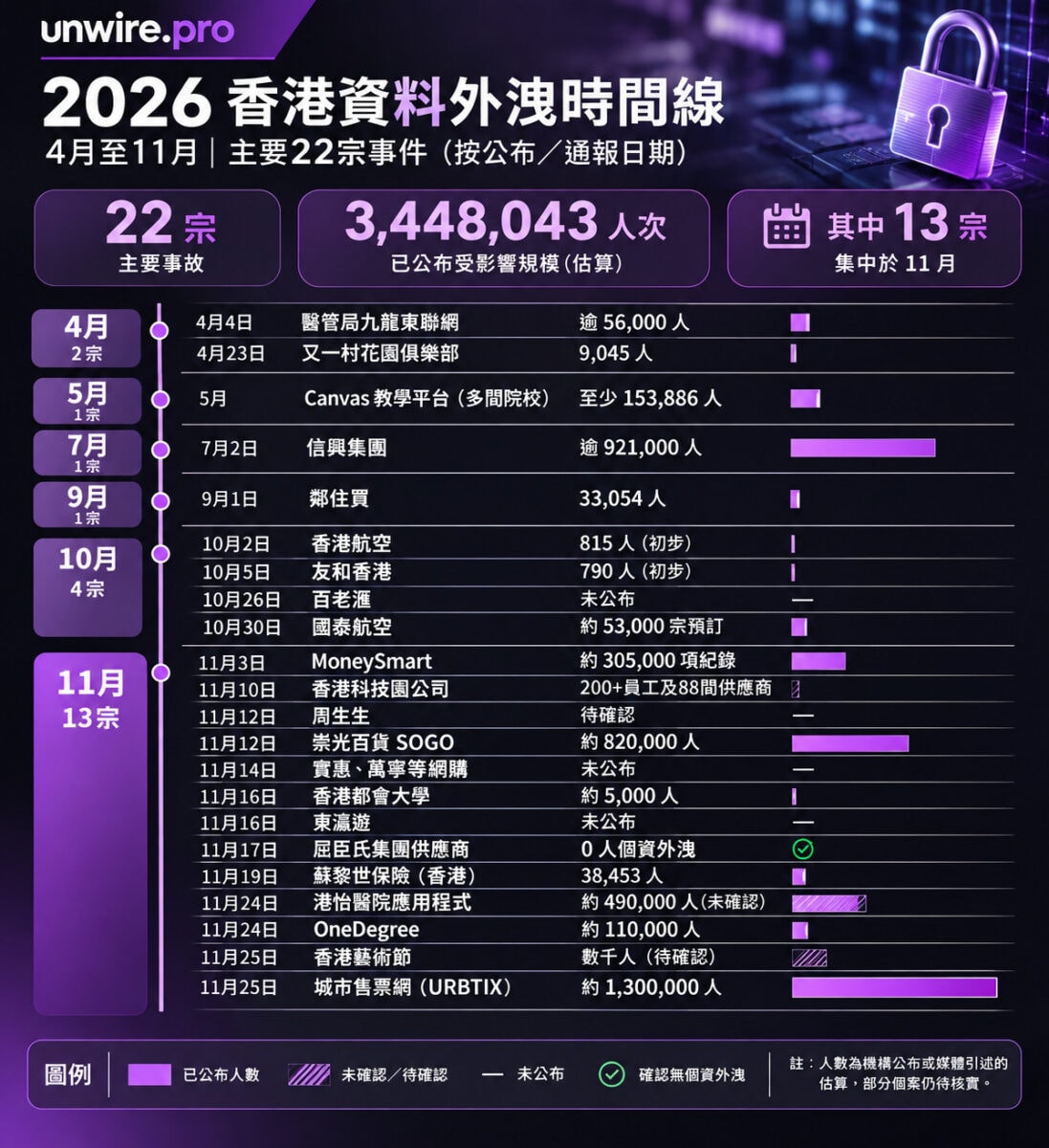
According to public reports and statistics up to late November 2026, there were at least 22 major data breaches and related incidents in Hong Kong this year. The publicized quantifiable number of affected individuals reached approximately 4,347,253 (involving about 358,000 records or reservations, not including multiple unverified and unpublished cases). In other words, considering Hong Kong's population of about 7.5 million, on average, one out of every two residents had their personal data "exposed" during the year.
When the cybersecurity defenses fully collapse, society cannot help but ask: As an international financial and technology hub, why has Hong Kong gradually fallen into the label of "the city of data breaches"? How is the cybersecurity situation and regulatory logic of its often-cited competitor Singapore different?
Data is Shocking: Systematic Failure of Public and Private Institutions
Looking back at the statistics from the Office of the Privacy Commissioner for Personal Data (PCPD), the number of reported data breaches in Hong Kong has continued to rise in recent years: from 157 incidents in 2023 to 203 in 2024, and further rising by 21% to 246 in 2025. Entering 2026, the disasters have shown a trend of "cross-sector, high-density, large-scale" outbreaks:
Public services and cultural and recreational activities: The Urban Ticketing System (URBTIX) under the Leisure and Cultural Services Department confirmed in November that it was hacked, affecting about 1.3 million user records; in April, the Kowloon East Network of the Hospital Authority had over 56,000 affected; the Hong Kong Science Park Company and the Hong Kong Arts Festival also fell victim subsequently.
Retail and consumption giants: Companies like Sincere Company (over 921,000 people) and SOGO department store (about 820,000 people) became hard-hit areas; daily consumer brands such as JUSCO, Yau Ma Tei, Broadway, Chow Sang Sang, and Eastern Travel also reported incidents or awaited confirmation.
Highly sensitive financial and medical fields: Virtual insurance provider OneDegree had about 110,000 affected individuals, with exposure involving images of Hong Kong identity card copies and some bank account numbers; Zurich Insurance (Hong Kong) had 38,453 customers affected; financial comparison platform MoneySmart involved about 305,000 records; the Hong Kong Sanatorium & Hospital application also reported unconfirmed incidents affecting hundreds of thousands of people.
Higher education and aviation: In May, the commonly used Canvas teaching platform in higher education experienced an incident impacting City University (nearly 147,000 people), Hong Kong Academy for Performing Arts, and the Construction Industry Council; in November, Hong Kong Metropolitan University also had about 5,000 people affected; Cathay Pacific and Hong Kong Airlines subsequently reported tens of thousands of reservation or passenger data breaches.
This list reveals a harsh reality: The data breaches in Hong Kong are not solely caused by the resource constraints of small and medium-sized enterprises but reflect a structural failure of the system and governance, as even the largest public sectors, multinational insurers, and leading retailers have continuously faltered.
The Four Major Pitfalls of Hong Kong Becoming the "City of Data Breaches"
Lack of Regulatory Teeth: Absence of Mandatory Reporting and Direct Administrative Fines
The current Personal Data (Privacy) Ordinance (PDPO) in Hong Kong has been in effect since 1996, and although criminal penalties were introduced in 2021 for what is commonly referred to as "doxxing" and achieved significant results, there has been severe lag in accountability for corporate data security and breaches compared to international standards.
To this day, Hong Kong still does not have a mandatory data breach reporting mechanism; reporting to the Privacy Commissioner is merely "voluntary." More importantly, the ordinance lacks direct administrative fines for cybersecurity negligence. Under the current system, even if an institution causes the personal data of millions of citizens to be breached due to security vulnerabilities, the Privacy Commissioner often can only conduct follow-up investigations, issue inspection reports, or send "compliance notices" for correction; criminal liability and a maximum penalty of HKD 1 million only come into play when an institution refuses to comply with the compliance notice.
This "first warn, then improve to avoid penalty" mechanism, as criticized by cybersecurity experts, resembles "not ticketing a parking violation until the driver leaves," which completely lacks deterrent effect. As for the long-anticipated amendments for mandatory 72-hour reporting and introducing administrative fines linked to revenue, legislative progress has remained slow.
Corporate Governance Inertia: "Zero Violation Cost" Fuels the "Completing Assignments" Mentality
Since after a breach incident, the involved institution usually only needs to publish a "deeply apologetic" statement and urge customers to be cautious of fraud, they do not face hefty fines or compensate victims; corporate management is naturally inclined to adopt a "no cost" lucky mentality.
In the absence of legal rigidity, cybersecurity in many Hong Kong enterprises is still regarded as a "pure cost" expenditure rather than a core corporate governance risk in the eyes of board members. Many institutions conduct only one routine penetration test per year to "complete the assignment" without urgency in phasing out outdated systems or investing in active defense, often waiting until systems are compromised and reputations damaged before urgently hiring cybersecurity personnel to patch the breach.
Outsourced Supply Chains as Vulnerabilities: Loose API and Cloud Permission Management
A detailed examination of the series of incidents in Hong Kong in 2026 indicates that third-party suppliers and outsourced systems (Supply Chain Attack) are key common vulnerabilities. Whether it is Cathay Pacific involving unauthorized access to third-party supplier Amadeus, incidents involving the shared Canvas platform among multiple universities, or large public and private institutions outsourcing their ticketing, membership rewards, or online shopping systems to contractors for development and maintenance, they all expose the fragility of supply chain regulations. Hackers often do not need to directly attack major corporate hosts; they can infiltrate by breaching weaker defense contractors or stealing their administrative credentials, thus gaining lateral access to and harvesting databases from multiple partnering firms.
At the same time, many enterprises currently fail to implement the "principle of least privilege" and multi-factor authentication (MFA) during digital transformation, cloud migration, and opening application programming interfaces (APIs), even encountering low-level technical vulnerabilities like broken object-level authorization (BOLA), allowing attackers to easily read through massive customer files.
Excessive Collection and Hoarding of Data Meets AI Weaponized Attacks
With the rise of generative artificial intelligence (AI), hacker groups have significantly reduced the threshold and increased the speed for automatically scanning software vulnerabilities, testing defenses, and launching attacks. Meanwhile, numerous retail associations, clubs, and service platforms in Hong Kong have long been accustomed to excessively collecting citizens' identity card numbers, birth dates, and detailed addresses, and have failed to timely destroy expired data after business purposes are served (i.e., "retention for too long"). Once the defenses are breached, historical personal data from years or even a decade ago may be leaked, immediately being input into AI systems that classify and create seemingly realistic "precise phishing scam scripts," exposing citizens to ongoing risks of fake customer service, impersonation, and even financial misuse.
Learning from Others: Singapore's Breach Status and Governance Logic
Whenever there is a governance controversy in Hong Kong, society loves to ask: "What about the situation in Singapore?" Objectively speaking, Singapore is by no means a "zero-breach" cybersecurity utopia; it too is under severe pressure from global cyberattacks. However, the significant difference between the two places lies in the "iron fist" of the system and the "cost of violations" after incidents occur.
Singapore's True Situation: Also Facing Supply Chain Vulnerabilities and Fraud Threats
As a regional digital hub, Singapore experienced several cross-industry data breach incidents between 2025 and 2026. According to analyses by Singapore's Business Times and the legal community, the recent breach cases in the Lion City cover sectors such as healthcare, media, telecommunications, aviation, travel, and human resource software (SaaS) providers, with leaked data primarily focusing on national identity card numbers (NRIC), full names, birthdates, and phone numbers.
Public opinion and the legal community in Singapore also highly concern themselves with the issue that "identity identification data cannot be remedied like credit cards by replacement," worrying that leaked data will be combined for targeted impersonation fraud and social engineering scams, and they publicly question whether mere compliance notifications from enterprises are sufficient to protect victims. From a technical perspective, Singaporean enterprises also face globally common challenges such as system configuration errors, external vendor vulnerabilities, and AI shortening the window for software vulnerability patches.
Critical Differentiation: How Singapore Establishes Authority through the Personal Data Protection Act (PDPA)
Despite facing hacker threats, Singapore has not allowed enterprises to fall into the mire of "zero-cost breaches." The key lies in its Personal Data Protection Act (PDPA), which underwent significant amendments and subsequent standard upgrades from 2020 to 2021, establishing a tightly interlinked accountability system:
Strict "3-Day Mandatory Reporting Deadline": Since February 2021, Singapore has mandated that once an institution assesses a data breach as a "reportable incident" (i.e., one that may cause significant harm to individuals financially or through identity theft, or affects a scale of 500 people or more), it must report to the Personal Data Protection Commission (PDPC) within 3 calendar days and notify affected individuals simultaneously to eliminate delayed reporting or concealment by enterprises.
Severe Disincentives Linked to Revenue: The PDPC has the authority to impose direct administrative fines on institutions that violate "Protection Obligations," with a cap of up to 10% of the institution's annual revenue in Singapore or SGD 1 million (whichever is higher). This directly converts cybersecurity vulnerabilities into significant financial risks affecting corporate financial reports.
Regular, High-Transparency Law Enforcement and Publication: In stark contrast to Hong Kong's infrequent substantive penalties, Singapore's PDPC continuously and frequently publicizes enforcement decisions and penalty cases, mercilessly targeting both multinational giants and SMEs alike. For example, the earlier shocking SingHealth medical breach case was penalized a total of SGD 1 million; during 2025 to 2026, the PDPC also issued fines to multiple infringing institutions, including travel agency Air Sino-Euro Associates Travel for a breach impacting over 336,000 personal data, which was fined SGD 47,000; human resource SaaS provider People Central was penalized SGD 17,500 in January 2026 due to lack of dual authentication and regular security testing, resulting in a leakage of 95,000 customer employee data; well-known companies like Marina Bay Sands and jeweler Goldheart Jewelry were likewise included in the enforcement decision list.
Mandatory Appointment of Data Protection Officers (DPO): Singaporean legislation requires all institutions (regardless of size) to designate a dedicated Data Protection Officer (DPO) and make their business contact information public, clearly assigning data compliance responsibilities to specific positions and governance structures.
Comparison of Personal Data Protection Systems Between Hong Kong and Singapore
Moving Beyond "Apologies," Hong Kong Needs Data Governance Breakthroughs
Comparing the two cities, it is evident that while cyberattacks and AI hackers are shared challenges faced by global metropolises, Singapore also cannot be completely immune to data breaches. However, the crucial factor determining whether a city becomes a "city of data breaches" lies not in how rampant hackers are, but in whether the system compels negligent enterprises to bear corresponding consequences.
When Hong Kong accumulates over 4.34 million data breach records within a year, yet each incident remains trapped in an endless cycle of "institutions publishing statements of apology and commissions urging citizens to beware of fraud," public trust in the digital economy and smart city construction will inevitably be continually overdrawn. To truly reverse the predicament, Hong Kong must decisively break through in three areas:
Accelerate Revisions to the Privacy Ordinance: The government and Legislative Council should quickly implement a mandatory data breach reporting mechanism (such as a 72-hour reporting deadline), and reference Singapore's PDPA along with Hong Kong's "Protection of Critical Infrastructure (Computer Systems) Ordinance" and the Hong Kong Monetary Authority's regulatory framework, regulating institutions according to the volume of personal data processed, and introducing direct administrative fines linked to revenue.
Plug Vulnerabilities in Outsourced Supply Chains and Excessive Data Collection: Include third-party data processors (contractors) within the scope of direct legal regulation, mandating the comprehensive implementation of multi-factor authentication (MFA) for privileged accounts and APIs, and strictly enforcing the principles of "data minimization" and "expiration destruction" to reduce unnecessary hoarding of identity card copies and sensitive files.
Promote Board Accountability and Victim Protection: Mandate public and private institutions that handle large amounts of citizen data to appoint dedicated Data Protection Officers (DPOs) and incorporate cybersecurity into core corporate governance and ESG metrics; simultaneously encourage and regulate enterprises to invest in cybersecurity insurance, providing substantial identity monitoring and aftercare protections to affected citizens after a breach incident, rather than merely absolving responsibility with a statement.
Only by making the protection of citizens' privacy the clear legal baseline for enterprises can Hong Kong tear off the label of "the city of data breaches" and reshape a digital trust commensurate with its status as an international financial and technology hub.
This article is reproduced from unwire.pro, with copyright belonging to the original author and original media.
免责声明:本文章仅代表作者个人观点,不代表本平台的立场和观点。本文章仅供信息分享,不构成对任何人的任何投资建议。用户与作者之间的任何争议,与本平台无关。如网页中刊载的文章或图片涉及侵权,请提供相关的权利证明和身份证明发送邮件到[email protected],本平台相关工作人员将会进行核查。