As AI concept stocks experience intense fluctuations, Federal Reserve Chairman Warsh faces a dilemma: continue raising interest rates to fulfill anti-inflation commitments, or accept the tightening effect on financial conditions brought about by a declining stock market? Core inflation in the U.S. rose to 3.3% in October, and AI investments are pushing demand higher, leaving limited room for policy shifts.
Written by: Xiao Yanyan, Jinshi Data
Nick Timiraos, chief economic reporter for The Wall Street Journal and known as the "voice of the Federal Reserve," recently wrote that if the tech stock sell-off intensifies this month, Federal Reserve Chairman Kevin Warsh may face a tricky policy choice: to continue raising interest rates to uphold his tough stance on controlling inflation, or to heed the signals from the market, as the market may have already accomplished part of the tightening work for the Fed.
This is not the first time Warsh has encountered a similar situation.
In December 2018, when the stock market had dropped about 11% from its peak, Warsh and investor Stanley Druckenmiller wrote in The Wall Street Journal, calling for the Fed to temporarily halt tightening monetary policy.
However, the Fed ultimately chose to raise rates at that time. As investors grew uneasy about officials hinting at possible further rate hikes in the future, the stock market sell-off intensified, resulting in the worst December performance since 1931. Just a few days later, Fed officials signaled that they were not in a hurry to raise rates again.
Timiraos wrote that the current situation resembles the end of 2018 in several respects: a newly appointed Fed chairman raising rates amid falling stock markets and a strengthening dollar; policymakers coping with geopolitical shocks; and voters recently expressing dissatisfaction with President Trump through midterm elections. Trump was also continually urging the Fed not to tighten monetary policy at that time.
However, the largest difference between the two situations lies in inflation.
In 2018, after years of inflation below target levels, the U.S. inflation rate had just risen to near the Fed's 2% target. Now, U.S. inflation has been consistently above this target for more than five years. Warsh, who took office as Fed chairman in May, has clearly stated that the Fed will not accept a situation where the inflation rate is even slightly above the target level for an extended period.
This makes it more challenging for Warsh to find a reasonable basis for pausing interest rate hikes compared to that time, while the Fed had chosen to pause actions in early 2019.
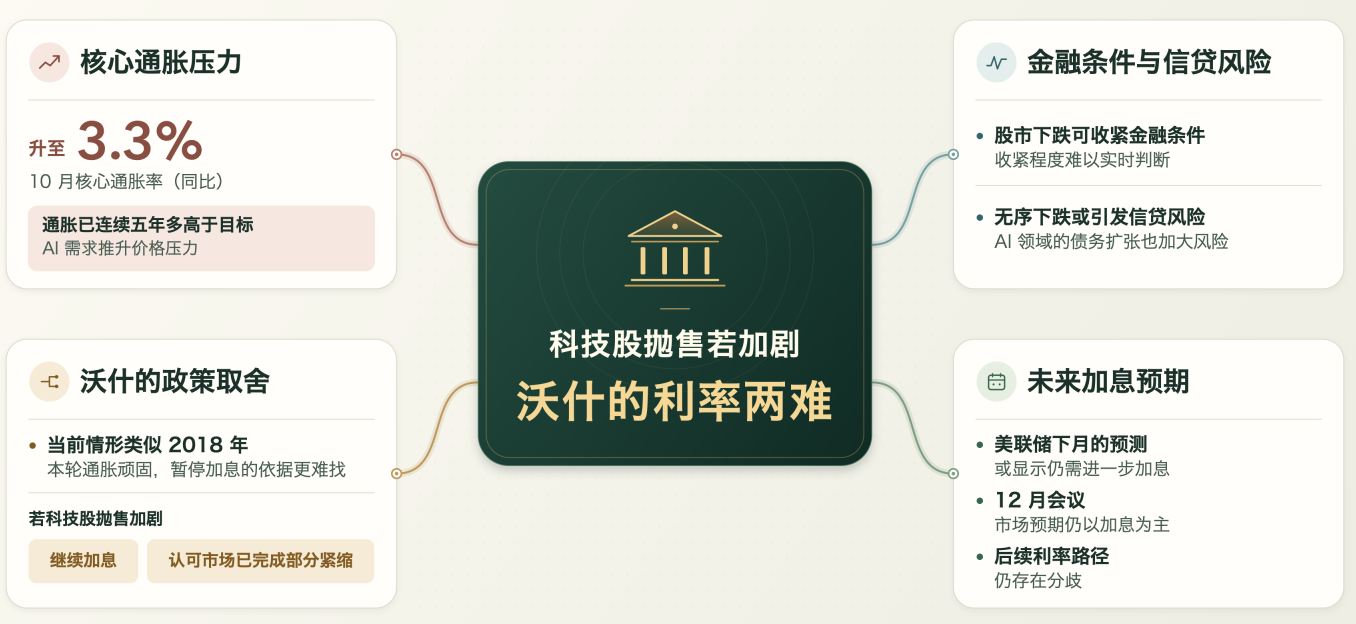
Core inflation rises to 3.3%, increasing pressure for rate hikes due to AI demand
Currently, the attention of Fed officials is almost entirely focused on inflation. Data released by the U.S. Commerce Department on Wednesday showed that inflation worsened further in October.
Excluding volatile food and energy prices, a key inflation indicator rose 3.3% year over year, up from 3.1% in September. Before March 2025, when the Trump administration significantly raised tariffs on imported goods, this indicator had dropped to as low as 2.6%.
Looking ahead, Fed officials are increasingly concerned that artificial intelligence (AI) is driving a surge in demand. Unlike rising oil prices or tariffs, this price pressure from growing demand is unlikely to dissipate on its own.
Previously, some officials were skeptical of the increased willingness of companies to raise prices, but they are now beginning to believe that these concerns indeed have a basis in reality. The economic forecast the Fed will release next month is likely to show that further rate hikes will still be needed in the future.
New York Fed President Williams told reporters on Monday, "What I am focused on is less about past supply shocks and more about how strong current demand is, much of which is related to AI."
Investments in AI infrastructure are intensifying this demand pressure. Data center developers are procuring chips and power equipment faster than suppliers' delivery capabilities, giving suppliers significant pricing power.
Chicago Fed President Goolsbee stated last week that business leaders told him that the prices of all electrical equipment-related products are "soaring."
Stock market decline may help the Fed tighten financial conditions
Persistent inflation pressure also suggests that Fed officials might not be as concerned about the stock market sell-off as many investors imagine.
Tightening financial conditions, including falling stock prices, are already one of the main ways that high interest rates suppress spending and drive down inflation. Eric Rosengren, who served as Boston Fed president from 2007 to 2021, noted, "You could absolutely view this as exactly the effect the Fed wants to achieve. If you want the economy to cool down, you have to cool down AI investments."
The continued market downturn is significant because it could change consumer spending decisions and corporate borrowing behavior. When households feel wealthier, they often reduce spending; businesses that rely on investor enthusiasm to finance new projects may also find it more difficult to raise funds.
This will suppress demand and may lead Fed officials to conclude that they do not need to raise rates as much.
However, market volatility also presents tricky issues for the Fed. Officials do not want investors to form an expectation that the Fed will step in to support the market whenever stock prices decline. Wall Street refers to this expectation as the "Fed put," a term derived from an options contract that protects investors from losses.
Timiraos points out that more importantly, it is difficult for the Fed to gauge in real-time when they can rely on market adjustments to accomplish part of the tightening work. Financial conditions could tighten rapidly and just as quickly loosen.
The recent fluctuations in tech stocks illustrate this uncertainty. On Monday, after Jensen Huang resumed his role as CEO of Nvidia (NVDA), tech stocks surged; however, as concerns grew over potential tightening of export controls and worries about the complex network of financing arrangements increased, tech stocks subsequently fell again.
U.S. Treasury Secretary Becerra attributed part of last week's market sell-off to comments from Fed officials regarding the possibility of further rate hikes in the future. He stated, "Many believe that if the Fed over-tightens monetary policy, it could make a policy mistake."
Becerra also mentioned that investors are worried that Democrats might slow down AI infrastructure projects after making gains in the midterm elections.
The market decline does not necessarily mean that the economy will cool down smoothly. In contrast, a disorderly collapse is more concerning, as it could lead to struggling companies incurring losses and trigger a credit contraction, creating a self-reinforcing vicious cycle.
Williams stated that if there were "substantial" and "sustained" changes in financial conditions, it would affect his judgment about the economic outlook. However, he believes that last week's significant market fluctuations "were likely more about increased volatility rather than a fundamental reassessment of the market's outlook on AI."
December rate hike expectations remain dominant, with policy paths diverging thereafter
The Fed already raised rates in September. Despite recent market volatility, investors generally expect that the Fed will raise rates again at the meeting scheduled for December 8 to 9. The focus of policy debates afterward will be on the pace and final magnitude of rate hikes.
If the recent trend of falling oil and other commodity prices continues, leading to a cooling of inflation, some Fed officials may be willing to pause after one more rate hike.
Over the past two months, commodity and energy prices have already declined. With refining margins narrowing, prices for products like diesel and aviation fuel have also recently retreated.
Meanwhile, rising borrowing costs and potential political resistance to new data center construction may slow down some AI infrastructure projects.
However, other officials believe that current interest rates are still too low. A set of calculations put forth by St. Louis Fed President Bullard suggests that three more rate hikes next year could be reasonable.
Williams has also not ruled out the possibility of consecutive rate hikes. He stated that if the economy continues to grow at a rate that exceeds its capacity and inflation remains above expectations, the Fed may need to raise rates in consecutive meetings.
"You can't just sit there and wait," he said.
Warsh has previously criticized the Fed for ignoring market signals but also called for a pause in rate hikes
Warsh's past comments do not clearly indicate how much weight he will give to recent market fluctuations.
For a long time, he has believed that the Fed relies too heavily on lagging government economic data and should pay more attention to market price signals to avoid being caught off guard by changing conditions and ultimately being forced to intervene to support the market.
In a speech in 2016, Warsh criticized the Fed for "systematically underestimating the importance of real-time market price signals, which often leads to delayed and panic-driven policy responses that in turn validate the market's expectations of central bank support."
In October 2018, Warsh mentioned in a podcast hosted by newsletter publisher Jim Grant that the U.S. economy was "booming," and the Fed should not overreact to market fluctuations.
He said, "What I want them to focus on is the actual performance of the real economy, rather than worrying about the consequences of a 10% drop in the stock market or a 50 or 75 basis point rise in bond yields. This shouldn't be their focus."
However, ten weeks later, as stock market sell-offs made it increasingly difficult for high-risk firms to secure lending, Warsh began calling for the Fed to pause rate hikes.
Former senior Fed advisor Jon Faust stated that if the market sell-off intensifies, how Warsh weighs the signals from market volatility against persistent inflation will "become the most critical issue before him."
The scale of AI-related debt is expanding, and credit risk is another concern for the Fed
When assessing market risks, Fed officials typically pay more attention to the credit market than to the stock market.
Fed Vice Chair Barr, responsible for supervisory matters, stated this month that AI-related debt is expected to exceed $800 billion this year, while off-balance-sheet financing commitments related to AI infrastructure construction are estimated to be more than three times that amount.
This means that the AI investment boom is not only related to stock valuations and corporate spending but also has accumulated a massive risk exposure in the credit market.
Rosengren warned that if a large number of heavily indebted companies begin to face real operational difficulties, the economy will not merely slow but could significantly weaken, potentially triggering even more severe downward risks through credit channels. He said, "At that point, you have a transmission mechanism that can lead to serious economic downturns."
For Warsh, the current dilemma is how to judge whether the market decline is truly helping the Fed contain demand and inflation, or whether it has begun to threaten corporate financing and economic stability. With inflation still stubborn and AI investments continuously driving up demand, market volatility alone may not be a sufficient reason to pause interest rate hikes.
免责声明:本文章仅代表作者个人观点,不代表本平台的立场和观点。本文章仅供信息分享,不构成对任何人的任何投资建议。用户与作者之间的任何争议,与本平台无关。如网页中刊载的文章或图片涉及侵权,请提供相关的权利证明和身份证明发送邮件到[email protected],本平台相关工作人员将会进行核查。