Original|Odaily Planet Daily(@OdailyChina)
Author|Wenser(@wenser 2010)
When the competition among public chains intensifies, what is the invincible secret to maintaining an advantage in the process of mainstreaming cryptocurrency?
In 2026, Solana's answer is to enhance performance through the Alpenglow consensus upgrade; Ethereum's L2 strategy has given birth to Robinhood Chain; Base seeks incremental AI Agent networks beyond the L2 route; stablecoin issuer Circle and payment giant Stripe choose to create their own public chains (Arc and Tempo) to take the initiative. Meanwhile, BNB Chain has chosen a path less traveled—starting anew by developing a new EVM L1 public chain.
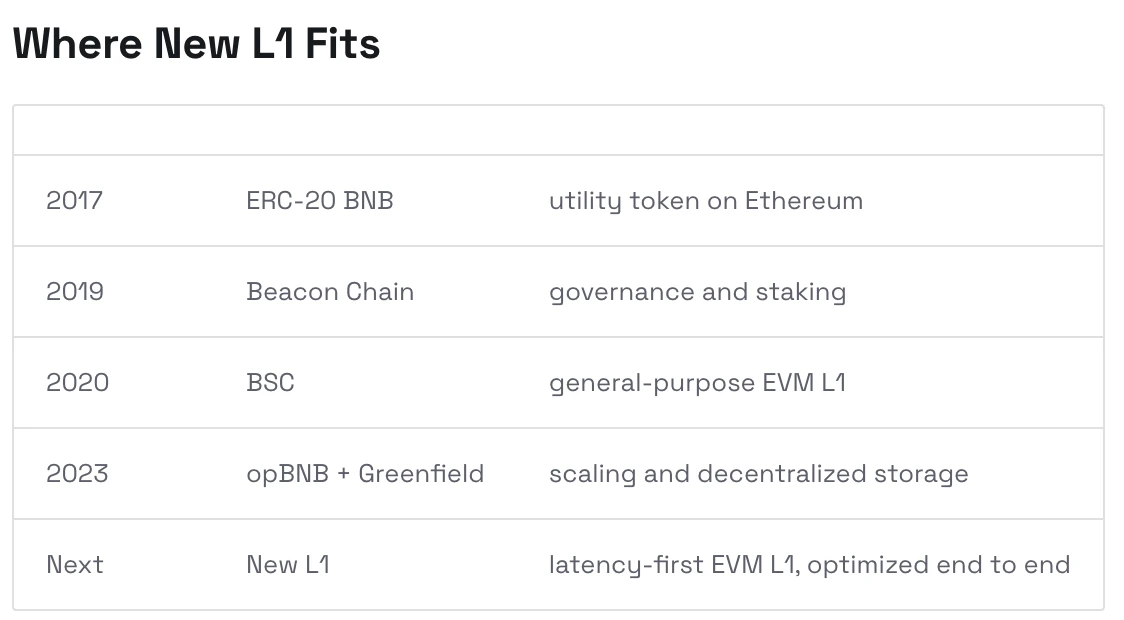
Since the launch of the BNB token in 2017, the BSC ecosystem has gone through stages such as the beacon chain, BSC chain, opBNB+Greenfield, and today, the new L1 is highly anticipated to carry forward past assets and technological accumulation to meet the on-chain ecosystem demands of AI and Perp DEX. At the same time, the wave of RWA asset and stock tokenization also determines that the new L1 of the BSC ecosystem will target the global financial entry point, building a new end-to-end on-chain system to open up new battlefields, enlarge the new cake, and use the solution of "multi-chain one coin" to unlock the developmental ceiling and imaginative space of Binance, BNB Chain, Yzi Labs, and other related projects.
For BNB Chain and the Binance ecosystem along with billions of users, we need not just a faster chain, but also a "new map" to tackle future challenges.
Key Proposition of the New L1: The Necessity Behind Delay Sensitivity and Challenges in Four Major Scenarios
After the new L1 strategy was proposed, CZ's response was simply one sentence—"Multiple chains, one coin."
Four words clearly outline the core interests and development boundaries of the new L1—without involving new tokens, maintaining the exclusive status of BNB along with functions such as network fees, staking, and governance, but focusing on the complementarity of multiple chains and their respective roles. The reason for this is that the current industry environment and the crypto increment have already undergone tremendous changes compared to the past. The primary question a new L1 public chain must first address is, where does its value lie? What is its use? Why do users need it?
The Necessity of the New L1: Competing for Users, Targeting the Global Financial Market
It is evident that for all public chains, CEXs, DEXs, and most crypto projects, the phase of lying low and cultivating a niche in the crypto market is over. In the current context of stock tokenization and deep coupling of RWA assets with traditional financial assets, the development status of the crypto ecosystem is akin to rowing upstream—if one does not advance, one retreats. What confronts BNB Chain is not just a singular market competition at the dimension of public chains.
With the development of the AI era, competition in on-chain Perp DEXs, and the demands of institutional financial reform, the new market environment is as follows:
Firstly, there is the AI era's "new economic model" with AI Agents as economic entities. This means that AI Agents place more, higher, and faster demands on on-chain payments and the construction of the Agentic Economy, requiring not only high-performance standards but comprehensive adaptation to AI Agent invocation, integration, payment, and execution.
Secondly, there is the competition for dominance represented by on-chain Perp DEXs such as Hyperliquid for derivatives markets and traditional financial asset pre-pricing. Although Binance's contract trading volume and holding value still lead the market, on-chain Perp DEXs are catching up rapidly. Beyond supporting projects within the ecosystem like Aster, BNB Chain also needs to bolster Binance's derivative business from a technological foundational layer.
Finally, as the process of stock tokenization and RWA asset on-chain transformation accelerates, traditional financial institutions and large-scale financial adoption have raised higher demands for on-chain privacy and real-time settlement confirmation. Binance's previous launch of over 7,000 on-chain US stock variants has made advances from the asset access side, achieving a TVL milestone of over $1 billion in about three months. However, from the perspective of institutional user adoption, conventional applications, compliance disclosure, and privacy trading still require a complete set of on-chain mechanisms. In this regard, BNB Chain's Chief Business Officer Thomas Chen has repeatedly emphasized its importance and achievements in media interviews, BNB Seoul, and Token2049.
In summary, the new L1 strategy of BNB Chain is highly necessary, and its primary application scenarios and technological advantages can ensure that various needs are met from a foundational mechanism.
The Four Major Application Scenarios of the New L1: High-Frequency Trading, Real-Time Payments, AI Agent, Privacy Finance
Although the new L1 is still in the developer network phase, based on information from official documents and other sources, its key technological advantages and application scenarios are already quite clear.
Specifically, considering the previous requirement for AI Agents and high-frequency trading, the main technological advantages of BNB Chain's new L1 include:
- Transaction Pre-confirmation: No global mempool, transactions are directly sent to the current and next block producer, reducing waiting time and increasing the cost and difficulty of on-chain frontrunning operations.
- Multi-Lane settings: Reserved block capacity for qualifying transaction types, isolating execution of price updates, settlements, payments, and Meme transactions during peak times; unutilized shares return to general channels. Additionally, this feature can be deeply customized at the "blockchain network level" for different application scenarios and business needs, such as compliance trading restricting transaction types, on-chain stages, and transaction validation throughout the compliance chain; or provides sorting solutions for proprietary automated market makers (PropAMMs) designed to meet specific trading demands.
- The protocol possesses underlying account abstraction capabilities: passkeys, batch operations, cost reimbursement, allowing senders not to hold BNB, while settlement fees can still be paid in BNB by the reimbursing party.
- Delegated authorization: Allows owners to restrict and revoke permissions, laying the groundwork for AI Agents to operate within user-designated scopes.
- Optional Privacy Pools: Supports disclosing asset information within limited scopes.
Based on these technological advantages, the new L1 is expected to shine in the following scenarios:
Firstly, for high-frequency trading and real-time payment with higher performance requirements. The new L1's design target is 100,000 TPS, with a block interval of 200 milliseconds; sub-blocks are sent approximately every 20 milliseconds. The revocable pre-confirmation mechanism can satisfy trading and payment speed requirements while ensuring flexible execution of transactions, thus supporting price updates and real-time payments. Improvements at the performance level will directly enhance user experience, making on-chain transactions and payments more "seamless,” akin to the user experience of centralized systems in Web2.
Secondly, for trading, payment, and financial platforms with higher stability requirements. For such platforms, the scale of users and volume of funds are crucial for the smooth running of their systems. The new L1's capacity reservation mechanism is designed to effectively ensure smooth operations of price updates and payment activities, avoiding issues such as stuttering or breakdowns in on-chain trading, payments, and financial operations.
Thirdly, for Agent operations with higher sensitivities to operational permissions. The new L1's delegated authorization mechanism allows setting ownership restrictions and revocation permissions, providing a native account control basis for the automated services of AI Agents while ensuring they operate within the user-authorized scope, thus avoiding issues of excessive permissions, excessive capital movement, and black-box operational processes.
Fourthly, for financial platforms with higher privacy requirements. The new L1 supports BNB and standard BEP-20 token assets, and permits viewing access within limited scopes. While ensuring that some publicly callable, cost, and settlement results are visible, when it comes to user information and operational asset confidentiality, the new L1's settlement design for privacy assets and scope-restricted disclosures greatly enhances the effectiveness of information security management and asset operation safety.
Of course, the development and migration of the new L1 is not a one-time effort and will inevitably accompany corresponding risks and challenges. However, the superiority of its underlying design determines that its application openness and scenario coverage will be more comprehensive.
New Problems and Solutions of the New L1: Migration Costs, User Experience, Automated Execution, Privacy
The probabilistic formula of choice in communication theory states that the likelihood of selecting information = guarantees of reward / level of effort. In simpler terms, the user's choice of a particular information result depends on the comparison between the media content meeting their needs and the investment costs.
Whether BNB Chain's new L1 can garner more support and usage from individual users, institutional users, and developers fundamentally adheres to this principle: only when benefits > costs will developers, users, and institutions choose to migrate to the new chain or pursue multi-chain coexistence. This presents the challenges faced in the development, growth, and subsequent long-term construction phases of the new L1.
Currently, potential solutions for the new L1 can be referenced from the following aspects:
- For trading platforms, market makers, quantitative teams, and trading institutions, the new L1 user experience will be closer to the feedback speed of centralized matching, while assets can still be managed in a self-custodial manner. BNB Chain CTO David Z previously stated to the media that the new L1 aims to make the onboarding experience for users as close to that of exchanges while maintaining on-chain asset control, balancing user experience and the need for self-custody of assets.
- For payment platforms and payment users, the new L1 significantly lowers the entry barrier for on-chain payments, with its native accounts supporting passkeys and cost reimbursement, allowing users to authorize using trusted device validation without needing to prepare BNB tokens in advance; meanwhile, applications or sponsors can cover Gas fees, which still use BNB for settlement. The barrier to payment for small transactions in daily life and consumer-level applications for first-time use will be further reduced.
- For AI Agents gradually permeating users' trading networks, the protocol layer has made limitable and revocable delegation a native feature, allowing AI Agents to place orders, transfer, and execute trading strategies within the user's authorized range without having to hand over all private keys, significantly improving account security and permission strength.
- For institutions that need to complete compliance disclosure and manage asset privacy, the new L1's liquidity pool supports hiding sender, receiver, and transaction amount information, while still permitting viewing privileges within limited scopes; some publicly callable aspects, costs, and settlement results remain visible. Thus, from the perspective of regulatory friendliness and reducing compliance costs, it effectively balances the diverse demands of on-chain funds management.
The development and popularization of new phenomena always takes time. For the new L1, which has a tentative mainnet launch date set for 2027, as long as functional groundwork is sufficiently laid, user education and market growth will naturally follow.
Starting Anew is Better than Patchwork: Differences Between New L1 and opBNB, Greenfield, and Other Chains
For this new public chain, perhaps the biggest question for many in the market is why BNB Chain needs to create a new L1? Does this mean that previous efforts like opBNB and Greenfield have failed?
According to BNB Chain forum's introduction, the new L1 is aimed at workloads that require deep architectural changes that BSC cannot meet through modifications; moreover, distinguishing it from extensible components like opBNB and Greenfield—assumed to expand on the BSC chain—the new L1 stands as a completely independent infrastructure layer.
In other words, the new L1 is meant to start fresh with clearly defined roles, rather than doing patchwork on the existing foundational ecosystem of the original chain. Its short-term goal is not to replace the BSC main chain but to complement it, leveraging flexible customized infrastructure capabilities to cover various application scenarios, ultimately achieving 100% support and full capacity for trading scenarios in the future.
In summary based on official information and community feedback, the subsequent division of labor among different chains is roughly as follows:
- The BSC main chain continues to serve as a broad application chain, handling existing DeFi, token issuance, and most routine contracts;
- opBNB continues as an expansion layer primarily responsible for cost-sensitive operations with throughput priority and lower sub-second pre-confirmation requirements;
- Greenfield continues to manage data and storage, functioning more like an "on-chain warehouse" compared to other chains;
- The new L1 focuses on addressing latency-sensitive on-chain markets with native abstract accounts and privacy settlements, pushing forward with efforts in on-chain trading, AI Agent applications, real-time payments, and large-scale institutional financial adoption.
The benefit of starting anew is that the new L1 can shed historical baggage and legacy issues, enabling it to take off light while absorbing existing users and market growth, directly facing a series of competitors like Solana, Hyperliquid, Base, Robinhood, and providing BNB Chain with another important conduit to connect with the global financial system.
Conclusion: Performance is Just One of the Characteristics of the New L1, Its Vision is Key
In the 2026 crypto market, the competition among public chains is no longer as simplistic as pursuing performance and speed. Instead, breakthroughs are needed at the levels of scenarios, applications, and ecosystems. Although BNB Chain's new L1 sets technical targets of 100,000+ TPS and sub-50ms, operational speed is just one characteristic, and not even the most crucial one. Judging solely from data will not truly reflect its value and role in the BSC ecosystem and Binance's core business.
For Binance and BNB Chain, the new L1 is not just the current focal point of derivatives trading and public chain ecosystem development but also embodies the hope of addressing future changes in the AI era, traditional financial market integration, and even the reshaping of the global financial asset system. From this perspective, perhaps we should show a bit more patience toward BNB Chain's new L1. After all, only with a solid foundation can high-rise buildings be built on top. The notion of "slow is fast" equally applies to the development path of the new L1.
免责声明:本文章仅代表作者个人观点,不代表本平台的立场和观点。本文章仅供信息分享,不构成对任何人的任何投资建议。用户与作者之间的任何争议,与本平台无关。如网页中刊载的文章或图片涉及侵权,请提供相关的权利证明和身份证明发送邮件到[email protected],本平台相关工作人员将会进行核查。