Author: AiPlot Research Institute
Focus: RWA / Digital Assets / In-depth Analysis of Financial Infrastructure
Website: https://aiplot.com/?utm_source=aicoin
The RWA market has recently encountered a typical case.
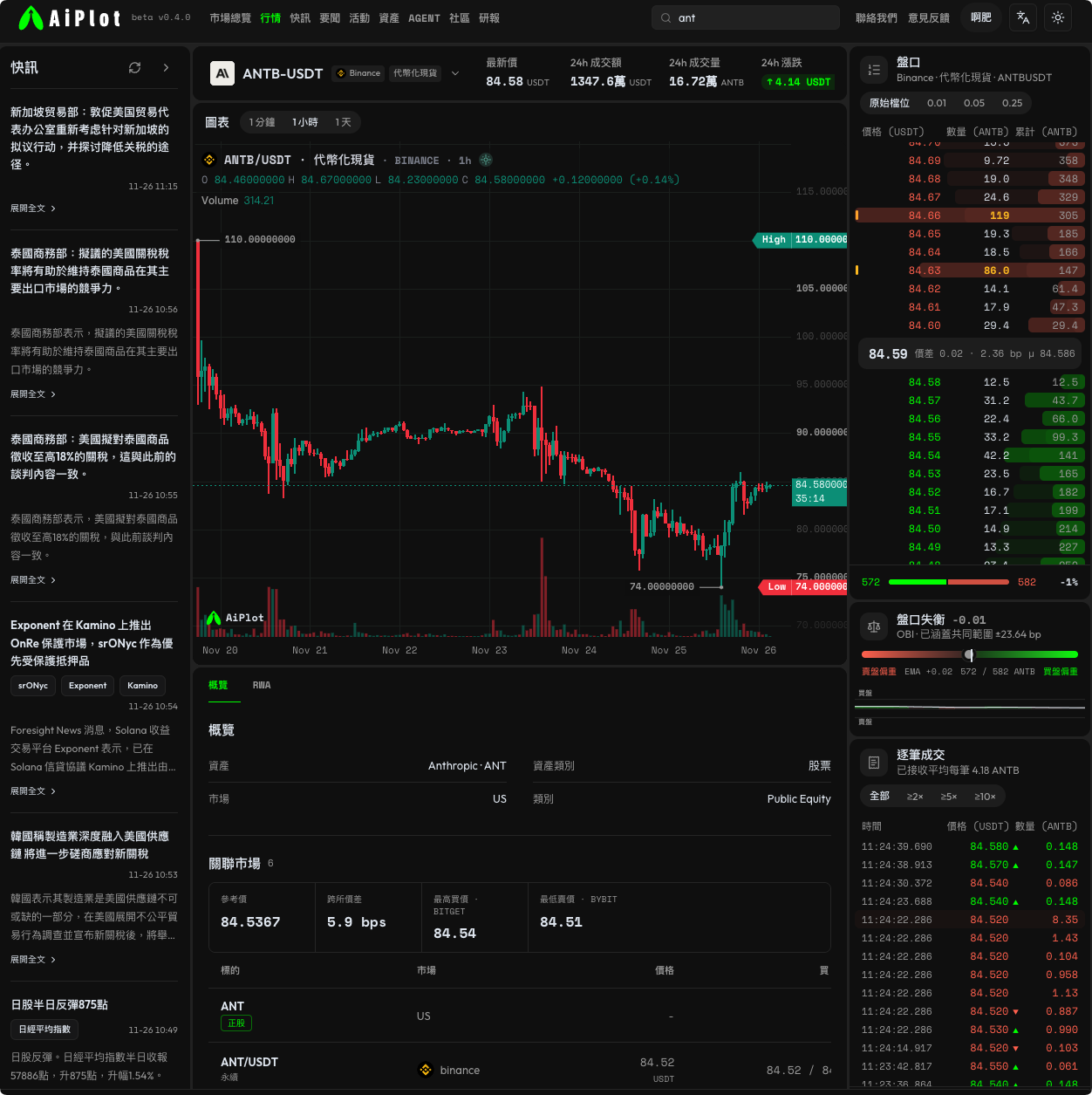
After the tokenization of Anthropic stock ANT launched on Solana, there was a very high trading volume in the short term. According to user-provided dynamics, the daily trading volume of ANT issued by Backpack on the Solana DEX dropped from approximately 58.2 million USD on November 20 to about 6.3 million USD on November 22, a decline of approximately 89% in two days.
Meanwhile, another market message pointed out that this year, only 37 RWA projects were able to generate fee income exceeding 100,000 USD, leading to the judgment that “RWA is still in a very early stage.”
These two pieces of information point to the same question:
Has the nominal scale and trading volume of RWA been mistaken for real demand and commercial income?
My judgment is that the decline in ANT's trading volume does not mean that tokenized stocks lack value, but it reminds the market that it must redifferentiate four concepts: transaction volume, real users, asset scale, and sustainable income.
1. Why Did ANT's Trading Volume Suddenly Decline?
Anthropic's tokenized stock was listed on Solana on November 19, 2026. Backpack, Ondo, xStocks, and other issuers launched their on-chain versions related to Anthropic stocks.
Tokenized assets being launched by multiple issuers could enhance market coverage but also introduce a structural issue: the same underlying asset being broken into multiple token versions.
Data from Solana Compass shows that Anthropic has four tokenized versions on Solana, including Backpack's ANT, Backed's ANTx, PreStocks' ANTHROPIC, and Ondo's ANTon.
These tokens claim to provide exposure to Anthropic-related assets, but their issuers, legal structures, redemption mechanisms, investor qualifications, and liquidity pools are not entirely the same. For traders, price differences create arbitrage opportunities; for data statistics, the same economic exposure may be fragmented into multiple trading markets, even including cases where a single asset is repeatedly converted between different versions.
Reports from Solana Compass on this controversy indicate that the trading volume of Backpack ANT on Solana DEX reached about 58.2 million USD on November 20 and fell to approximately 6.3 million USD on November 22.
However, the reports also clearly stated that pure DEX trading volumes cannot prove that these transactions are from long-term investors. On-chain data can record each exchange but cannot directly determine whether the traders are the same entity, whether the transactions are completed by bots, whether the trades are cross-version arbitrage, or whether the trades are circular.
Therefore, the 89% drop in trading volume confirms the market's rapid decline in enthusiasm but cannot directly confirm that investor demand has fallen by 89%. It may simultaneously encompass the following changes:
- The initial rush and price discovery at the launch have ended;
- Arbitrage opportunities between different issuance versions have decreased;
- High-frequency bots are no longer repeating trades;
- Real user transactions have also decreased as market attention declines.
In other words, the drop in trading volume is a fact, but what that volume originally consisted of still determines how we should interpret this fact.
2. Are Arbitrage Trades "False Trades"?
In this controversy, a significant divergence is whether arbitrage should be regarded as authentic market activity.
The perspective from Sunrise is that healthy arbitrage helps to keep prices consistent between different trading venues and improves liquidity in a 24/7 market.
This viewpoint holds true regarding market microstructure. Arbitrageurs are willing to buy lower-priced versions while selling higher-priced versions, thus narrowing the price spread between different pools. Without arbitrageurs, tokenized stocks might experience greater price deviations across different platforms, making it harder for ordinary users to obtain quotes close to the underlying stock.
However, arbitrage trades cannot be directly considered long-term investment demand.
Arbitrageurs typically do not care about Anthropic's long-term profitability, nor are they necessarily willing to hold the tokens long-term. Their concern is the price gap, trading fees, on-chain speed, and capital efficiency. As long as the price gap disappears, related trading volume may fall quickly.
Therefore, while arbitrage is useful for the market, it cannot independently prove that the asset has developed a stable investment demand. Researchers should separate two questions:
Does arbitrage improve market quality? This pertains to liquidity issues.
Are there investors willing to hold long-term and bear the risk of the underlying assets? This pertains to demand issues.
The answer to the former may be affirmative, while the latter requires verification through holding periods, redemption data, independent holders, and actual asset issuances.
3. Why Might the "Number of Holders" Also Be Overestimated?
Many RWA projects use the number of holders as an indicator of adoption rate. However, in a multi-version token and complex on-chain trading environment, the number of holders also needs to be interpreted cautiously.
Reports from Solana Compass show that the number of wallet accounts holding Backpack ANT increased from about 13,000 on November 20 to over 16,500 on the morning of November 23. However, these numbers include token accounts, liquidity pools, and program accounts, which do not necessarily equal 16,500 independent investors.
A user may hold multiple wallets. A liquidity pool may be counted as one holder's address. A trading program may also hold tokens. Issuers, market makers, bridging contracts, and trading agreements might own many token accounts.
This indicates that RWA data must at least differentiate between three criteria:
1. Token holders: The number of addresses or token accounts holding tokens;
2. Unique traders: Independent addresses that actually traded over a period;
3. Beneficial owners: Investors who truly hold economic rights after deduplication and identity verification.
These three may vary significantly. An increase in the number of holders for an asset does not mean the number of real investors is increasing at the same rate; an increase in trader numbers does not imply that funds will stay in the asset long-term.
Currently, the asset page on Solana Compass shows that there are approximately 219,200 Unique Traders related to the Anthropic tokens over 7 days, with a trading volume of about 224.9 million USD. The total Tokenized Value across the four versions shows approximately 1.2 billion USD.
These data indicate that there is market interest and trading activity, but they do not directly prove that the 1.2 billion USD represents the same type of token, nor do they confirm that all traders have obtained equal legal rights to the underlying stock. The page itself also reminds that different versions are provided by different issuers, and traders need to separately focus on liquidity and the trust level of issuing bridges.
4. What Does It Mean That 37 Projects Received Over 100,000 USD in Fees?
Harry Tran's post states that this year only 37 RWA projects generated fee incomes exceeding 100,000 USD, leading to the conclusion that RWA is still in a very early stage.
Since this dataset comes from dynamic images and its particular statistical criteria, rather than a publicly available comprehensive market audit, the “37 projects” should not be considered the final precise number for the RWA industry. However, it still provides a valuable perspective: the number of projects that can sustainably generate fees may be far fewer than those with inflated valuations, high trading volumes, or high social popularity.
RWA fee revenues generally arise from several types of business:
- Asset issuance and structural design fees;
- Fund management fees or asset management fees;
- Transaction fees and market-making spreads;
- Subscription, redemption, and transfer fees;
- Custody, compliance, and data service fees;
- Interest or protocol income generated from collateralized lending.
Among these, transaction volumes can grow easily in the short term and are most susceptible to the impacts of arbitrage, market-making, and incentive activities. Management and custody fees, although growing more slowly, are closer to long-term asset scale. Lending interests and redemption fees depend on whether the assets truly engage in financial activities.
Thus, if an RWA project only has trading volume without a stable asset scale and sustainable fees, its business model remains incomplete.
5. What RWA Currently Lacks Is Not Assets, But "Quality of Use"
In the past, the market has typically measured RWA's development using a few indicators: the scale of tokenized assets, the number of supported public chains, the number of issuers, and trading volume.
These indicators have reference value, but they are not sufficient. The true commercial value of RWA depends on whether new financial use cases are generated once real assets are brought on-chain.
For example, if tokenized government bond funds are only held long-term by a few addresses, they are more akin to registration and distribution tools on-chain; if they can be traded, collateralized, used for cash management, or serve as settlement assets, they start to form deeper financial value.
The same holds true for tokenized stocks. If stocks can be traded on Solana, it proves that the infrastructure for on-chain distribution and trading can operate. However, if it lacks a stable redemption mechanism, clear shareholder rights, sufficient market depth, and lending demand, then it is still primarily a trading product, not a complete on-chain capital market asset.
This also distinguished the previous article discussing Aave Equities Hub: when tokenized stocks can be used as collateral to borrow USDC, the asset transitions from the "tradable" to the "financeable" stage. Trading is the starting point for asset use, and credit expansion represents a higher level of financial application.
6. Four Layers of RWA Data
To avoid being misled by a single indicator, RWA data can be divided into four layers.
First layer: Asset Existence
This layer answers whether assets truly exist and if the token supply aligns with the underlying assets. Core data includes custody proofs, audit reports, net asset values, and issuance volumes.
Second layer: Market Liquidity
This layer answers whether assets can be bought and sold and if prices exhibit continuity. Core data includes real trading volumes, bid-ask spreads, trading depth, redemption times, and price deviations across different markets.
Third layer: User Adoption
This layer answers whether there are real investors using the asset. Core data includes unique holders, independent traders, holding periods, net inflows, and subscription/redemption records.
Fourth layer: Financial Composability
This layer answers whether assets can be used by other financial protocols. Core data includes lending supply volumes, borrowing amounts, collateral rates, settlement volumes, repurchase transactions, and corporate fund management scales.
The ANT case primarily occurs in the second layer, but market discussions tend to easily upgrade nominal trading volumes at the second layer directly into user adoption at the third layer, and even further into financial infrastructure maturity at the fourth layer.
This is precisely the most common logical leap in RWA research.
7. Three Insights from ANT for the RWA Market
First, multiple issuers do not automatically yield a better market. Multiple token versions of the same underlying asset can increase coverage but may also lead to liquidity fragmentation, price differences, and repeated data calculations.
Second, trading volume must undergo quality analysis. Trading volume may arise from long-term investment, short-term trading, market-making, arbitrage, incentives, or circular trading. On-chain data transparency does not mean statistical criteria are inherently accurate.
Third, the next stage for RWA must shift from "issuance" to "revenue." Only when projects can continuously generate fees through asset management, custody, trading, settlement, lending, or data services can the market assess whether they have established sustainable business models.
The observation of 37 projects exceeding 100,000 USD in fees should not be regarded as a comprehensive market audit, but it reminds us: RWA is still in the infrastructure and product validation stage. Many projects can issue tokens, but have yet to create adequately stable user demand and cash flows.
Conclusion: Truly Mature RWA Is Not Afraid of Trading Volume Decline
The story of ANT does not signify "RWA has failed," but represents a valuable stress test.
It tested whether tokenized stocks could enter a public chain on the IPO day, whether cross-platform liquidity could be formed, and whether traders could be attracted. It also tested whether the market could distinguish real demand from short-term trading volume.
If an asset's prosperity largely depends on bots, circular trading, or the initial attention at launch, then a decline in trading volume is not frightening. What is concerning is the market continuing to misinterpret the nominal trading volume prior to this decline as real adoption and consequently overestimating project value.
What RWA truly needs to prove is not “Can I issue assets as tokens?” but rather:
Can the assets be held long-term by real investors, can subscriptions and redemptions be carried out within a compliant framework, can stable fees be generated, and can they ultimately enter real financial processes like lending, settlement, and asset management?
When AiPlot can simultaneously track asset scale, capital flows, holder quality, trading volume structure, and protocol usage, RWA research will shift from narrative comparison to fundamental analysis.
For more data and analysis, please follow Aiplot:
https://aiplot.com/?utm_source=aicoin
📖 Community Interaction:
-Telegram:
https://t.me/+IIYMcJigBAo4Mjg1
The content of this article represents the author's personal views and does not reflect the stance of this platform. The opinions, conclusions, and suggestions in this article are for investor reference only and do not constitute any investment advice related to this platform. The market has risks, and investment should be approached with caution.
免责声明:本文章仅代表作者个人观点,不代表本平台的立场和观点。本文章仅供信息分享,不构成对任何人的任何投资建议。用户与作者之间的任何争议,与本平台无关。如网页中刊载的文章或图片涉及侵权,请提供相关的权利证明和身份证明发送邮件到[email protected],本平台相关工作人员将会进行核查。