Original | Odaily Star Daily (@OdailyChina)
Author | jk

Introduction: How many of the 36 policies can be overturned?
Since Trump returned to the White House in January 2025, US crypto regulation has seen a significant shift. Congress passed the first federal stablecoin law, the White House signed multiple executive orders related to digital assets, the SEC and CFTC withdrew a large number of lawsuits, and gradually rolled out exemptions, interpretations, and rule proposals, while banking regulators retracted previous restrictive guidelines on crypto businesses.
However, in the mid-term elections in November 2026, the Democratic Party won both the House and the Senate. The new Congress will begin its term on January 3, 2027. But Trump's presidential term lasts until January 2029, holding the veto power, while the Democrats still fall significantly short of the two-thirds majority (67 votes in the Senate, 290 votes in the House) needed to override a veto. This means that from 2027 to 2028, the Democrats can block new crypto laws, initiate investigations, and refuse to approve personnel appointments, but cannot abolish any measures that have already taken effect. However, once a Democratic president takes office in 2028, they can start overturning decisions.
A popular judgment in the external world is that once the Democrats take over, everything enacted after the GENIUS Act could be overturned. This judgment holds only partially true: whether a policy can be overturned does not depend on the order of its enactment, but rather on its legal form. In the past two years, there have been statutory laws passed by Congress, executive orders that can be rescinded by the president with a stroke of a pen, and internal staff statements from regulatory agencies, with strikingly different levels of fragility.
A measure that is easily rescinded legally does not equate to being easily overturned in reality. Already traded ETFs, issued federal licenses, and the business structures that banks have built around new rules will create established facts that incur high political and market costs for successors.
This article will sort through 36 major measures during this period item by item, explaining what each measure is, who issued it, the current progress, and how difficult it would be to overturn it if the Democrats regain power.
This article divides reversibility into four levels:
- "High" refers to measures that the new government or newly appointed heads can repeal in a relatively short time. Typical representatives include executive orders and agency guidance.
- "Medium" refers to measures that need to go through the rule-making process again, typically taking one to two years, and may face court challenges.
- "Low" refers to measures that can only be changed through re-legislation by Congress, which is nearly impossible under the Senate's 60-vote threshold.
- "Irreversible" refers to matters like pardons and concluded lawsuits, which cannot fundamentally be reversed legally.
The main text is organized according to reversibility from high to low.
1. High Reversibility: The new government and Congress can repeal quickly (13 items)
This category contains 13 items, including executive orders, presidential task force reports, staff statements, interpretative letters, retracted guidance, rules still in the proposal stage, and internal memos from the Department of Justice. Their common point is that they have a relatively weak legal basis, and the new government or newly appointed heads can repeal, suspend, or rewrite them without Congressional approval.
1. SEC Staff Statements and Guidance
SEC staff issued a series of "staff statements" between 2025 and 2026, expressing views on whether certain types of transactions or activities constitute securities. Topics include meme coins, proof-of-work (PoW) mining, specific stablecoins, protocol staking, and liquidity staking, as well as the broker-dealer custody statement in December 2025, the tokenized securities classification in January 2026, and the position paper on self-custodied interfaces in April 2026. These statements are not binding as they do not go through the committee vote, but they are treated as a "safe harbor" by the market, prompting the industry to adjust its operations.
These statements are roughly in chronological order as follows:
- On February 27, 2025, regarding meme coins: it was believed that their value is driven primarily by market demand and speculation, thus sales do not need to be registered with the SEC, and are not considered securities.
- On March 20, 2025, regarding proof-of-work (PoW) mining: it indicated that mining on PoW networks does not constitute the offering and sale of securities, including methods like self-mining.
- In April 2025, regarding "covered stablecoins": it similarly believed these stablecoins do not belong to securities.
- On May 29, 2025, regarding protocol staking: it determined that self-staking on proof-of-stake networks or staking through third-party services does not constitute a securities offering. At that time, liquidity staking and re-staking were not covered, and the company's financing department later issued a separate statement recognizing that liquidity staking and staking tokenized securities meeting the description would also not involve a securities offering.
- On December 17, 2025, regarding broker-dealer custody: it explained how broker-dealers can meet the "actual possession" requirements for crypto asset securities under the "Customer Protection Rule" (Rule 15c3-3), with the actual practice involving control of the corresponding private keys and maintaining blockchain transfer capabilities.
- On January 28, 2026, tokenized securities declaration: reaffirmed that tokenized securities are still securities and divided them into those self-tokenized by issuers and those tokenized by third parties, with the latter further differentiated into custodial and synthetic types.
- On April 13, 2026, regarding "covered user interfaces": websites, browser plugins, or applications that do not custody user assets, do not recommend specific transactions, and meet other conditions, will not lead staff to recommend enforcement action for not registering as a broker. This statement will automatically be withdrawn in five years unless the committee takes further action.
Reversibility is "high". Not binding means it can be rescinded overnight. This is also heavily emphasized by law firms advising clients that building business upon staff statements carries considerable uncertainty.
2. Proposed SEC Regulation Crypto Assets
This is the SEC's most important crypto rule proposal to date, released on August 18, 2026. It designs a specialized financing and disclosure framework for crypto projects, including $5 million exemptions for startup phases, fundraising exemptions divided into two tiers (the first tier cap is $20 million, and the second tier cap is $75 million), a set of safe harbors, and priority applicability to state law. It allows a crypto project to legally raise funds through token issuance under specific limits and conditions, without fully registering under traditional securities issuance standards. The comment period ended on October 20, 2026, and it has not yet been officially passed.
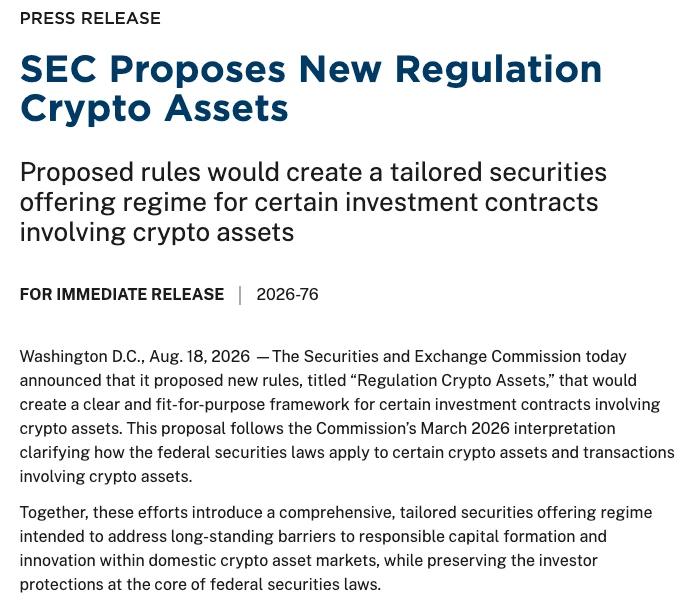
Official SEC statement, source: SEC website
For detailed interpretation, see this article: Interpretation of SEC's New Crypto Regulation: $5 Million or Less Token Financing Doesn't Require Registration, Is the Altcoin Season Coming Back?
The current reversibility is "high" since it is just a proposal at this stage, which can be declared void or rewritten. Once finalized in 2027 to 2028, it would change to "medium," requiring re-running the rule-making process. If it drags on until the final phase of Trump's term, around late 2028, it may also fall into the CRA's retroactive window, where it can be directly abolished by the new Congress.
3. CFTC's Crypto Asset Market Rules
The Commodity Futures Trading Commission (CFTC) oversees futures, options, and other derivative markets. Its current situation is quite special: Chairman Michael Selig was confirmed by the Senate on December 18, 2025, by a vote of 53 to 43, and his predecessor Caroline Pham subsequently left to join MoonPay. Legally, the CFTC governs leveraged, margin, or retail financing crypto commodity transactions; it can only deal with fraud and manipulation related to fully paid spot trading. This "legal ceiling" applies equally to committees that support crypto as well as those with stricter future attitudes.
In this context, the CFTC submitted a preliminary rule document titled "Crypto Asset Trading Rules and Crypto Asset Market Rules" (RIN 3038-AF80) to the White House's Office of Information and Regulatory Affairs (OIRA) on September 17, 2026. The text is now public, in the form of an Advance Notice of Proposed Rulemaking (ANPRM), with a comment period of 60 days following its publication in the Federal Register, which has now concluded.
This document primarily defines the scope of crypto asset regulation: it only targets retail transactions as described in Section 2(c)(2)(D) of the Commodity Exchange Act, namely leveraged, margin, or financed retail transactions in crypto assets (Crypto Asset Transactions, abbreviated CTX). Such transactions must take place on a Designated Contract Market (DCM), unless there is an exception. The document's definition of "crypto assets" excludes payment stablecoins issued by licensed issuers under the GENIUS Act and provides preliminary explanations on what constitutes "offers" and what counts as "actual delivery."
Reversibility is "high". Measures in the proposal stage can easily be sidelined when the policy shifts.
4. CFTC Staff Guidance and "No-Action Letters"
CFTC staff released FAQs on crypto assets on March 20 and September 24, 2026, covering topics like tokenized collateral and margins. Additionally, staff letter 26-25 provided a "no-action" commitment regarding "passive software," indicating that staff would not take enforcement action against such software providers under certain conditions.
The specific contents of these documents are as follows:
- The December 2025 staff letter allowed tokenized US Treasury bonds, money market fund shares, and other real assets to be used as collateral; 26-05 is a "no-action" stance, allowing futures commission merchants (FCMs) to accept non-securities digital assets like Bitcoin, Ethereum, and payment stablecoins as collateral for clients.
- The March 20, 2026, letter supplemented operational details for the above correspondence, stating: crypto assets (including payment stablecoins) cannot serve as eligible collateral for non-cleared swaps, but tokenized eligible collateral can be used as long as it grants equivalent legal and economic rights; clearinghouses can accept crypto assets including payment stablecoins as initial margin provided they meet credit, market, and liquidity risk standards.
- The March 17, 2026, staff letter granted a "no-action" position to wallet software developer Phantom Technologies, exempting it from having to register as an introducing broker. The September 17 letter extended similar conditions to all "passive software providers," meaning those that only provide front-end solutions routing users to regulated FCMs, introducing brokers, and designated contract markets.
Reversibility is "high." Staff guidance and no-action letters can be rescinded by staff or the new committee.
5. Specific Implementation Rules for GENIUS (from the Treasury, FDIC, NCUA, FinCEN)
The execution of the GENIUS Act requires participation from numerous government agencies: the Office of the Comptroller of the Currency (OCC), the Treasury, the Federal Deposit Insurance Corporation (FDIC), the National Credit Union Administration (NCUA), and the Financial Crimes Enforcement Network (FinCEN) each overseeing different aspects, including deposit insurance, credit unions issuing stablecoins, and anti-money laundering obligations. As of November 2026, about 13 rules are still in the proposal phase. Among them, the Treasury's interim final rule on state-level regulatory system certification procedures became effective on September 30, 2026; however, the Treasury's proposed "substantially similar" state-level regulatory principle from April 2026 has yet to be finalized. "Substantially similar" means if a state's stablecoin regulatory system is substantially similar to the federal standard, its issuers can opt for the state-level path.
The reversibility in terms of "content" is "high." Rules in the proposal stage can be rewritten by the new leadership or finalized in different directions. However, the statutory legislative authorization will not disappear, and the new government must operate within the legal framework to complete the rules, rather than leaving it unresolved.
6. Executive Order 14178: "Strengthening US Leadership in Digital Financial Technology" (CBDC Ban)
This is the first major crypto executive order signed by Trump after his return to the White House, dated January 23, 2025. Its function has three layers: it declares federal government support for the development of the digital asset industry, prohibits federal agencies from advancing central bank digital currency (CBDC), and establishes the "President's Working Group on Digital Asset Markets" (PWG), responsible for proposing regulatory framework suggestions.
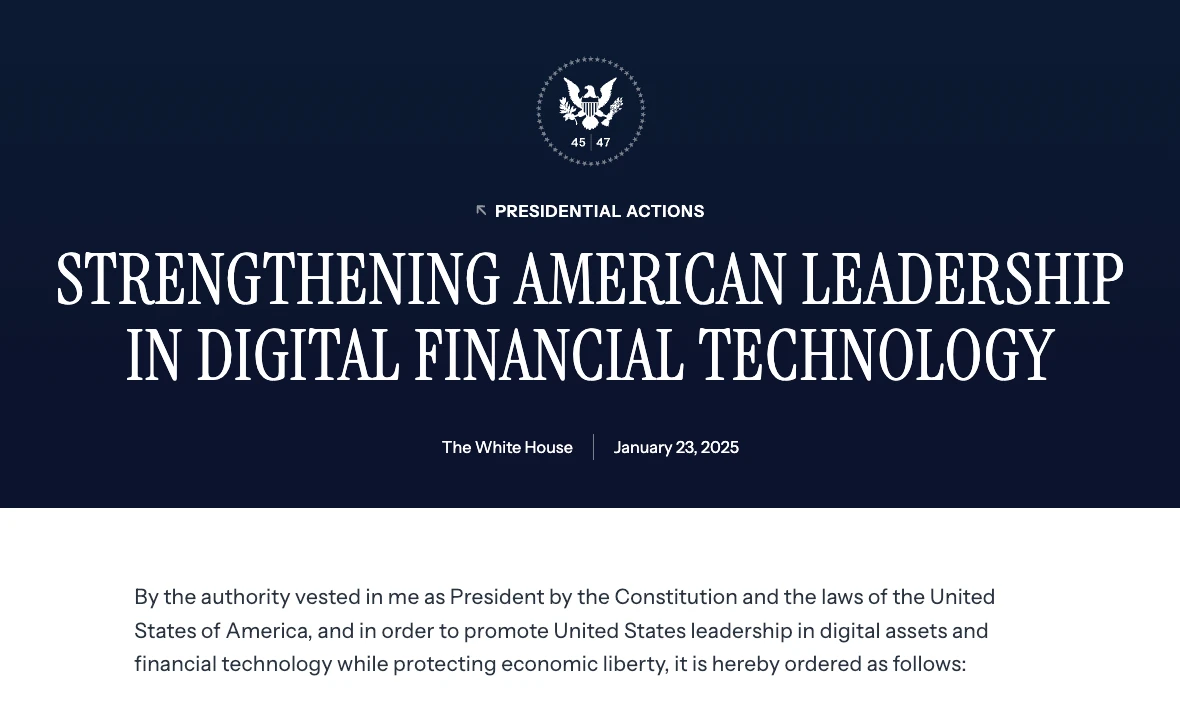
Original text of the bill, source: White House website
The CBDC ban mentioned in item 34 currently relies solely on this order at the federal level.
Reversibility is "high". The next president can rescind it on their first day in office. The CBDC ban will only become solid if Congress enacts a different law after that.
7. Executive Order 14331: "Ensuring Fair Access to Banking Services for All Americans" (Anti-Debanking)
"Debanking" refers to banks refusing to provide account services to specific individuals or businesses due to political positions, industry reputation, or other non-financial risk reasons. During the Biden administration, the crypto industry has long complained of being a major victim. This order, signed on August 7, 2025, requires federal banking regulators to rectify related practices. The order itself does not create any rights enforceable in court, with binding force stemming from subsequent final rules issued by the OCC and FDIC (see item 23).
The crypto industry's narrative is that there has been an action against the crypto industry during the Biden era (Operation Choke Point 2.0). This name was proposed by crypto venture capitalist Nic Carter, originating from the successive collapses of three US banks friendly to the crypto industry, alleging it to be a conspiracy aimed at preventing crypto companies from accessing banking services. This accusation remains controversial, but it has become a core narrative for Trump's camp: during the White House crypto summit in March 2025, Trump announced the end of this action; this executive order demands retroactive reviews of past complaints and banking regulator records. The order text does not specify "crypto" but prohibits "political or illegal debanking" against any legitimate business, with its protective scope not limited to the crypto industry.
As for the order itself, the reversibility is "high".
8. Executive Order 14405: "Integrating Financial Technology Innovation into Regulatory Framework"
This order, issued on May 19, 2026, requires each financial regulatory agency to review its rules within 90 and 180 days, removing obstacles to fintech and crypto businesses, and requires the Federal Reserve to submit a report on access to payment accounts for fintech companies. It continues the previous executive orders, advancing the goal from "statement" to "clearing rules by agency."
Reversibility is "high"; the next president can rescind it on their first day in office.
9. OCC Interpretive Letters
An "interpretive letter" is the OCC's formal response regarding what banks "can do". In several letters issued in 2025, it clarified that banks can provide crypto asset custody, participate in stablecoin business, operate blockchain nodes, and hold crypto assets for payment network fees.
The specific contents of the three letters are as follows:
- Letter 1183 confirmed that participation in activities like independent node verification networks is feasible. It also rescinded letter 1179, which required banks to obtain regulatory agencies' "no objection" before engaging in these activities;
- Letter 1184 allows banks to buy and sell assets being custodied per client instructions and to outsource allowed custody-related services to third parties.
- Letter 1186 confirmed that national banks can pay blockchain network fees (i.e., gas fees) to conduct already permitted businesses and can hold crypto assets for testing already allowed crypto platforms.
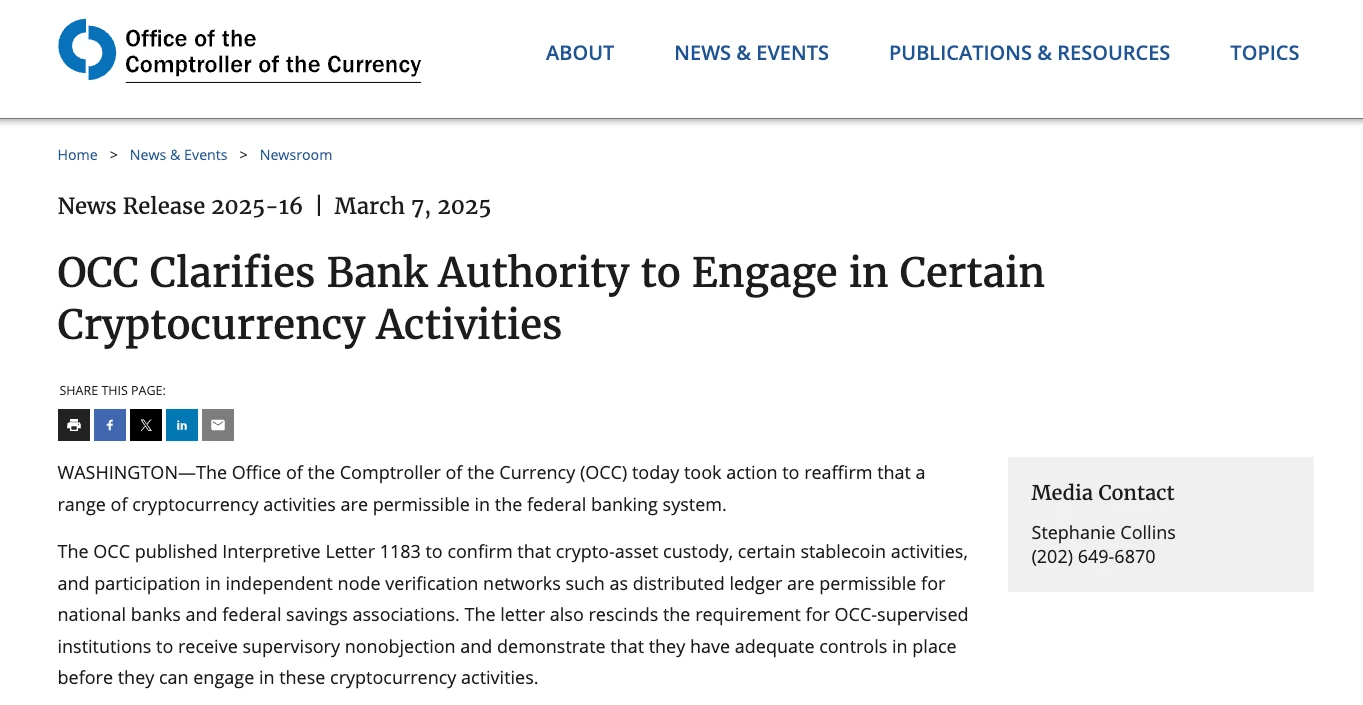
Original text of the interpretive letters, source: OCC website
Reversibility is "high". The new OCC head can directly rescind these letters, and similar rescissions have occurred in the past, for example, the interpretive letter 1179 issued in 2021 was rescinded by 1183 after Trump's administration took office in 2025.
10. FDIC and Federal Reserve Guidance
The FDIC's FIL-7-2025 issued in 2025 canceled the requirement for banks to notify regulators in advance before engaging in crypto business. On April 24, 2025, the Federal Reserve withdrew its previous guidance on crypto assets; on August 15, 2025, it ended the "Novel Activities Supervisory Program" and regulatory letter SR 23-7, both of which had been the Federal Reserve's primary tools for reviewing banks' crypto business.
Reversibility is "high". New guidance can be directly republished without needing public comment.
11. Federal Reserve Payment Accounts ("Slimmed-Down Master Accounts")
A master account is an account held by an institution at the Federal Reserve. With it, an institution can directly access the Federal Reserve's payment clearing system without having to go through partner banks. Crypto companies and fintech companies have long considered this a key bottleneck. In March 2026, Kraken obtained a 12-month limited master account pilot; on May 20, 2026, the Federal Reserve proposed a "payment account" (Docket OP-1878) proposal, opening a more limited, less empowered "slimmed-down" account to fintech and crypto companies. The comment period closed on July 27, 2026, and it has not been finalized yet, with some third-tier applicants' decisions on hold until the end of the year.
The reversibility is "high" before finalization. The direction of this matter depends more on the composition of the Federal Reserve board than on the 2028 presidential election.
12. DOJ's "Ending Regulation by Prosecution" Memo
On April 7, 2025, Deputy Attorney General Blanche issued an internal memo titled "Ending Regulation by Prosecution" and disbanded the "National Cryptocurrency Enforcement Team" (NCET) responsible for crypto cases. Its stance is that prosecutors should not use criminal prosecutions to enforce rules that originally belong to regulatory agencies. This is an internal policy, not a law.
The reversibility moving forward is "high"; the new Attorney General can directly rescind it. However, cases that have passed the statute of limitations or have been abandoned are difficult to pursue again.
13. President's Working Group Report on Digital Assets (Legislative Reference)
The President's Working Group on Digital Markets released a report on digital asset markets in July 2025, proposing policy recommendations covering stablecoins, market structure, taxation, and banking. This report itself is not binding, neither a law nor a rule, but it provides a policy basis for subsequent regulatory actions, with some recommendations already adopted by various agencies.
The reversibility is "high". Since it does not have legal effect, the next government can completely disregard it or start from scratch.
2. Legally Easy to Repeal, But Practically Face Resistance (Items 14 to 16)
These three can also be swiftly repealed legally, but subsequent rules, existing assets, or businesses already established by banks make the true cost of repeal significantly higher than the apparent difficulty.
14. Executive Order 14330: Allowing Alternative Assets (Including Crypto Assets) in 401(k) Retirement Accounts
401(k) is the primary employer pension plan in the US, with tens of millions of Americans placing their retirement funds within it. This order, also signed on August 7, 2025, requires the Department of Labor (DOL) to reconsider rules, making alternative assets, including crypto assets, more accessible for investment options in pension accounts. The DOL issued a proposed rule on March 30, 2026, currently, the final rules have been submitted to the White House's Office of Information and Regulatory Affairs (OIRA) for review, this office is responsible for the final administrative review before official publication.
Once the final rule is published, repealing it will require going through the rule-making process again, with difficulty rated as "medium". Additionally, if this rule only finalizes around late 2028, it may fall under the "retroactive window" of the Congressional Review Act (CRA), and be abolished by the new Congress using CRA.
15. Executive Order 14233: Establishing Strategic Bitcoin Reserves and Digital Asset Stockpile
This order, signed on March 6, 2025, announces the establishment of a "Strategic Bitcoin Reserve" and a "Digital Asset Stockpile."
The core idea is to consolidate Bitcoin acquired by the federal government through criminal or civil forfeitures as a national reserve for long-term holding, with plans to not sell it at will. As of now, the government has not announced any public market buying plans. According to BitcoinTreasuries estimates, the government holds approximately 328,372 Bitcoins, and reports indicate disputes over which department (Treasury or Commerce) will manage the reserves.
The reserves currently only exist by this order and have no legal protection. Legally, reversibility is "high," the next president can revoke it on the first day and restore the sales of forfeited Bitcoin; in practice, it is "medium," as the asset forfeiture process and compensation arrangements for victims will limit the government's ability to sell these coins at will.
16. SEC Withdrawal of SAB 121 (Replaced by SAB 122)
SAB refers to the SEC's "Staff Accounting Bulletin." SAB 121 issued in 2022 required companies holding crypto assets for clients to account for these assets as liabilities on their balance sheets, making it almost impossible for banks to provide crypto custody services. On January 2025, the SEC rescinded this through SAB 122. It needs clarification that this was a staff-level repeal, not under the Congressional Review Act (CRA) procedure; Congress had previously passed a resolution in 2024 to overturn SAB 121, but it was vetoed by Biden.
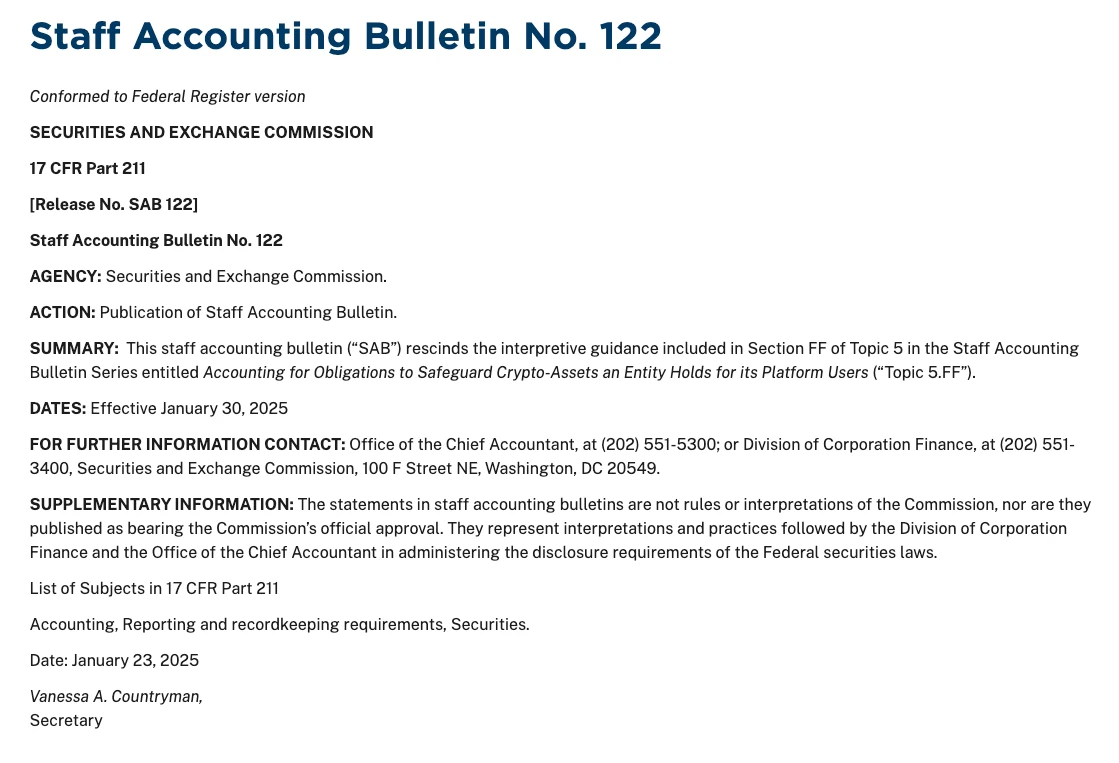
SEC staff accounting bulletins, source: SEC website
From a legal perspective, staff bulletins can be reissued by a future SEC, but in practice, banks have already built products and teams around custody business, making actual withdrawal difficult, with practical reversibility not high.
3. Medium Reversibility (Items 17 to 24)
This category requires regulatory agencies to make formal decisions again but does not necessarily require going through the entire rule-making process; hence it is slower than the first tier but still relatively easy.
17. Joint SEC and CFTC "Interpretation" and Token Classification
On March 17, 2026, the SEC and CFTC jointly issued a committee-level interpretative document categorizing crypto assets into five classes: digital commodities, collectibles, tools, stablecoins, and digital securities. This attempts to provide a temporary answer to "which tokens fall under SEC jurisdiction and which under CFTC" without congressional legislation. It holds a higher status than staff statements as it is approved by committee votes.
The interpretive document can be withdrawn without public comment, but market participants have already arranged their businesses based on it, and a sudden reversal may invite judicial challenges for "arbitrary treatment".
18. SEC's "Innovation Exemption": Tokenized Stock Trading on the Blockchain
On September 17, 2026, the SEC provided a five-year conditional exemption for "tokenized national market system stocks" through an exemption order (Release 34-106402). Tokenized stocks refer to securities represented in blockchain token form that correspond to real listed company shares, allowing such products to be traded on chain. The exemption is valid until September 17, 2031, but comes with a "modifiable" clause. Chairman Atkins himself stated that this exemption "must be followed up with durable rules."
For further interpretation, see here: SEC's Five-Year "Innovation Exemption" Launched, Who Gets a Ticket for Tokenized US Stocks?
The committee may modify or terminate the exemption through a new order without needing to go through the complete rule-making process.
19. National Trust Bank License Granted to Crypto Companies by the OCC
The national trust bank license is a federal license allowing issued institutions to provide custody and stablecoin-related services nationwide without state-by-state applications. The OCC has approved a batch of applications since December 2025. Those ultimately approved include Ripple (October 2026), Circle, BitGo, and Coinbase (November 2026); conditionally approved include Paxos, Fidelity Digital Assets, Crypto.com, Bridge, Protego, and World Liberty Trust (linked to Trump's family), which was approved in August 2026. In October 2026, the Independent Community Bankers Association (ICBA) has already sued, questioning OCC's authority to grant such licenses to crypto firms.
The reversibility needs to be viewed in two parts. Finalized approved licenses have low reversibility because revocation needs valid reasons. Conditionally approved licenses can be delayed or not finalized. Democratic members have explicitly stated they will investigate the OCC's conditional approval of World Liberty Trust.
20. GENIUS Implementation Rules by the OCC (12 CFR Part 15)
The OCC regulates federally chartered banks and is one of the primary enforcers of the GENIUS Act. On October 21, 2026, the OCC issued final rules, published on October 23, spanning 721 pages, adding Section 15 of Title 12 of the Federal Regulations. The rules stipulate pressure testing and liquidity buffer requirements for issuers, set a minimum capital threshold of $5 million, and establish exemption processes for issuers who submitted applications by January 18, 2027. The preamble states that OCC has anti-evasion authority regarding income evasion behavior. The rules will also take effect on January 18, 2027.
Finalized rules must be modified through a new rule-making process, requiring public comment and reasonable explanations, and usually taking one to two years. However, the OCC's leader (Comptroller) is appointed by the president and can be dismissed at any time, so if the Democrats hold power in 2029, they can tighten requirements through new rules within the legal limits.
21. Closure of Investigations into Robinhood Crypto, Uniswap Labs, OpenSea, etc.
In 2025, the SEC closed investigations into several companies without taking enforcement actions, including Robinhood Crypto, Uniswap Labs, Crypto.com, OpenSea, Yuga Labs, and Gemini. Investigations are different from lawsuits; they are internal agency procedures, and "closure" does not mean a legal finality.
In theory, the new SEC can reopen investigations within the statute of limitations for fines (reported to be five years). However, in practice, the cost of evidence collection is high and the timing has passed, making it rare for cases to be restarted.
22. General ETF Listing Standards
Previously, every cryptocurrency ETF needed individual approval from the SEC, which was a long and uncertain process. On September 17, 2025, the SEC approved rule modifications by Nasdaq, Cboe BZX, and NYSE Arca, establishing "universal listing standards", allowing qualifying commodity trust shares (including crypto assets) to list without individual approval. This change significantly compressed the time to market for new products.
Future SECs can require exchanges to modify standards or review them again under the powers of Section 19 of the Securities Exchange Act, but clearing already listed products from the market is another matter (see item 27).
23. OCC and FDIC "Reputation Risk" Rules
"Reputation risk" has been a vague term often used by regulators, allowing them to imply to banks not to serve certain clients, with crypto companies being primary victims. The OCC and FDIC issued final rules on April 7, 2026, removing this concept from the regulatory framework and prohibiting regulator-driven debanking; the rules took effect on June 9, 2026. Additionally, a final rule on "unsafe or unsound practices" was published in August of that year. This is the implementation version of the seventh executive order.
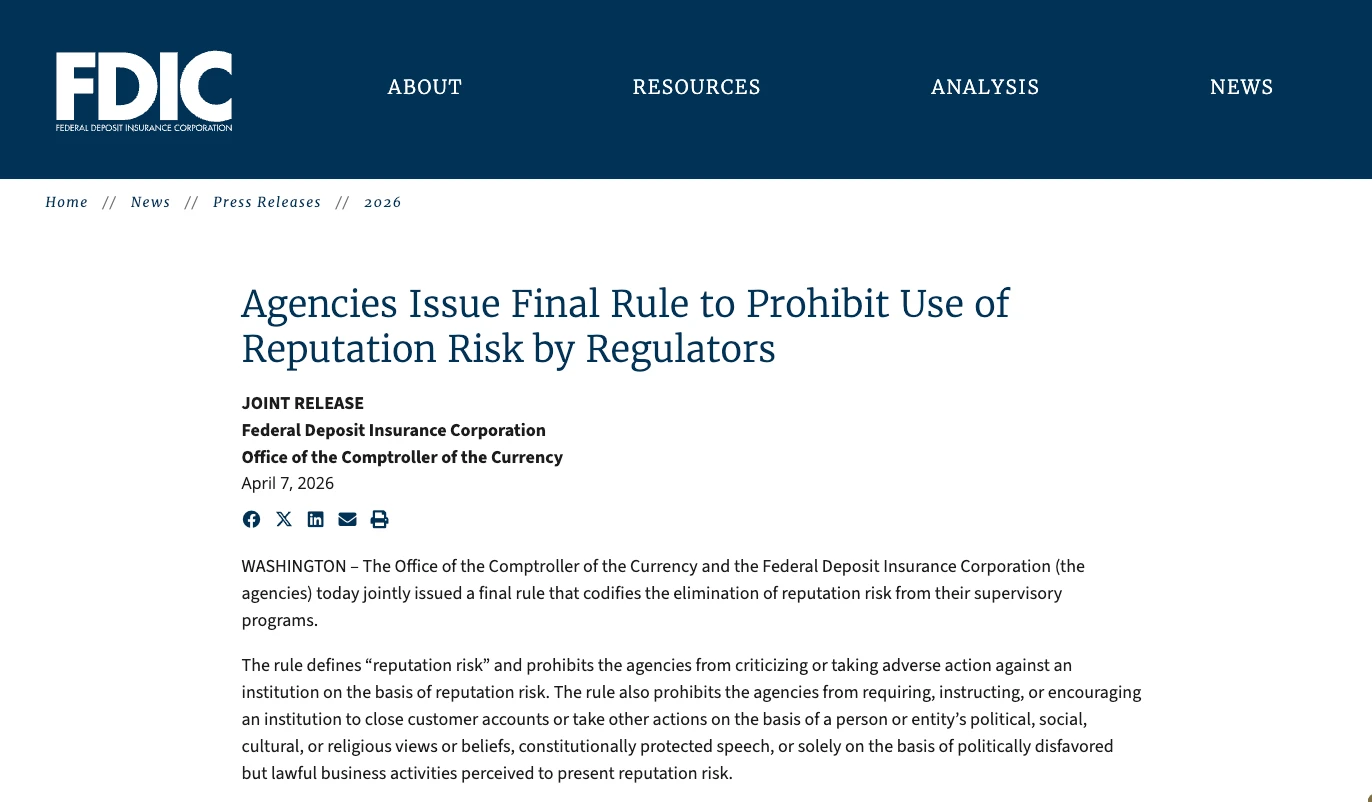
Joint statement by the OCC and FDIC, source: FDIC website
To repeal it, it requires going through the rule-making process again, usually taking 12 to 24 months and facing potential court challenges under the Administrative Procedure Act (APA). Since Trump holds the veto power, the Democrat-controlled Congress cannot repeal it using CRA before 2029.
24. Treasury OFAC Lifting Sanctions on Tornado Cash
Tornado Cash is a mixing protocol on Ethereum, allowing users to "launder" the sources of their funds. In 2022, the Treasury's Office of Foreign Assets Control (OFAC) listed its smart contract address as a sanctioned entity, prompting industry and legal critiques. In March 2025, OFAC removed it from the sanctions list.
In theory, OFAC can relist it for sanctions, but the Fifth Circuit Court's ruling in the Van Loon case regarding "immutable smart contracts" imposes limitations on re-sanctioning.
5. Low Reversibility or Irreversible (Items 25 to 32)
This tier either involves deep integration into institutional daily operations or has been codified into law, making repealing them entail high political and market costs.
25. ETF Physical Redemption Mechanism
On July 29, 2025, the SEC approved Bitcoin and Ethereum exchange-traded products to adopt "physical redemption." Before this, authorized participants could only exchange or redeem ETF shares for cash; now they can do so directly with Bitcoin and Ethereum, reducing operational costs and tax friction.
This mechanism has been deeply embedded in the daily operations of fund companies, and forcing a reversal would incur significant operational costs.
26. GENIUS Act (Stablecoin Law)
The GENIUS Act is the first federal law specifically regulating stablecoins, numbered Public Law 119-27, signed by Trump on July 18, 2025. Stablecoins are crypto tokens pegged to the value of fiat currencies like the US dollar, with USDT and USDC being the most common examples. The core idea of the act is to establish a federal licensing and regulatory framework for stablecoin issuers, requiring them to hold sufficient high-quality reserve assets, and restricting direct payments of gains to token holders, known as the "earnings ban."
This law has wide political support. The Senate passed it by 68 to 30, with 18 Democrats voting in favor; the House approved it 308 to 122, with support from 206 Republicans and 102 Democrats. The law stipulates that it will take effect on the earlier of the following two: 18 months after enactment or 120 days after final implementation rules are published. Under the legal timetable, regulatory agencies were supposed to complete rule-making by July 18, 2026, which deadline has been missed. Since the 18-month fallback deadline comes sooner, the act will take effect on January 18, 2027.
Amending this law requires new legislation, and Trump holds veto power until January 2029, following which even if the Democrats fully control, they would still face the 60-vote threshold in the Senate. A more realistic path is revision, such as adding ethical rules for officials holding crypto assets, or blocking loopholes in the earnings ban rather than completely abolishing it.
27. Already Listed Spot Crypto Asset ETFs
From October 2025 to now, a batch of spot crypto asset ETFs have been launched in the US market, with underlying assets including SOL (including staking ETFs, such as BSOL), XRP, LTC, HBAR, DOGE, LINK, and multi-asset products GDLC. According to data from Morgan Stanley, there are about 140 crypto-related ETPs listed in the US, of which about 40 are spot single-asset products.
For products already in the hands of investors, a forced delisting would be an extremely rare move with significant political costs.
28. Congressional Review Act Overturning IRS DeFi Broker Rules (H.J.Res. 25)
This is the most solid victory during the entire period. At the end of Biden's term, the IRS issued a rule requiring certain participants in decentralized finance (DeFi) to report user transaction information to tax authorities as "brokers." The industry argued that decentralized protocols do not control user identities and cannot fulfill this obligation, effectively banning DeFi.
Congress used the Congressional Review Act (CRA) as a tool to overturn this rule. The CRA stipulates that Congress can pass a "disapproval" resolution within a certain period after rule issuance with a simple majority, and upon presidential signature, that rule becomes null and cannot be reissued in "substantially similar" form unless authorized by Congress. H.J.Res. 25 was signed by Trump on April 10, 2025, becoming Public Law 119-5. The Senate passed it 70 to 28, and the House 292 to 132, with significant Democratic support. The Treasury removed this rule from the Federal Regulations Compilation on July 11, 2025. It should be noted that the 1099-DA reporting regime for custodial brokers is enforced from the 2025 tax year and has not been abolished.
Reversibility: Without new legislation, it cannot be reversed. Once this rule is negated by the CRA, no government can issue similar rules again; it must be re-legislated by Congress.
29. Pardons for Ross Ulbricht, BitMEX Founders, and CZ
In 2025, Trump granted pardons to several iconic figures in the crypto industry, including Ross Ulbricht, who was sentenced to life imprisonment for operating the dark web market Silk Road, the founding team of the crypto derivatives exchange BitMEX, and Binance founder CZ. The power of pardon is an independent power conferred to the president by the Constitution and does not require Congressional or court approval.
Once a pardon is delivered, no successor can reverse it, making it the most absolute category among the 36 measures.
30. Dismissal of Lawsuits Against Companies such as Coinbase, Kraken, Consensys, Binance, etc.
Between February and May 2025, the SEC successively dismissed lawsuits against several crypto companies, including Coinbase, Kraken, Consensys, Cumberland DRW, Dragonchain, Balina, and Binance. The original core accusations were that these companies provided securities-like trading, brokerage, or staking services without registration. According to the research report, these cases were dismissed in a "with effect" manner, meaning they cannot be re-sued on the same issue legally.
A dismissal "with effect" is legally known as res judicata, and a new committee cannot bring it up again.
31. Conclusion of the Ripple Case
The SEC sued Ripple in 2020, alleging that sales of XRP constituted unregistered securities issuance, making it one of the most influential lawsuits in the crypto industry. In August 2025, both parties retracted appeals. The regional court's imposed $125 million fine remains unchanged, as the court did not approve the proposed reduction of the fine to $50 million suggested by both parties.
Reversibility is "irreversible"; this is a final judgment.
32. Settlement between Justin Sun with Tron and the SEC
On March 5, 2026, the SEC reached a settlement with parties related to Justin Sun of Tron. Rainberry Inc. paid $10 million, and the accusations against Sun and related foundations were dismissed with effect. This is another significant historical leftover case concluded by the SEC in 2026.
Reversibility is "irreversible"; settlements and dismissals with effect are both final results.
Appendix: Four Bills Not Yet Become Law (Items 33 to 36)
These four do not face "overturning" issues but only question whether they can be passed. In the new Congress controlled by Democrats, they are unlikely to be advanced.
33. CLARITY Act (Market Structure Bill)
The CLARITY Act attempts to address the most core legal issues in the crypto industry: which tokens are securities and governed by the SEC, which are commodities and governed by the CFTC, and how trading platforms, brokers, and custodians should be registered and regulated. It complements the GENIUS Act, where GENIUS governs stablecoins, CLARITY governs the entire trading market structure.
The House passed the bill on July 17, 2025, by a vote of 294 to 134, including support from 216 Republicans and 78 Democrats. In the Senate, the Agriculture Committee passed its version on January 29, 2026, by a vote of 12 to 11; the Banking Committee reported on May 14, 2026, passing with 15 to 9 votes, including support from two Democrats. However, on September 15, 2026, the Senate's motion to enter deliberations failed the cloture vote by 49 to 50, falling short of 11 votes from the 60-vote threshold, with all Democrats and four Republicans voting against. According to analysis from Orrick law firm, major disagreements focused on ethical rules for officials holding crypto assets and stablecoin earnings issues. Senator Tillis's motion for reconsideration kept the bill procedurally alive during the recess, but firms like DLA Piper, Troutman Pepper Locke, and Orrick believe it is basically hopeless in this Congress.
Since CLARITY is not yet a law, discussions of "overturn" do not apply. The newly controlled Democratic Congress only needs to not advance it, equating to a veto. Troutman Pepper Locke also points out that regulatory agencies cannot replicate several core components of this bill with rules, including CFTC licensing of spot intermediaries, priority protection for customer property in bankruptcies, and broad priority applicability to state laws.
34. Anti-CBDC Surveillance State Act
Central Bank Digital Currency (CBDC) is a digital form of legal tender directly issued by central banks. There is a strong opposition voice in the US, fearing it would enable government monitoring of individual spending. This bill, numbered H.R. 1919, aims to prohibit the Federal Reserve from issuing CBDCs targeted at retail users. The House passed it on July 17, 2025, by a vote of 219 to 210; on April 29, 2026, this content was attached to the House's amendment to S. 1318, but the Senate did not reach a consensus on it, and the bill has yet to become law.
Thus, the only effective federal level CBDC ban in the US currently relies on the executive order 14178 from January 2025 (see item 6), which can be revoked by the next president. Unless Congress enacts genuine legislation, the ban's solidity is limited.
35. Digital Asset Tax Certainty Act
This bill (H.R. 10357) is a long-awaited crypto tax reform by the industry. It includes several aspects: setting a tax exemption threshold for small transactions (reportedly a $10 gas fee exemption), extending "wash sale rules" applicable to stocks to crypto assets, and clarifying tax methods for staking and mining gains. The "wash sale rules" refer to the prohibition of claiming tax deductions for losses if an asset sold at a loss is repurchased within 30 days; currently, crypto assets are not subject to this rule, introducing it would close a tax loophole, but also involves trade-offs for the industry. The House Ways and Means Committee passed the bill 38 to 5 on September 16, 2026, but neither chamber has voted on it. The future of its advancement over the recess will likely depend on the attitude of Ron Wyden, who will chair the Senate Finance Committee.
36. Bitcoin Act and American Reserve Modernization Act (ARMA)
The Bitcoin Act (S. 954) was proposed by Senator Lummis, aiming to have the federal government buy a significant amount of Bitcoin over several years as a national strategic reserve. The American Reserve Modernization Act (ARMA) is another proposal related to reserve assets, which was passed in the House Financial Services Committee on September 16, 2026, by a vote of 28 to 21. Both have yet to become law.
With the Democrats controlling Congress, it is almost impossible for such bills to advance. Relatedly, the current "strategic Bitcoin reserve" exists solely based on an executive order (see item 15) without any legal basis.
Appendix: Five Types of Institutions and Legal Tools
Background 1: How Legislation Works in the US Congress
In the US, for a bill to become law, it must receive majority votes in both the House and the Senate, and then be signed by the president. The Senate has an additional special hurdle: most bills require 60 votes to end debate and proceed to a vote, a procedure known as "cloture." Understanding these two points helps to comprehend why legislative actions by Congress are hard to overturn once completed and why some other bills get stalled for extended periods in the Senate.
Background 2: Executive Orders and Pardons
An Executive Order (EO) is a directive from the US president directly to federal agencies, requiring no Congressional approval and effective immediately. Its advantage is flexibility, but its downside is equally evident: the next president can entirely rescind it by signing a new order, making executive orders almost always rank highest in terms of reversibility. The power of pardon, in contrast, stems from privileges granted to the president by the Constitution; once effective, there are nearly no mechanisms to reverse it.
Background 3: What is the SEC and How it Operates Today
The US Securities and Exchange Commission (SEC) is an independent agency that regulates securities markets at the federal level. The most controversial practice in recent years has been during the tenure of former Chairman Gensler, which defined which crypto assets are securities through lawsuits rather than rules, a practice termed "law enforcement regulation" by the industry. Since current Chairman Paul Atkins took office, the agency has shown a clear shift. Currently, there are no Democratic commissioners on the committee (in the nomination process), and Peirce's announcement to resign on September 25, 2026 leaves only Chairman Atkins and Commissioner Uyeda on the committee.
Background 4: OCC, FDIC, and the Federal Reserve
For crypto companies wishing to connect with the traditional financial system, they cannot avoid the interplay between three agencies: the Office of the Comptroller of the Currency (OCC), which regulates federally chartered banks; the Federal Deposit Insurance Corporation (FDIC), which handles deposit insurance; and the Federal Reserve. During the Biden era, these three agencies served as a "firewall" between banks and crypto businesses through a series of informal guidelines; during Trump's era, this set of restrictions gradually disassembled.
Background 5: Legal Authorities and Current Situations of the SEC and CFTC
After the CLARITY Act faced setbacks in the Senate, regulatory agencies began to use their authority to fill the gaps. The commonality among this batch of measures is that they mostly remain in proposals, exemptions, or internal guidance phases, with legal foundations far weaker than codified laws. Troutman Pepper Locke law firm's assessment labels these regulatory actions as "unable to provide certainty" and suggests that under future administrations, they are "easily overturned." Another reality is that both agencies are currently composed very singularly: the SEC has no Democratic commissioners, and the CFTC has only Chairman Michael Selig since December 2025, who is in the process of nominating new commissioners. The Supreme Court overturned over a century-old precedent in the June 2026 Trump v. Slaughter case, allowing the president to dismiss heads of independent agencies at will, signifying that the next president can take control over these agencies rapidly.
Scenario Analysis of Democratic Takeover and Final Conclusion
Phase 1: Democrats Control Both Houses, Trump Still in Office (January 2027 to January 2029)
This is a currently established reality. The greatest tool the Democrats will have in these two years is oversight power. Elizabeth Warren is expected to take over as chair of the Senate Banking Committee, Maxine Waters will take the helm of the House Financial Services Committee, Robert Garcia will lead the House Oversight Committee, and reports suggest Sherrod Brown will chair the Senate Agriculture Committee. They have all indicated they will investigate World Liberty Financial, USD1 stablecoin, $TRUMP meme coin, and the OCC’s conditional license approval for World Liberty Trust.
The Democrats can also let the CLARITY Act, Bitcoin reserve-related bills, and crypto tax bills sit idly; the Senate can refuse to confirm SEC and CFTC nominees. SEC Chairman Atkins's term expired in June 2026; the SEC website indicates that members can continue serving for up to 18 months past their term expiration, roughly until the end of 2027 for Atkins. The Democratic Senate can sustain the two agencies' "understaffed" status, thereby making their rules legally easier to challenge.
What the Democrats cannot accomplish is equally clear. They cannot abolish the GENIUS Act, cannot use CRA to overturn rules from the Trump administration (the president will veto), and cannot rescind executive orders or re-litigate cases that have been dismissed. The agencies can still advance Trump's crypto agenda under current authorizations. Possible bipartisan consensus includes a smaller scale market structure bill featuring strict disclosure and divestment clauses for officials who hold crypto assets, and partial amendments to the GENIUS Act, such as closing earnings loopholes without total repeal. TD Cowen analyst Jaret Seiberg warns that the current political climate might render an acceptable version of CLARITY "entirely impossible to advance."
Phase 2: Democrats Gain Complete Control After 2028 Elections (Beginning January 2029)
Once the Democrats control both the White House and Congress, things will unfold in three phases. On the first day, executive orders 14178, 14233, 14330, 14331, and 14405 can be rescinded, the DOJ memo can be retracted, and leadership of the SEC and CFTC can be changed. The Supreme Court, in the June 29, 2026, Trump v. Slaughter case, overturned the Humphrey's Executor precedent, allowing the president to dismiss commissioners of independent agencies with almost no obstacles, although the statutory limit of not more than three commissioners from a single party still exists. Within months, staff statements, OCC interpretive letters, and no-action letters can be revoked, exemptions can be modified or terminated, and unfinalized proposals can be rewritten or nullified. Within one to two years, new rule-making will be needed to dismantle the reputation risk rule, the finalized crypto asset regulations, and labor department rules, while tightening the implementation of the GENIUS Act, including reserves, capital, anti-evasion of earnings, and state-level certifications.
Meanwhile, per the Congressional Research Service interpretation, rules submitted for review to Congress before the end of the previous Congress session (fewer than 60 Senate working days or fewer than 60 legislative days in the House) can be re-evaluated by the new Congress using CRA. This implies that if Regulation Crypto Assets, CFTC's crypto rules, or Labor Department's 401(k) rules are finalized only by late 2028, they could face instant abolition risks.
Even in this scenario, there are several things that are nearly impossible to achieve: complete repeal of the GENIUS Act (it requires 60 votes in the Senate, and many Democrats were co-sponsors of the bill), rescinding pardons, re-litigating cases that have already been dismissed, and forcing already listed ETFs to delist.
免责声明:本文章仅代表作者个人观点,不代表本平台的立场和观点。本文章仅供信息分享,不构成对任何人的任何投资建议。用户与作者之间的任何争议,与本平台无关。如网页中刊载的文章或图片涉及侵权,请提供相关的权利证明和身份证明发送邮件到[email protected],本平台相关工作人员将会进行核查。