Author: AiPlot Institute
Focus: RWA / Digital Assets / In-depth Analysis of Financial Infrastructure
Website: https://aiplot.com/?utm_source=aicoin
If one day you see HSBC-USDT perpetual contracts on a crypto trading platform, your first reaction might be: Are traditional bank stocks entering the crypto market too?
But what truly deserves research is not whether HSBC can trade on crypto platforms, but whether the familiar valuation, liquidity, and risk management frameworks can still be applied directly when a traditional financial asset enters the crypto derivatives market?
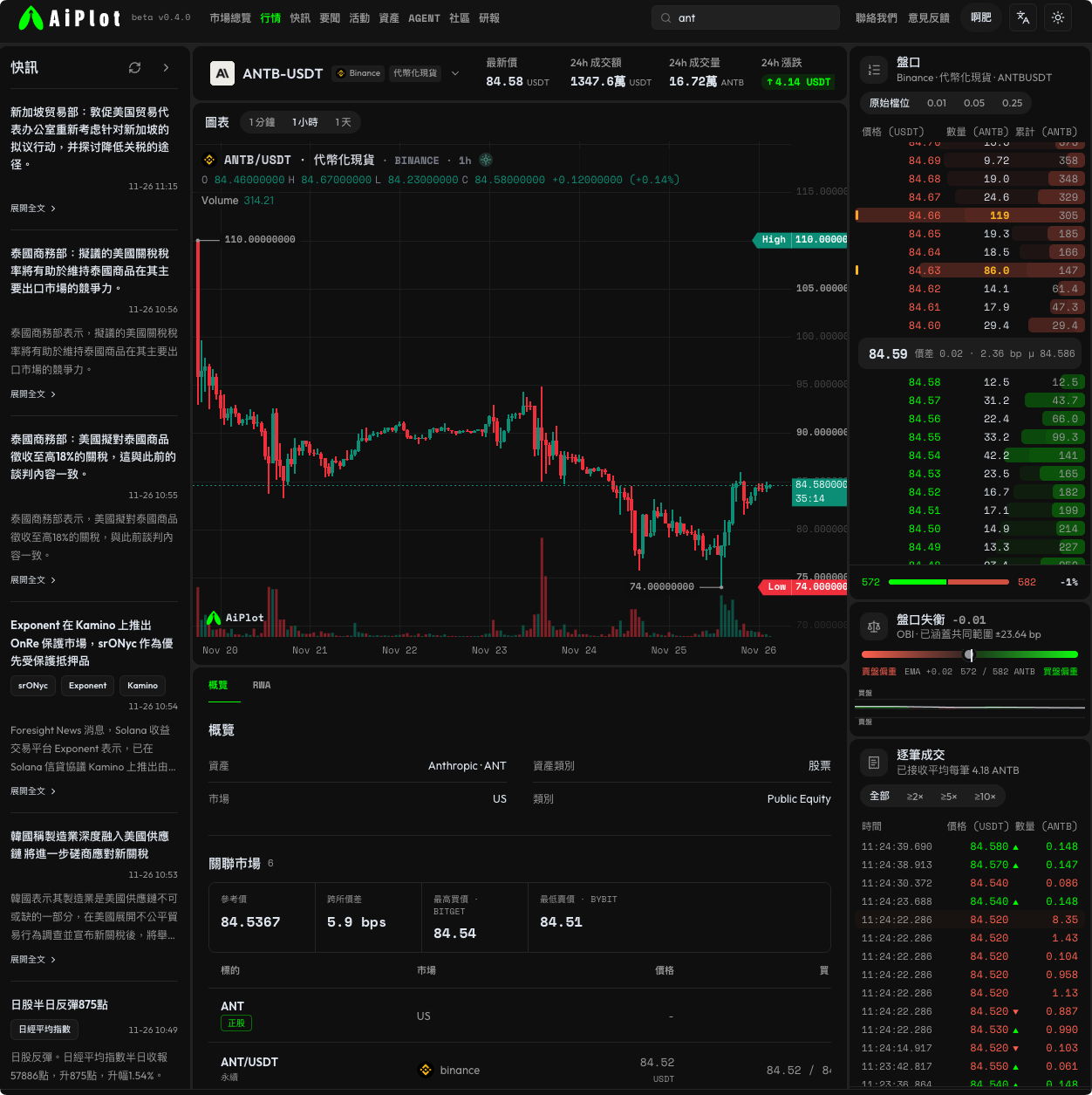
The HSBC-USDT market page on AiPlot provides an excellent observation case.
1. HSBC on Different Scales in Two Markets
First, let’s look at the fundamental data of the company on the page:
- Market Cap: Approximately HK$2.2 trillion
- ROE: 12.56%
- ROA: 0.73%
- Earnings per Share: 4.37
- Free Cash Flow: 25.11B
- Dividend Yield: 3.96%
These figures reflect a large bank's operational scale, profitability, and shareholder returns.
Now, let’s look at the HSBC-USDT perpetual contract on the same page:
- Latest Price: 81.68 USDT
- Mark Price: 81.79 USDT
- Index Price: 81.793 USDT
- 24-hour Trading Volume: Approximately 2.74K USDT
- 24-hour Trade Quantity: 33 HSBC
- Funding Rate: 0% / 8 hours
The most notable aspect is the trading volume.
A bank with a market cap exceeding 2 trillion HKD has a corresponding perpetual contract with a 24-hour trading volume of only about 2,740 USDT as seen in the screenshot.
This reveals an important distinction:
A large underlying asset does not mean it has sufficient liquidity on every trading platform.
The traditional market's HSBC stocks have the backing of the Hong Kong Stock Exchange, London Stock Market, institutional investors, market makers, and a large number of spot trading activities.
However, an HSBC perpetual contract on a crypto platform operates in a separate trading venue. Its trading depth, participants, price formation, and settlement arrangements need to be evaluated individually.
One cannot assume that just because HSBC is a large bank, its USDT contract will have the liquidity of large bank stocks.
2. The Risk Traditional Financial People Often Overlook: Asset Liquidity Does Not Equal Contract Liquidity
In the traditional stock market, analyzing HSBC typically looks at:
- Earnings Growth and Net Interest Margin
- Non-performing Loans and Credit Costs
- Capital Adequacy Ratio
- Dividends and Buybacks
- Valuation and Shareholder Returns
But in the perpetual contract market, one must also consider:
- Depth of Buy and Sell Orders
- Bid-Ask Spread
- Open Interest Size
- Funding Rate
- Mark Price and Index Price
- Margin Calls and Liquidation Mechanisms
These two analytical frameworks cannot replace each other.
For example, the OBI imbalance indicator in the screenshot shows -0.84, indicating the platform's current order book leans to one side, but it does not directly prove that the market will necessarily decline afterward.
Because orders may be canceled, depth may change instantly, and actual transactions are the true result of the buyers and sellers completing trades.
Looking at the funding rate, the page shows it as 0%.
This does not mean the market is risk-free, nor does it mean that the long and short forces are completely balanced. It only indicates that the platform recorded a current funding rate of zero at the moment the screenshot was taken.
For derivatives traders, directional judgment is just the first step; trading costs, liquidity, and settlement risks are equally important.
3. HSBC’s Fundamentals Still Worth Independent Study
If we pull our perspective back to traditional finance, HSBC itself has operational changes worth noting.
In the first half of 2026, HSBC reported a 23% year-on-year increase in pre-tax profit, reaching 19.5 billion dollars. However, this includes about 2.2 billion dollars from favorable one-off items, so the entire growth cannot be simply interpreted as sustained growth in core banking operations.
During the same period, HSBC announced a CET1 capital ratio of 14.1%.
On November 18, Group CEO Georges Elhedery published a strategic article discussing how AI could assist banks in enhancing operational efficiency, improving customer service, and accelerating the delivery of payment, investment, and treasury services.
This shows that large banks face competition not just from interest rates and loan-deposit spreads.
Future challenges will also include:
- Whether wealth management can continue to attract Asian funds
- Whether AI can truly reduce operational costs
- Whether cross-border payment and corporate treasury services can improve efficiency
- Whether capital returns can maintain an attractive level
For the Hong Kong financial market, HSBC is a very representative case: it stands at the intersection of traditional banking, cross-border finance, wealth management, and financial technology transformation.
4. What Really Deserves Attention in Hong Kong: How Tokenized Financial Products Establish Secondary Markets
This is where the article truly opens up for further exploration.
The Hong Kong Securities and Futures Commission announced in April 2026 a secondary trading framework for tokenized, SFC-approved investment products, initially expected to focus on tokenized money market funds and exploring how to support secondary market trading on licensed virtual asset trading platforms.
As of March 2026, there were 13 tokenized products available to the public in Hong Kong, with the total asset size of tokenized shares increasing to 10.7 billion dollars.
This direction is not the same as offshore trading platforms launching stock perpetual contracts.
There are at least three important differences between the two:
First, What Are You Trading?
Stock perpetual contracts typically provide derivatives exposure to fluctuations in the underlying prices; tokenized funds involve fund shares and their legal, custody, and issuance arrangements.
Second, What Rights Do Investors Obtain?
Holding stock perpetual contracts should not be directly equated with holding common shares of HSBC, nor should it imply that one enjoys dividends, voting rights, or shareholder status. Specific rights must be defined by the product contract and legal documents.
Third, Who Regulates and Provides Assurance for the Market?
The SFC's framework for tokenized products emphasizes fair pricing, orderly trading, liquidity provision, and information disclosure. These are foundational issues that cannot be overlooked when tokenized assets enter secondary markets.
The opportunity in Hong Kong is not just to migrate traditional assets onto the blockchain but also to connect issuance, custody, trading, settlement, and investor protection.
5. In Future Evaluations of RWA, We Should Not Only Ask "Can It Be Traded?"
From the case of HSBC-USDT, I believe we can establish a more comprehensive observation framework:
- Asset Level: Does the underlying asset have real value? What is the fundamental condition?
- Product Level: Is what is being traded stocks, fund shares, or price derivatives?
- Liquidity Level: Is the trading depth, trading volume, and spread sufficient?
- Pricing Level: How are the index price, mark price, and actual transaction prices formed?
- Risk Control Level: Are the margin, settlement, collateral, and extreme market handling transparent?
- Rights Level: What legal rights do holders actually enjoy?
The next phase of RWA should not just be about which assets have more listings.
True competitiveness should provide investors with clear knowledge of what they are buying, what risks they are assuming, and whether they can exit fairly and orderly during market fluctuations.
Traditional finance provides assets and credit, while the crypto market offers new trading and settlement methods. But for both to converge, it cannot rely solely on a trading code, but requires a complete market system.
For more data and analysis, please follow Aiplot:
https://aiplot.com/?utm_source=aicoin
📖 Community Interaction:
-Telegram:
https://t.me/+IIYMcJigBAo4Mjg1
The content of this article only represents the author's personal views and does not represent the platform's position. The opinions, conclusions, and suggestions within the text are for investors' reference only and do not constitute any investment advice related to this platform. The market has risks, and investments should be cautious.
免责声明:本文章仅代表作者个人观点,不代表本平台的立场和观点。本文章仅供信息分享,不构成对任何人的任何投资建议。用户与作者之间的任何争议,与本平台无关。如网页中刊载的文章或图片涉及侵权,请提供相关的权利证明和身份证明发送邮件到[email protected],本平台相关工作人员将会进行核查。