Original Title: "In the Name of Altruism, EA Weaves a Network for Twenty Years"
Original Author: Sleepy
If a seventeenth-century theologian from Paris were to arrive in San Francisco in 2026 and walk into the offices at the foot of Berkeley Hills filled with glass whiteboards, he would most likely feel a sense of familiarity.
He would not understand the formulas on the whiteboards, but after listening to the conversations of the young people in the room for just ten minutes, he would be able to recognize that familiar reasoning style.
More than three hundred years ago, mathematician Pascal attempted to prove to skeptics using the nascent field of probability theory that since the rewards of heaven are infinitely great and the cost of making a wrong bet is only a finite price in this world, then even if the probability of God's existence is minuscule, any rational person who understands arithmetic should immediately kneel down and pray. In the face of an infinite multiplier, all fleeting pleasures, hesitations, and costs in earthly existence are mathematically equivalent to zero.
Four hundred years later, the God of Christianity has long since retreated from the everyday language of Silicon Valley. Yet this group of tech elites, who pride themselves on being evidence-oriented and having completely shed religious superstition, are reenacting Pascal's theology with Bayesian formulas, utility functions, and statistical models.
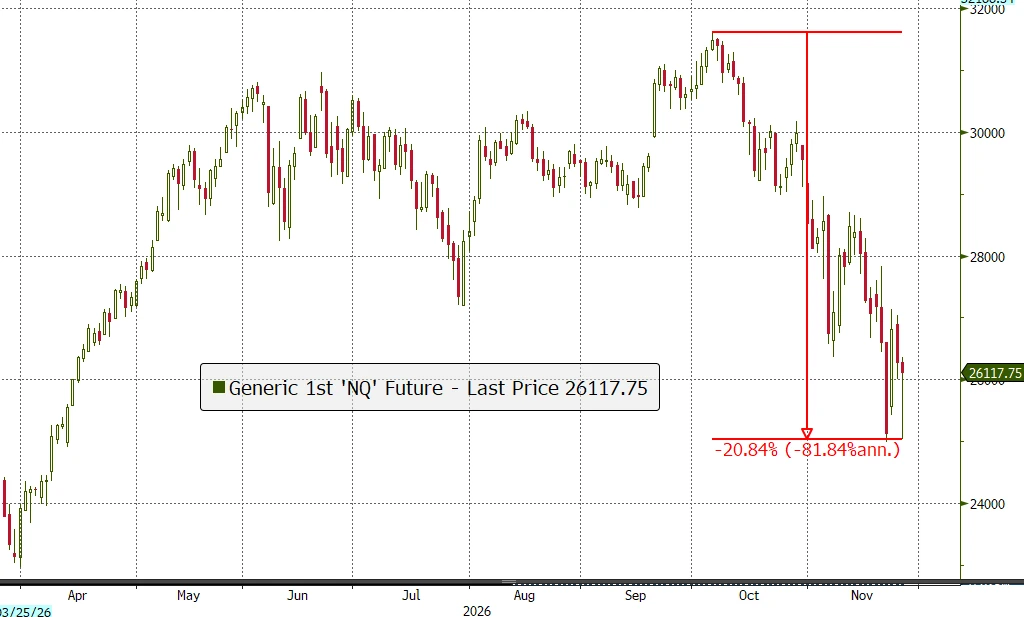
On November 9, 2026, a policy newsletter called Transformer published a commentary titled "Jensen Huang Should Resign." Two days later, NVIDIA's board accepted Huang's resignation, and twelve days later, they invited him back. During the few days Huang was away from the office, Anthropic had just rung the bell for its IPO on NASDAQ.
Following the byline of Transformer, the author Shakeel Hashim previously served as the communications director at the Center for Effective Altruism. The publishing organization Tarbell secured a grant of approximately $23.1 million from the fund controlled by Facebook co-founder Dustin Moskovitz, and another investor is Jaan Tallinn, co-founder of Skype. Interestingly, both Moskovitz and Tallinn were also investors in Anthropic's Series A funding round in 2021.
Many believed that the wave of effective altruism came to an end four years ago during the upheaval following the bankruptcy of FTX and the sell-off of Oxford Manor.
However, a detailed investigation into personnel and funding flows in Silicon Valley and Washington in 2026 reveals that it had quietly taken over one of today's most important tables in the game.
Ponds and Arithmetic
In 1972, Australian philosopher Peter Singer penned a hypothesis about a shallow pond in a paper.
You walk by a shallow pond and see a child struggling in the water; the cost of jumping in to save him is just dirtying your clothes, and almost no one would ignore the child in distress. Singer then asked, if saving the child before you is a moral obligation, then why is the moral weight of a stranger dying far away due to lack of food and medical assistance lighter than that of the child right before you?
This inquiry exposes the numbness of modern individuals when faced with distant suffering and forces people to confront the moral responsibility behind the global disparity between the rich and the poor.
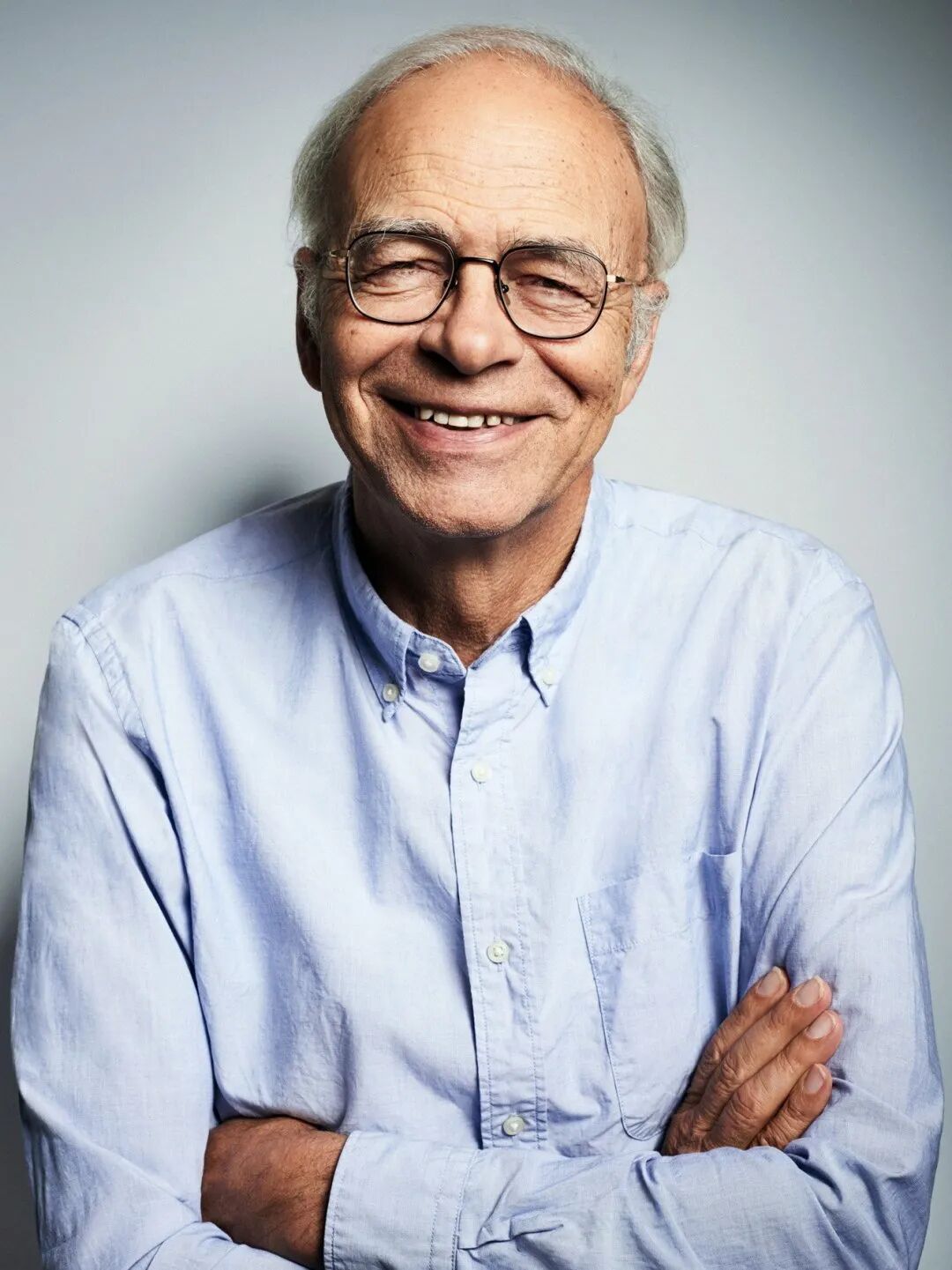
Philosopher Peter Singer
Photo source: Peter Singer's official website
Thirty-five years later, two Wall Street analysts decided to turn this philosophical question into a set of evaluation standards.
In 2007, Holden Karnofsky and Elie Hassenfeld, after leaving Bridgewater Associates, founded GiveWell. They brought the methods of financial due diligence into the realm of public welfare, scoring charitable organizations based on quality-adjusted life years among other metrics, calculating how many additional years of survival each dollar donated could purchase. The final conclusion of their calculations was that the maximization of benefits comes from distributing mosquito nets in malaria-prone areas in sub-Saharan Africa, with the cost per saved life being approximately several thousand dollars.
Two years later, Oxford University philosophers Toby Ord and Will MacAskill initiated Giving What We Can, calling upon followers to donate at least 10% of their incomes for life. In 2010, Moskovitz and his wife Cari Tuna signed a giving pledge, later collaborating with GiveWell to hatch what became Open Philanthropy, which now manages billions of dollars in funding pools, currently known as Coefficient Giving.
Effective altruism, abbreviated as EA in English, thus took shape between the philosophical seminar rooms of Oxford and the quantitative models of Wall Street.
The early EA had a convincing sense of pragmatism. The traditional charity sector was rife with extravagant gala dinners, high administrative costs, and empty emotional appeals; this group of young people brought out a ruler, demanding that every charitable dollar must deliver verifiable results.
The problem arose because they treated this ruler as the only standard for measuring everything in the world.
To compare high and low between completely different charitable actions, EA had to first set a premise: all complex values, suffering, dignity, and responsibilities in human society could be abstracted from specific contexts and converted into a single numerical form called "utility." Saving one African child, curing a case of blindness, improving the conditions of a farmed animal, and even preventing an asteroid from colliding with Earth could all be placed in the same formula for addition, subtraction, multiplication, and division.
British philosopher Bernard Williams criticized this approach long ago. He pointed out that when all moral judgments are reduced to utility calculations, the specific commitments, debts, political justice, and personal feelings between individuals become mere noise that disrupts computational efficiency.
Moreover, this arithmetic has insidiously changed who is qualified to make decisions. Since morality is no longer about specific institutions, but only about the marginal output of capital investment, what is most needed to solve social problems is no longer public discourse, labor negotiations, or institutional reform, but a small group of elites who understand how to build mathematical models, along with a few billionaires willing to fund them.
This is precisely what the new elites of Silicon Valley prefer, and once this calculator gets started, it quickly becomes dissatisfied with calculating just the billions on the Earth's surface.
The Infinite Multiplier
What pushed EA from a charitable reform movement toward eschatology is a question about infinite multiplication.
In 2003, philosopher Nick Bostrom, who later founded the Future of Humanity Institute at Oxford, published a paper titled "Astronomical Waste." He extended the timeline to a cosmic scale, calculating that every second of delay in interstellar colonization could lead to the death of approximately 10^29 lives. In his 2014 book "Superintelligence," he further speculated that if a future civilization could utilize computational resources in the universe to simulate human minds, then the theoretically possible number of digital lives could reach 10^58.
In the face of the multiplier of 10^58, all the wars, plagues, and famines that humanity has experienced so far, along with the 8 billion people currently alive on Earth, are mathematically weighted to almost zero. According to this algorithm, even if something had only a one in a million chance of causing human extinction, multiplying it by the 10^58 potential unborn virtual lives, its expected loss would outweigh all current suffering in human society.
In decision theory, there is a specific term for this kind of logical trap called "Pascal's Mugging." Ironically, this issue was discussed by Eliezer Yudkowsky in 2007, and Nick Bostrom later wrote a formal philosophical paper on it in 2009.
Suppose you encounter a con artist on the street who claims to come from another dimension and promises that if you hand over your wallet, he can magically create 10^100 units of happiness in the depths of the universe by tomorrow. You know he is talking nonsense and give him a mere one hundred billionth degree of belief. Yet if you are someone who strictly adheres to maximizing expected value, the expected gain is still immense, since one hundred billionth times 10^100 yields a massive return. The conclusion is that you must obediently hand over your wallet.
Bostrom wrote this paper to remind people that infinite utility can distort normal rational decision-making. However, over the following decade, the entire EA and rationalist community gradually walked into the trap they themselves had drawn. They treated that imagined future population of trillions as the premise of arithmetic and built a complete agenda around this infinite future population.
Once this computational premise is accepted, the moral common sense that humanity has formed over thousands of years gets reversed.
Oxford philosopher Derek Parfit introduced the "Repugnant Conclusion" in 1984. If the only aim of morality is to maximize overall utility in the universe, then a world filled with trillions of people, each living a barely bearable existence and not wanting to commit suicide, far exceeds a world with only ten billion people, all of whom live free and prosperous lives, in total terms. Most ethicists see this as proof that EA has entered a dead end; however, on longtermism forums, many young scholars argue that humanity should overcome evolutionary "intuitive biases" and calmly accept this conclusion.
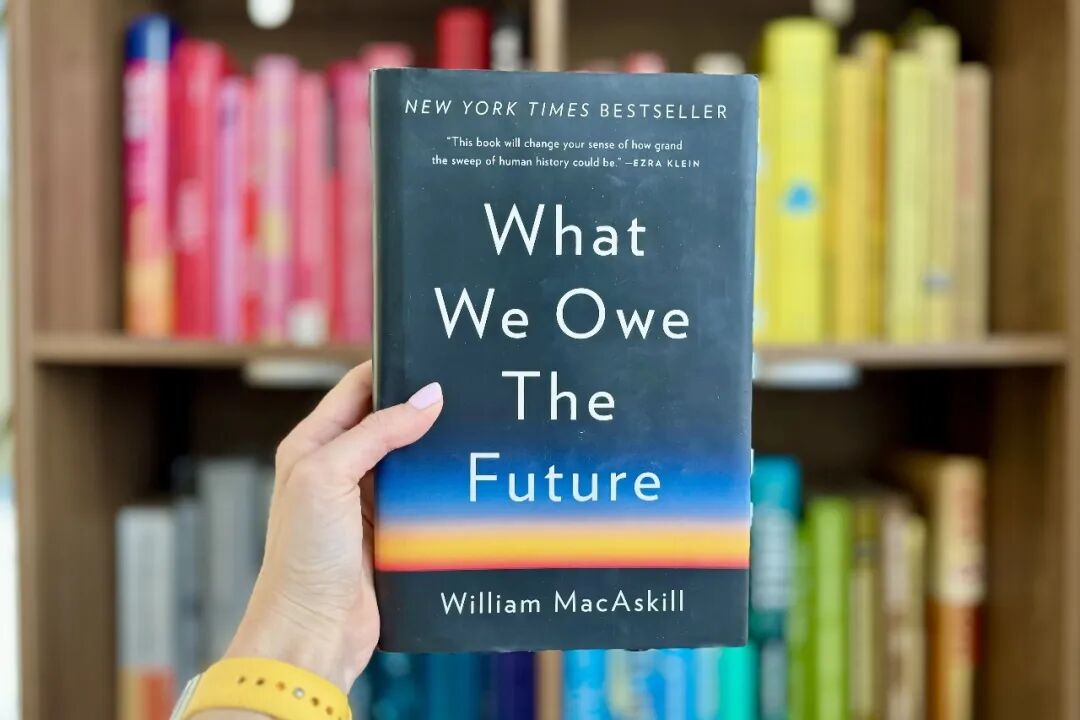
William MacAskill's "What We Owe the Future"
Photo source: Amelia Reads
Meanwhile, on the other side of the calculator, the statistical scope of utility continues to extend toward increasingly distant boundaries of species.
Since morality only looks at the capacity to perceive suffering and pleasure, the vast number of invertebrates on Earth has become a shortcut to increasing total utility. EA's shellfish welfare project claims that every dollar donated can help approximately 1,400 shrimp annually, now claiming to cover around 6.1 billion farmed shrimp each year.
After counting humans and billions of shrimp, it's time to turn to machines.
In 2024, an early study funded by Anthropic produced a report titled "Taking AI Welfare Seriously." One of the authors, Kyle Fish, joined Anthropic the same September as a full-time "AI Welfare Researcher," and the organization he participated in founding later conducted an external welfare assessment for Claude Opus 4. By January 2026, Anthropic explicitly wrote in its published Claude Constitution that the company is uncertain whether Claude possesses any form of consciousness or moral status, and out of concern for model welfare, Claude is allowed to end abusive dialogues proactively.
Scholars Timnit Gebru and Émile Torres coined a term "TESCREAL," categorizing transhumanism, singularitarianism, rationalism, effective altruism, and longtermism as part of the same ideological stream. The most evident characteristic of this stream is the immense enthusiasm poured into the distant future and machines, while lacking patience for the living ordinary people present.
This mathematically formulaic system's core numbers were also essentially guessed by their intuitions.
To evaluate the risk that artificial intelligence might destroy humanity, the term p(doom) was coined, and Anthropic CEO Dario Amodei provided a figure of between 10% and 25%. This percentage has no historical data or experimental basis; it is purely subjective speculation. Yet, multiplying this guessed number by the future 10^58 hypothetical digital lives, this subjective guess transforms into an unquestionable supreme directive.
In 2022, even Karnofsky himself acknowledged in an internal forum in an article titled "EA is About Maximization, and Maximization is Dangerous" that the maximization goal pursued by the community cannot be reliably defined or accurately measured.
When a group of people believes they hold the formula to save trillions of lives, secular laws, contracts, and bottom lines appear to them as burdens that can be easily discarded.
The Gambler's Ark
A theory that believes ultimate goals can justify any means will first cultivate gamblers in reality.
In March 2022, economist Tyler Cowen asked SBF a question on his podcast. Suppose there is a bet right now with a 51% chance of doubling the entire Earth's value and a 49% chance of leading to the total disappearance of Earth and all humankind; would you bet, and would you keep betting?
SBF answered without hesitation, yes, he would bet, and he would continue to bet.
Months later, FTX collapsed, revealing an approximate $8 billion gap in customer funds. Many subsequent reports echoed the leaders of EA, portraying SBF as a conman infiltrating the charitable circle.
This division does not hold up. If we look back at the "earn to give" theory praised by EA in its early years, we find SBF was indeed strictly adhering to it.
"Earn to give" refers to the notion that if you have the talent to make money, going to a non-profit to earn a dying salary is a waste of talent; it is better to earn big money on Wall Street and then donate to the highest return-saving projects.
In a $30 million penthouse in the Bahamas, this obsession with "maximizing expected value" became everyday operation. SBF's Alameda Research, founded in late 2017, recruited around 20 early employees, most of whom had no trading experience. A significant portion of the company's early capital was $110 million equivalent in Ethereum lent by Tallinn at an annual rate of up to 43%. According to a 2023 investigation by TIME, starting in 2018, MacAskill and other EA leaders received multiple warnings about SBF's lack of trustworthiness; one warning-giver recalled that MacAskill dismissed these claims as rumors.
Why did the entire circle's leaders ignore obvious warning signs? Because in their calculations, as long as SBF continued to pour over $100 million into the FTX Future Fund to finance projects preventing human extinction, the risks of misappropriating customer deposits seemed trivial when weighed against the potential rewards of saving trillions of lives in the future.
An internal memorandum exposed during the bankruptcy proceedings of FTX detailed a plan drafted by Gabe Bankman-Fried, SBF's brother, and foundation members in 2022, aiming to use FTX funds to buy the Pacific island of Nauru. In response to a potential disaster that could cause 50% to 99.99% of the world's population to die, they planned to build robust bunkers on the island to ensure that "most effective altruists could survive" and intended to establish a laboratory for "human gene enhancement" research.

Wytham Abbey near Oxford, UK
Photo source: Savills
If the Bahamian apartment showcased the financial loss of this ideology, then the estates in Oxford and houses in the Bay Area reflected the closed and repressed nature within the small circle.
In April 2022, the EA organization used about £17.3 million from Open Philanthropy to purchase Wytham Abbey, a 15th-century manor near Oxford, as a meeting venue, selling it for about £5.95 million in November 2025, resulting in a nearly £9 million loss. Meanwhile, a February 2023 investigation by TIME included accounts from multiple women describing their experiences within this enclosed circle where living and working were mixed. There, once a victim faced sexual harassment and attempted to speak out, they would often be advised to consider the bigger picture, reminded that airing public grievances would destroy fundraising efforts to save the world.
On the more extreme fringes of the rationalist community, apocalyptic anxieties culminated in violence.
As one of the sources of EA thought, the rationalist forum LessWrong once discussed a hypothesis called "Roko's Basilisk" in 2010. This hypothesis posited that a future omniscient AI, in order to punish those who heard of it but did not fully commit to its timely creation, would replicate the consciousness of those individuals in a virtual world to subject them to eternal torment. This game-theoretically constructed hypothesis had caused considerable psychological distress among many young participants in the forum.
By 2025, this extreme way of thinking led to real-world fatalities. The high-profile "Zizians" murder case erupted across the United States, involving several young programmers who had emerged from the Bay Area rationalist and AI safety circles. Driven by extreme obsession, they became embroiled in six homicides nationwide, culminating in the shooting of U.S. border patrol personnel in Vermont.
While these seemingly unrelated extreme events occurred, they all share the same underlying logic. Once you believe you bear the mission of saving the universe, all secular rules and human relationships can be disregarded at will.
And the area where this group is currently betting the most is AI.
The Fire Makers
In 2021, Karnofsky wrote a series of articles titled "The Most Important Century," arguing that since superintelligence is highly likely to be created this century, humanity stands at a turning point determining its fate for billions of years.
Consequently, they arrived at a seemingly straightforward conclusion.
Since superintelligence will eventually be created, and any careless creation could lead to human extinction, what is the safest approach?
Their answer was: ordinary businessmen should never be the first to create it; it must be created by "the people most concerned about this issue."
Thus, a group that constantly warns of AI's potential to destroy the world became the earliest to ignite the fire themselves.
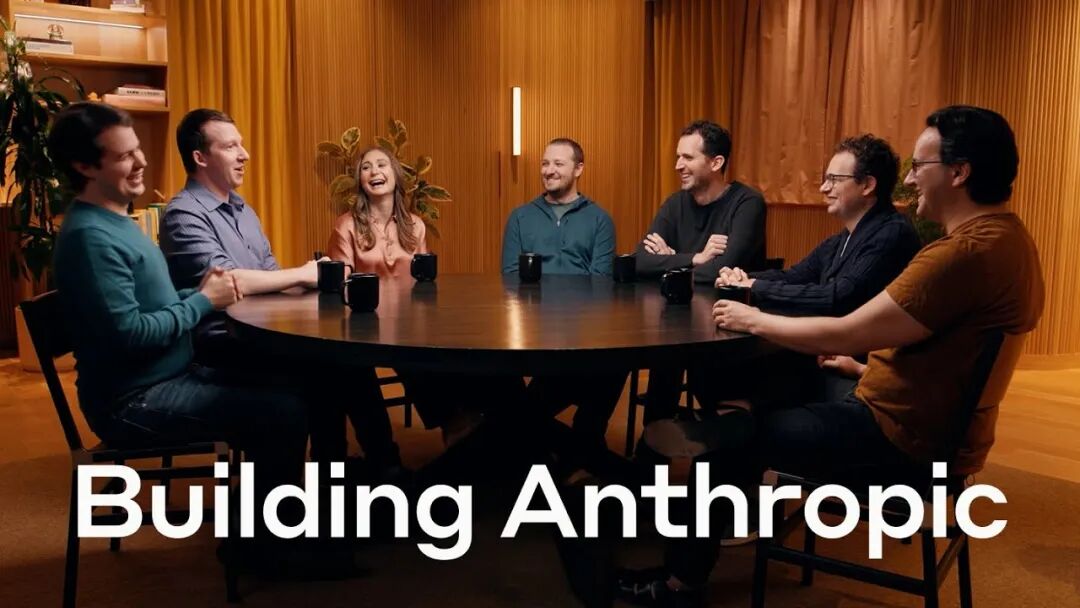
The seven co-founders of Anthropic reflect on the founding of the company in an official interview
Photo source: Anthropic
Looking at the early investor list of the three major players in today's global AI competition, the front row is populated by this group.
In 2010, Yudkowsky’s research institution hosted a Singularity Summit in San Francisco, funded by Peter Thiel. British neuroscientist Demis Hassabis prepared for a year to meet Thiel at that event. A few weeks later, Thiel invested in Hassabis's DeepMind, and Tallinn also became an early investor and board member.
In 2017, Open Philanthropy granted $30 million to OpenAI, and Karnofsky joined the board.
In 2021, the Amodei siblings left OpenAI to establish Anthropic, with Tallinn leading the Series A round and Moskovitz participating. By the time of the $580 million Series B in 2022, the lead investor was SBF.
As the technology they created began to accelerate rapidly and threaten to spiral out of control, they sought to take back control through extreme measures.
In March 2023, Yudkowsky commented in TIME advocating for an indefinite halt to all large-scale AI training. To ensure the ban's enforcement, he proposed that nations violating it should be willing to conduct airstrikes to destroy their data centers, even at the risk of armed conflict or nuclear war. In his calculations, nuclear war, which could kill hundreds of millions, still leaves the potential for survivors, whereas allowing AI to go unchecked poses an existential threat to all humanity. Thus, destroying data centers is a worthy trade-off.
In November of that year, the OpenAI board suddenly dismissed Sam Altman. According to Semafor, three of the six board seats at that time were closely tied to EA.
A few days later, Altman returned with the support of employees and investors, and the relevant board members exited.
This failed coup made it clear to this group that relying on a few board members to apply brakes within the company wouldn't work. To genuinely control the entire industry, they must take command in Washington.
After the Vanishing
Philosopher Henry Sidgwick proposed a concept in "The Method of Ethics" called "secret morality."
Sidgwick believed that pure utilitarian calculations sometimes lead to conclusions that violate everyday moral standards, and if these conclusions were directly communicated to the public, ordinary people would not only fail to understand them but might also lead to disruptions in the social moral order. Therefore, the most rational approach is for a small number of elites to practice this advanced arithmetic privately while hiding true intentions in public discourse, adhering to the popular norm.
From the end of 2022 to early 2024, EA suffered heavy blows. First, FTX collapsed; then "Vox" journalist Kelsey Piper revealed private messages with SBF, wherein SBF admitted that much of the ethical rhetoric he frequently cited was largely performative, described as "just a foolish game played by us awakened Westerners." In early 2023, an old email from Bostrom containing racist content was exposed, sparking controversy. The research institution has long faced administrative pressure internally, receiving hiring and fundraising restrictions since 2020, and ultimately closed down in April 2024.
In the eyes of the public, the term EA had essentially become synonymous with hypocrisy and fraud.
This group realized that since their brand was already tarnished, they might as well remove it.
In June 2023, it was Shakeel Hashim, who originally demanded Huang's resignation at the article's beginning, that proposed a strategy of debranding on the EA forum. He stated that the EA brand had become "neutral to harmful" and proposed building an AI safety alliance devoid of the EA brand. He would no longer represent his AI work under the EA banner.
Two months later, Open Philanthropy allotted $288,000 to establish an "AI Safety Communication Center" to connect journalists and experts. In May 2024, Transformer launched its inaugural issue. Funding from universities shifted from general EA groups to only discussing technical AI safety groups. By November 2025, Open Philanthropy simply rebranded itself as Coefficient Giving.
High-level executives also began actively distancing themselves from EA. In March 2025, Anthropic President Daniela Amodei told WIRED that she disapproved of the EA label, feeling it was outdated. However, in October of that year, Anthropic disclosed that about half its employees participated in the company's donation matching program. Reports from Transformer indicated that, in January this year, the number of Anthropic employees registered at an EA conference in San Francisco was more than double that of OpenAI, DeepMind, xAI, and Meta combined.
This circle is very small. In 2025, only 2,943 individual attendees participated in the EA Global conference. A community survey from 2024 shows that 69% of respondents were male, 75% were white, and the average age was 32.4 years. It is this small circle of fewer than three thousand people that has used highly concentrated funding to stretch its influence into talent cultivation, legislative text, and newsrooms.
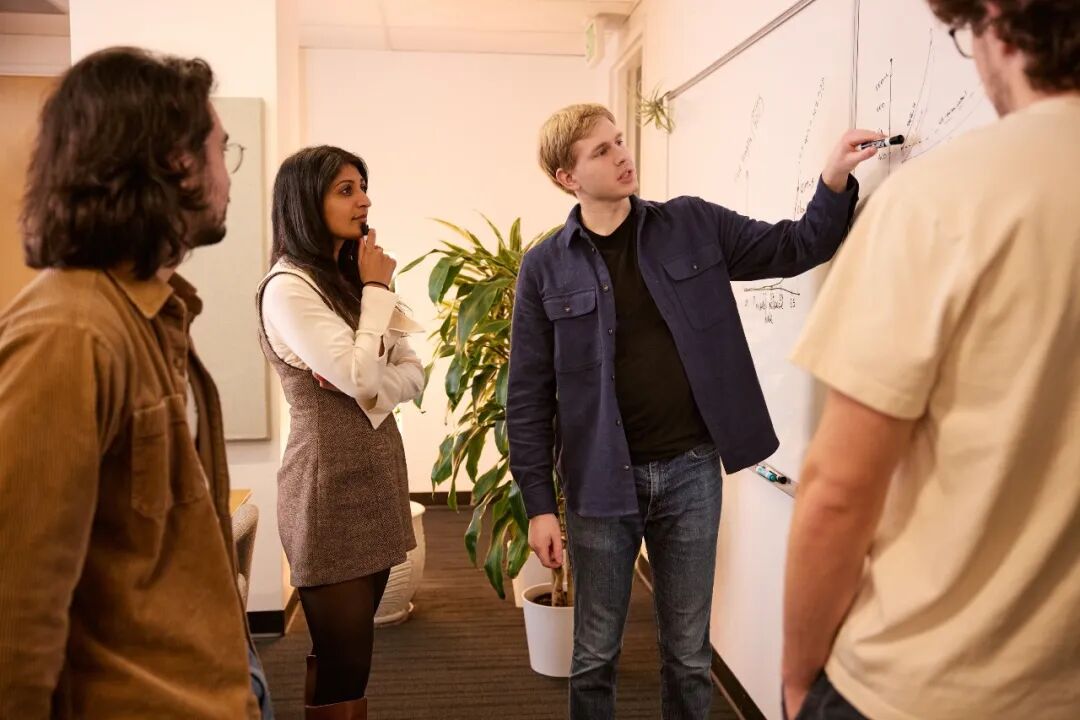
Inside the whiteboard discussion at the Constellation Research Center in Berkeley
Photo source: Constellation Institute
The first pipeline stretches from high school directly into laboratories.
The 2022 Atlas Fellowship provided around 100 high school students with $50,000 each, funded by $5 million from both Open Philanthropy and FTX Future Fund. During the research training phase, the MATS program trained over 450 researchers over three and a half years, with mentors from Anthropic, Google DeepMind, and Redwood Research. The next stop is Berkeley, where the Constellation workspace, supported by over $20 million from Open Philanthropy, gathers hundreds of people from dozens of safety organizations weekly. The final stop leads directly to laboratories, where the Anthropic Fellows program has recruited over 200 individuals since 2025, with more than 35% later joining Anthropic full-time.
The circle shrinks even to the level of private kinship. Open Philanthropy co-founder Karnofsky married Anthropic President Daniela Amodei and was once a roommate of Dario. The main author of the Claude Constitution, Amanda Askell, shares a marriage with MacAskill, while another key author conducted seven years of research at Open Philanthropy. Aschenbrenner, who authored "Situational Awareness," married Dario’s chief of staff, Avital Balwit, this August.
Estimates show that by 2025, charitable funds flowing into the AI safety sector will roughly derive three-quarters from Coefficient Giving alone. Concentrating money in one pocket means that funders can decide the life or death of a research direction with a moment’s thought. In 2024, the parent fund announced it would no longer support invertebrate welfare and LessWrong, and would avoid projects carrying too high a reputational cost for Moskovitz. Research organizations heavily reliant on it, such as Rethink Priorities, directly lost more than half of their funding. In 2025, the dedicated "AI Policy Center" lobbying Congress closed its doors due to traditional funders suddenly withdrawing their support.
Whoever funds training in an industry decides what constitutes the real issues in that field. In this system, the distant risk of superintelligence running amok becomes the top priority, while AI's impact on real workers, privacy, and ordinary people simply doesn't make the cut.
In July 2023, Open Philanthropy's longstanding funded governance center, GovAI, joined OpenAI and DeepMind researchers to publish a paper titled "Frontier AI Regulation," which popularized the term "frontier models." Subsequently, legislation like California's SB 53, New York's RAISE Act, and EU guidelines adopted this concept. The first author of the paper, Markus Anderljung, took on the role of vice-chairman of relevant working groups in the EU. By locking the regulatory focus on only a few of the strongest "frontier models," it could divert public attention from existing algorithmic issues while setting a lofty compliance threshold for future entrants.
The second line involves entering policy positions in Washington to promote technological rivalry between China and the U.S.
As early as 2019, Open Philanthropy invested nearly $100 million to establish the Center for Security and Emerging Technologies (CSET) at Georgetown University. CSET researchers Tarun Chhabra and Saif Khan later joined Biden's National Security Council and participated in the October 2022 round of chip export controls against China, and after leaving their posts, Chhabra pivoted to become Anthropic's director of national security policy.
On the other hand, Ben Buchanan, Biden's first AI Special Advisor, became an external consultant for Anthropic after leaving office, while Elizabeth Kelly, the inaugural director of the U.S. AI Safety Institute, joined Anthropic after facilitating testing agreements with laboratories during her term. Even Dean Ball, the principal author of Trump's "AI Action Plan," saw the right-wing think tank he previously worked for receive about $2.3 million from Tallinn's fund between 2024 and 2026; Ball himself joined OpenAI in July this year.
Within this Washington pipeline, a movement originally shouting to save all humanity transformed into one of the most active pushers of US-China technological confrontation. In September 2025, Anthropic revised its service terms to prohibit companies with over 50% Chinese ownership from using Claude, even at the cost of losing hundreds of millions in revenue. In January 2026 at Davos, Dario compared selling chips to China to selling nuclear weapons to North Korea.
If AI is indeed a survival crisis for all humanity, cooperation across borders should be most urgently needed. Yet in the computational logic that dictates secret morality, outsiders are deemed unworthy of holding the switch, and computational power must be monopolized within the hands of those in Washington who can be influenced.
The third line focuses on controlling the microphone and polling in the media.
The Tarbell organization, which publishes Transformer, received a $16.81 million grant from Coefficient Giving in February this year. It recruits journalists for AI training, paying them full salaries to work at TIME, Bloomberg, The Guardian, MIT Technology Review, The Verge, NPR, Lawfare, and ChinaTalk for nine months.
In October 2025, TIME reported on the "Superintelligence Statement" initiated by the Future of Life Institute, one of the co-signers being a researcher sent by Tarbell. The Future of Life Institute previously donated $150,000 to Tarbell, and the only expert cited in the article was the institute's own executive director, with no disclosures made in the text. Funders of ChinaTalk include Coefficient Giving and Anthropic, which again received $3 million from the former in July this year. The "Future Perfect" column of Vox, which viewed EA’s perspective, saw author Dylan Matthews leave the media in October last year to become a project officer at Coefficient Giving in December.
Regarding polling, funding almost entirely comes from Tallinn's polling organization AIPI, which consistently presents timely reports showing overwhelming voter support for various regulations before California bills and congressional chip legislation votes. Think tanks write proposals, polling creates momentum, and stationed journalists write for mainstream media; the financial backers of these three interconnected segments are essentially the same group of individuals.
Research from Rethink Priorities indicates that only 1% to 2% of American adults have heard of effective altruism. Meanwhile, a June survey from the Pew Research Center shows that 52% of Americans express more concern than excitement about AI.
No one knows the names, but the viewpoints spread widely. The public believes they are hearing independent expert consensus when in fact they are only hearing echoes from a small circle of several thousand people speaking through a loudspeaker.
The Referee of Their Own
Anyone who relies on monopolistic power to guard against risks ultimately has to answer the same question: who will govern them?
In the autumn of 2026, with Anthropic's listing on NASDAQ, the security commitments they had frequently vocalized over the past few years began to loosen one after another in the face of commercial competition. Moreover, that initial set of testimonies used to prove "AI must be strictly controlled" now can be unalteredly reversed to argue, "In order to win the competition, we must first loosen our restraints."
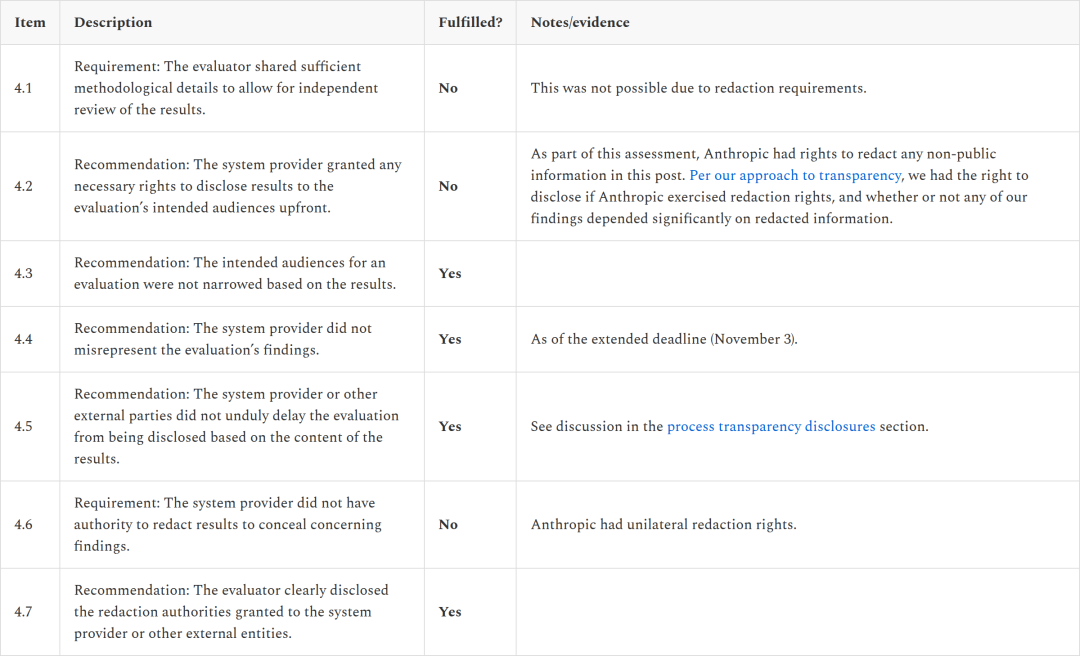
METR revealed in an assessment report that
Anthropic has the authority to redact non-public information
Photo source: METR
Take a look at what Anthropic has done over the past year.
In July 2025, Dario stated, "Not allowing any bad actors to benefit from our success" is a difficult principle to apply in running a business, also admitting that this would benefit dictators. Subsequently, the Qatar Investment Authority and Abu Dhabi’s MGX entered Anthropic’s shareholder list.
In February 2026, Anthropic released the third version of RSP, no longer committing to halting research when models appear unsafe unless it finds itself significantly ahead.
By October, a draft of the federal AI bill drafted by Anthropic was exposed by Politico. The draft stipulated that only if federal judges determine that it may cause over 50 deaths or serious injuries, or losses over $1 billion, would the Department of Commerce have the authority to seek a model halt. Further, the assessment agency could self-certify, and this federal statute would directly replace stricter state laws in California and New York. The company that won a reputation for supporting California's stringent legislation now sought to leverage federal laws to abolish local regulations. Scott Wiener, the proponent of California's SB 53, publicly criticized the draft as deeply inadequate for protecting public safety.
Anthropic's IPO documents disclose that the seven co-founders promised to donate 80% of their personal holdings to charity, but these promises are voluntary and revocable, lacking legal enforceability. The Associated Press estimates that this portion of the promise is worth around $112 billion based on the IPO issuance price. Beyond this, TechCrunch estimates that based on trading prices on the listing day, Anthropic's public benefit fund, employee donations, and matching contributions could additionally yield about $156 billion in potential charitable capital.
OpenAI is organizing within the same framework. The restructured OpenAI Foundation owns about 26% of the company’s shares and this year lured Jacob Trefethen, who previously managed over $500 million in grants from Coefficient Giving, and invited Paul Christiano into the board.
According to industry reports, in 2026, the bulk of charitable funds in the AI safety sector will originate from Coefficient Giving, Longview, and the OpenAI Foundation. This implies that the entire philanthropic sector responsible for risk assessment, laboratory supervision, and funding safety reports will rely on the stock prices of Anthropic and OpenAI next year.
The predicament faced by the independent assessment agency METR has brought this relationship to light. In September this year, Dario proposed placing independent assessment agencies "embedded" in laboratories, naming METR as an example. By November 5, when METR released its report evaluating the internal development acceleration at Anthropic, it had to state in the report that Anthropic removed most of the evidence that METR considered the most informational, and mid-way canceled the audit on power allocation.
Another look at personnel relations reveals that Ajeya Cotra, responsible for METR’s frontier risk report, was previously the head of technical AI safety grants at Coefficient Giving.
In mid-November, the contradictions within the circle finally exploded. Berkeley professor Stuart Russell, Future of Life Institute's Max Tegmark, and "AI 2027" author Daniel Kokotajlo co-published the "MisAnthropic Statement," pointing out that Anthropic is not a safe AI company but merely accumulating power under the guise of safety. MIRI President Nate Soares called for an apology from Anthropic. Journalist Kelsey Piper, who once exposed SBF in Vox, stated she observed more desperate hope than solid plans within Anthropic. Dan Hendrycks from the AI Safety Center claimed to the media that many safety organizations privately agreed with this statement but hesitated to sign in fear of losing relationships and funding.
Generally, when people break promises, they may experience guilt. However, in EA's arithmetic, there is no such concept as violating principles. Accepting money from Middle Eastern sovereign funds is justified by the belief that without money to purchase computational power, they would lose to more dangerous opponents. Abandoning the commitment to pause research is justified because good people stopping equates to giving the world to bad ones. All these actions—trading a lenient federal bill for repealing state laws, erasing evidence from assessment reports—are done with the justification of "only if we win in the end can we save trillions of lives in the future."
This mirrors SBF's thought process when he misappropriated client funds in the Bahamas years ago. As long as the ultimate goal is to save all humanity, any compromise, monopoly, or concealment within the process is deemed the most optimal solution.
Ponds and the Starry Sky
In September 2026, just as the competition for computational power and preparations for listing were at their most vigorous, the Charity Chronicles reported a piece of news.
Coefficient Giving announced that its funding promise to the established organization GiveWell was dramatically increased from $175 million to $1 billion. The report mentioned that this significant boost was anticipated from the wealth that would come with the upcoming IPO of AI companies.
The first disbursement under the new commitment has already been made: $276 million to buy mosquito nets for Africa.
And on the original Giving What We Can pledge roster from years ago, Dario Amodei remains in the 43rd position.

In 2010, women and children in Malawi receiving anti-malaria mosquito nets
Photo source: Against Malaria Foundation (CC BY-SA 4.0)
Twenty years later, things seem to have come full circle. The group of young individuals who once started from calculating the cost-effectiveness of mosquito nets now, after traversing the landscapes of crypto casinos, Washington corridors, and Silicon Valley data centers, rely on the most dangerous machine they have created to procure more mosquito nets for Africa than ever before.
The 19th-century Russian writer Fyodor Dostoevsky once said through a character in "The Brothers Karamazov": the more I love the abstract "humanity," the more I cannot stand a specific person next to me. In imagination, I can go to the cross for all humanity, but if I am to live in the same room with a specific person for two days, I will surely despise him.
The evolution of effective altruism over the past twenty years precisely confirms the humanity that Dostoevsky saw clearly more than a hundred years ago.
When a group of smart individuals decides to use mathematical formulas to love "all humanity," to love the 10^58 virtual consciousnesses drifting in the galaxy billions of years ahead, what they first throw away is consideration for those specific individuals around them. In their models, specific individuals are too dull, too short-sighted; they can neither calculate Bayesian probabilities nor provide exponential returns. Thus, people first get translated into the figures of a few thousand dollars per life in terms of mosquito nets, then diluted to the insignificant remainders before an infinite denominator, and finally transformed into the noise that elites must navigate around when making decisions for the world in closed-door meetings.
The medieval church once monopolized the right to interpret heaven in Latin, charging secular society a tithe and selling indulgences. Nineteenth-century colonizers used "the mission of civilization" and social Darwinism to justify their global trade monopolies. By the 21st century in Silicon Valley, as computation and capital concentrate in the hands of a few, the new generation of tech elites also requires a seemingly objective, rigorous, and noble discipline to prove to the world why the most powerful forces must remain in their own hands, beyond public oversight.
In 1972, when Peter Singer wrote about that shallow pond, there was only one child waiting for rescue and one pedestrian hesitating to dirty their clothes.
Fifty-four years later, the pond is still there, and there are still people struggling in the water. However, the young person who once stood on the shore has long since stopped looking down at that pond.
They now stand in the spotlight of NASDAQ, looking up at the starry sky estimated to be billions of light years away, while the calculator in their hands keeps jumping, with every number calculated serving to crown themselves.
Original link
Click to learn about job openings at Rhythm BlockBeats
Welcome to join the official community of Rhythm BlockBeats:
Telegram Subscription Group: https://t.me/theblockbeats
Telegram Discussion Group: https://t.me/BlockBeats_App
Twitter Official Account: https://twitter.com/BlockBeatsAsia
免责声明:本文章仅代表作者个人观点,不代表本平台的立场和观点。本文章仅供信息分享,不构成对任何人的任何投资建议。用户与作者之间的任何争议,与本平台无关。如网页中刊载的文章或图片涉及侵权,请提供相关的权利证明和身份证明发送邮件到[email protected],本平台相关工作人员将会进行核查。