This article, written by Tiger Research, thoroughly analyzes the profound impact of the bill on four core entities: centralized exchanges, traditional financial institutions, overseas stablecoin issuers, and Web3 foundations. It deconstructs the painful transition as the South Korean crypto market enters a strictly regulated era, covering issues such as accountability for false statements during token listing, a 20% shareholding cap for major shareholders of exchanges, and the balance of bank monopolies on stablecoin consortia against offshore tax havens.
Key Takeaways
- Overview of the Bill: The bill clearly defines four categories of digital asset business types and establishes a strict compliance framework for the issuance of KRW stablecoins, local token Initial Coin Offerings (ICOs), and centralized exchanges.
- Centralized Exchanges (CEX): The token listing disclosure report has been officially upgraded to a legal obligation, and exchanges will bear strict legal liability for significant false statements, while the ownership ratio of major shareholders is capped at 20%.
- Local Financial Institutions in Korea: Initially, the issuance of KRW stablecoins will only be open to consortia that have an “absolute majority holding by banks,” but the subdivision of licenses also opens new opportunities for brokerages and trust companies in custody and brokerage.
- Overseas Stablecoin Issuers: Foreign issuers that have obtained compliance licenses in their home country must establish registered branches in Korea and meet a statutory minimum capital requirement of 5 billion KRW and corresponding reserve isolation requirements.
- Web3 Foundations and Project Teams: The substantial lifting of the ICO ban in Korea is noted, but given the significant tax incentives in overseas crypto hubs like Singapore and Dubai, the likelihood of large-scale repatriation of projects remains low, and they face extremely rigorous information disclosure thresholds.
Transforming Market Practices into National Legal Systems
Approximately two years after the first phase of the "Virtual Asset User Protection Act" is implemented in July 2024, ruling party member Kim Jae-seop officially proposed the "Basic Digital Asset Act" draft (the second phase of digital asset legislation) in February 2026. The bill still needs to undergo extensive legislative debates and negotiations before it can be formally passed in Congress.
Nevertheless, the core significance of this draft lies in its elevation of the previously administrative-guided "unwritten market rules" into statutory provisions, clearly delineating the legal boundaries of various market activities and filling the long-standing legal gap regarding the stablecoin framework and local issuance mechanisms.
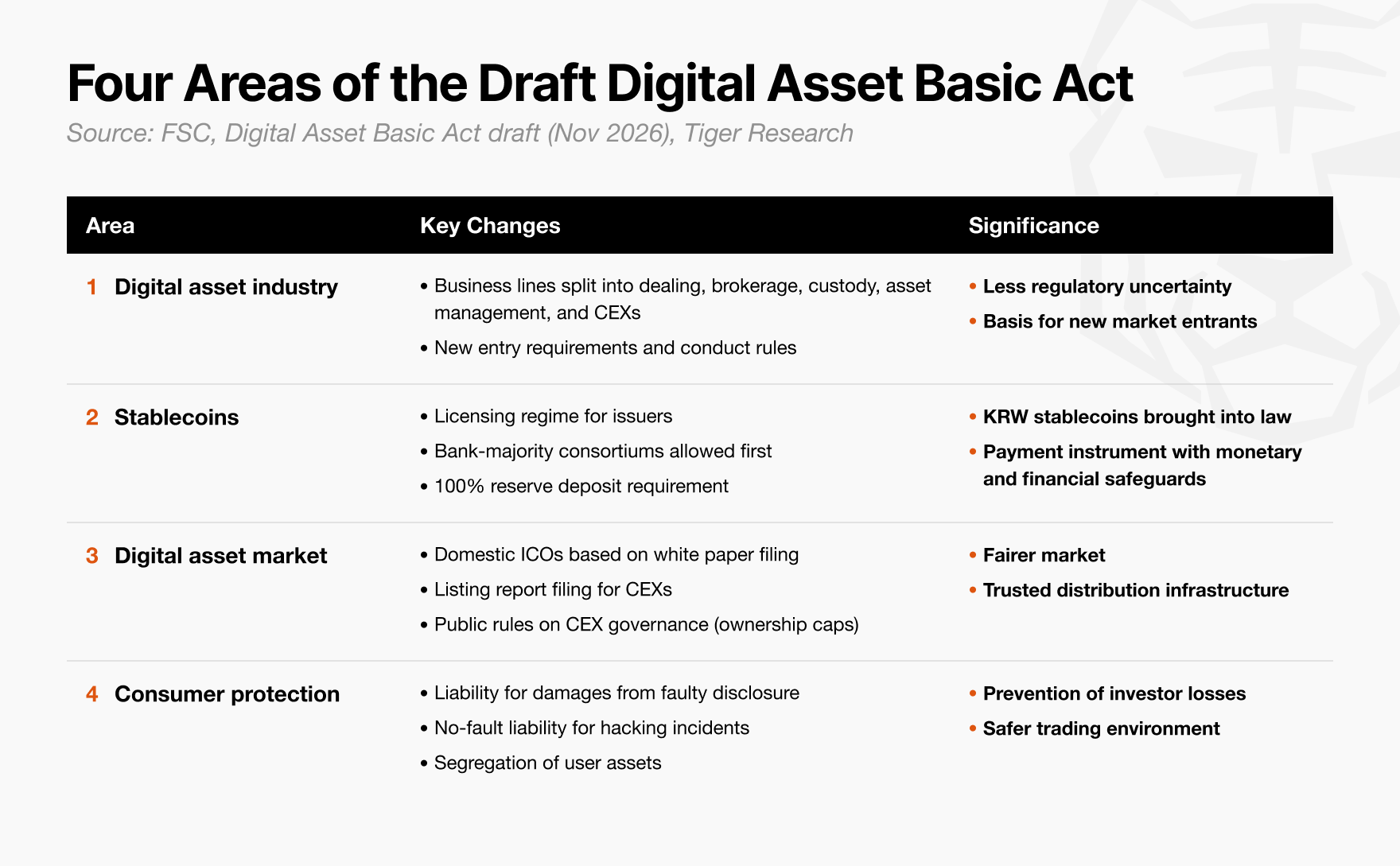
As a result of this bill's impact, all four core participants in the South Korean digital asset market need to undergo disruptive restructuring of their long-term strategies: 1) Centralized Exchanges (CEX), 2) Local Financial Institutions, 3) Overseas Stablecoin Issuers, and 4) Web3 Foundations and Project Teams. This article aims to go beyond a dry dissection of laws to deeply explore the strategic maneuvers and industrial reshaping of these four major market players under a new regulatory framework.
Centralized Exchanges (CEX): Legalizing Token Listing Responsibility and 20% Shareholding Cap
Under the new regulatory framework, centralized exchanges must not only submit official token listing verification reports to the Financial Services Commission (FSC) for each token listed but also publicly disclose them, and must assume joint civil liability for any false statements or significant omissions in these reports. The legal risks associated with token listing reviews have sharply increased, directly leading to a tightening of listing strategies by exchanges.
The core reforms aimed at centralized exchanges focus on two main dimensions: the asset listing admission mechanism and the equity governance structure of the exchanges themselves. In these two major reshapes, the rules for listing verification will become effective one year after the issuance of the bill, thus forming an urgent compliance deadline for exchanges; meanwhile, the rectification regarding the cap on major shareholders’ shares will provide designated exchanges with a three-year grace period from the date of designation.
1 Mandatory Disclosure of Token Listing Verification Reports
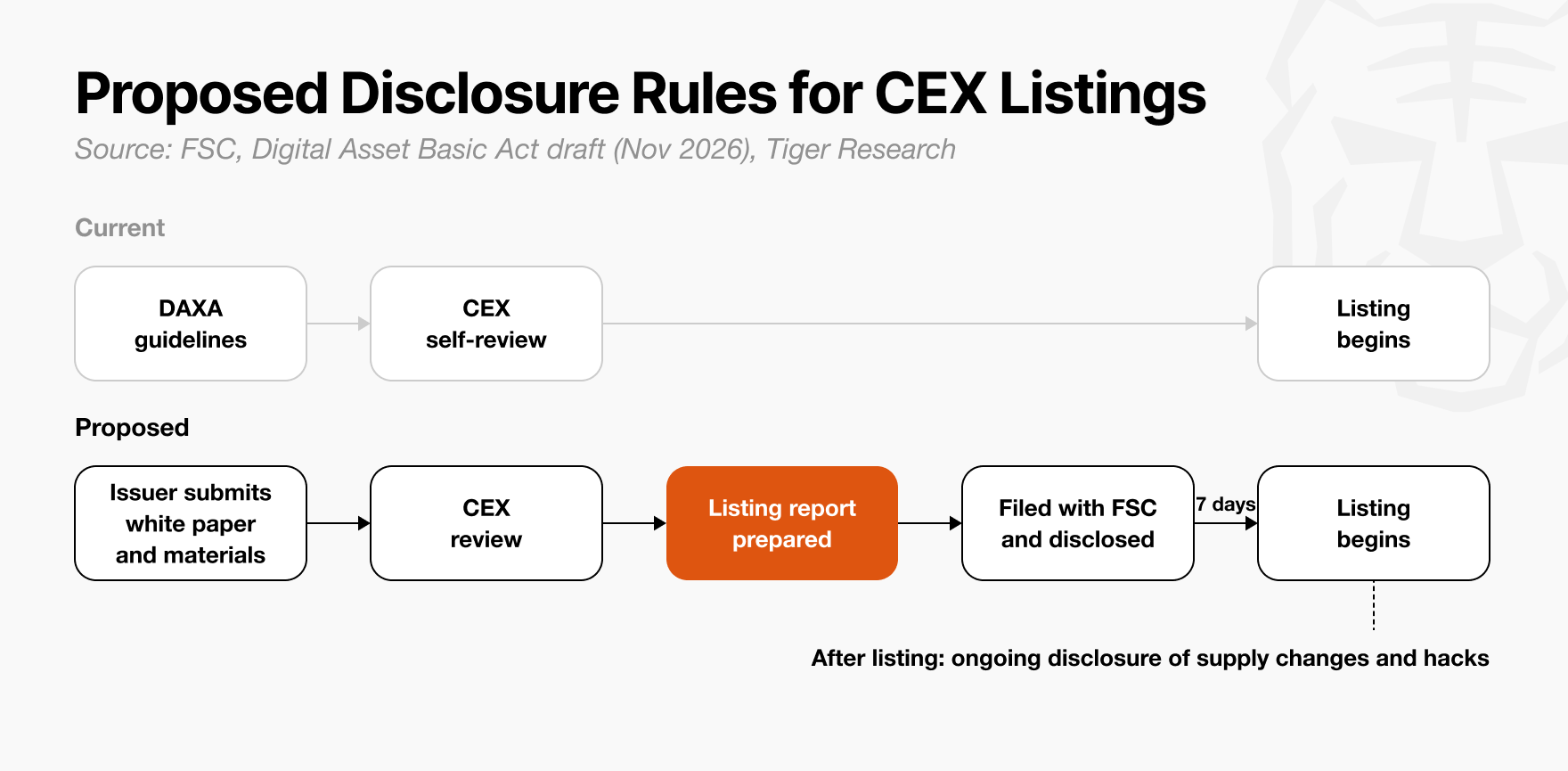
Article 11 of the draft explicitly states that digital asset exchanges (i.e., the "digital asset trading intermediary businesses" as defined in the bill) must submit a token listing review report covering the issuer, technical white paper, token economic distribution, and potential conflicts of interest to the regulatory authority when deciding to list any asset, and must publicly release it.
Even more critically, Article 15(1) establishes a very strict civil liability mechanism: if there are any false records, significant false statements, or omissions of key facts in the listing report, resulting in economic losses to ordinary investors, the reporting exchange must assume civil liability for damages to the affected investors.
However, the vast majority of mainstream blockchain protocol developers are established in offshore jurisdictions, and South Korean exchanges have extremely limited capabilities to conduct cross-border verification of their off-chain finances and codebases. If an offshore project engages in malicious fraud, South Korean exchanges could become a potential focal point for collective lawsuits from affected investors, forcing their legal compliance departments to undertake prolonged due diligence, compelling them to scale back to more robust, well-established mainstream assets.
2 Designated Exchange System and 20% Shareholding Cap
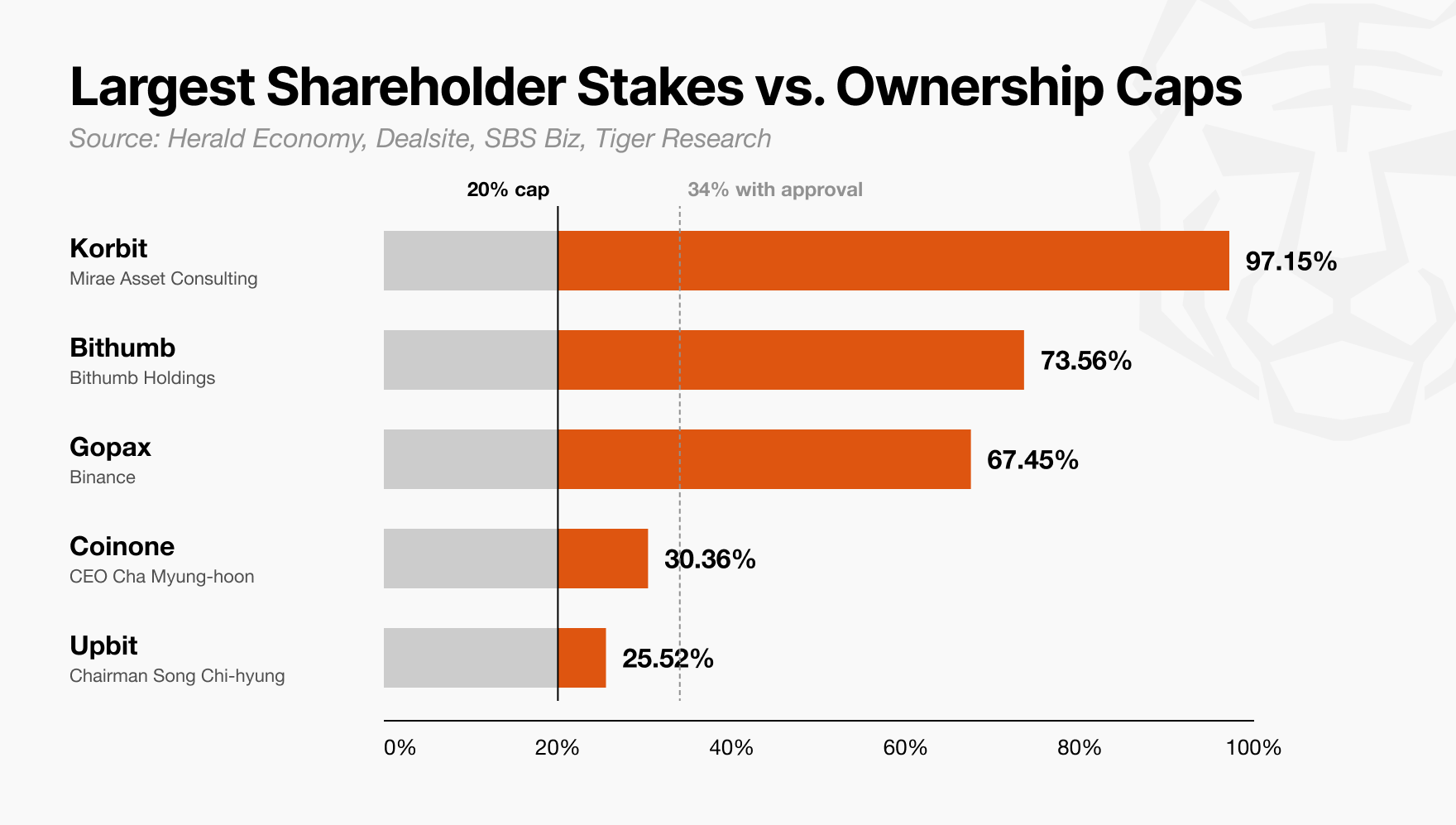
Article 42(1) introduces a powerful "Designated Exchanges" system: for leading platforms that meet specific thresholds for trading volume and market impact, the Financial Services Commission can designate them as systemically important exchanges and apply the same stringent public governance requirements as traditional securities exchanges.
Among the most shocking provisions is Article 42(2): any single entity and its affiliates may not hold more than 20% of shares directly or indirectly in any designated systemically important exchange.
This clause directly targets the two dominant exchanges in Korea, Upbit (Dunamu) and Bithumb. Currently, the founding core members like Song Ji-hyung tightly control over 20% of Dunamu's shares through consensus actions; meanwhile, Lee Jung-hun and his associates also hold substantial control in the Bithumb system. Upon the bill's formal enactment, existing designated exchanges, although enjoying a three-year remediation grace period, will be forced to list and sell off significant excess shares in the secondary market or dilute their holdings by bringing in institutional consortia, leading to an irreversible historic reshuffle of actual control and capital patterns of the entire South Korean exchange landscape.
Local Financial Institutions in Korea: A Diverse Expansion Blueprint Beyond Stablecoin Framework
Traditional commercial banks, securities brokerages, and trust companies, which have long been firmly blocked from the realm of digital assets, will experience historic institutional breakthroughs through this bill.
1 KRW Stablecoins: Bank-led Consortia and Fintech Admission
Article 21(1) formally establishes the issuance admission license for fiat currency-backed stablecoins (specifically KRW stablecoins). To prevent systemic financial risks similar to the collapse of Terra-Luna, regulators have set strict capital and governance thresholds:
The issuing entity must have at least 5 billion KRW (approximately 3.7 million USD) in paid-in capital and fully segregated custody of 100% high liquidity reserve assets equivalent to the scale of stablecoin circulation at secure institutions such as banks. More substantively, the Financial Services Commission has established stringent thresholds for shareholder structure: commercial banks must collectively hold no less than 60% in the issuing entity (for example, four major banks each holding 15% to form a consortium, with fintech companies holding 30% and other strategic partners holding 10%).
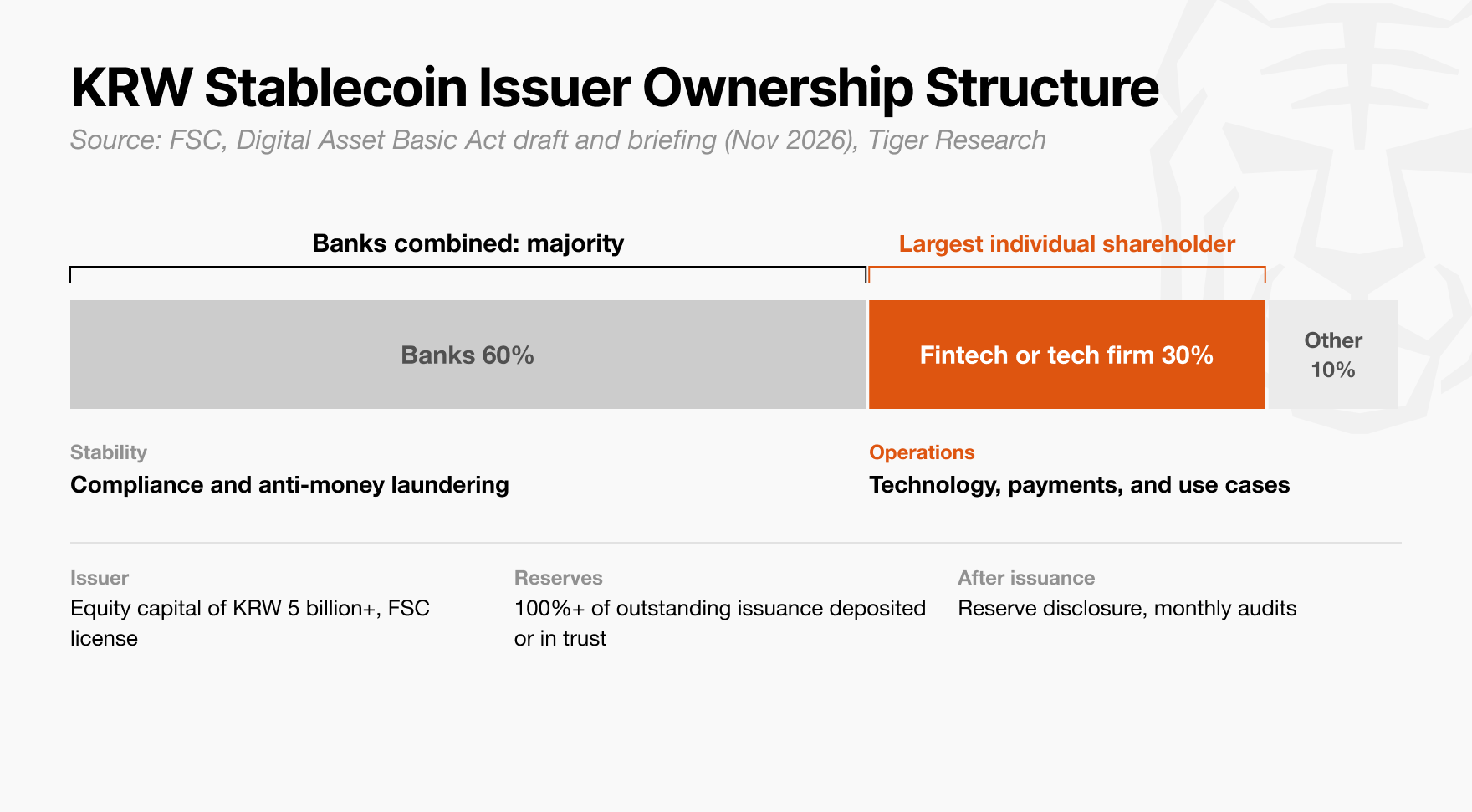
The 15% shareholding cap for shareholders stipulated in the Banking Act is a key variable here. According to the current Banking Act, a single bank's investment ratio in non-financial enterprises is generally limited to within 15%, which is also the legal basis for the Financial Services Commission’s official policy forecast of "four banks each holding 15% to meet 60% control." However, the draft does not explicitly exempt the bank consortium structure from the current Banking Act's restrictions. In the absence of clear operational guidance, any company attempting to enter the KRW stablecoin space must first form a coalition with multiple mainstream banks to create a community of interest.
This also implies that purely fintech companies or Web3 native teams are almost impossible to monopolize the issuance rights of KRW stablecoins independently and that the future will inevitably evolve into a competitive norm of "commercial banks holding licenses and reserve credits + fintech giants offering front-end scenarios and circulation networks."
2 Diverse New Tracks Born from the Split of Four Business Licenses
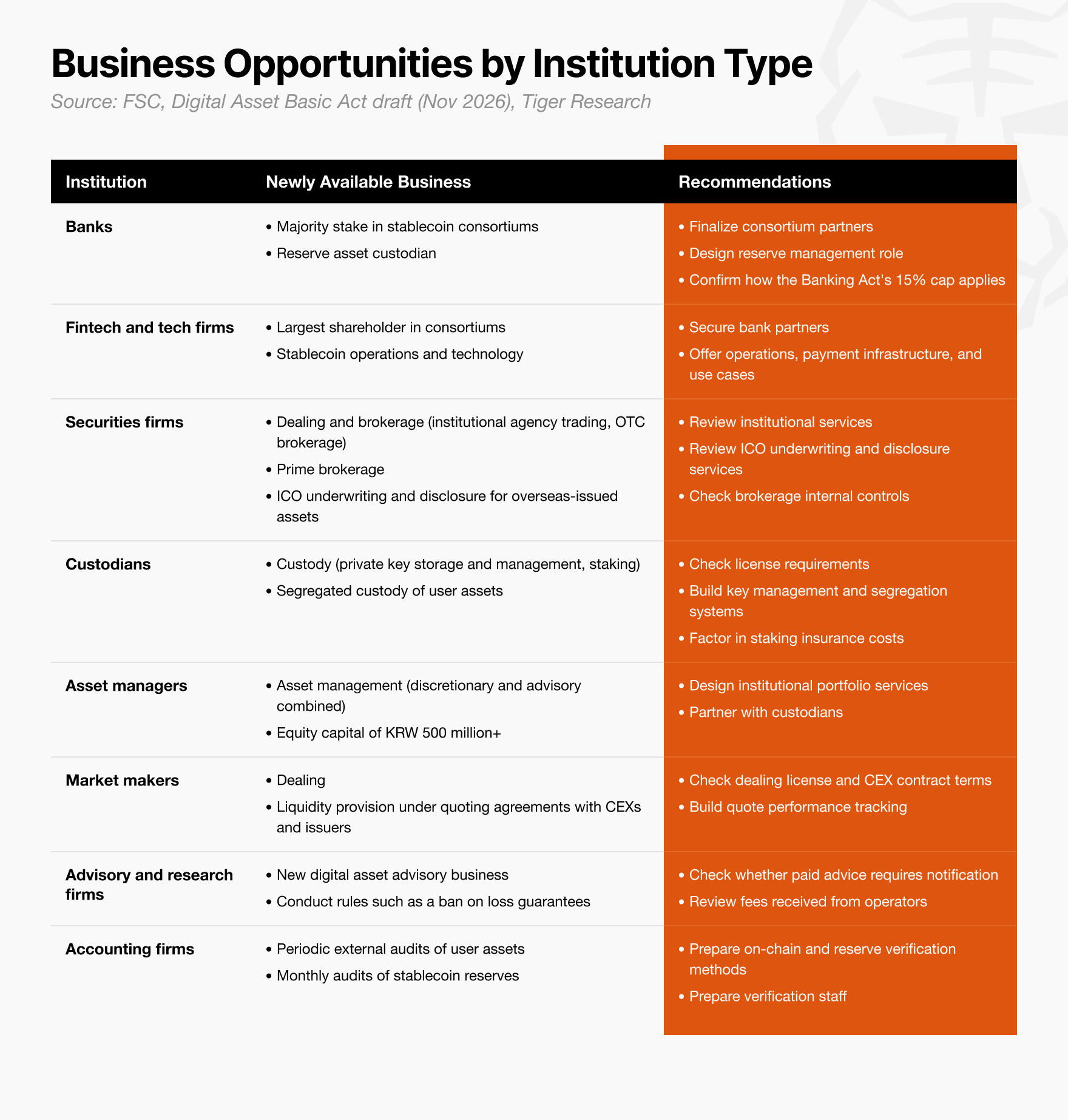
The draft completely abandons the previous ambiguous concept of "Virtual Asset Service Provider (VASP)" and instead, borrowing from traditional capital market legislation, meticulously divides the digital asset industry into four independently licensed business types:
- Digital Asset Trading Intermediary Business: Responsible for matching orders (i.e., purely order book exchanges);
- Digital Asset Custody Business: Independently and securely safeguarding customer assets;
- Digital Asset Brokerage Business: Executing trading instructions on behalf of clients;
- Digital Asset Consulting Business: Providing investment analysis and asset allocation advice.
This refined segmentation of licenses allows traditional brokerages to avoid the high cost of building their own exchanges by applying for separate brokerage and consulting licenses, directly integrating crypto asset trading modules into their existing securities apps; while large trust companies and commercial banks can swiftly seize the custody supremacy for institutional funds in the independent custody license track due to their high sovereign credit endorsement.
3 Unresolved Issues in the Draft
Despite the framework now taking shape, the bill still leaves significant gaps in many key operational details: Are commercial banks allowed to directly allocate spot digital assets on their balance sheets using their own capital? Can traditional financial institutions use KRW stablecoins directly in cross-border payment and clearing settlements? These unresolved red lines will await the Financial Services Commission's subsequent issuance of enforcement decrees for final determination.
Overseas Stablecoin Issuers: Applying South Korean Localized Admission and Registration Procedures
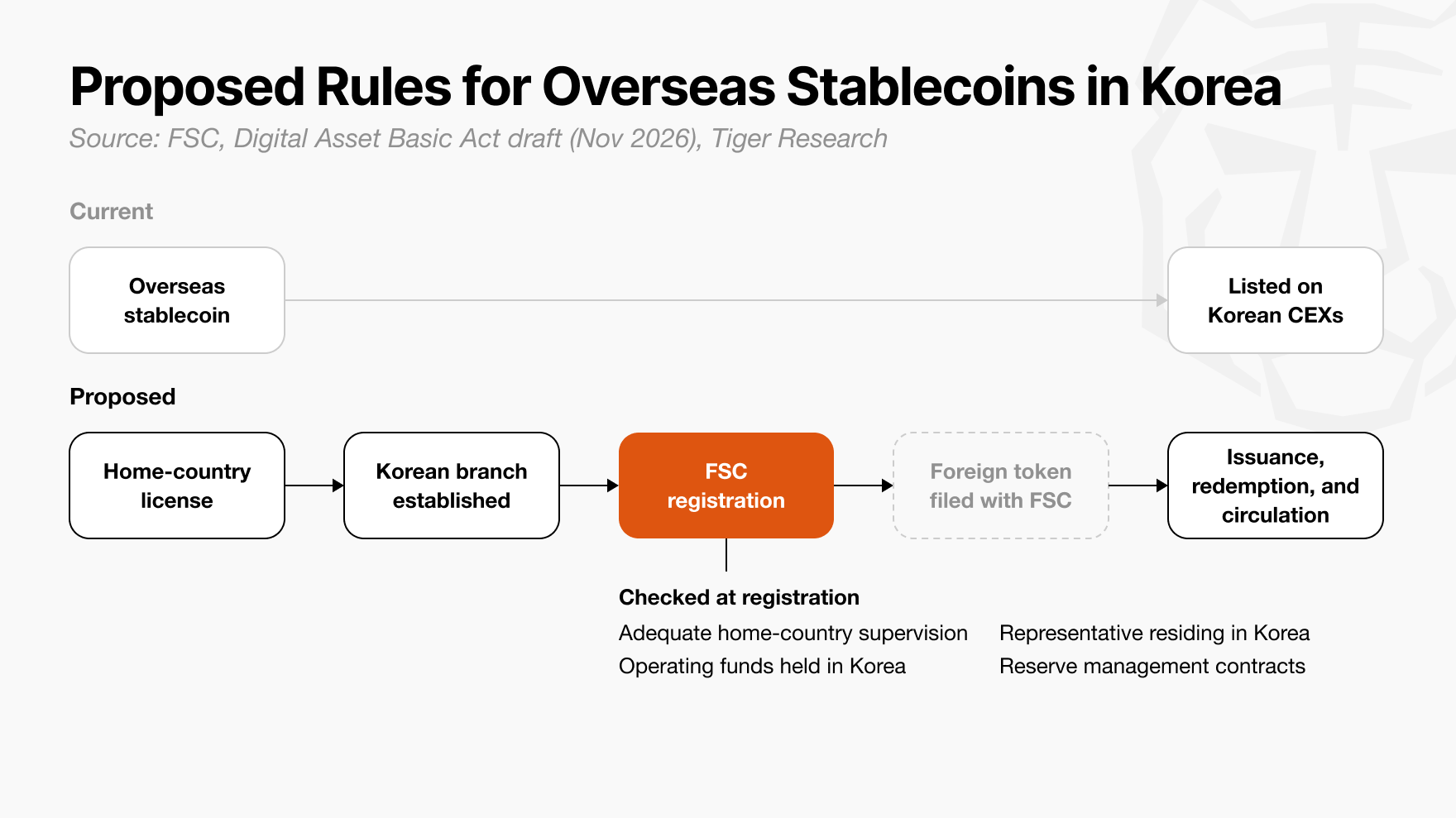
In response to the current monopolistic position of offshore USD stablecoins (such as USDT issued by Tether and USDC issued by Circle) in the South Korean trading market, Article 28 of the draft establishes a highly targeted cross-border regulatory jurisdiction mechanism:
If overseas issuing entities want their stablecoins to maintain compliant trading on major CEXs in Korea and circulate legally to Korean residents, they must establish formal registered branches in Korea or designate legal local agents. Additionally, issuers must have obtained equivalent compliance licenses in their home jurisdictions and regularly submit reserve asset sufficiency ratios and audit reports to the Korean Financial Supervisory Service (FSS).
The introduction of this regulation means that overseas giants must accelerate the establishment of their local legal entities in Seoul and the integration of their banking settlement networks. If certain offshore unregulated stablecoin issuers refuse to meet these localized compliance requirements, South Korean regulators will have the authority to order major exchanges to enforce mandatory delisting and isolation.
Web3 Foundations and Project Teams: Local ICO Ban Lifted but Tax Advantages Remain Unshaken
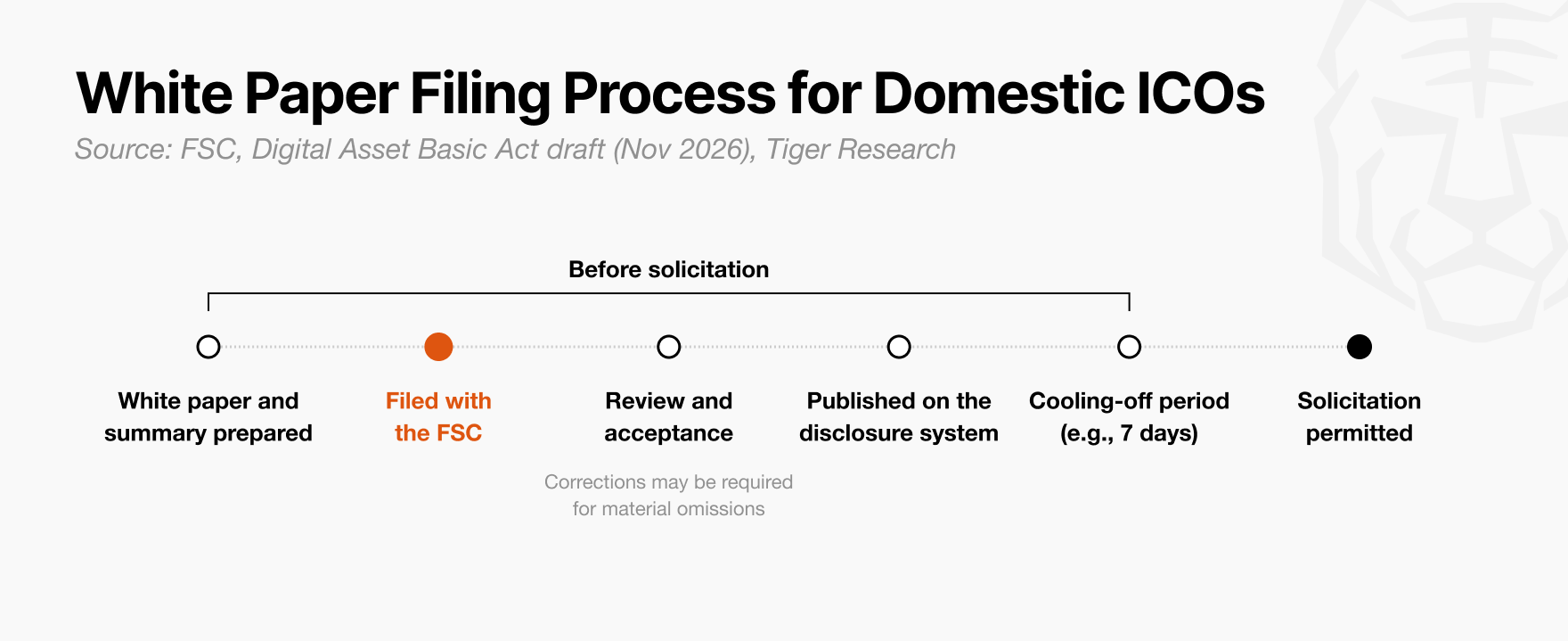
Since the blanket ban imposed by the South Korean Financial Commission on local ICOs in September 2017, most outstanding domestic entrepreneurial teams have been forced to set up offshore foundations in Singapore, Switzerland, the United Arab Emirates (Dubai/Abu Dhabi), or the Cayman Islands to indirectly issue tokens for almost a decade. Article 7 of the draft finally lifts the ban on local compliant ICOs at the legal level.
However, Tiger Research's investigation suggests that this policy relaxation is unlikely to trigger a large-scale repatriation of overseas foundations in the short term. The core constraints lie in heavy tax burdens and stringent disclosure responsibilities:
- Significant Tax Disparities: In Dubai or the Cayman Islands, foundations can enjoy almost zero tax rates offshore; however, once the token issuing entity is moved back to Seoul, the foundation will immediately fall under the South Korean standard corporate income tax regime of up to 24%.
- High Costs of Mandatory Disclosure: The draft requires local issuing entities to submit detailed technical code audits, token unlocking schedules, treasury fund flow directions, and executive holdings to the regulatory authorities, assuming full legal joint liability for the accuracy of disclosures.
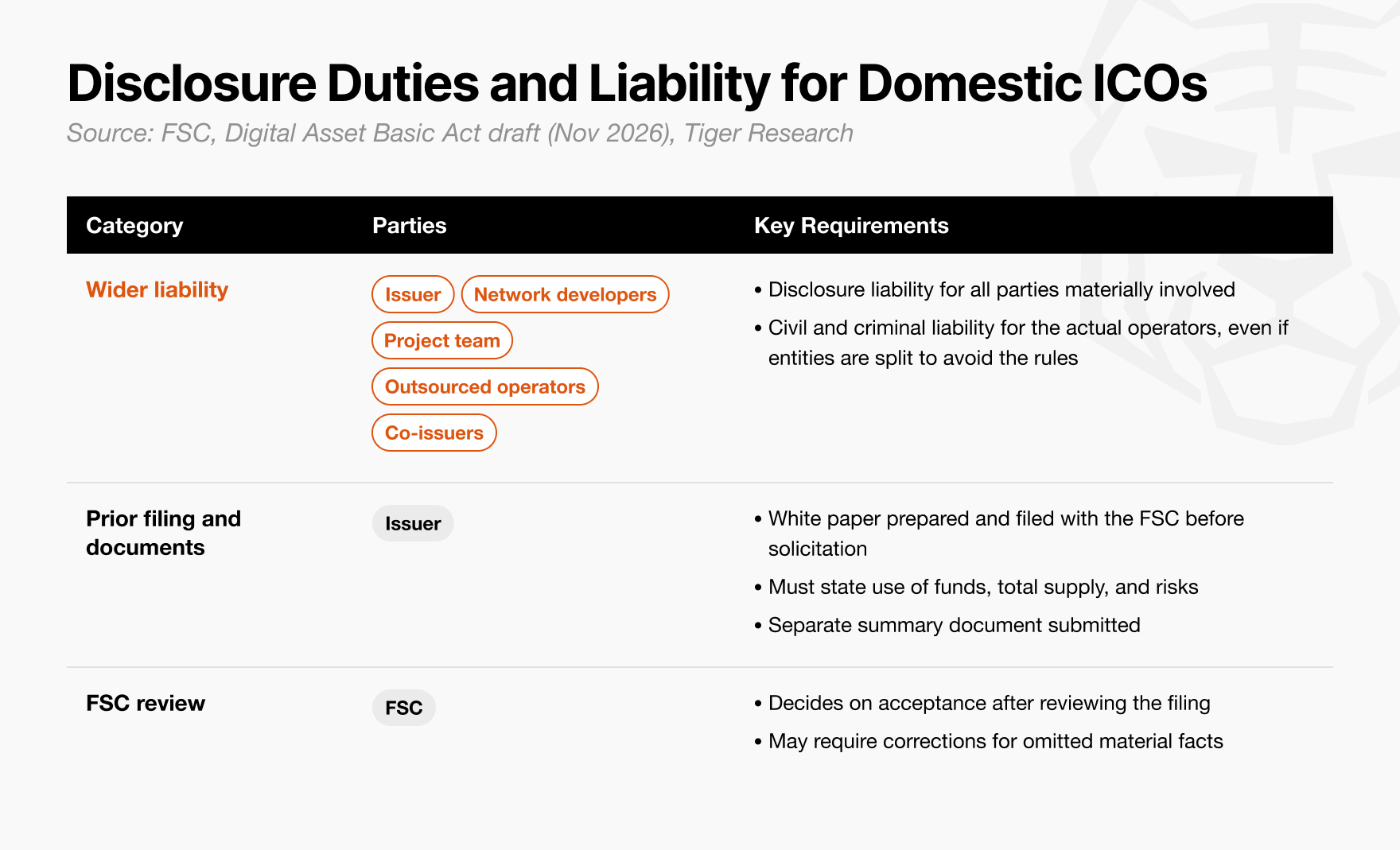
Therefore, for the vast majority of leading Web3 teams with a global perspective, maintaining a dual-track structure of "offshore foundation issuance + domestic technical subsidiary development" remains the most rational and pragmatic optimal solution.
The bill further expands the scope of joint liability for information disclosure from solely the issuing entities significantly to include underlying network developers, core project teams, and token sales and promotion agencies. Any individuals involved in writing the white paper or promoting the sale of tokens may become entangled in civil liability whirlwinds if false statements occur within the project. To cope with this high-risk environment, overseas foundations must establish permanent compliance liaison offices in Korea in the future or hire local professional law firms to undertake statutory information disclosure responsibilities.
Digital Assets: A Key Step into a Compliant Traditional Financial System
The introduction of the draft "Basic Digital Asset Act" marks a significant farewell for the South Korean crypto market to years of savage and rough development and gray area maneuvering, officially entering an era of modernization governed by law that closely aligns with traditional capital markets. Although intense debates regarding the property rights controversy surrounding the 20% shareholding cap, the banking monopoly tendency on KRW stablecoins, and the crowding-out effects of high taxes on local innovation will continue in Congress, the broader trend of institutionalization, transparency, and compliance within the entire industry has been irrevocably established.
免责声明:本文章仅代表作者个人观点,不代表本平台的立场和观点。本文章仅供信息分享,不构成对任何人的任何投资建议。用户与作者之间的任何争议,与本平台无关。如网页中刊载的文章或图片涉及侵权,请提供相关的权利证明和身份证明发送邮件到[email protected],本平台相关工作人员将会进行核查。