Before 2026, the Crypto industry had established a fairly clear division of labor regarding "security."
Contracts were entrusted to audits and bounty programs, private keys were handled through hardware isolation and offline backups. Although these two lines of defense did not guarantee absolute asset security, the industry had generally regarded them as the primary security boundaries for a long time.
Because of this, security in the past Web3 world carried a "cost attribute": it was an investment that products had to bear for safety, sometimes even viewed as a necessary friction that increased operational steps and sacrificed user experience.
However, several recent Crypto security incidents are breaking this inherent perception.
Attackers do not necessarily need to breach core protocols, and users’ mnemonics may not have left their original positions, yet assets can still be at risk due to altered browser scripts, stolen API credentials, or abused transaction permissions granted to Agents, leading to actual losses.
In a sense, when AI Agents begin to participate in asset management and transaction execution, security transitions from merely being a protective cost borne by products to becoming a critical infrastructure supporting automated financial activities.
1. Where is the attack surface of the crypto industry shifting to?
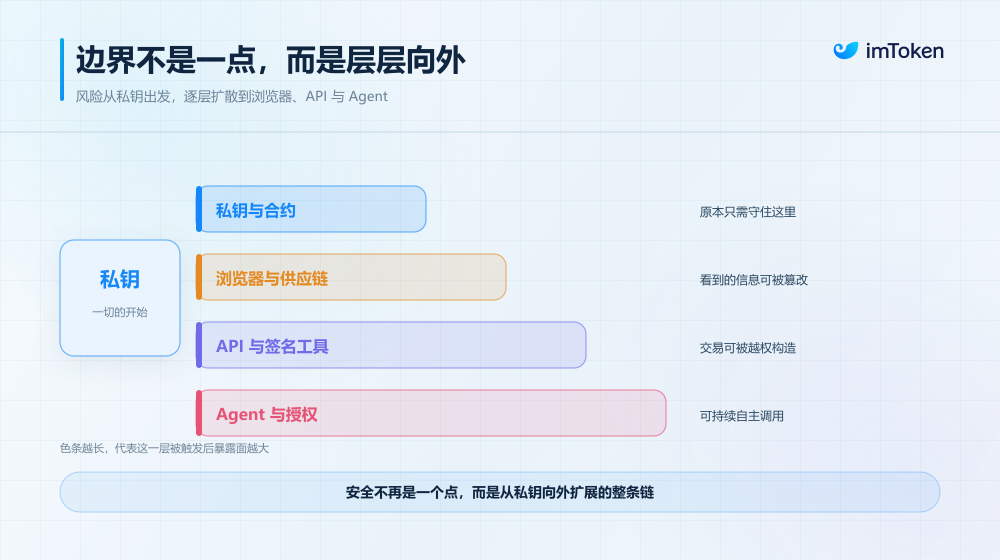
If we only view the recent incidents as isolated security news, it is easy to fall into the superficial understanding of "switching platforms and reducing phishing links," but a careful comparison reveals a remarkably clear path of attack surface migration:
Risks are quickly spreading from the periphery of on-chain assets to the browser front-end, software supply chains, delegated credentials (API), and AI Agent authorization layers (further reading: From Private Key Protection to Systematic Defense: How Will Crypto Rebuild Security and Trust in the AI Era?).
First is the Optimizely front-end supply chain poisoning.
Here, attackers exploited vulnerabilities in a third-party experience optimization platform, injecting malicious scripts into the websites of hundreds of companies worldwide via its official CDN, directly altering copied cryptocurrency addresses in users' browsers while also capturing users' bank card information, cookies, and other data.
This means that attackers do not need to breach the user's wallet nor necessarily the website's own servers; as long as they control a third-party service within the user's trust chain, they have the opportunity to change the transaction information the user sees before they click send.
Second is the Lighter API signing key leak.
On November 16, Lighter experienced a security incident involving API keys from trading accounts. Subsequent disclosures indicated that affected accounts used a custom signing process that reused the random number Nonce in cryptographic signatures, allowing attackers to derive the API private key from the public signature.
Once the key was obtained, attackers utilized the affected account's existing public fund pool permissions to transfer funds into the pool and then withdraw through the share redemption path. Approximately 10.39 million USDC were observed flowing out, and the platform subsequently paused withdrawals and new fund pool creations, recovering about 5 million USDC with the assistance of the Security Council.
Lastly is the authorization risk of the Hyperliquid Agent Wallet.
On November 14, automated trading service HyprEarn disclosed that a small number of Hyperliquid user accounts that had previously authorized its Agent Wallet had exhibited unauthorized trading behavior, requesting users to revoke the old Agent's authorization and re-establish connections.
Notably, while Hyperliquid's Agent Wallet cannot directly withdraw funds or transfer to external addresses, it can execute transactions on behalf of the user. This means that, even if attackers cannot directly steal assets, they can still cause real losses to users through unusual transactions.
These risks are not created by AI Agents, but as Agents link information retrieval, strategy decision-making, tool invocation, and transaction execution, the originally dispersed risks may be further amplified, indicating that the attack surface of the crypto industry is expanding from traditional private key and contract security to fully overflow to the browser front-end, third-party supply chains, delegated credentials (API), and AI Agent identity and authorization layers (further reading: From Binance to PHP2Shell: In the AI Era, Web Security Defenses Need Redefining).
2. The "new boundaries" of security in the AI era
If the events mentioned above reflect the overflow of traditional crypto attack surfaces, then the proliferation of AI Agents further changes the underlying nature of security issues.
In traditional wallet interactions, users typically need to actively select assets, confirm transactions, and sign; even if there are phishing sites or malicious contracts in the process, the user remains the main decision-maker in the entire execution chain.
However, Agents are different.
For users, "automatically buying the dip on Uniswap when ETH falls to the target price, transferring remaining funds into Aave yield strategy" is just a simple command, but the Agent behind it needs to read market data, call trading APIs, construct transactions, connect wallets, sign contracts, and even continually adjust positions afterward (further reading: When Hackers "More Efficiently" Use AI, How Does the Arms Race of "Spear and Shield" Upgrade in Web3?).
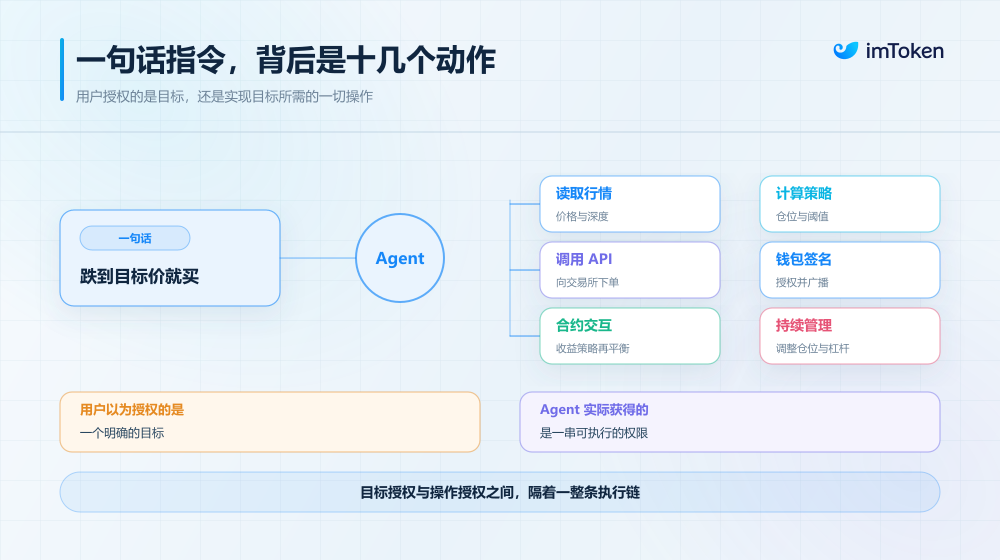
This switch in interaction paradigms brings about two structural changes that were not prominent in the past.
First, authorization evolves from "one-time confirmation" to "continuous operational capability."
In the past, signing a transaction meant approving a clear action within boundaries, whereas once an Agent is authorized, it can operate continuously for hours, days, or even longer, dynamically adjusting strategies based on external information and interim results.
Thus, the risk is no longer bound to the correctness of a single transaction; it depends on the duration of authorization, operational radius, and trigger boundaries. After all, why should an Agent responsible only for dollar-cost averaging ETH have the authority to adjust leverage, call across protocols, or transfer assets?
If users only assign task objectives without explicitly defining execution boundaries, even if the private key has never leaked, the actual control of the account may be inadvertently over-delegated.
Second, isolated vulnerabilities become linked into a continuous execution chain.
A typical Agent workflow often spans multiple layers, for example, fetching information through the browser, executing tasks via third-party Skills or MCP tools, connecting to trading platforms through APIs, and finally calling wallets to complete signatures.
The entire chain can be said to be interlinked; any breach can cause a cascading effect. Just like malicious instructions embedded in external web pages can alter the Agent’s decision-making, contaminated third-party tools may swap transaction parameters during the assembly phase, and leaked API keys can directly bypass the original interaction process to access funds.
This is why the security of the Agent era cannot rely solely on the alignment and guardrails of the models themselves. What truly determines whether an operation can be released must be a set of deterministic permissions and strategy foundations independent of model inference.
In other words, Agents can become increasingly autonomous, but autonomy must have hard boundaries; this is the true intersection of Crypto security and AI Agent security.
3. From wallets to Agent platforms: What do new security standards require?
When both the attack surface and risk entities change, wallets, exchanges, and Agent platforms need to establish more than just traditional private key protection and contract audit mechanisms.
Regarding all-link risk transmission, at least four dimensions of capabilities are becoming new industry benchmarks.
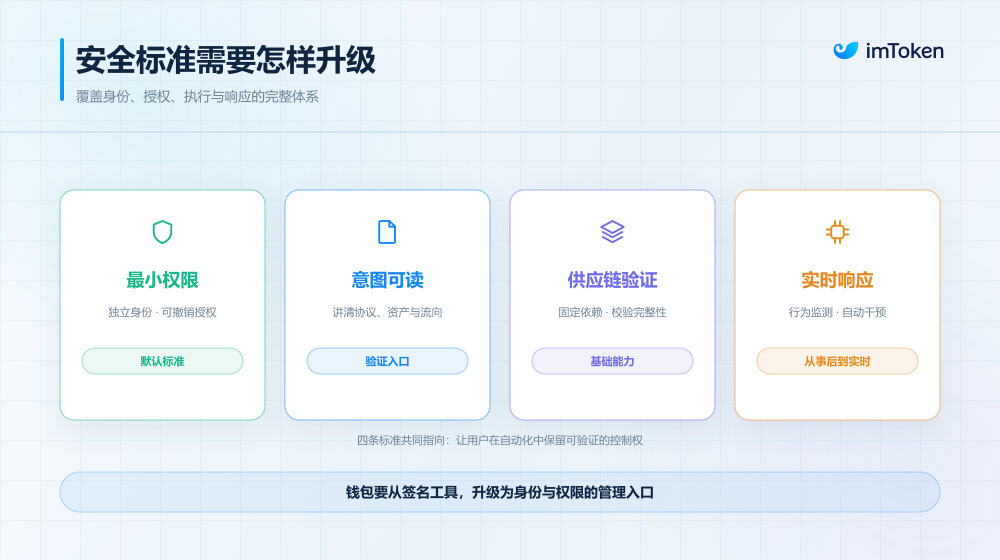
First, we must establish an independent Agent identity and minimal permission system.
Agents should not directly inherit all permissions of user accounts but should operate as independent, limited entities. A mature permission model should achieve deconstructible hard constraints on at least five dimensions:
- Operational scope: Clearly distinguish between read-only queries, spot trading, and specific contract calls, rejecting broad generic authorizations;
- Asset scope: Limit the specific Tokens that can be utilized to prevent risks from spreading to other assets in the main account;
- Amount scope: Set limits on single transaction amounts, accumulated spending, and maximum risk exposure;
- Time scope: Bind authorizations to effective periods, automatically expiring when tasks are complete;
- Delegation scope: When Agents invoke sub-Agents or third-party tools, permissions may only be narrowed, and must not spread downstream;
More critical than fine allocation is the revocability of permissions. If an Agent’s actions deviate from expectations, users must be able to autonomously and immediately cut off authorization without waiting for a response from a centralized service provider. For wallets, this means their functions are extending from merely being a "signing entry" to also encompassing identity verification, permission allocation, and full lifecycle authorization management.
Second, transaction intentions must be truly readable and verifiable.
In the Agent era, a practical issue faced by users is that even if transactions ultimately require wallet signatures, users may not fully understand what the Agent is actually submitting.
A natural language command, after model inference, tool invocation, and contract coding, may turn into a chain transaction with complex parameters. Therefore, wallets should not merely display raw transaction data or simply require users to click confirm; rather, they should strive to revert the transaction into specific actions understandable by users.
For instance, clearly displaying the protocols and contracts involved, indicating the assets, amounts, and receiving addresses involved, identifying high-risk actions like unlimited authorization or permission changes, and explaining the potential impacts of transactions involving leverage, collateral, and position changes, possibly even combining with transaction simulations to showcase asset changes before and after execution.
The critical bottom line is that transaction descriptions generated by the model itself must never serve as the final safety basis.
Wallets must independently parse the underlying parameters to be signed locally, ensuring strict consistency between "the intention seen by the user" and "the facts to be executed on-chain." For large assets, irreversible operations, or permission expansions, a clear manual confirmation mechanism must be retained.
Third, extend supply chain verification to the entire tool ecosystem of the Agent.
The lessons from Optimizely and Lighter have proven that defenses often break down in third-party dependencies that users cannot see, and in the Agent era, this supply chain is exponentially lengthened:
Besides traditional browser scripts and software SDKs, various Skills, MCP Servers, third-party APIs, external data sources, and automation execution tools are being directly integrated into the execution chain.
Therefore, future security validation cannot merely reside within the model and wallet themselves; it must also cover the dependency map of the entire tool ecosystem. For example, implementing strict source verification for SDKs, plugins, and Skills, prioritizing trusted release channels; locking dependency versions and verifying software package integrity, blocking unreviewed silent updates; enforcing sandbox isolation for third-party tools, strictly limiting their access boundaries to local files, account credentials, and external networks.
Especially for tools involving wallet signatures and asset operations, they should not gain unauthorized access to other resources simply because they are "normally invoked by the Agent."
Lastly, establish continuous monitoring and anomaly response mechanisms for Agent behavior.
Traditional security systems often focus on abnormal logins, unusual transfers, and suspicious contract interactions, but for Agents, abnormal behaviors may manifest earlier in the transaction execution process.
For instance, an Agent originally responsible for low-frequency spot trading may suddenly start frequently adjusting leverage, continuously opening positions, or invoking contract interfaces that have never been used before, all of which may suggest that task execution has deviated from the user's original authorization scope.
Thus, trading platforms and Agent service providers need to establish more granular behavior monitoring mechanisms, including setting real-time thresholds around transaction frequency and amount limits, maximum positions and leverage exposure, anomalous API calls, and unfamiliar contract interactions; once strategies cross red lines, the system should automatically pause tasks, downgrade, or revoke corresponding permissions.
It is especially important to note that once an on-chain transaction is completed, it is usually not straightforward to revoke. Therefore, effective risk control should occur as much as possible before transaction execution, rather than waiting for asset loss to take remedial action.
For Agent platforms, it is also necessary to record the source, authorization basis, tool invocation, transaction parameters, and execution results of each task so that users can trace back to identify which stage encountered an issue.
In conclusion
Reviewing the development history of the crypto industry, every upgrade in interaction paradigms ultimately drives a reconfiguration of security systems.
From early private key management and cold wallets to smart contract audits, multi-signatures, and MPC, to today’s account abstraction, permission management, and automated risk control, every product form upgrade brings along new security boundaries.
AI Agents will be no exception.
As Agents start interfacing with wallets, exchanges, payment networks, and on-chain protocols, security has already transitioned from information protection to real asset control and financial execution.
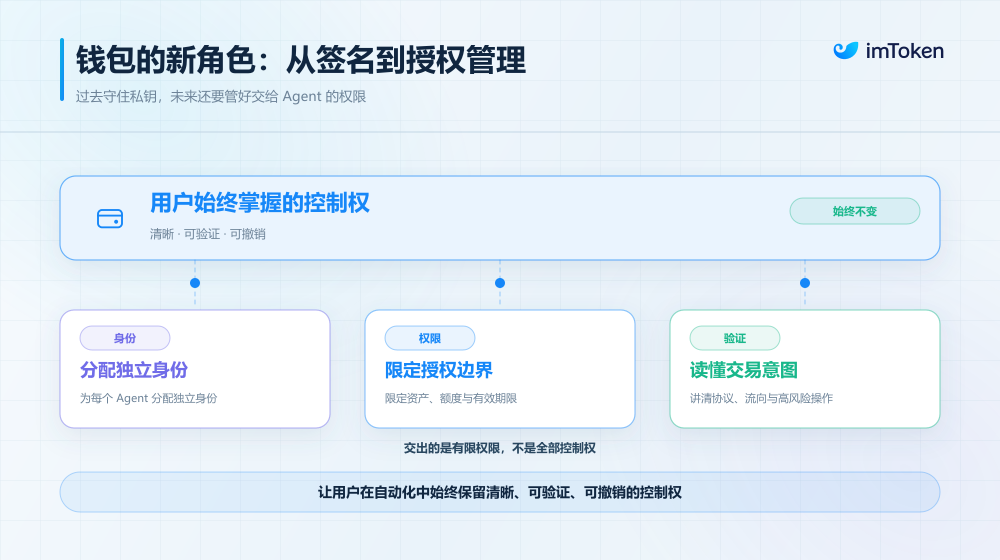
For wallets, the core challenge in the AI Agent era is not just how to support more complex automated operations, but how to ensure that users always maintain clear, verifiable, and revocable asset control while enhancing execution efficiency.
Automation can change the way transactions are executed, but it should not change the ownership of asset control. This may very well be the bottom line that the crypto security infrastructure needs to uphold in the era of AI Agents.
免责声明:本文章仅代表作者个人观点,不代表本平台的立场和观点。本文章仅供信息分享,不构成对任何人的任何投资建议。用户与作者之间的任何争议,与本平台无关。如网页中刊载的文章或图片涉及侵权,请提供相关的权利证明和身份证明发送邮件到[email protected],本平台相关工作人员将会进行核查。