The next step for tokenized stocks is to be collateralized.
Written by: sealaunch intelligence
Translated by: Chopper, Foresight News
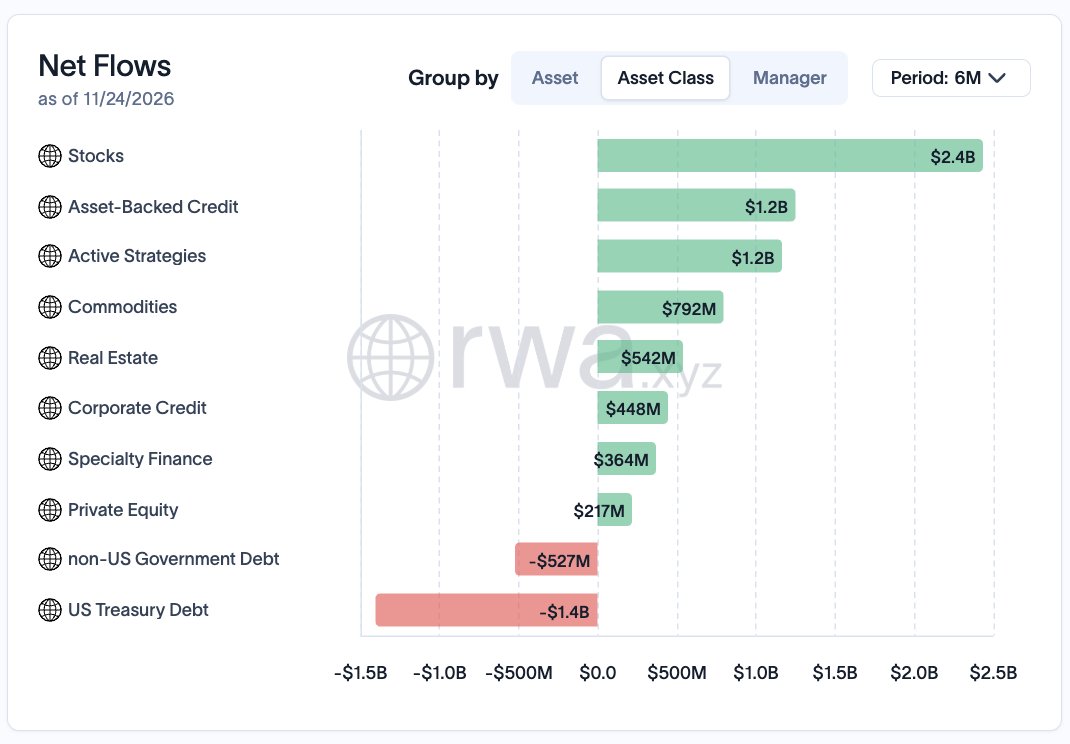
In the past six months, tokenized stocks have been the most popular segment in the RWA world, with a net inflow of 2.4 billion dollars; during the same period, U.S. Treasury bonds had a net outflow of 1.4 billion dollars.
Source: rwa.xyz
Putting a stock on the blockchain has direct benefits: 24/7 settlement, and the keys are in your hands. But the truly valuable application is using it as collateral to borrow money: you still hold onto the stock, you still benefit from price changes, and at the same time, you can borrow some cash to use.
The earliest to act was Coinbase, which launched a dedicated Aave V4 lending market for its stock tokens on the Base chain.
Coinbase's Stock Tokens
In August, Coinbase launched tokenized stocks on the Base chain. Each token corresponds to one share of real stock, held in custody by a regulated third-party platform, separate from Coinbase's own assets, on a 1:1 basis. Even if something happens to Coinbase, this portion of the stocks will not be affected. The token issuance takes place on the Base chain and can be stored in your own wallet for direct use.
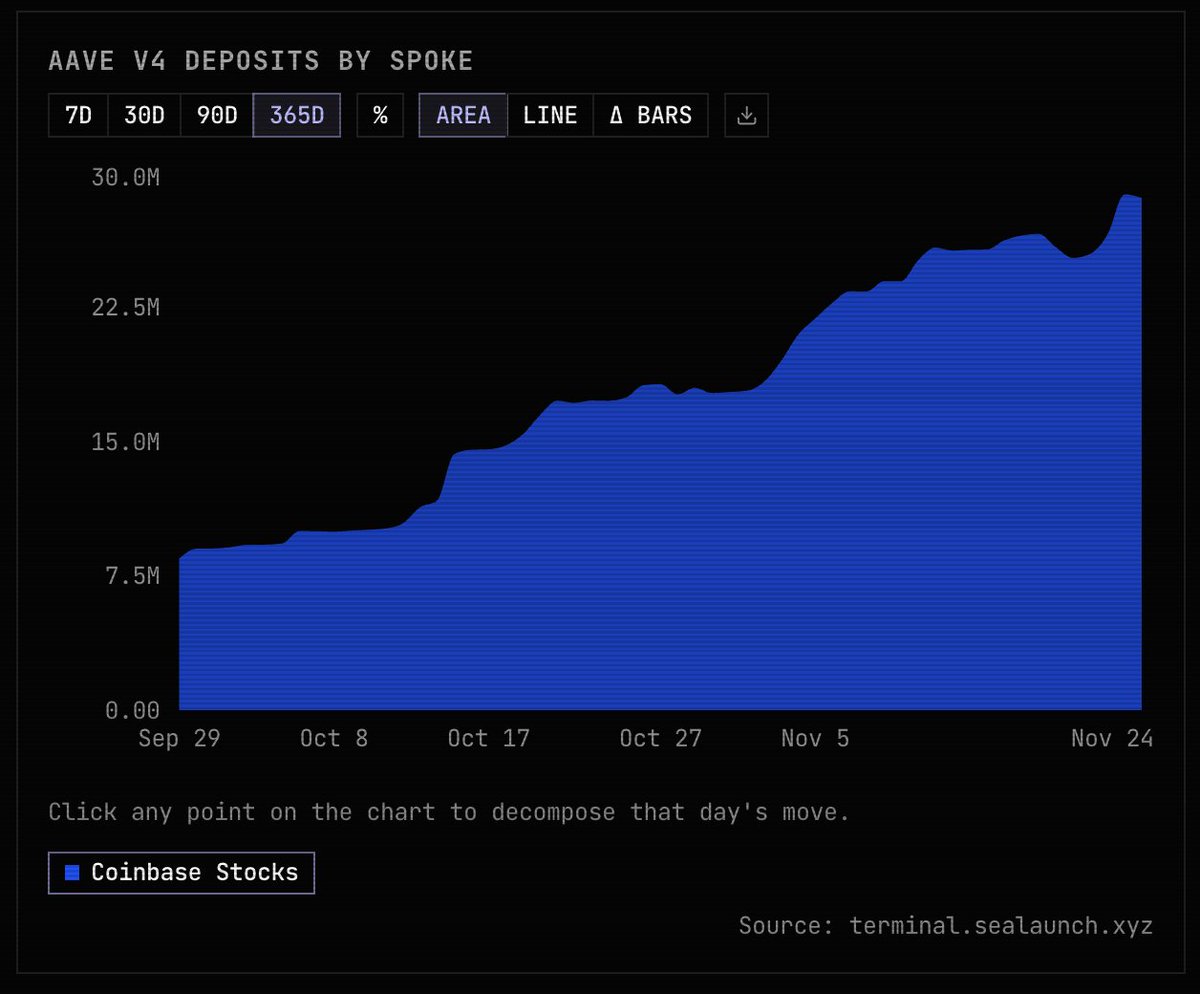
Within three months, the on-chain scale of this product reached 45 million dollars, covering nearly 400 stocks and 97,000 holders. The largest few are:
- NVDAc, 10.9 million dollars
- GOOGLc, 10.4 million dollars
- METAc, 5.4 million dollars
- SPCXc, 4.2 million dollars
How does this Aave V4 market operate?
At the end of September, Coinbase set up a "central pool + branch" structure specifically on Aave V4, becoming the main lending market for Coinbase's stock tokens.
The specific approach is: users deposit stock tokens as collateral to borrow USDC. There is no fixed loan term; as long as the collateral ratio remains healthy, it can be repaid at any time.
The central pool holds USDC, and all loans come from here; the branches hold the risk parameters for each stock: how much can be collateralized, the maximum amount that can be stored, and the liquidation thresholds. In practice, it's a USDC pool that simultaneously provides loans for eight stocks, with each stock's risk managed separately. To add a new stock, you just need to adjust the parameters in the branches; there's no need to create a new market or bring in new lenders.
This aspect is crucial for a product covering close to 400 stocks. If each stock had its own independent market, each would need to gather a batch of people willing to lend USDC, resulting in most pools having insufficient liquidity, making it impossible to lend money. By sharing a central pool, lenders only need to provide funds in one place, increasing liquidity as the number of stocks grows.
Currently, this market has about 19 million dollars of stocks as collateral, approximately 40% of all of Coinbase's on-chain stock tokens, with 8.3 million dollars in USDC borrowed. The main collateral consists of GOOGLc (6 million dollars), NVDAc (5.1 million dollars), and METAc (3.7 million dollars). Each stock has a deposit limit: NVDAc has reached 73%, GOOGLc is at 54%, while the others are below 30%.
Growth Mainly Relies on Treasuries
The primary borrowers are not retail investors but a group of treasuries. Each treasury deposits stocks as collateral to borrow USDC; because some are borrowing, lenders of USDC can earn interest. For users, the treasury handles the operations and risks; for the platform, they get large borrowing demands instead of a pile of small orders.
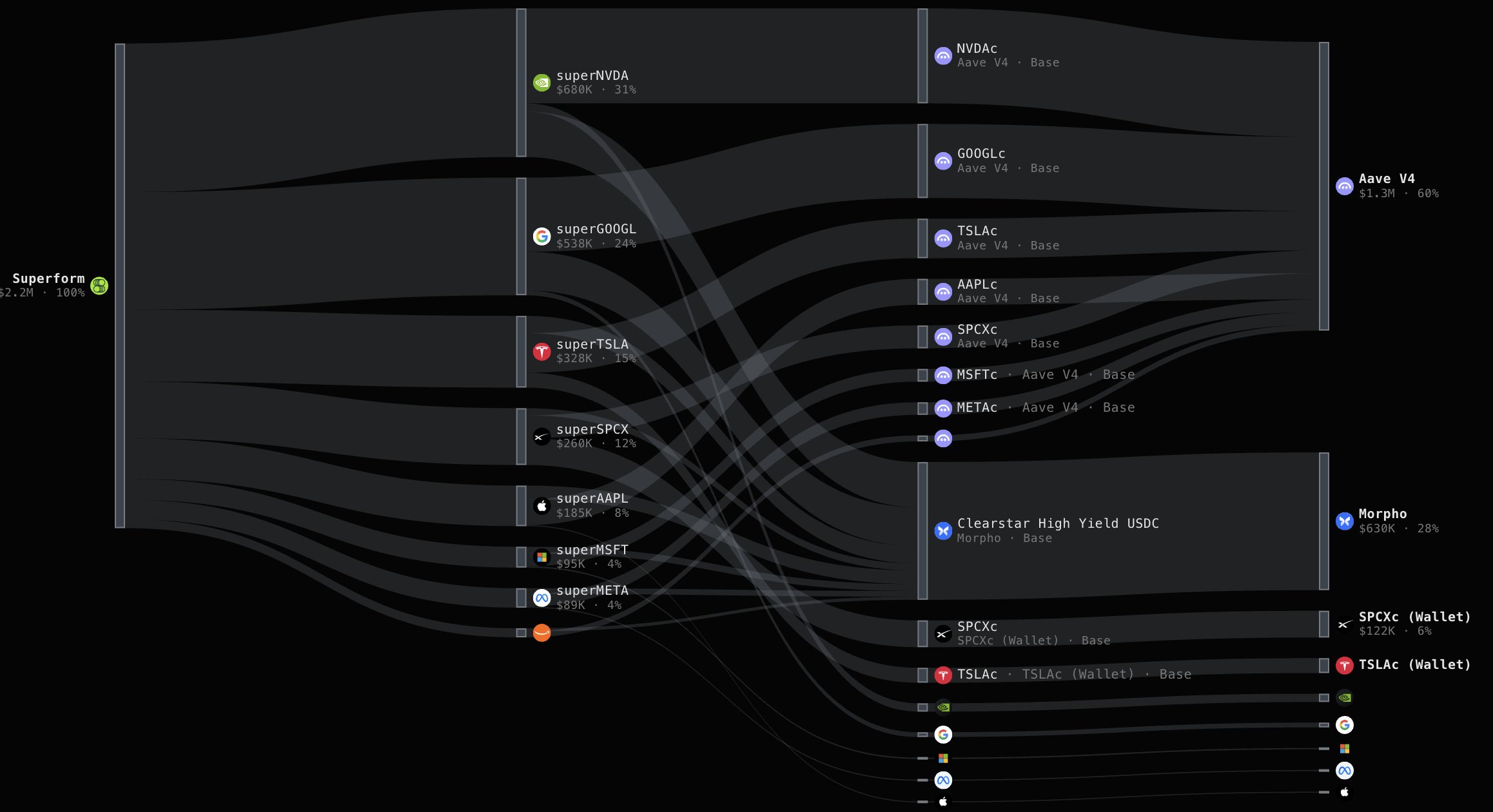
Three strategy teams operate a total of 22 treasuries, with a scale of about 10 million dollars, together providing one-third of the stock collateral for this central pool. The three teams follow the same strategy, adhering to four steps:
- Hold stock tokens
- Deposit in Aave V4
- Borrow USDC
- Invest USDC into stablecoin yield strategies
For depositors, the result is that they still hold the stocks while additionally earning the difference between "stablecoin interest minus borrowing interest." Originally, this arbitrage method was used for yield-generating stablecoins, and now the underlying asset has changed to stocks.
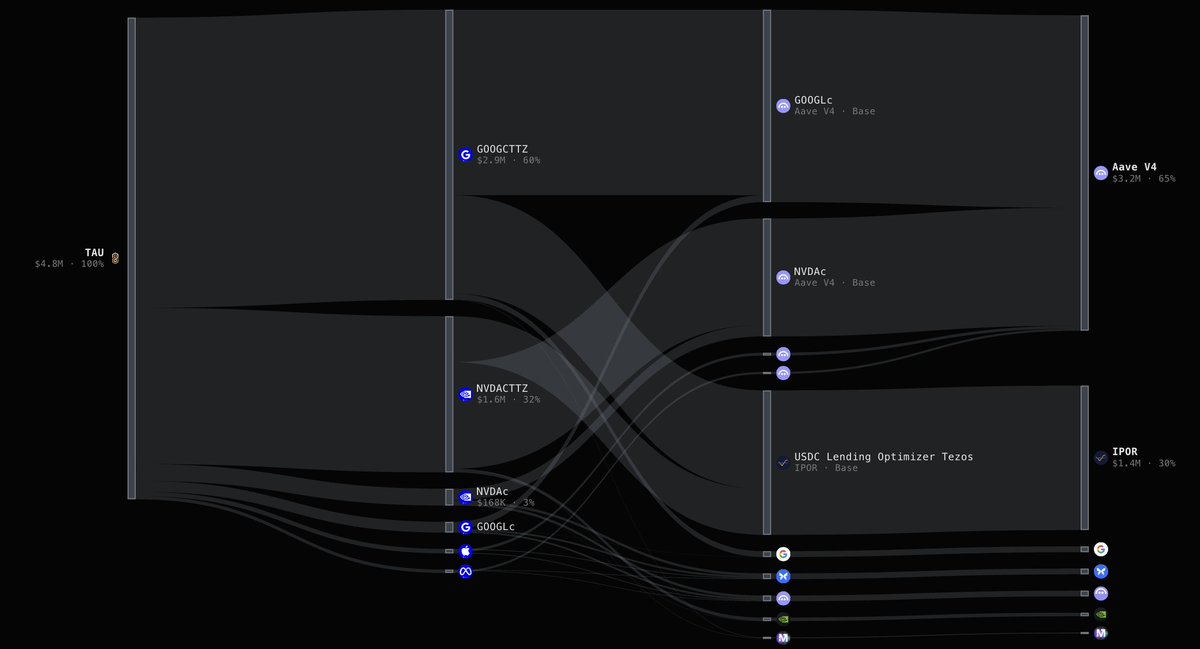
628 Labs: 4.8 million dollars, primarily a treasury for GOOGL and NVDA. 65% is placed in Aave V4, with 30% invested in the USDC Lending Optimizer treasury of the DeFi protocol Fusion.
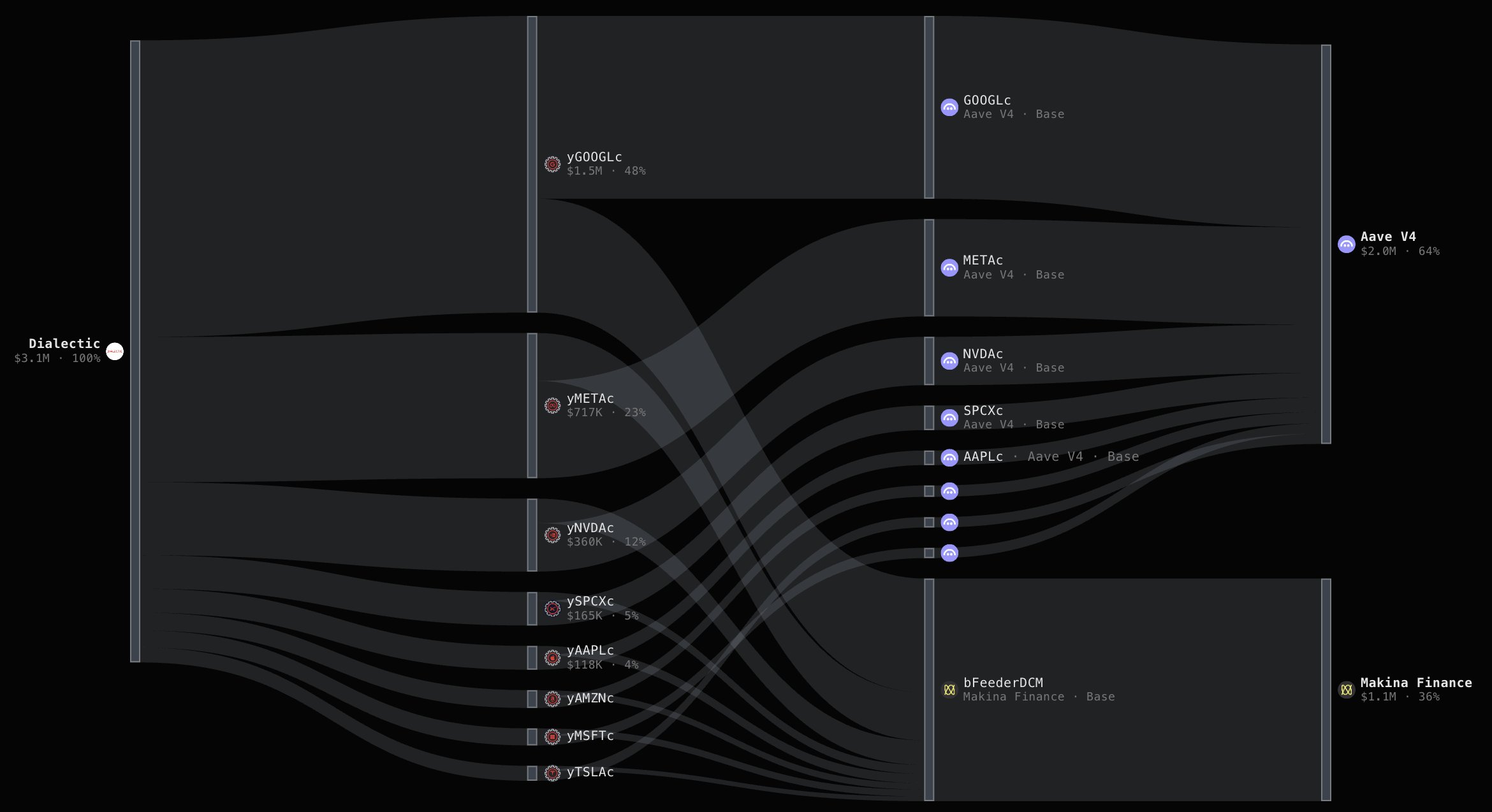
Dialectic Group: 3.1 million dollars, 8 treasuries, the largest being yGOOGLc (1.5 million dollars). 64% is placed in Aave V4, and 36% invested in Makina Finance.
Superform: 2.2 million dollars, 8 treasuries, with the largest being superNVDA (680,000 dollars). 60% is placed in Aave V4, and 28% invested in the Clearstar High Yield USDC treasury on Morpho.
There will be more plays coming. For example, Keyring is working with Bitget and Reality to create a "Stock Basis Index": holding Reality's stock tokens, leveraging in a permissioned lending market, and then opening an equivalent short on Hyperliquid. The price movements on both sides cancel each other out, and the index earns from the funding fees paid by long positions; lenders earn interest from over-collateralized loans, while index holders earn after deducting costs from the funding fees.
What Should Issuers, Brokers, and Strategy Managers Do?
For issuers, being able to collateralize a stock token is much more useful than just holding it. Those who can put assets on a market where "real money can be borrowed," and are chosen by the treasuries, are the ones who successfully turn "issuing" into "using."
For brokers and exchanges, users already hold stock tokens and crypto assets, with deposits and collateral readily available. By connecting to an existing Aave V4 central pool, they can enable the "using stocks as collateral to borrow" functionality without building a market themselves.
For strategy teams, stocks are a brand new type of collateral, allowing for arbitrage and basis trading, and related venues are already online. This can also allow strategy portfolios to be more diversified—currently, such strategies mainly profit from stablecoins, ETH, and BTC; incorporating stocks adds a component driven by equity markets and stock funding rates, rather than relying solely on cryptocurrencies.
免责声明:本文章仅代表作者个人观点,不代表本平台的立场和观点。本文章仅供信息分享,不构成对任何人的任何投资建议。用户与作者之间的任何争议,与本平台无关。如网页中刊载的文章或图片涉及侵权,请提供相关的权利证明和身份证明发送邮件到[email protected],本平台相关工作人员将会进行核查。