The on-chain collateral lending path for BTC, judging from the data after sorting four types of custodial models, indicates limited on-chain scale and that traditional finance may dominate.
Written by: Rejamong
Translated by: AididiaoJP, Foresight News
Asset prices continue to fall, and those wanting to add positions at low levels find themselves short on cash. It is at this time that they remember the Bitcoin forgotten in their hardware wallet, which can be used as collateral to lend stablecoins on-chain to continue buying.
The problem is that Bitcoin itself does not support universal smart contracts, so DeFi protocols cannot directly use BTC from the Bitcoin network as collateral. The common approach is to first lock BTC on the Bitcoin network and then issue corresponding tokens on a chain that supports smart contracts. Therefore, the real issue to decide is who to trust with the custody of BTC and how to issue wrapped tokens. Fixed-rate lending on-chain is currently not mature, with rates fluctuating rapidly alongside the market; before comparing rates, one must first confirm what kind of custodial arrangement they can accept.
Who is really safeguarding your Bitcoin?
Currently, there are mainly four models.
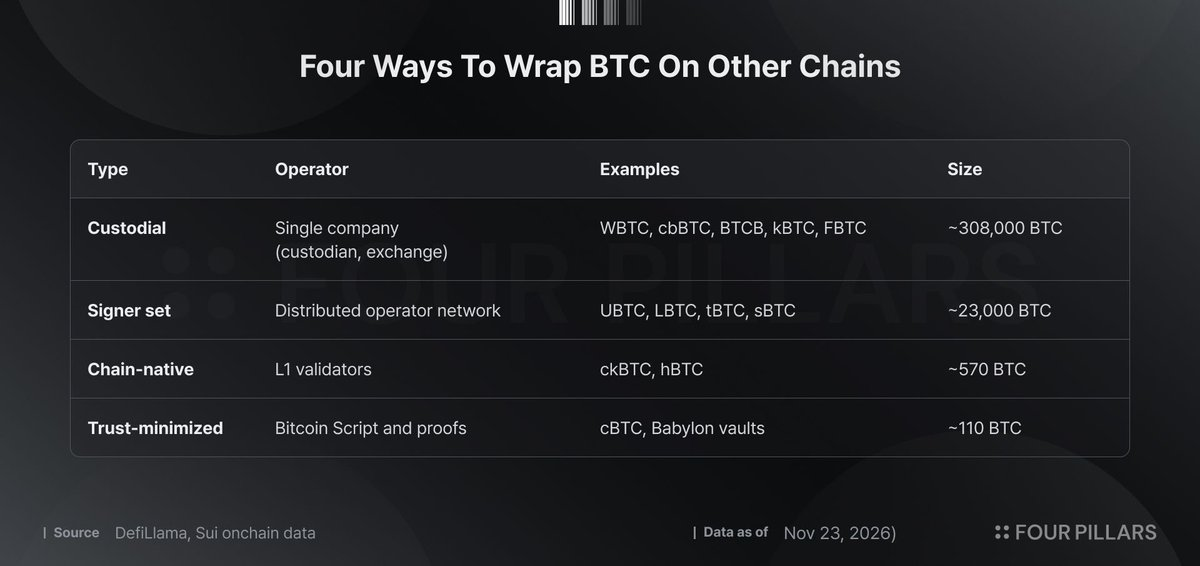
Custodial tokens are the simplest. Companies (custodians or exchanges) hold BTC and issue tokens 1:1 on a smart contract chain. The WBTC launched in 2019 represents this, and Coinbase will launch cbBTC in September 2024, while Circle will launch cirBTC on Ethereum on June 8, 2026.
These types of tokens currently account for about 85% of cross-chain BTC. Just Morpho's cbBTC market on Base has a collateral scale of about $2.5 billion, with borrowers having borrowed about $1.4 billion USDC. The drawbacks are also obvious: trust must be placed in a single company. Advocates of self-custody who believe "not your keys, not your coins" find it hard to accept such arrangements.
Multi-signature assemblies disperse control to multiple signers. tBTC requires the signatures of 51 out of 100 randomly selected operators to move BTC; sBTC is jointly controlled by Stacks signers. Compared to single custody, this is an improvement—unauthorized transfers require multiple independent signers to collude or be compromised.
Currently, this type of solution protects about 23,000 BTC, accounting for about 6% of cross-chain BTC. The specific thresholds vary by project: UBTC on Hyperliquid needs just two of three guardians to agree; around 15 institutions controlled by Lombard manage LBTC; sBTC requires approval from about 70% of ten selected signers.
On-chain native custody goes further. If you have already borrowed through a DeFi protocol on a certain chain, you have essentially trusted that chain's validators. Handing BTC to the same validators does not introduce new trust parties.
This is essentially still multi-sig, but the signers are also responsible for validating the layer of the network where the tokens reside. Internet Computer (ICP) first tried this with ckBTC in 2023, and Hashi, which launched on Sui on November 19, 2026, also adopted a similar design.
Trust-minimized bridges and vaults lock BTC using Bitcoin script, relying on proofs happening on other chains to release it. Designs like BitVM assume that as long as there is one honest participant, BTC can remain secure. Citrea’s Clementine bridge went live on January 27; Babylon vault is another example. On November 9, Aave DAO supported accepting BTC from these vaults as collateral for Aave V4. The drawbacks are slow withdrawals and limited liquidity.
According to Babylon’s design, reclaiming BTC from the vault takes several days, including a challenge period. On November 23, Babylon co-founder David Tse’s team proposed witness cryptography, which would allow BTC to be released solely based on withdrawal proof, aiming to shorten the waiting time.
Protocols often promote these arrangements as "native BTC," where "native" usually just means there is no single company issuing wrapped tokens. Regardless of the model, BTC always remains on the Bitcoin network, and DeFi protocols only receive tokens representing it.
How to choose a DeFi protocol?
Once wrapped tokens are obtained, the selection range becomes narrow. Different tokens are issued on specific chains, and protocols with deep liquidity vary. Currently, about $11 billion of BTC tokens are deposited in the DeFi lending market, with Aave accounting for about $4.7 billion, and Morpho about $3.8 billion, both together accounting for 77%.
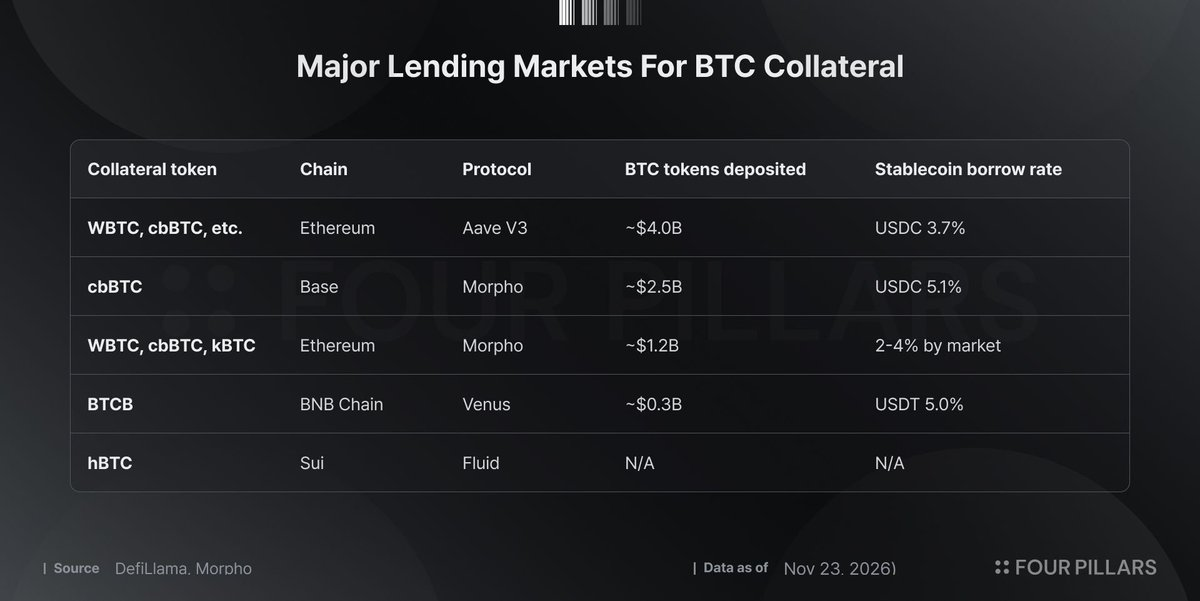
Users holding WBTC or cbBTC on Ethereum naturally choose Aave. All depositors share a single pool, providing the deepest liquidity. Its annualized borrowing rate for USDC is relatively low, around 3.7%. Borrowers can borrow up to 81% of their collateral value, with a loan-to-value ratio exceeding 85% triggering liquidation.
If BTC is with Coinbase, they are more likely to go with Morpho. The Bitcoin collateral loans provided within the Coinbase app utilize this market. Morpho establishes separate markets for each pair of collateral and borrowed assets, ensuring that bad debt in other asset markets does not spill over. The liquidation threshold for the cbBTC market on Base is 86%.
On the BNB chain, BTCB can be used to collateralize stablecoins on Venus; on Sui, hBTC can be used in Fluid, which launched simultaneously with Hashi, but the supply of hBTC is currently just around 276. Aave V4 is expected to support Babylon’s trust-minimized vault, but mainnet integration is yet to go live.
How much Bitcoin is actually on-chain?
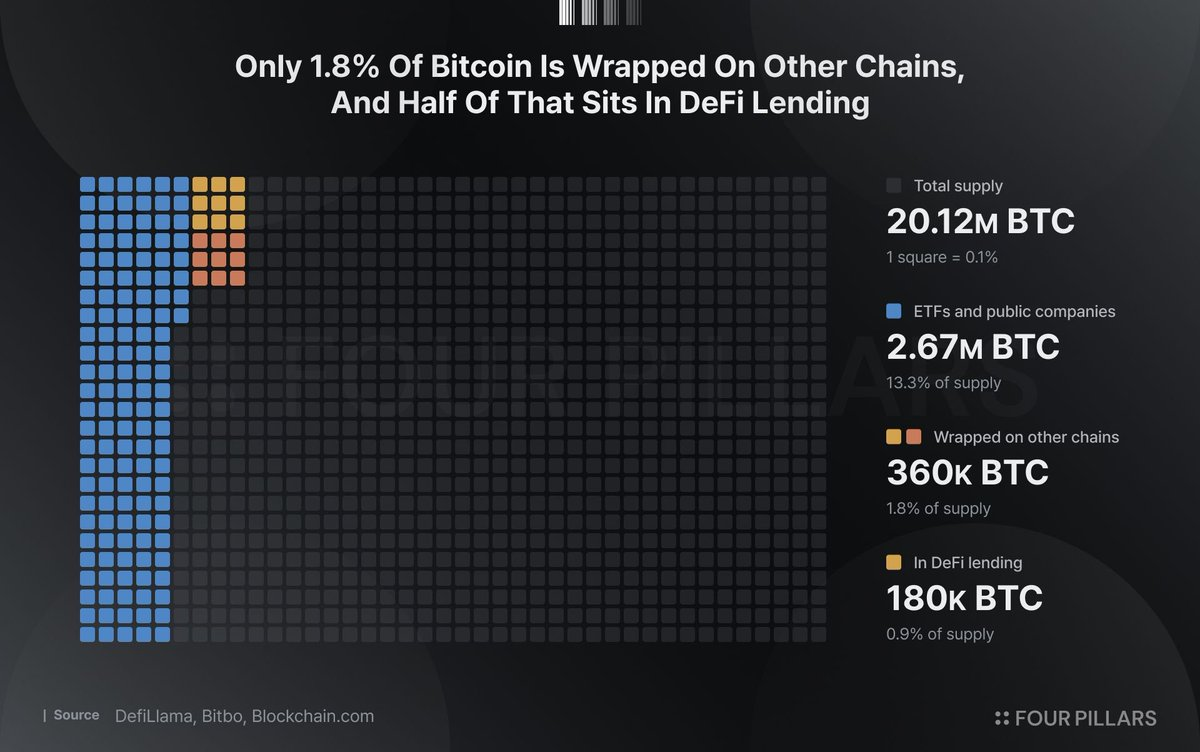
As of November 23, 2026, about 20.12 million BTC have been issued, of which only about 360,000 (accounting for 1.8% of total supply) have been mapped to a smart contract chain.
Even within this 1.8%, custodial tokens dominate overwhelmingly. WBTC, cbBTC, BTCB, kBTC, and FBTC together account for 85% of the 360,000. Approximately 180,000 BTC are actually deposited as collateral in DeFi lending markets, which is half of the cross-chain total, and only 0.9% of the total supply. Ethereum and Base account for 82% of these lending deposits, primarily concentrated in Aave and Morpho based on the protocol.
In contrast, Bitcoin ETFs hold about 1.44 million BTC, and publicly traded companies hold about 1.23 million, with both totaling 2.67 million, accounting for 13.3% of total supply, over seven times the cross-chain figure.
New use cases continue to emerge, but the overall cross-chain total has hardly changed. The supply of WBTC peaked at about 285,000 in May 2022 and then fell to about 116,000; part of it flowed to cbBTC, which will go live in September 2024, and has increased to about 103,000. The total of both is about 219,000, still below the peak of WBTC alone in 2022. Bitcoin’s status as a store of value and internet currency is unquestionable, but the assets that are actually liquid and used are pitifully few.
Will more holders put Bitcoin into circulation?
The structure of holders is changing, and idle BTC is likely to begin flowing. In the past, Bitcoin holders were reluctant to trust other chains. Now, ETFs and publicly traded companies are becoming the largest incremental buyers. Even if they wish to hold long-term, they still need cash and income channels. As long as a small portion puts BTC to use, the market size will significantly expand.
Multiple projects are actively contacting these institutions. Circle emphasizes its identity as a regulated issuer; Sui is investing considerable effort into enabling validator control over BTC while simultaneously building institutional integration for Hashi; Anchorage Digital offers Hashi access through institutional wallets; a three-party settlement arrangement expected to be launched in early 2027 will allow institutions to stake BTC while maintaining custody. Hashi has also received legal opinions from Fenwick, deeming deposits and withdrawals non-taxable events under U.S. tax law. Aave is collaborating with Babylon to accept BTC collateral without going through custodians in V4.
As crypto adoption expands, BTC as collateral may also be accepted by traditional finance. In December 2025, the U.S. Commodity Futures Trading Commission (CFTC) will initiate a pilot allowing BTC, ETH, and USDC as margin for derivatives; JP Morgan reportedly plans to accept BTC and ETH as loan collateral from institutional clients.
If BTC is widely accepted as collateral in traditional finance, demand for on-chain wrapped assets may further decline. Those who view Bitcoin as a fiat alternative and fundamentally refuse to hand it over to anyone will not easily part with their coins through any path. The demand for BTC collateral lending may come more from traditional financial institutions than from on-chain markets.
Can on-chain lending really become mainstream?
People often mention utilizing severance pay or even mortgaging property when they talk about going all in on an investment. The appeal of Bitcoin as a "last resort collateral" inherently shows it is highly suited for this role. In the past, options were few and trust was hard to come by; now there are multiple paths available.
However, I suspect that most of this lending will ultimately not remain on-chain. Lenders could very well accept BTC as collateral without putting the loan itself on-chain. Anyone on-chain can borrow without permission around the clock, positions are public, and liquidations are executed by code. Large traditional investors may find these features unattractive: they cannot identify counterparties, their positions are visible to everyone, and there is no one to negotiate when margin calls occur. The money lent is likely spent outside of crypto. Public companies may use it to pay operating costs or repay debts, while individuals may use it for home purchases or tax payments. For these purposes, it is simpler to directly transfer dollars into a bank account through traditional lenders.
Currently, BTC-supported on-chain loans mostly attract those wanting to use the borrowed funds to continue buying crypto assets. At the very least, they don't have to mortgage their homes for it.
免责声明:本文章仅代表作者个人观点,不代表本平台的立场和观点。本文章仅供信息分享,不构成对任何人的任何投资建议。用户与作者之间的任何争议,与本平台无关。如网页中刊载的文章或图片涉及侵权,请提供相关的权利证明和身份证明发送邮件到[email protected],本平台相关工作人员将会进行核查。