On November 23, 2026, before the US stock market opened, Nvidia's board announced the reinstatement of CEO Jensen Huang.
Eleven days prior, Huang resigned due to a personal scandal, causing Nvidia's market value to evaporate by over one trillion dollars; eleven days later, with the intervention of the White House and unanimous board vote to reinstate him, Nvidia's stock price surged 31.48% in one day, peaking at 36.6%. The company's market value regained 952 billion dollars in a single day, marking the largest single-day increase since May 2003. The entire Wall Street bet on Nvidia's continued decline had more than 12.2 billion dollars in paper profits wiped out within hours.
On the other end of the screen, a trader who was vigilant ahead of time pressed the buy button early.
Within minutes of the news breaking, Nvidia's stock price rose almost vertically, and his floating profit jumped directly by over ten million RMB. Subsequent trading community screenshots revealed that he made approximately 1.8 million dollars (around 12.6 million RMB) from this Nvidia bullish position. Combined with other operations in US and A-shares that day, he earned over 15 million RMB in total. Two days later, he tallied his assets on social platform X: 48 million in a single trading account, 14 million in stocks, 12 million in cash, and around 20 million in real estate, totaling 94 million yuan—just one step away from "a small goal."
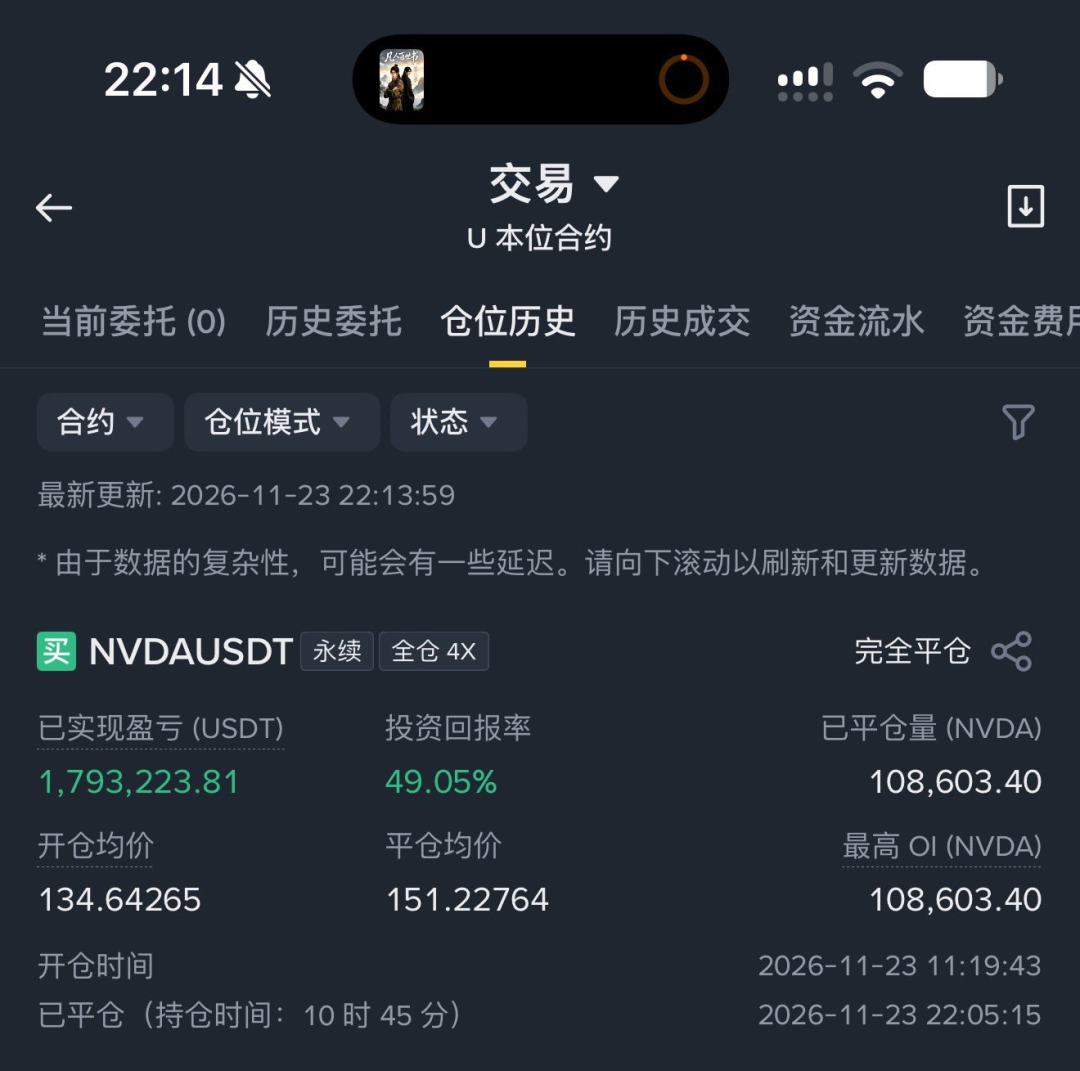
The trader himself announced transaction earnings, with real-time data sync on the trading platform. He even watched the red fruit on the side.
The financial market is a very brutal place. It's so brutal that a person can earn in a few minutes what an average person would earn in a lifetime, yet it is equally cruel in that same person spent a full five years crawling out from a pit of 600 RMB a month in a basement in Beijing, facing 400,000 in online debt and repeated liquidations, experiencing several downturns.
That brief moment of fame was backed by five years of squinting through red eyes.
600 Yuan Bunk and 200,000 Hex
The story's starting point had nothing to do with finance.
On the day the college entrance examination results were released, he scored 118 in Chinese, 81 in English, 31 in mathematics, and 40 in physics. His father rushed back from out of town, looked at the score that was barely enough for him to get into a junior college, and exploded in anger at him. He left with 200 yuan in his pocket and walked for two hours along the road to Southwest Petroleum University. After his father's anger subsided, fearing he might do something foolish, he called him back home and apologized.
"That was the first time he apologized to me."
In his second year of college, his father was diagnosed with esophageal cancer and soon passed away. From that day on, there was no one in the family to support him. He began working, doing customer service, part-time jobs, and later switched to learning how to be an internet product manager, working non-stop until 2023. In Beijing, he lived in a basement, in an eight-person dorm with bunk beds, where the lower bunk was 600 and the upper was 550.
At the end of 2020, due to work, he encountered the cryptocurrency industry for the first time. In 2021, he began trading "contracts." At that time his monthly salary was over ten thousand, and he managed to scrape together three to five thousand each month to invest in the trading platform.
Contract trading, simply understood, involves leveraging your capital; for instance, you take ten thousand yuan in principal and borrow five or ten times that from the platform to bet on price direction. If you predict correctly, your profits multiply; if you’re wrong and losses exceed your principal, the platform will forcibly close your position, leaving you with nothing, a term known as "liquidation."
He had no financial background, and his approach to learning trading was rather unconventional: skipping classes, avoiding dense technical charts, and exclusively browsing actual trading records from real traders in open trading software, finding ways to sneak into their chat groups, and relentlessly questioning them about why they bought or sold certain positions.
This was the intuition of a product manager: first find those who have succeeded, then deduce the underlying logic. He later summarized, "What I learned from them was not a systematic methodology, but the ability to avoid a lot of detours and losses."
However, understanding others' trades and placing your own money on the line are two entirely different matters.
2022 was the hardest year. With mortgage and debts weighing heavily, a fixed salary couldn’t keep up. He was burdened with nearly 400,000 in online loans, spending his days writing requirement documents at the company and watching the market at night in his rented room. He recalled those nights online: "Losing painfully, closing my eyes at night, I’d dream of being sad and crying over my gambling debts being discovered by others."
Surviving through two identities, he endured four years. That year he developed a habit that would persist throughout his trading career: not sleeping after opening a position. "When encountering major market movements, I would stay awake, sometimes up to 40 or 50 hours. Once the volatility ended, I would sleep for a day without any issues."
Before long, he grew his account to 200,000. Then, for three whole years, he was unable to surpass that threshold.
200,000 is a very awkward number. It’s enough to buy a car, to repay half of his online loans, enough for family to think "this kid is doing well out there." But he repeatedly hit 200,000 and repeatedly lost it all back to the market. He calculated, "I gambled from 24 to 28 years old. I’ve lost count of how many times I deposited 1,000 dollars, at least 15 or 20 times." The outcome was always the same: earn a few tens of thousands of dollars, then get liquidated to zero.
What trapped him wasn't the technique but the debt. When you're burdened with 400,000 in debt, that little money in your account no longer feels like cold chips but like a lifeline—when losing, you simply can't bring yourself to exit and admit a loss, always thinking, "If I just hold on a bit longer, I can break even." The result was that he eliminated the stop-loss line and stubbornly held until his account was wiped out.
He later reflected brutally, "The vast majority of large losses ultimately come from unwillingness to stop losses... I just didn't lose enough to feel the pain." About "pain," he set a harsh scale: "Making a thousand mistakes in the first year, two hundred times in the third year, and only once in the last month is when discipline forms."
In February 2024, after another round of liquidation, he was left with only 13,000 RMB. That was his salary for a month, enough just to cover rent and food.
The days underwater in debt had finally reached rock bottom.
Thirteen Thousand Yuan: Lowering the Leverage
The turning point came without any warning.
In February 2024, Bitcoin spot ETFs had just been approved in the US for a month—equivalent to Wall Street's regular army being able to buy Bitcoin like a stock for the first time, large amounts of traditional funds flooded in. Market sentiment was ignited, and hot money spilled out with Bitcoin; a batch of established altcoins began to soar in succession. One old coin that shared its origin with Bitcoin first surged by 30%, then soared to 50%.
The trader calculated: this was like the lead stock in the market going crazy, and funds naturally would seek out cheaper alternatives in the same sector that hadn't taken off. Another asset, larger in volume and also from the same camp, hadn’t moved yet; "If the big brother is up so much, it should also catch up." He took all his savings and opened a 5x leveraged position betting on its rise.
In two days, that coin skyrocketed by 80%. He didn’t greedily hold out for the last part, but took profit at a 2.7 times gain, boosting his account from over 3,000 dollars to over 10,000 dollars.
"That was the first particularly big trade of my life." In recalling this transaction, he emphasized not how much money he made but the fact that he "successfully closed it"—someone who had been struggling underwater for three years, for the first time didn’t panic and run away as soon as he made a little profit, nor did he stubbornly hold on in losses; he fully executed the trade to his preset target.
Once the window paper was pierced, the following path became clear.
In the first half of 2024, the cryptocurrency market witnessed three waves of significant movements, each backed by a completely different "story" and emotion. The first wave was the AI concept—such as the "Iris Scanning to Disburse Money" project initiated by OpenAI founder Sam Altman; whenever there was a new release from the Silicon Valley AI circle, the market treated this project as the AI barometer in the crypto sphere to hype. The trader rode this narrative wave for short-term trades; the second wave was the widely shared "Sad Frog" meme token, which had no actual business and relied solely on social media sentiment; he deftly entered while the heat was rising and withdrew before it receded; the third wave occurred right before global exchanges announced new items for sale, where their native tokens typically performed a small surge ahead—those wishing to buy new coins had to purchase them as "entry tickets," resulting in a price increase upon buying; he specialized in profiting from this guaranteed expectation difference. When Bitcoin and Ethereum (the second largest cryptocurrency after Bitcoin) fluctuated back and forth in a range, he engaged in "whack-a-mole"—betting on downward movement when it peaked, allowing for a maximum of 10% fluctuation, and exiting if wrong.
What truly propelled him into the millions was another sudden trade that year.
At that time, a founder of an established financial project in the crypto world was exposed for liquidating privately, causing market panic over a funding crisis. The trader was in Thailand, standing on the deck of a yacht preparing to dive when he saw the news while scrolling Twitter. The mainstream media hadn’t yet published anything, but he directly opened a 2x leveraged short position—betting the opposite that it would plummet; the harsher the drop, the more he would profit. No sooner had he made the call than that coin dived down 20% below its historical low. Watching the chart freeze, he quickly closed the short position, reversed his bet to buy long, and profited from a 20% rebound. Back and forth, he netted over 3 million RMB.
Later, when he reviewed this trade, he didn’t glorify it as a brilliant move; he admitted that if that project really had collapsed to zero like some others in history, his reversal might have ultimately hurt himself. There was indeed some luck involved. But luck only deals the cards; during those few seconds on deck, deciding to make a bet and then reversing it was entirely his decision.
In 22 days, he turned 20,000 into 1 million. On the day he hit his first million, he paid off the 400,000 in online debt he had carried for four years in one go. "From being underwater with 400,000, with just 13,000 turning into 1 million, at that moment I could really stay awake for 30 hours straight." Four months later, his account surged from 20,000 dollars to 10 million RMB.
This turnaround contained the first cornerstone of his methodology: low leverage and compound interest.
Throughout 2024, aside from that initial trade using 5x leverage, all his subsequent trades maintained actual leverage below 5x, with even the volatile small tokens (colloquially termed altcoins) only extended 0.8x, 1x, or 2x leverage. "The lower the leverage, the braver I could be, and the more stable it became. When losing, I dared to cut losses; when earning, I dared to hold on." What truly accumulates wealth isn’t a reckless all-in with high leverage, but rather cashing out completely after each trade and rolling with the increased principal into the next trade.
However, the market has never allowed anyone to graduate smoothly.
Not Looking at Charts, First Considering Events
In June 2025, the trader posted two screenshots over 11 days.
At 8:43 PM on June 5, the first one: "Still caught it, keep a memento, my first trade earning 1 million dollars in my life."
Eleven days later, at 5:28 AM, the second screenshot: "One trade, 1 million dollars! Loss achieved!"
One screenshot of making a million dollars, the other of losing a million dollars, separated by 11 days. This was the price of having a larger capital base—when your single position reaches 5 million dollars, just the fees for one buy and one sell would amount to 4,500 dollars, magnifying both profits and losses.
The 1 million dollar gain came from the public feud between Trump and Musk. That day, Tesla's stock dipped by 5% during trading, then fell to 8% and 10%, but the cryptocurrency market hadn’t reacted yet. The trader immediately recognized this "time difference": Dogecoin is highly tied to Musk; the stock market panic would undoubtedly spill over. He decisively shorted at a low point, and when Dogecoin broke support and fell another 10%, he cashed out over a million dollars.
This approach became more refined the more he engaged with it, almost losing its mystery. While others filled their trading screens with indicators and trend lines, he simply revealed: "I don't look at charts; I think about events first. Can the event persist? If it can, I trade in alignment; if it can’t, I counter trade at critical positions."
Without the expensive intelligence terminals of Wall Street, he relied on an economic data website, Twitter, and a little bell for notifications from key figures. "The real key is situational reaction ability—can you spot an event right away and quickly judge whether it can affect prices in the following days?"
In May 2025, Ethereum surged for four consecutive days, rising nearly 80%. Those who missed that train held onto heaps of cash ready for buying the dip, hesitant to chase an Ethereum that had already soared high. The pent-up enthusiasm would inevitably flood into still-unseen small coins. Normally, if a small coin surged 100% one day, on the next day no one would dare chase it; but in that atmosphere of extreme excitement, the trader specifically targeted one small emotional coin that had gained popularity thanks to a Thai internet celebrity, going with the flow of hot money to open nine trades in total, with none at a loss, growing from over 1 million to over 5 million. On October 11 of the same year, Trump released a lengthy article on tariffs, and he was among the first in the Chinese-speaking community to read through it and react, reversing his position to short Bitcoin at the market's peak downturn.
He categorized himself as a trader without a fixed system. Many people exhaustively analyzed his screenshots to derive a universal formula, but he stated there was none: "My trading is entirely responsive. I can trade breakouts, and I can trade ranges; the key lies in my thoughts about the market at that moment."
He summarized this adaptability in terms of driving an F1 car: accelerate on the straightaway, brake in the turns. Bull markets and unidirectional trends are straightaways, demanding decisive action to maximize profits; bear markets and sideways movements are turns, requiring slowing down. And the one unbreakable rule is that acknowledging mistakes must be swifter than anyone else: "A second ago, I felt Bitcoin might break through, and I instantly declared a price target of 100,000; the next second it drops 1%, and I immediately stop-loss and reevaluate for zero."
But a methodology that works in a favorable environment doesn’t mean it's truly developed. At the end of 2025, he faced his final major test before closing the methodological loop.
In October 2025, he had already acquired cars, houses, and watches, yet he posted a rare moment of introspection—having turned small amounts into tens of millions, thirty million, even seventy million across various instances, the actual amount left in hand paled in comparison to the spectacular surface figures. The money in trading accounts was just chips; only the cash transferred to the bank mattered. A month later, the straightaway came to an end.
By the end of 2025, the cryptocurrency market experienced a sudden dry spell. The US-listed company MicroStrategy, known for borrowing to hoard Bitcoin, was suspected of needing to sell coins, causing Wall Street funds to continue flowing out, leaving the market without new narratives. When it truly hit a turning point, he mindlessly kept hitting the gas in the cold trading environment, stubbornly chasing prices up and down, using high leverage to repeatedly hit stop-losses. In 40 days, he lost 1.12 million dollars, and the account once dropped from a six-fold high to merely 350,000 dollars. In total, this round retraced 16 million RMB from its peak.
Prior investments combined with consecutive retracements drained his available funds. In April 2026, he sold the Wanjie M9 he bought "to reward himself" a year prior, exchanging it for 490,000 in cash. "The cash was completely gone by that April; I had to sell it." Five months prior, the car and watch were symbols of victory; five months later, they became lifelines for survival.
Being pushed to sell the car ironically unveiled the last two pieces of his methodological puzzle: firmly holding onto low leverage and no longer obsessively sticking to a single market.
On April 22, 2026, he didn’t hide but instead took 10,000 dollars to start over, openly trading in real time, posting trade confirmations daily without adding any extra principal mid-way. This time, he locked the leverage firmly below 4x, no longer gambling with his life in the turns. In half a day, he turned 10,000 into 100,000; in eight days, hit 200,000; in two months, pushed back to 1 million dollars; by July 30, his 10,000 dollars had turned into 10 million RMB.
Immediately after, he took the most crucial step: stepping out of his comfort zone and moving the battlefield out of cryptocurrencies.
When cryptocurrency trading grew quiet, with prices fluctuating in place, he applied that "event + industry chain transmission" strategy directly to the US stock market. When Nvidia announced a 15% increase in chip prices, he analyzed the supply chain, determining that the cost of storage raw materials was under pressure, and decisively shorted several global leading storage chip companies—Micron, SanDisk, and SK Hynix. Continuing to follow the logic, he shorted the storage sector as Apple raised prices to cope with storage increases. After several rounds, he netted millions of dollars profit solely from the US stock market. "The basic profit had no relation with cryptocurrencies at all."
On September 15, he withdrew 20 million from his account, completely exiting from cryptocurrency risks, declaring, "Even if Bitcoin drops 99% in a day, I won’t dip back in." At 2:20 AM on November 13, he posted a screenshot without any charts or emoji, just a line of numbers: 10M—ten million dollars. The caption had six words: "Returning to the land of immortals."
The day before, across the ocean in Silicon Valley, an earthquake erupted that could rewrite the history of the US stock market.
Jensen Huang's Return and Battle
On November 12, 2026, Nvidia announced that CEO Jensen Huang resigned from his positions as president, CEO, and board member due to personal scandals.
The news hit Wall Street like a deep-water bomb. As the absolute heart of global AI computing power, Nvidia’s stock price immediately bled out, and in the following days, the market cap accumulated evaporated by over one trillion dollars, creating the longest consecutive drop record since the 2008 financial crisis. Panic spread rapidly; investors during the Asian trading session completely disregarded financial reports and positive earnings guidance, and the entire chip sector was in disarray.
The trader was far from detached; he focused all his attention on Nvidia’s market activity.
This was exactly the battlefield he was most familiar with and best at: Major unexpected events, extreme market panic, dramatic mismatch of information and emotions.
However, the battle for fame wasn't a myth of hitting the target on the first shot. By November 16, when Nvidia dropped to around 160.5 dollars, the trader cautiously bought a bullish position. The logic at the time was straightforward—company profitability and earnings guidance were intact; the market had panicked too harshly. He openly questioned, "Besides Jensen Huang's return, with positive performance and guidance, does anyone really think Nvidia would fail if Huang doesn’t return?"
However, the market initially wouldn’t heed reason. The stock price continued under pressure. The trader didn’t stubbornly hold onto losses like in the past but strictly executed his rule of "quickly acknowledging mistakes," decisively cutting losses and exiting. Ironically, on November 17, just as he cut losses, news surfaced that Huang was willing to return to Nvidia, leading onlookers to joke about it all day in community forums.
If it had been three years prior, this feeling of "just cutting losses and getting positive news" would have been enough to send someone into a panic. But this time, he didn’t flinch; he kept his eyes glued to the winds from Washington and Silicon Valley.
Before November 23, a weekend's worth of undercurrents surged unexpectedly. US Treasury Secretary Yellen relaxed her tone, and Trump along with Vice President Pence directly intervened, pressuring Nvidia's board, stating that national security briefings found no illegal behavior on Huang's part.
The trader seized this decisive turning point. On the morning of November 23, he had initially planned to wait until December 1 to enter Nvidia, but seeing the losses far exceed expectations and signals from the White House intensifying, he decisively tore up his original plan—things had changed and he couldn't wait—he heavily invested in bullish positions on Nvidia.
"That morning the Treasury Secretary loosened up and Trump added more pressure; it was highly likely the Nvidia board would find a compromise. But I didn't expect the return to be so swift."
Before the US stock market opened on Monday, November 23, Nvidia's board suddenly announced: unanimously voted to restore all of Huang's positions.
The one trillion dollars' worth of suppressed emotion that had built up over eleven days burst forth in an instant.
Nvidia's stock price surged, opening up like a galloping horse, soaring 31.48% in a day, gaining back 952 billion dollars in market value. The Nasdaq index rose by 6.51%, and the Philadelphia Semiconductor Index soared by 14%, with SK Hynix, Micron, and Intel all taking off together.
In those frantic minutes of explosive market activity, the trader’s account skyrocketed, netting about 1.8 million dollars (around 12.6 million RMB) from a single Nvidia bullish position, with total earnings across multiple markets exceeding 15 million yuan for the day.
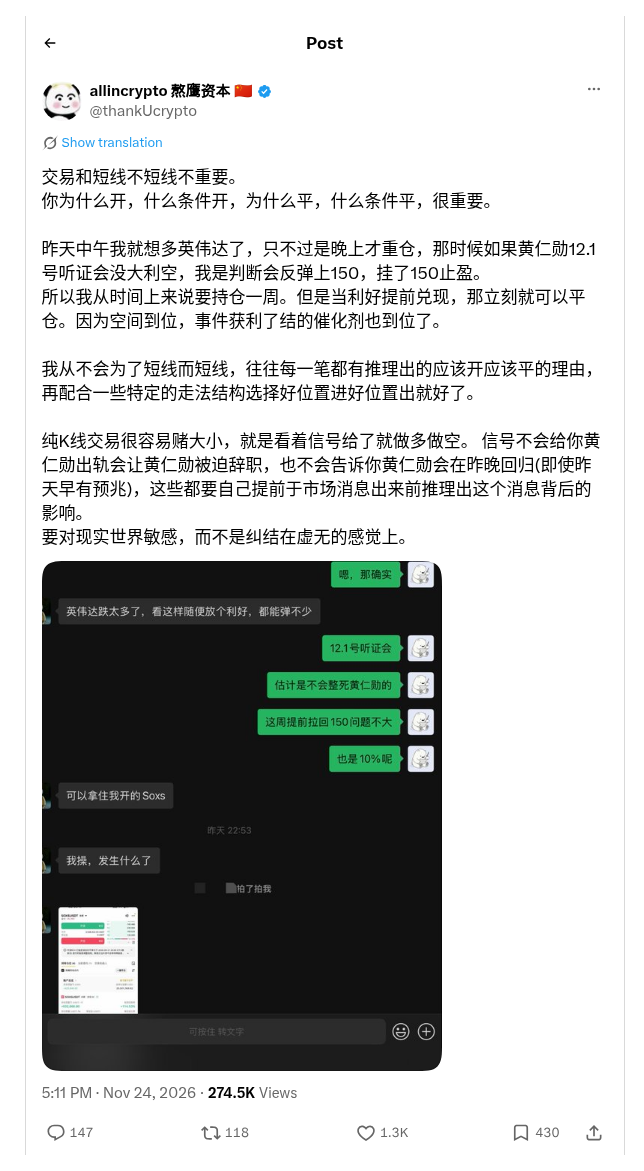
In terms of absolute figures, more than ten million RMB was not the largest amount he had seen on his account; just ten days prior, he had shared a screenshot of ten million dollars in his account. However, this battle still became his true name-making battle: firstly because of the extreme speed of pulling in millions within a few minutes; secondly because he no longer relied on the luck from small altcoin surges but on a comprehensive strategy he had honed over five years, leveraging low positions, decisively cutting losses, closely monitoring events, and executing heavy attacks, executing a textbook-style comeback, also positioning himself at the door of a hundred million net worth.
Two days later, on November 25, he rarely revealed his total asset composition on X platform: 48 million in a trading account, 14 million in stocks, 12 million in cash, and roughly 20 million in real estate, totaling about 94 million yuan. From taking 10,000 dollars to restart in April of this year, it only took him seven months.
He wrote calmly in his post: achieving nearly one hundred million from small funds in the public market is extremely difficult, facing multiple potential liquidation risks, and it was entirely thanks to timely stop-losses that he survived.
Epilogue
In the days when the college entrance examination results were released in 2025, the trader wrote a dream online. In it, it was his wedding day, and his deceased father walked over to him, saying, "I'm sorry, I shouldn't have scolded you; I apologize." He woke up from the dream and cried for a bit.
The ending of that post had only three words:
It was really hard.
Over five years, the trader posted thousands of trading screenshots. The numbers have always been wildly fluctuating.
Now he is just a few steps away from "a small goal," and his account's chips have turned into real estate, stocks, and locked cash in bank accounts. Nvidia's euphoria only lasted a day, and by Tuesday's pre-market, the stock price pulled back nearly 6%, and new fluctuations were already on the way. The market never issues any diplomas, and he doesn’t know when the next turning point will come. He only knows that as long as the screen is still lit, he has to endure through it.
Click to learn about job openings at Rhythm BlockBeats
Welcome to join the official community of Rhythm BlockBeats:
Telegram subscription group: https://t.me/theblockbeats
Telegram discussion group: https://t.me/BlockBeats_App
Twitter official account: https://twitter.com/BlockBeatsAsia
免责声明:本文章仅代表作者个人观点,不代表本平台的立场和观点。本文章仅供信息分享,不构成对任何人的任何投资建议。用户与作者之间的任何争议,与本平台无关。如网页中刊载的文章或图片涉及侵权,请提供相关的权利证明和身份证明发送邮件到[email protected],本平台相关工作人员将会进行核查。