Written by: Techub News Compilation
Introduction
In October 2026, Jensen Huang, the founder and CEO of NVIDIA, the world's most valuable company, returned to his birthplace Taiwan to participate in the annual Taipei International Computer Show (Computex). During this time, he invited the renowned tech podcaster Lex Fridman for a deep, 90-minute night market exploration and conversation. This seemingly casual "food journey" was, in fact, a profound discussion between two thinkers on the technological landscape of the artificial intelligence era, global supply chains, geopolitics, and engineering culture. At that time, NVIDIA had firmly held the global market capitalization top spot, with its AI chips and computing platforms forming the cornerstone of the modern digital world, while Taiwan, this small island, produced over 90% of the world's most advanced semiconductors. The dialogue took place at a critical intersection of technology, economy, and geopolitics.
Summary
- Jensen Huang believes that the core business model of the AI economy has shifted from "renting cores" to "generating tokens", where computing speed and efficiency directly determine value creation.
- He elaborated on the "technology-economic flywheel" theory, advocating that long-term national security and prosperity should be built on a positive cycle formed by technological leadership and vast markets, rather than simple technological blockades.
- Jensen Huang reviewed the origin of his 30-year partnership with TSMC's founder Morris Chang, emphasizing the importance of partnerships based on trust, long-termism, and "rough justice".
- He argued that the rise of Taiwan’s semiconductor industry is rooted in its educational culture that values engineering, historical opportunities (such as the PC revolution), and the diligence, generosity, and helpful nature of its people.
- In the face of US-China competition, Jensen Huang called for avoiding conflict through competition, maintaining peace through deep technological, economic, and cultural interconnections.
AI Philosophy in the Night Market: A Paradigm Shift from Cores to Tokens
In the bustling night market of Taipei, Jensen Huang explained to Lex Fridman the fundamental changes in computing infrastructure in the AI era. He pointed out that the previous generation of large-scale CPUs represented by x86 had an economic model built around "renting cores," with the core metric being "cost per core." However, in the AI-dominated new world, the economic model has fundamentally changed. AI does not "rent cores" but "generates tokens" and sells those tokens. This means the ultimate purpose of computing systems has become to complete data processing cycles at the fastest speed and generate valuable outputs.
This transformation has had a profound impact on hardware design. Jensen Huang showcased NVIDIA's latest fully liquid cooling solution, mentioning that its predecessor, Grace Blackwell, had a liquid cooling ratio of 80%, whereas the new generation has reached 100%. This extreme cooling design is aimed at meeting the AI computing demands for continuous and high-intensity computing power. When computing speed directly equates to commercial value, the system's reliability, energy efficiency, and maintainability become paramount. “Things that are easy to build are often more reliable,” Jensen Huang concluded.
This paradigm shift from "resource leasing" to "value generation" not only reshapes hardware but also reshapes the software stack and the entire ecosystem. It requires businesses to think of their strategies from a broader "flywheel" perspective.
“Flywheel Effect” vs. “Export Controls”: Jensen Huang's Geopolitical Technology View
Lex Fridman steered the conversation towards the sensitive yet crucial issues of geopolitical technology and export controls. Jensen Huang provided a nuanced analysis. He first “steelmaned” the arguments supporting export controls: for specific materials with "force multiplier" properties that are hard to replicate, such as rare earths and ammunition, limiting opponents' access can enhance one's own advantages.
However, he then shifted to propose a more fundamental framework: What is the best path for long-term national security and prosperity? Jensen Huang's answer is: Build a “technology-economic flywheel”. The safest countries are often the wealthiest. The foundation of America's military power lies in its vast wealth, which stems from leading technologies. Technology and economy mutually promote each other, creating a continuously accelerating positive cycle—that is the flywheel.
“The question is, do you want to optimize for keeping others from obtaining this technology, or do you want to optimize for this flywheel?” Jensen Huang asked. He inclined towards the latter, a more complex and long-term strategy: simultaneously pursuing technological leadership and economic prosperity. This resembles the logic of platform companies: a large user base and customer interactions (economy) drive more technology consumption, thereby generating more wealth, which can further invest in R&D and consolidate technological leadership.
He believes the US has a unique advantage: the global nature of the English language. Products based on the American tech stack and standards can be easily deployed worldwide, forming a global flywheel that is hard for other countries to match. “Technology without customers is useless,” he added. Thus, excessive isolationism and closure may bring short-term benefits but sacrifice this global platform advantage, leading to a slowdown or even halt of the flywheel.
Regarding US-China relations, Jensen Huang's stance is clear: “We should do everything we can to avoid conflict. We can compete; that is inevitable. But we should do everything we can to avoid conflict.” He believes that the deep interdependence of the technology stack—where everyone uses the same hardware and software, engages in academic exchanges, builds friendships, and cooperates—makes "decoupling" exceedingly difficult, and this is precisely the natural barrier to preventing conflict. “The harder it is to decouple, the harder conflict occurs.”
The Taiwan Miracle: The Cultural Code and Historical Opportunities of the Semiconductor Heart
Lex Fridman was astonished by Taiwan's absolute dominance in the semiconductor field. Jensen Huang interpreted it from multiple dimensions of history, culture, and personal experience.
He traced the origins to the late K. T. Li, a "tech father" of Taiwan. In the 1950s, K. T. Li foresaw bringing technology and tech manufacturing to Taiwan. This vision later attracted people like Morris Chang back to Taiwan to contribute. Jensen Huang also mentioned a key moment: the European consumer electronics giant Philips split its wafer fabrication and semiconductor equipment division, which became seeds for TSMC and leading lithography giant ASML. “It’s remarkable; it originated from Philips.”
The real takeoff synchronized with the PC revolution. IBM opened up the specifications of IBM-compatible chipsets, and clever engineers in Taiwan seized the opportunity to design chipsets based on these specifications, which were manufactured by TSMC and UMC. This gave birth to a massive PC chipset industry, allowing companies like Compaq, IBM, and later Dell (Michael Dell) to quickly assemble PCs, promoting the democratization of the global PC industry. “The whole cycle... Michael (Dell)'s relationship with Taiwan goes back a long way,” Jensen Huang said.
In addition to historical opportunities, Jensen Huang emphasized the cultural factors even more. He shared a vivid story: a woman who grew up in Taiwan told him, “I learned to spell CoWoS (TSMC's advanced packaging technology) earlier than I learned to spell Gucci.” This statement profoundly reflects the value and honor of engineering in Taiwanese social culture. Hard work, humility, and willingness to help are the traits of Taiwan that Jensen Huang repeatedly mentions. In the night market, he saw vendors working hard, with thin profit margins, yet still willing to generously share food. “This is the Taiwanese way.” This spirit of collaboration and generosity rooted in society, in Jensen Huang's view, is precisely why Taiwan can become the core of the global supply chain. “Their fundamental ability to help others and their generosity is why they become the world's supply chain.”
30 Years of Trust: Jensen Huang and Morris Chang’s “Jump Through Hoops” Commitment
The most personal aspect of the dialogue was Jensen Huang's reflection on the beginning of NVIDIA's collaboration with TSMC. In 1996, at the height of the PC revolution, a fledgling NVIDIA was desperately seeking a wafer foundry. At the time, manufacturing capacity was scarce, and many foundries required customers to exchange licensed IP for services.
Jensen Huang heard about TSMC and UMC in Taiwan. He tried calling TSMC's US office but only heard a recorded message. After multiple voicemails went unanswered, he ultimately chose to write a letter directly to Morris Chang. A few weeks later, one evening, the phone rang, and the other party said, “This is Morris Chang from TSMC.” At that time, Jensen Huang's colleagues were playing PlayStation in the office and making quite a noise, and he excitedly quieted everyone down: “It’s Morris Chang!”
After that call, Morris Chang invited Jensen Huang to Taiwan. This was Jensen Huang's first return after many years. He visited UMC and TSMC in turn. When asked why he eventually chose TSMC, Jensen Huang mentioned a key detail: during discussions with Morris Chang, he directly responded to many of NVIDIA’s requests with "we can't do that." Morris Chang spent a lot of time talking about corporate governance, integrity, partnership, and long-term thinking, rather than specific technological commitments. In the end, Morris Chang told him, “Jensen, if we cooperate together, I promise we will ‘jump through hoops’ for you.”
“For the past 30 years, they have been ‘jumping through hoops’ for us,” Jensen Huang reflected. He realized that this was not about “buying” something but about “choosing” who to build with. Chip design and manufacturing are full of uncertainties, and it is crucial to choose trustworthy partners with aligned values. He introduced the concept of “rough justice”: in long-term collaborations, one party might be at an advantage at times, while at other times the other party benefits, but overall it should be fair in the long run.
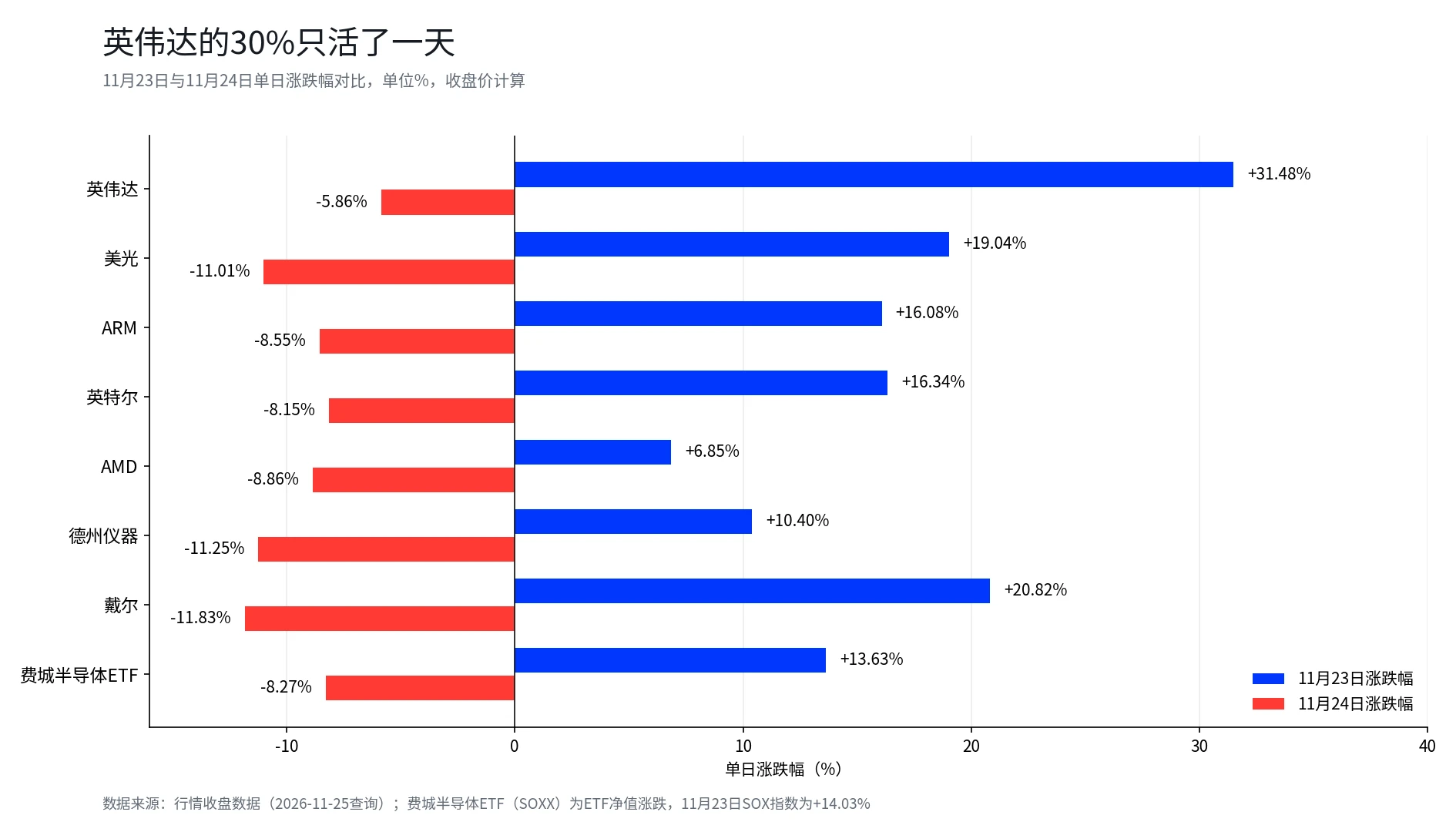
The essence of this partnership lies in mutual achievement. “TSMC knows I want them to win. All my employees know I want them to win,” Jensen Huang said. “Our company is built on the platform of TSMC, built on the platform of Taiwan. These relationships are essential.” He gave an example: when the stock price of his entire supply chain company rose by 300% while NVIDIA's stock price remained flat, he wasn’t upset, because this indicated that their platform was strong enough to allow all partners to rise together.
Rock Stars of Engineers and the Future of Reindustrialization
Throughout the Computex and night market journey, Lex Fridman was stunned by the enthusiasm of Taiwanese engineers and people towards Jensen Huang, describing him as akin to “The Beatles of the 60s.” Jensen Huang remained humble, turning the spotlight to others. He believes that engineers built the world and deserve more love and recognition; he hopes to be a role model to inspire millions of young people to pursue engineering careers.
Speaking about the United States, Jensen Huang expressed hopes of driving America's “reindustrialization” through the wave of AI. He believes that the explosive demand for AI presents an excellent opportunity to invest in infrastructure, sustainable energy, and revitalize manufacturing. Due to immense demand, manufacturing domestically in the U.S. now has economic feasibility. Combining AI and robotics, now might be the perfect time to relocate some lost industries back to the U.S. He specifically noted that Taiwan is the “true strategic partner” in America’s reindustrialization process, as exemplified by TSMC's factory in Arizona, sending engineers, investing heavily, and training local talent, reflecting this partnership.
Ultimately, after indulging in countless Taiwanese delicacies like oyster omelets, pig's trotters, shaved ice, sausages, and QQ balls, this thought-provoking journey filled with the essence of life came to an end. The dialogue between Jensen Huang and Lex Fridman transcended technical specifications and business strategies, touching upon how to build a more resilient, prosperous, and peaceful future through collaboration, trust, and cultural connections in an era where AI is reshaping the world. As Lex Fridman summarized: “Ultimately, among all humanity worldwide, our commonalities far exceed our differences.” Understanding and celebrating these commonalities may very well be the beacon for navigating the complex geopolitical fog.
免责声明:本文章仅代表作者个人观点,不代表本平台的立场和观点。本文章仅供信息分享,不构成对任何人的任何投资建议。用户与作者之间的任何争议,与本平台无关。如网页中刊载的文章或图片涉及侵权,请提供相关的权利证明和身份证明发送邮件到[email protected],本平台相关工作人员将会进行核查。