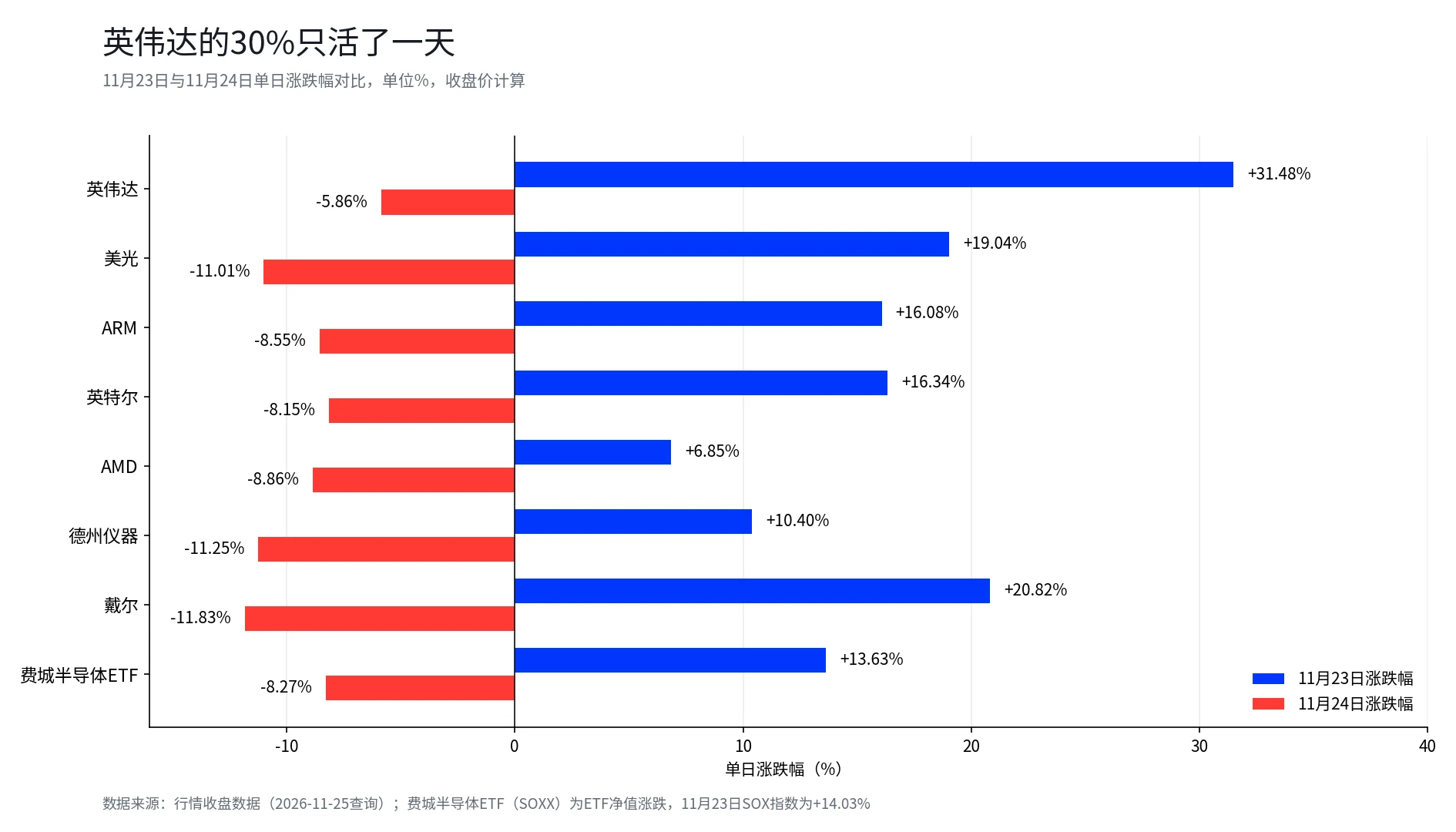
1. Nvidia's 31% Surge Lasted Only One Day
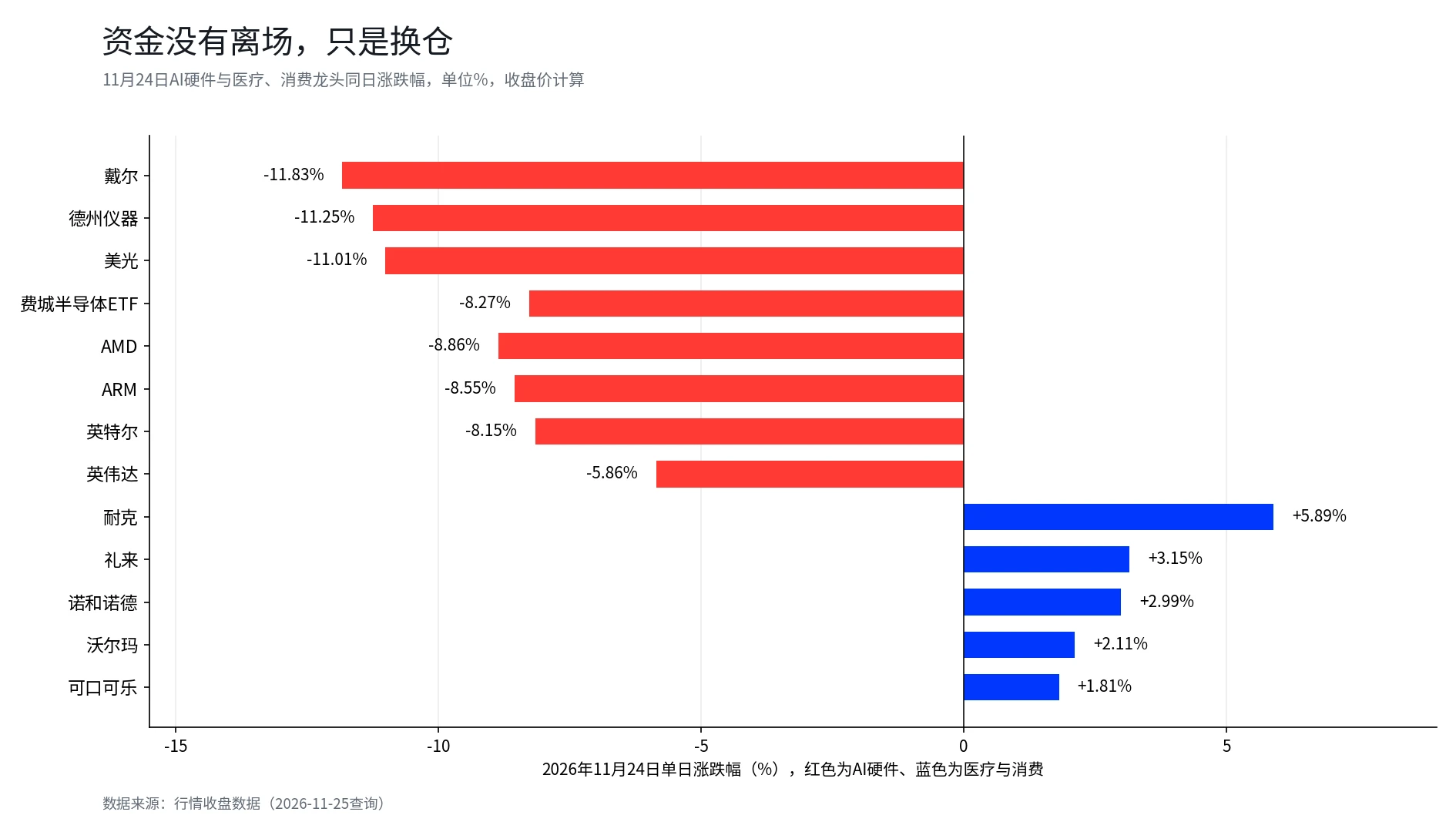
On Monday, Nvidia surged 31.48%, reigniting AI trading in the market. Just a day later, Nvidia fell 5.86% to $155.38, the SOXX ETF dropped 8.27% in a single day, Micron declined 11.01%, Dell fell 11.83%, AMD dropped 8.86%, and Texas Instruments slipped 11.25%. The AI hardware sector nearly reversed the optimism seen the previous day. Meanwhile, the Dow Jones increased by 0.85%, closing at 50,018.70 points, indicating that funds did not completely exit the stock market, with clear signs of sector rotation.
The overall market shape is also worth noting. After opening about 1.7% lower, the QQQ oscillated within the range of $631.15 to $648 throughout the day, closing at 638.10 points, down 1.99%, with the decline only about a quarter of that of the Philadelphia Semiconductor ETF. Much of the selling pressure at the index level was absorbed by position adjustments, which is direct evidence that this round of retracement has not yet evolved into a comprehensive risk aversion. Side indicators also provided the same signal: the VIX closed at 26.36, slightly retreating about 1% from the previous day, still near the 52-week mid-range, and the fear index did not spike on a trading day when the semiconductor sector fell 8%.
This means that the most critical focus has shifted from "can Nvidia continue to rise" to whether this round of AI sell-off has transformed from an emotional pullback to a trend adjustment. Monday's 31% surge itself does not prove that the fundamentals have changed, and Tuesday's 5.86% drop does not definitively indicate the end of the AI market. After this round of intense fluctuations, whether funds are willing to re-enter Nvidia, AMD, Broadcom, TSMC, and the server supply chain, or continue to shift toward more stable cash flow sectors like finance, consumption, and pharmaceuticals, is what should be monitored in the coming days.
In the coming days, the AI sector can be closely monitored for three signals: whether the leaders can stop falling, whether the semiconductor index can regain stability, and whether interest rates will continue to rise. If Nvidia's decline is accompanied by gradually shrinking trading volume, and SOXX does not hit new lows, while U.S. Treasury yields pull back, it indicates that funds may begin to accumulate again. If Nvidia rebounds but SOXX continues to weaken, or the rebound mainly focuses on a few leaders, this is closer to a technical repair, and the evidence for the sector returning to an upward trend is not sufficient.
2. South Korea Completes Circuit Breaker Cycle of Buying and Selling in 48 Hours
The South Korean market has displayed the change in risk appetite for this round of AI trading more directly. On November 24, KOSPI rose by 6.32%, closing at 5,006.03 points, with semiconductor heavyweights like Samsung Electronics and SK Hynix becoming the core targets for funds. Just a day later, KOSPI fell over 4% intraday, triggering a sell-side algorithm to pause trading, with reports from South Korean media stating that Samsung Electronics and SK Hynix plunged during the day. As this article goes to press, KOSPI is reported at 4,763.24 points, down 4.85%, and still has not closed.
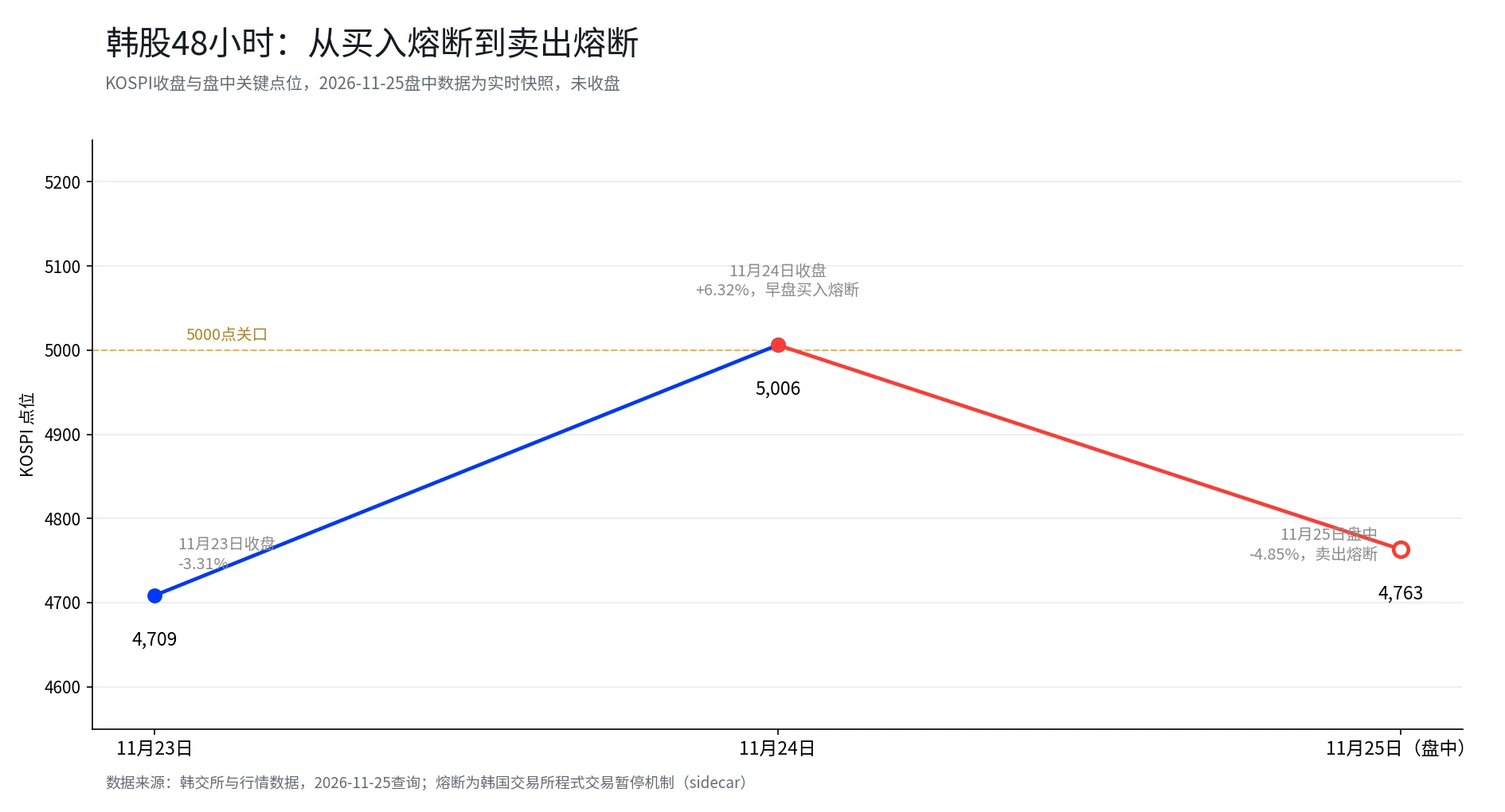
This extreme reversal does not mean that the fundamentals of South Korea's semiconductor industry changed within 24 hours; rather, it indicates that when the market is crowded on the same trading line, changes in fund direction can be amplified by the industry's high beta. HBM, DRAM, AI server segments continue to benefit from AI capital expenditures, but when valuations have already factored in a large number of optimistic expectations, any changes in interest rates, the dollar, or the price of leading stocks can quickly transmit to the supply chain.
The severe fluctuations in South Korean semiconductors are better viewed as a thermometer for risk appetite, while isolated fundamental signals cannot effectively be read. For AI trading, if Nvidia stabilizes while core assets in the supply chain like SK Hynix, Samsung Electronics, and TSMC also stop falling, it indicates the market is starting to accept the logic of AI capital expenditures again. Conversely, if U.S. stock leaders rebound while Asian semiconductors continue to decline, it signals that funds are merely replenishing positions in U.S. stock leaders without re-establishing a bullish narrative across the entire supply chain.
3. Hong Kong Stocks Open High but Close Low, Southbound Net Buy of 6.2 Billion
Hong Kong stocks also showed a significant divergence. On November 24, the Hang Seng Index opened 243 points higher at 22,627 points, once rising about 263 points during the day, but ultimately closed down 0.73% at 22,219.65 points, while the Hang Seng Tech Index fell 1.17%. Meanwhile, southbound funds net bought approximately HKD 6.203 billion, with Xiaomi, Hua Hong, Tencent, Alibaba, and SMIC being the main purchase targets.
This combination is worth noting: the index did not continue to chase higher, but funds did not completely exit, indicating a search for more certain companies in a weak market. This reflects the same market characteristic as the U.S. stock market's new highs and the drop in AI hardware; funds are shifting from a single high-volatility theme to assets with clearer cash flows, earnings certainty, and industry positioning.
In the future, it is vital to observe not only the ups and downs of the Hang Seng Index but also whether southbound funds can continue to net flow in, and which sectors funds concentrate on. If the index continues to adjust while southbound funds keep flowing in and focusing on core assets in internet, semiconductor, and consumption, it suggests that funds are still searching for structural opportunities. If the index falls while southbound funds shift to continuous net outflow, it indicates that risk appetite may not yet be repaired.
4. Gold Falls Too: The Common Variable Behind AI, Gold, BTC is Interest Rates
Another easily overlooked signal in recent days is that gold has not risen in tandem with the weakening dollar. On November 24, spot gold briefly fell below $3,560 per ounce, with a daily decline close to 2%, while the dollar index retreated to 103.85. Meanwhile, the yield on U.S. 2-Year Treasuries was about 4.68%, while the 10-Year was around 4.91%, and the market priced a close to 96% chance of a 25 basis point rate hike by the Federal Reserve in December.
This shows that the core contradiction in the current market has shifted from "dollar appreciation and depreciation" to a repositioning of funds regarding future interest rates and real funding costs. A high-interest rate environment raises the holding cost of gold, which does not provide cash returns while simultaneously compressing the valuation space of high-growth stocks, creating pressure on volatile crypto assets. AI, gold, and BTC may appear to belong to completely different assets, but during times of rapid changes in funding costs, they are all influenced by the same macro variable.
Determining whether the AI market is stabilizing cannot rely solely on Nvidia. Whether the 10-Year Treasury yield can fall from close to 4.9%, whether the 2-Year yield continues to rise, and whether the dollar regains strength are variables that may be more significant than Nvidia's daily price movements. If interest rates continue to rise while the AI sector only experiences a technical rebound, the sustainability of that rebound should be discounted. If interest rates peak and then fall, while AI leaders successfully attract funds again, then this round of adjustments will be closer to "repricing after a decline."
5. Dell Sets Record Orders, Why Did Post-Market Shares Not Rise Much?
This may be the most understandable change at present. Dell's latest quarterly revenue was $54.9 billion, a year-over-year increase of about 103%, with AI server orders reaching $60.2 billion and back orders for AI servers at $132.3 billion. The company also emphasized the need for strict evaluations of customer quality, capital capabilities, land, and power conditions. Looking solely at these figures, AI demand remains very strong.
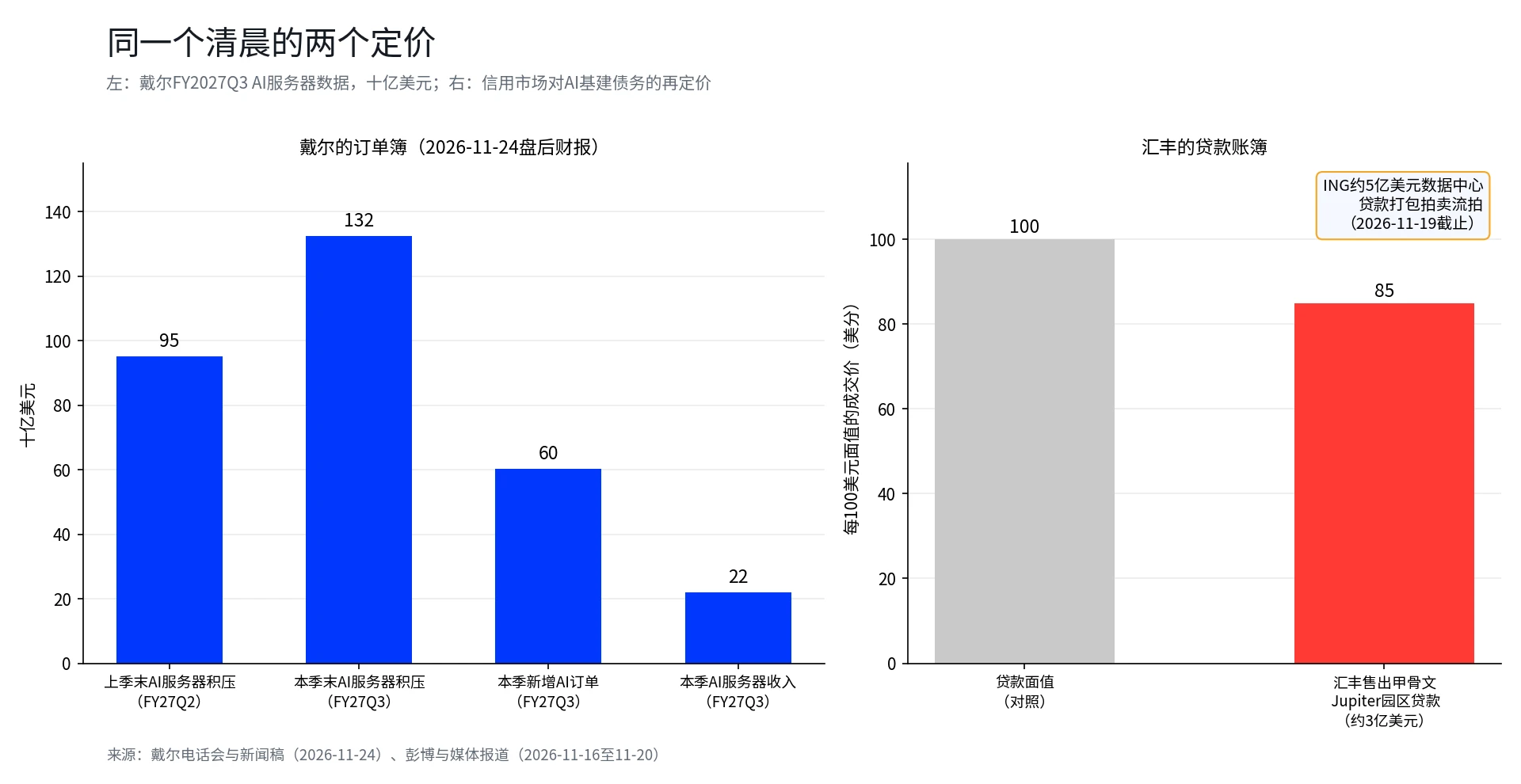
However, the market responded with less excitement than the financial report numbers indicated. Dell fell 11.83% in regular trading on November 24, and although shares peaked after the financial report was released, the increase was limited, failing to reflect a revaluation that matched the order scale. This is the most critical change in AI trading at present: "a good financial report" no longer automatically equates to "the stock price should rise significantly."
The reason is not complicated. The market's current concerns have shifted a notch back: when will orders be confirmed for revenue, do customers have sufficient capital to complete projects, do data centers have land and power, what are the profit margins after server delivery, and can the massive capital expenditures ultimately translate into free cash flow? Dell's emphasis on customer quality, capital capabilities, land, and power conditions during the earnings call indicates that AI infrastructure is entering a phase that places more importance on project execution and financial capability.
Against this backdrop, according to Bloomberg, HSBC sold a portion of a loan related to an Oracle data center project, worth about $300 million, at approximately 85 cents on the dollar. This does not prove that there is systemic risk in the entire AI financing market, but at least shows that there is a temperature difference emerging between the hotness of upstream orders in the AI supply chain and the credit pricing downstream.
Therefore, future research on AI stocks should not only focus on "how much order growth," but should push the chain further back: order → revenue → gross profit → free cash flow → financing cost. Companies like Nvidia, Broadcom, and TSMC, which already have strong earnings and cash flows, face different risks compared to project-based assets that still require significant external financing to complete data center construction in a high-interest-rate environment. The market is beginning to filter out who can ultimately translate AI demand into cash.
6. How to View Core PCE Tonight: Assessing Whether This Round of AI Adjustments Can Conclude
Tonight (Beijing time), the U.S. Core PCE for October will be公布d, representing one of the most important macro variables for the short-term market. Currently, the market is highly pricing in a 25 basis point rate hike in December; therefore, the questions PCE needs to answer have shifted from "Will there be a rate hike in December?" to whether the interest rate path for the coming months will become tighter again.
If the Core PCE is higher than expected, the market may push up the yields of 2-Year and 10-Year Treasuries again, the dollar may strengthen, and AI growth stocks, gold, and BTC could be under pressure. Conversely, if the PCE is lower than expected, yields and the dollar may retreat, allowing overvalued growth assets to potentially enjoy valuation recovery. If the data meets expectations, the market reaction may not be a simple rise or fall; attention will need to be paid to whether Treasury yields and leaders like Nvidia show synchronized confirmation.
Therefore, whether this round of AI adjustments is ending can be observed through the market reactions after tonight. If PCE release leads to a fall in interest rates, while Nvidia and SOXX stabilize and the semiconductor supply chain simultaneously recovers, the market may begin to shift from "decongesting" back to "seeking opportunities." If a strong PCE results in rising yields, while AI leaders struggle to rebound, it indicates that the digestion of valuations may not yet be complete.
At this moment, more valuable than guessing a bottom is observing whether the four signals of "interest rates peaking + leaders stopping falls + supply chain following + earnings realization" can appear simultaneously. AI demand itself has not disappeared, but the market has shifted from the past "high valuations for having AI orders" to a stricter phase: who can convert orders into revenue, who can turn revenue into cash flow, and who can implement projects under high financing costs, who is more likely to become the object of repricing in the next stage.
The Nvidia, SOXX, and other targets mentioned in this article, as well as industry sectors, heat maps, and U.S. Treasury yields, can be tracked on the BIT U.S. Stock Market page.
Disclaimer:
The contents of this article are for general information and market commentary only, compiled based on publicly available information as of the time mentioned in the article; relevant market data, expectations, and probabilities may change based on market conditions. This article does not constitute investment advice, research, solicitation, or a recommendation for any securities, investment products, or trading strategies, and should not be the basis for any investment decision. Financial markets involve risks, and securities prices and market performance may fluctuate; past performance and historical market trends do not represent or guarantee future results. Investors should independently assess the related risks based on their circumstances and seek professional advice when necessary.
免责声明:本文章仅代表作者个人观点,不代表本平台的立场和观点。本文章仅供信息分享,不构成对任何人的任何投资建议。用户与作者之间的任何争议,与本平台无关。如网页中刊载的文章或图片涉及侵权,请提供相关的权利证明和身份证明发送邮件到[email protected],本平台相关工作人员将会进行核查。