【MSX Research Institute · US Stock RWA Daily Observation】 is a flagship daily report produced by the leading RWA trading platform MSX. Leveraging our strong macro research capabilities, we capture the core pulse of global traditional US stocks, liquidity changes, and the RWA tokenization market, helping you to strategically lay out quality assets.
Today's Observation
Dell's latest financial report shows that the demand for AI infrastructure is simultaneously driving the increase in the company's revenue scale and profitability, with the server and storage business becoming a major source of growth.
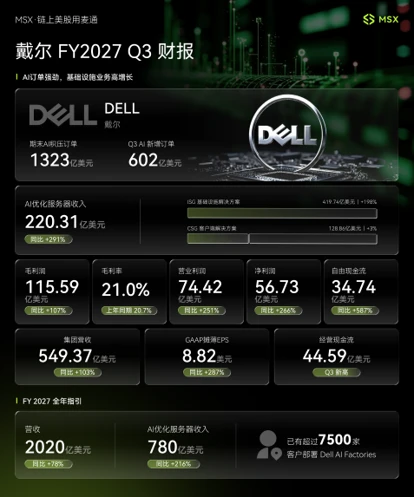
On Eastern Time, November 24, Dell announced its Q3 FY2027 results for the period ending October 30: revenue reached $54.937 billion, a year-over-year increase of 103%; adjusted EPS was $9.45, a year-over-year increase of 265%. According to data listed by Benzinga, the market had previously expected revenue of approximately $49.24 billion and adjusted EPS of $6.61, with both actual results significantly exceeding expectations.
Order performance continues to provide support. This quarter, Dell received $60.2 billion in AI server orders, confirming $22 billion in AI server revenue, with the AI backlog reaching $132.3 billion at the end of the quarter, further expanding from $95 billion in the previous quarter. The company stated that over 7,500 customers are deploying Dell AI Factory, covering new cloud service providers, sovereign projects, and enterprises.
This quarter's growth also extended to traditional infrastructure. Revenue from traditional servers and networking increased by 235% to approximately $15 billion, with storage revenue increasing by 24% to approximately $4.9 billion. The Infrastructure Solutions Group (ISG) overall revenue grew by 198% to about $42 billion, with operating profit reaching about $7.1 billion, a year-over-year increase of 308%.
Based on this, Dell raised its full-year revenue guidance from $192 billion to $202 billion, increased the AI server revenue target from $74 billion to $78 billion, and raised the full-year adjusted EPS guidance from $25.50 to $29.68. Dell is currently transforming infrastructure demand into more profit through delivery scale, product mix, and cost efficiency.
Data in One Minute
• Q3 FY2027 revenue $54.937 billion, a year-over-year increase of 103%;
• GAAP net profit $5.673 billion, a year-over-year increase of 266%;
• GAAP diluted EPS $8.82, adjusted EPS $9.45;
• Adjusted operating profit $7.826 billion, a year-over-year increase of 213%, corresponding to an operating profit margin of 14.2%;
• AI server revenue approximately $22 billion, a year-over-year increase of 291%;
• This quarter added AI server orders of $60.2 billion, with an AI backlog of $132.3 billion at the end of the quarter;
• ISG revenue approximately $42 billion, a year-over-year increase of 198%, with segment operating profit margin of 17.0%;
• Traditional server and networking revenue approximately $15 billion, a year-over-year increase of 235%;
• Storage revenue approximately $4.9 billion, a year-over-year increase of 24%;
• Client Solutions Group (CSG) revenue $12.886 billion, a year-over-year increase of 3%, with operating profit of $704 million, down 6% year-over-year;
• Quarterly operating cash flow $4.459 billion, with cumulative operating cash flow for the first three quarters at $10.765 billion;
• This quarter returned approximately $4.9 billion to shareholders through repurchases and dividends, with the board adding a new $25 billion repurchase authorization;
• FY2027 full-year revenue guidance raised to $202 billion, AI server revenue guidance raised to $78 billion;
• Full-year adjusted EPS guidance raised to $29.68;
• Q4 revenue guidance approximately $56.3 billion, adjusted EPS guidance $8.40.
MSX View
Dell's current revenue growth is beginning to bring more apparent profit amplification effects. The sales of hardware companies can rapidly increase with device deliveries, but how much return shareholders ultimately receive still depends on procurement costs, product mix, cost efficiency, and cash recovery. These factors collectively drove profit growth this quarter.
Looking at the company as a whole, revenue increased by 103% year-over-year, adjusted operating expenses grew by 20%, and the expense-to-revenue ratio decreased from 11.8% in the same period last year to 7.0%. Meanwhile, the adjusted gross margin slightly increased from 21.1% to 21.2%, and the adjusted operating profit margin rose from 9.3% to 14.2%. This indicates that the profit improvement this quarter is largely due to the significant slower growth of expenses compared to the revenue growth that comes with expanded revenue scale.
The business mix is also playing a role. Traditional server and networking revenue increased by 235%, and storage revenue increased by 24%, contributing more revenue and profit to ISG. When enterprises procure AI infrastructure, they still need to address data storage, network connectivity, operation of business systems, and updates of existing equipment. Dell's product mix covering these aspects allows it to expand sales ranges within the same customer base.
However, it is important to distinguish between the overall ISG profit margin and the profit margin of the AI server business. 17.0% is the operating profit margin for the entire ISG segment, encompassing AI servers, traditional servers, networking, and storage. Management indicated on the conference call that the AI server business is still operating at a mid-single-digit operating profit margin level. Therefore, analyzing Dell's profit potential requires observing both AI server deliveries and the accompanying sales of products such as networking and storage, without directly applying the ISG profit margin to AI server revenue.
The high growth of traditional servers also needs to be understood in conjunction with the change in value per device. Management indicated that customers are purchasing systems with higher configurations, more memory, and larger storage capacities, while updating outdated equipment and freeing up power and space in data centers. Revenue growth is driven by procurement demand as well as influenced by product configuration and pricing. What needs to be observed going forward is whether customers can still achieve sufficient efficiency and return on investment despite rising device prices.
The $132.3 billion backlog increases the visibility of future deliveries. Dell stated that before accepting purchase orders and starting production, the company reviews the customers' financial capabilities, terminal contracts, as well as land, power, and other conditions. These processes help improve order quality, but actual revenue recognition still depends on the customers' readiness, equipment supply, and delivery acceptance. As backlog orders continue to expand, the importance of completing deliveries as scheduled also increases.
Dell's delivery capability is an important part of its competitive advantage. For customers, after cabinets arrive, they still need to complete network, cooling, power, and system debugging before they can start production. Reducing coordination and waiting during the deployment process helps customers provide services sooner and increases Dell's opportunities to secure follow-up orders and sales of related products. Competition thus involves not only product prices but also system integration capabilities and delivery efficiency.
This quarter's profit margin performance also has stage-specific factors that need continued observation. Management noted that some improvements arose from scale and operational efficiency, while a favorable sales mix in North America also contributed. As this mix returns to normal, subsequent profit margins are expected to decline sequentially. Therefore, when assessing future profitability, attention should focus on whether cost efficiency can be maintained, whether products such as storage can continue to contribute to profit, and whether new pricing can cover procurement costs.
Supply and pricing of storage chips are another key variable. Management expects related supply pressures to continue into 2027. Securing supply in advance and adjusting pricing can help Dell manage costs, but the number of devices customers budget to purchase, procurement pace, and product mix may also adjust with price changes. The company needs to maintain a balance among delivery capability, price competitiveness, and profit margin.
Cash flow provides a foundation for further expansion. This quarter, operating cash flow reached $4.459 billion, with cumulative operating cash flow for the first three quarters at $10.765 billion. However, as hardware delivery scales expand, this will also increase inventory, accounts receivable, and supplier settlement needs. Therefore, when observing profit quality, it is also necessary to track whether revenue growth aligns with cash recovery, and whether customer financing arrangements can remain stable.
The newly authorized $25 billion repurchase reflects the company's confidence in its ability to return funds, but the authorization amount and actual repurchase expenditure need to be observed separately. Long-term shareholder returns ultimately depend on sustained profitability and cash flow; during a phase of rapid business expansion, the company also needs to retain sufficient funds to support procurement, delivery, and customer service.
The CSG business has shown more moderate growth. This quarter, revenue grew by 3%, while operating profit declined by 6%, creating a noticeable contrast with infrastructure business. The PC business still provides customer coverage, supply chain scale, and cash flow, but currently, the main determinant of Dell's overall growth rate and profit increment is the operational performance of ISG.
Dell has demonstrated the profit improvement brought by scale expansion this quarter; as the full-year revenue target is raised to $202 billion, the coordination between delivery, profit margin, and cash recovery will become an important basis for judging growth quality.
About MSX:
MSX is a leading RWA trading platform dedicated to providing secure, efficient, and transparent access to global financial markets. As one of the earliest on-chain US stock trading platforms globally, MSX has always been at the forefront of the industry, leading market changes through continuous innovation.
The platform deeply integrates blockchain technology with compliance frameworks, offering a comprehensive trading service for nearly 400 types of tokenized stocks and pre-IPO assets, perfectly bridging the gap between traditional finance and the digital asset industry.
Focused on the core mission of “enabling quality assets to flow freely,” MSX has currently built a diversified digital financial service system covering US stocks spot and perpetual contracts, cryptocurrency trading, pre-IPO, and MSX Research Institute, aiming to provide global investors with high-performance access to quality assets around the clock.
Official Website:https://msx.com/
Chinese TG:https://t.me/MSXOfficial
Global TG:https://t.me/MSXGlobal

Risk Warning: Macro economic and US stock market volatility is severe; the content of this article is for academic reference and research observation by MSX Research Institute only and does not constitute any investment advice.
免责声明:本文章仅代表作者个人观点,不代表本平台的立场和观点。本文章仅供信息分享,不构成对任何人的任何投资建议。用户与作者之间的任何争议,与本平台无关。如网页中刊载的文章或图片涉及侵权,请提供相关的权利证明和身份证明发送邮件到[email protected],本平台相关工作人员将会进行核查。