This morning, the brand-new video model from Sand.ai, MAGI-2, has finally been released.
Teacher Cao Yue has worked hard for two years and has finally, finally presented their model. I have really waited too long for this; it may be one of the few challengers I’ve seen in the entire AI video field that can rival Seedance 2.5.
If you're a long-time fan, you might remember that last October I wrote about their video performance model GAGA-1, which honestly performed quite well at that time.
However, then in February of this year, a piece from Seedance made the entire AI video industry dim; even six months after its release, they still hadn't truly welcomed their challengers.
This time was no different. Actually, a few days ago when Sand.ai told me their new model was about to launch, my initial feeling was, "Oh, here comes another one." To be frank, I wasn't very optimistic at that moment. I could only say that I would take some time to test it out.
So I approached the testing of this model with a mindset of just watching a joke, honestly not holding any expectations.
To be honest, after testing a few cases, the quality far exceeded my expectations. If Seedance 2.5 is currently the state of the art (SOTA), then I truly believe that the quality of Sand.ai's MAGI-2 can reach the level of Seedance 2.3, and under the same 1080P quality, the price is only 0.5 yuan per second, which is 1/10 of Seedance 2.5, 90% cheaper, and even much lower than Seedance 2.5 Flash.
Let's take a look at two 30-second character performance cases that I casually rolled out at that time.
After watching these two videos, you will probably understand the absurd feeling I had at that time.
I feel like I can open a topic on Zhihu next time: “What did Sand.ai do right…”
Let’s briefly talk about the basic information of MAGI-2.
It’s a 480B full-modal video model (yes, they even disclosed the size), and it should be the largest video model I know of. It supports 20 materials for multi-modal reference at once, capable of handling images, audio, videos, etc., and also supports local editing, with generating capabilities of up to 30 seconds.
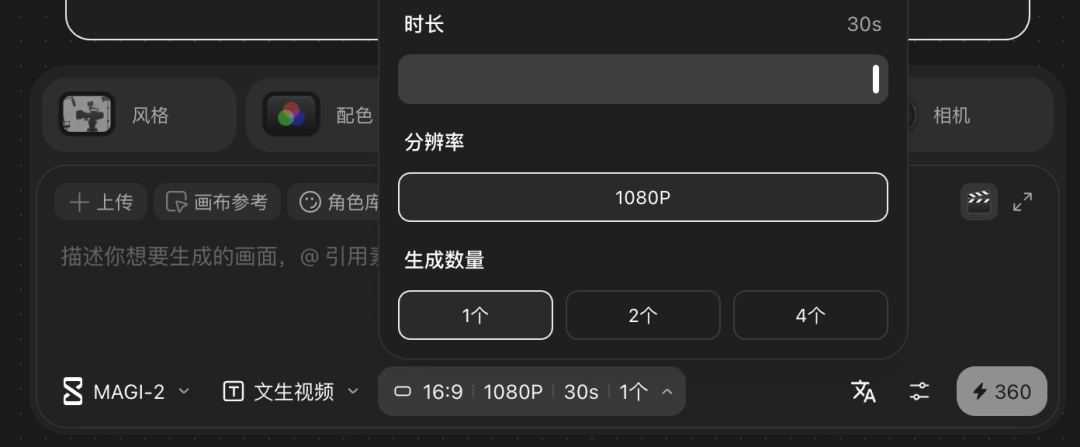
From our own testing, we summarize that the audio quality is average, roughly at the level of Seedance 2.0, similar to many current AI short dramas. Meanwhile, in terms of visual quality, it falls short of Seedance 2.5. However, in terms of camera movement performance, adherence to prompts, and physical performance, it is very strong with an extremely low failure rate. I feel the draw was very smooth.
Regarding character performance observed, I’ll go through other aspects one by one.
1. Camera Movement Performance
Firstly, the playability of a video generation model largely depends on how much motion the model supports. Here, the motion refers not only to the character's postures and actions in the video but also the model's overall camera movement performance.
So the first thing I wanted to see when I got access to the internal testing of MAGI-2 was its camera movement performance, so I prepared the following prompt:
iPhone camera shooting: Smoothly tracking a female model in a coat from the side, moving closer to the front side and accelerating slightly, circling to the back side and quickly rising to a top-down shot. Then, quickly dropping back to the front along an arc, stabilizing on a close-up of the face for a moment, before accelerating backward and rising smoothly to a high distant shot of the city.
Using a natural wide-angle feel of about 28–35mm, keeping enough distance when close-up to avoid elongating the face and limbs. The lens elevation and descent are both gentle, with character movements maintained at a constant speed; rhythm changes mainly rely on camera movement. The background presents continuous parallax as the camera moves, with large movements closer and smaller movements farther away, avoiding the whole city rotating like a texture.
Maintain a continuous shot throughout. For any abrupt cuts, only transition when clothing or foreground buildings briefly obscure the frame, ensuring continuity of action and matching proportions and spatial positions before and after the cut. Also, music should complement the camera movement, generating a strong sense of rhythm.
The result generated by MAGI-2 in one run looks like this.
Surprisingly, the effect is quite good; the camera movement is very smooth and bold, and some angles have a deceleration and pause treatment, giving a natural sense of high quality.
So, purely based on this scene, I personally believe MAGI-2 is the best-performing video model, even better than Seedance.
Even when running effects from other models in a blind test and having other colleagues judge, everyone indeed tended to prefer MAGI-2.
Next, I gave it a more complex requirement:
iPhone native camera shooting, natural light, dusk glow, continuous shot, naturally connected scene space:
Under the setting sun, a white paper airplane flies from the rooftop of a southern teaching building. The camera follows the paper airplane over the building edge, diving into the next open corridor. The plane enters the classroom, gliding over desks, brushing past the blackboard, with the camera moving under the wing to the other side, accelerating around to the front of the plane, aiming at the back door. Outside the back door, there’s a completely open wide window, and through it, the playground can be seen. The paper airplane flies through the window outside, gently tilts to turn, gliding a few meters away from the exterior wall, and slides diagonally down along a row of windows. The camera looks down from above, then follows an arc down to under the wing, capturing from below. As it approaches the first floor, the paper airplane turns into the open side door of the hall, and the camera circles back to the tail of the plane, following it through the hall, while rolling around its own optical axis completely, perfectly leveling out as it exits. Then it glides close to the grass, rising along an arc to the wingtip, slowing down together with the airplane, ultimately landing steadily in the hand of a European girl walking towards it, at the moment the paper wings gently tremble. The paper airplane always glides naturally, swaying slightly due to the breeze, with speed changes primarily coming from the camera. Nearby window frames quickly pass by, faraway floors are revealed sequentially; each rotation retains clear and continuous spatial parallax.
Note that the space must be a cohesive sequence, and there should be no instances of the paper airplane passing through walls.
The effect generated this time looks like this:
Actually, just from this prompt, it becomes clear that it not only tests the camera movement of the model but also poses a significant challenge to the AI's understanding of multi-scene spatial comprehension and structural accuracy, which is currently one of the biggest issues in video generation. Thus, initially, there was a stairway scene in the prompt, because navigating that structure is genuinely complex...
However, regardless of whether I used MAGI-2 or other models, none could present the stairway structure adequately; perhaps this is indeed a bit too challenging for current video generation models...
So when I changed the stairway element to an open window, the effects became much more stable.
Moreover, from these two cases, you can see that MAGI-2's adherence to instructions is unexpectedly strong.
2. Physical Performance
Next, regarding the testing of physical laws, I directly blended multiple scenes that could reflect the accuracy of physical laws into one video; there were really a lot. The prompt I wrote was:
iPhone handheld direct-out real-world feel, real daily natural light, no movie color grading or special effects, slightly realistic shakes. Fast-paced actions match hard cuts, leveraging each explosion and splash moment to neatly cut into the next daily scene:
On a winter street, sports shoes forcefully kick away half a meter of snow piled on the ground, fluffy snow mist exploding towards the camera → Cut to a kitchen with ceramic tiles, a large transparent glass jar filled with colorful hard candies slips and crashes to the ground, shattering glass and hundreds of candies violently bouncing and rolling everywhere → Cut to the outdoor poolside, a young person wearing a sweatshirt slips and falls into the water, sending up a two-meter clear water column and a shower of splashes → Cut to living room flooring, a large shaken bottle of cola falls to the ground, sending a high-pressure spray of white foam water shooting and swirling wildly, toppling a row of paper cups → Cut to an outdoor empty lot, fingers puncturing a balloon filled with colored cornstarch, causing the elastic membrane to tear and retract, with colored powder exploding into the air like a swirling colorful mist falling down. All at normal speed, strictly adhering to real gravity, elastic collisions, fluid splashes, and dust diffusion laws, avoiding clipping through models, floating, and objects disappearing into thin air. No dialogue, just authentic sounds of kicking snow, shattering glass, bouncing candies, crashing into water, soda spraying, and balloon bursting sounds.
This is the answer provided by MAGI-2. To make it clearer, I compared it side by side with Seedance 2.5:
There are a total of five small segments; let's first look at the effects from MAGI-2.
Among those, the first segment of stepping on snow and the third segment of jumping into the pool hardly show any faults. I think there are two points worth discussing.
The first is the cola spraying segment; irrespective of why the cola can spray so fiercely, it might be because there were too many Mentos, the color of the liquid that sprayed out is undoubtedly incorrect, for which I even specifically searched online:
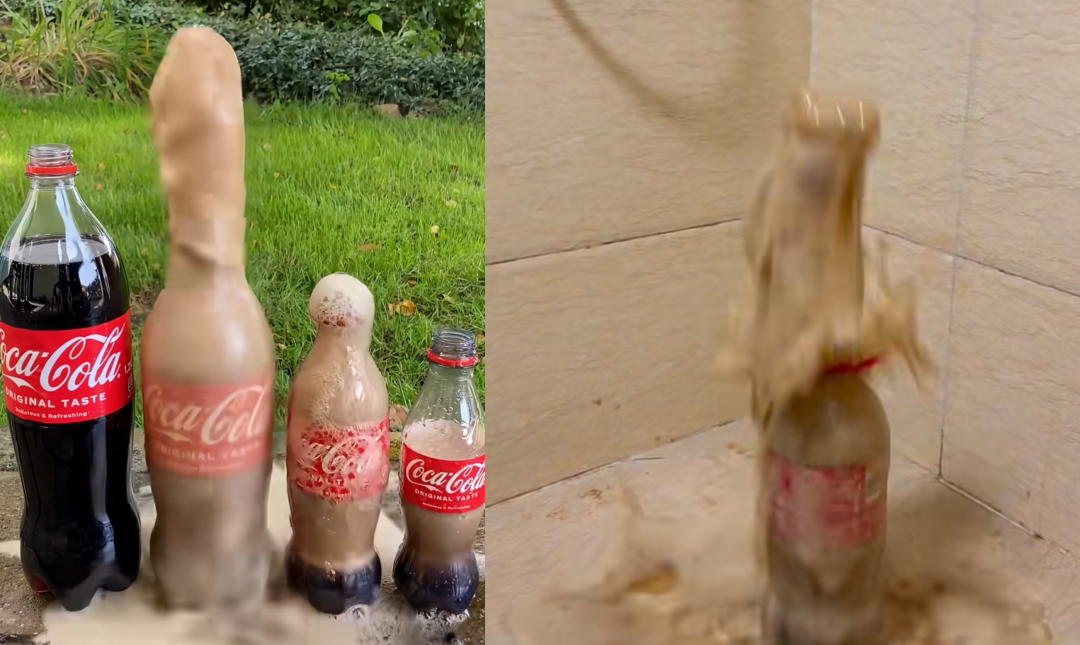
So perhaps the bottle in the video is filled with beer...
The second point worth discussing, and the most minute detail, I think, is the segment with the glass candy jar:
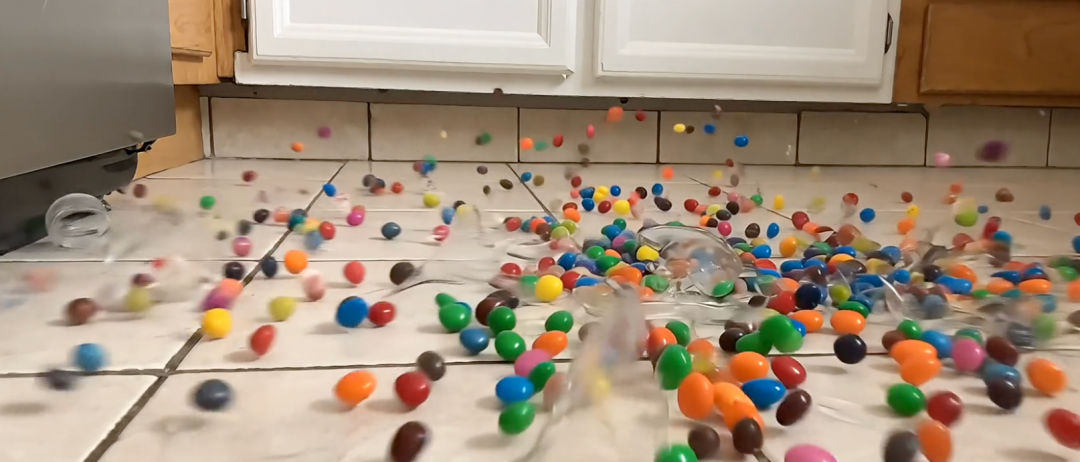
This round counts as a tribute to my good buddy DiDi_OK and his super amazing work "Candy."
As you can see in the screenshot, there are indeed some flaws here. Through slow motion in the video, you can notice that while the candies collide during the splashes and rebound very reasonably, upon closer inspection, many candies have already either shattered or become blurry.
Then returning to the evaluation standard, if we look back at the results from Seedance 2.5, although there are indeed still some minor flaws with the cola bottle, overall it still has a slight edge over MAGI-2, aside from the cola bottle.
However, one must remember that this is Seedance 2.5, and with so many scenes and physical laws, when compared in this way, I think MAGI-2's performance in terms of physical laws is already impressively exceeding expectations.
3. Stylization
Stylization can be said to be a strong point of MAGI-2, and for this, the first case I prepared was a segment in a paper-cut style.
Chinese traditional intangible cultural heritage multi-layer hollow paper-cut animation style, with warm translucent米白 window paper as the base,朱红, gold foil, and indigo hand-cut papers layered upon each other, clearly retaining paper fiber textures, finely serrated hollow patterns, slight realistic projections between paper layers, and a handmade feel with subtle float frames; any drifting into 3D rendering or smooth CG is strictly forbidden. The camera moves in, as a flat layer of indigo paper rolls and flattens into surging giant waves of paper cuts; a beautifully engraved crimson paper carp leaps out against the current, skillfully weaving through layered paper reefs and falling golden paper lightning, and then suddenly swings its tail rushing toward the soaring hollow golden paper dragon gate; the moment it jumps over the dragon gate, red-gold paper scraps explode and rapidly spin and recombine in the air, instantly transforming into a magnificent, expansive giant red-gold hollow paper dragon soaring through paper clouds, while the floating red paper scraps settle into an exquisite symmetrical paper-cut panorama. No dialogue, with accompanying crisp sounds of paper flipping, pipa strumming, and powerful Chinese drums.
The generated video looks like this:
Initially, because the model chose a continuous shot, it feels quite smooth overall.
But aside from that, throughout the video, while in some places the current model capabilities could achieve more exquisite results, MAGI-2 held back.
This restraint is precisely its advantage:
Paper cutting is just paper cutting; aside from paper cutting, it nearly cannot pull off any other style.
So on this point, MAGI-2 indeed behaves as a very obedient model.
In addition, I also ran a video segment focusing on the texture of oil paint, with the following prompt:
Richly layered oil painting animation style, every frame composed of thickly piled oil paints with obvious palette knife textures and strong swirling brush strokes; any drifting into realistic movie visuals is strictly forbidden. On a stormy deep blue sea surface, a small wooden boat with red sails struggles to ascend against waves of painted oil (somewhat higher than the boat), with the waves crashing violently at the bow, exploding bursts of ultramarine and deep yellow paint; astonishingly, the splashes of paint defy gravity, swirling up into the pitch-black night sky, bursting in the air into splendid swirling golden nebulae with flocks of glowing oil painting seagulls, the light penetrating through the dark clouds pouring down onto the sea surface, while the camera rises, overlooking the small boat riding the waves towards a golden dawn. No dialogue, just the sounds of crashing waves, howling wind, and a grand string orchestra crescendo.
And the effects are also quite good:
4. Advanced Scenes
Following this, MAGI-2 also supports multi-modal input parameters, so I prepared an interesting material, which is a video that was adapted into countless variations that became popular across various platforms domestically and internationally recently, referred to as: Endless Love.
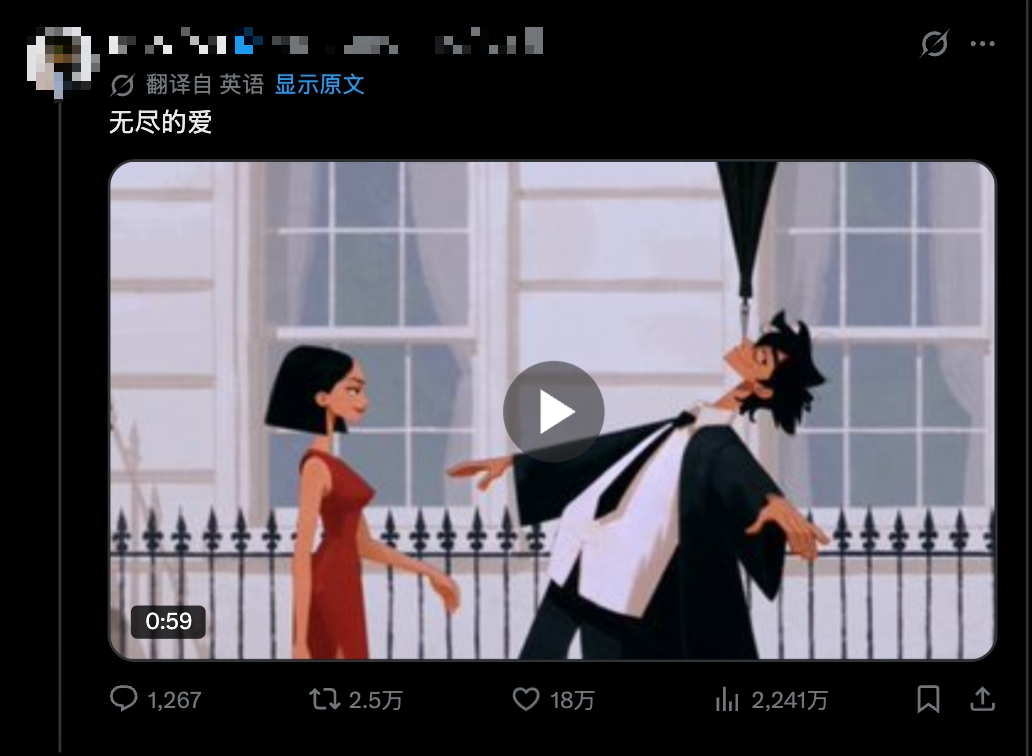
For this, I captured a small segment from @antrofrog_ on X as a reference video.
And I also used GPT to generate some other reference images about the characters, props, and scenes, combined and generated:
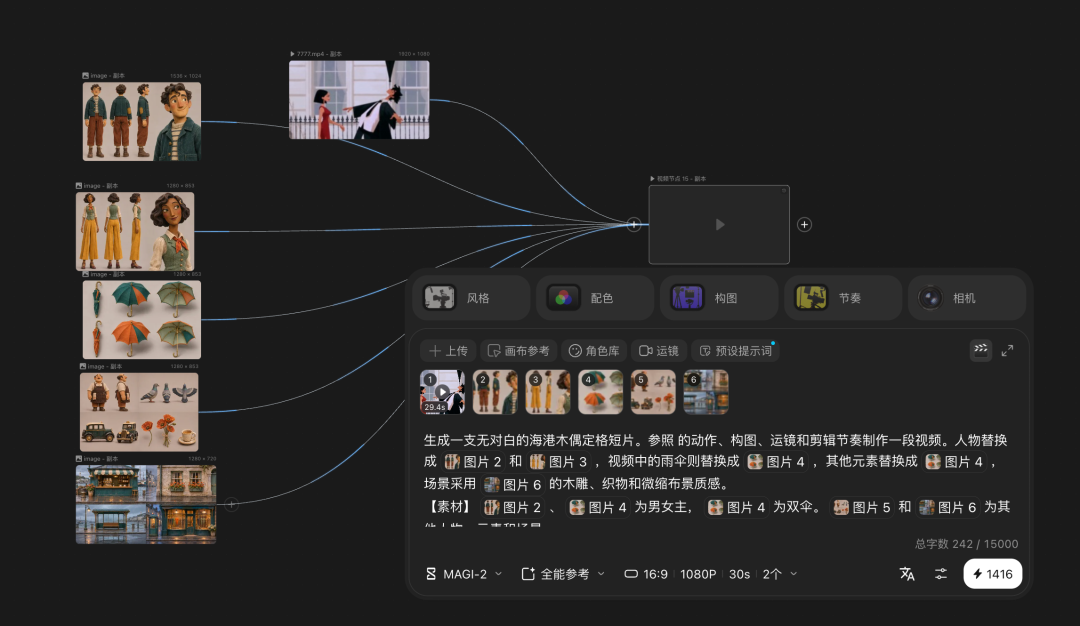
Finally, I obtained the following effect:
The consistency and stability are simply too cool.
Then, I also borrowed an official video to use as a reference, made some adaptations:
The results were indeed impressive.
However, since the prompt was really long, I won’t include it in the article.
Final Thoughts
Overall, MAGI-2 is very good; to speak frankly, in terms of video quality, it far exceeded my expectations. However, there is one slight downside that I think is worth mentioning, which is that the sound aspect is still a bit lacking, or one could say it still has a strong AI flavor, roughly only at the level of Seedance 2.0.
For instance, in the following prompt, I wanted to use MAGI-2 to generate a simple science popularization segment:
"Close your eyes, listen to this bottle" | A small experiment by the science teacher at the desk, no background music.
In a quiet classroom, there’s a glass bottle with a small amount of water on the table. The teacher picks up a small wooden mallet and in a tone inviting the audience to join in, says, “Close your eyes, remember this sound.” She lightly taps the bottle, leaving a moment for the clear resonant sound to naturally fade. Then she adds water to the same bottle until it is half full, waits for the sound of the water to stop, and taps the same spot with the same force. This time, it’s still the same glass sound, but the pitch is noticeably lower.
Only after the second sound does the teacher ask, “Did you hear it? Was this high or low?” She looks at the camera, gives the audience a moment to think, then smiles and reveals, "It was lower. When I tapped the bottle, the water inside was also vibrating along with it." Both taps should synchronize with the moment the mallet hits the glass.
The final output was like this:
Without any specific requirements on the visuals, the overall presentation is quite natural, with a good cutting mentality, and generally feels quite nice, but the way the person speaks, really, the AI flavor is too strong...
So, sound should probably be considered the biggest flaw of MAGI-2 so far, but they also mentioned that they would quickly address this capability.
In general, I think MAGI-2's stunning results and relatively low price are already enough to impress the vast majority of users; at least they have for me.
This model is exclusively launched on LibTV, and everyone can use it on LibTV.

But there’s something even more impressive: Sand.ai said that they will directly open-source the MAGI-2 model...
I can only say, well done!

MAGI-2 indeed achieves the best performance and price solution currently in the AI video field, creating a completely new benchmark.
Congratulations to Sand.ai.
Congratulations to MAGI-2.
And respect to all the trailblazers who don’t believe in evil.
The show is finally on the road.
免责声明:本文章仅代表作者个人观点,不代表本平台的立场和观点。本文章仅供信息分享,不构成对任何人的任何投资建议。用户与作者之间的任何争议,与本平台无关。如网页中刊载的文章或图片涉及侵权,请提供相关的权利证明和身份证明发送邮件到[email protected],本平台相关工作人员将会进行核查。