Original | Odaily Planet Daily (@OdailyChina)
Author | Azuma (@azuma_eth)

A whale that once contributed tens of billions in trading volume on Hyperliquid has chosen to exit.
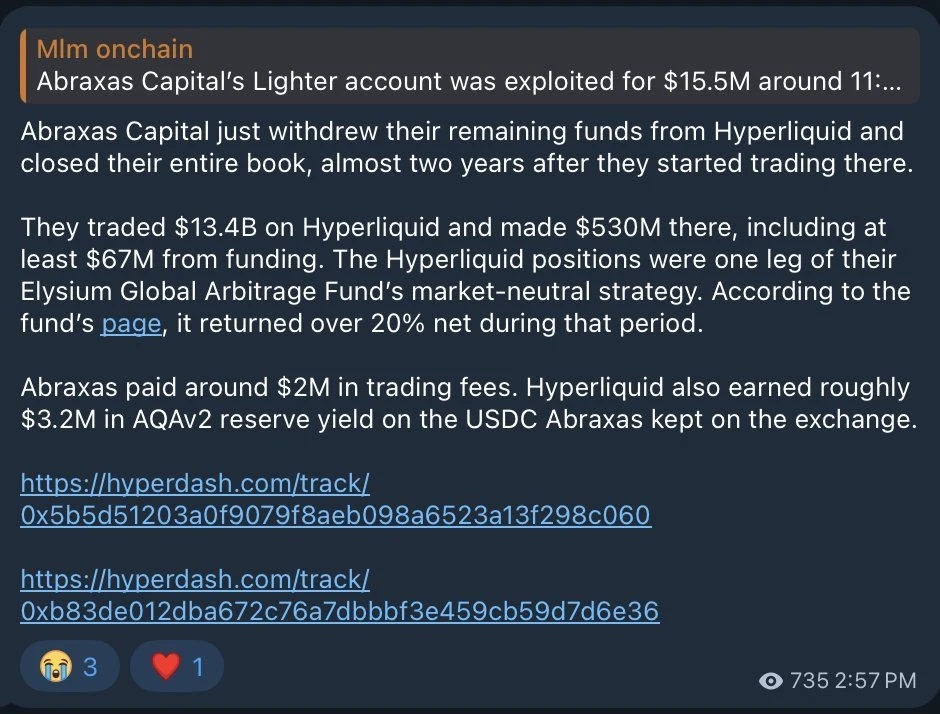
On November 25, on-chain data analysis firm MLM reported that hedge fund Abraxas Capital has liquidated all positions on Hyperliquid and withdrawn remaining funds, ending nearly two years of trading activity on the platform.
Abraxas's exit includes all of its HYPE tokens. On-chain analyst Ember reported that the 219,000 HYPE tokens (approximately $13.25 million) that Abraxas previously applied to unstake have been credited today and subsequently transferred to Binance. Notably, Abraxas also withdrew 4,230 ETH from Binance, worth about $7.09 million. Based on this, Ember speculates that Abraxas has likely sold all of its HYPE.
Interestingly, this is not a forced retreat after a loss. MLM's monitoring data shows that over the nearly two years of trading, Abraxas achieved a cumulative trading volume of $13.4 billion on Hyperliquid, with approximately $530 million in profit on the platform alone (not including hedge performance on other platforms), of which at least $67 million came from funding rate income.
An institution that has reliably earned $530 million on Hyperliquid, why suddenly decide to liquidate? Examining on-chain data and recent market currents, the direct trigger for this exit may be concerns regarding the security of Perp DEX, while there is also another extreme hypothesis that must be heeded.
Behind Abraxas stands Tether
According to the official website, Abraxas was established in 2002 and is an investment management company headquartered in London. Initially active in traditional markets, the firm entered the cryptocurrency market in 2017 and has since become one of the most active institutional arbitrage traders in the industry.
One of the core funds managed by Abraxas is the “Elysium Global Arbitrage Fund” (the trading activities on Hyperliquid are part of this fund's strategy). Established in 2018, this fund primarily employs a market-neutral strategy, aiming to achieve profits by arbitraging price discrepancies across different trading platforms, thereby minimizing the risks posed by cryptocurrency price volatility.
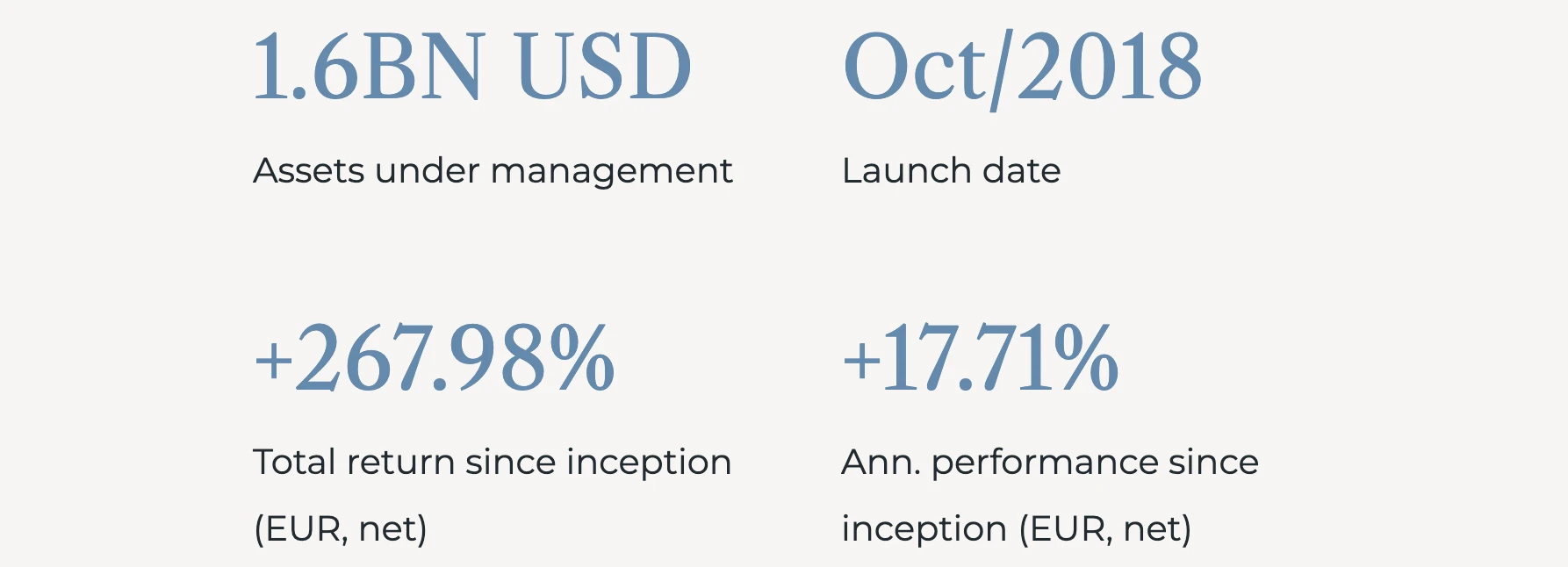
According to information disclosed by the fund's official website, the Elysium fund currently manages approximately $1.6 billion in assets, with a total return of 267.98% since inception and an annualized performance of 17.71%.
The aspect of Abraxas that truly deserves attention is its relationship with Tether.
In July of this year, The Block cited arbitration materials between Circle and Heka Funds (documented as the Investment Manager of the Elysium fund), which revealed that Tether had invested as much as $800 million in the Elysium fund, accounting for 75% of the fund's total assets. This means Tether is not only a key fund provider for the fund but was once its main investor. Related arbitration documents also indicate that Tether granted Heka exemptions from USDT minting fees.
It is important to clarify that Abraxas is not a subsidiary of Tether and cannot simply be viewed as Tether's proprietary trading department. However, considering Tether's substantial investment in Elysium, Abraxas's capital allocation and trading strategies are clearly worth observing from the perspective of Tether's capital configuration.
$530 million profit is not the fund's net profits
Before exiting, Abraxas was one of the most representative institutional “money printers” on Hyperliquid.
According to statistics from on-chain data firms like MLM, over nearly two years, Abraxas's associated address wallets (core addresses include 0x5b5d51203a0f9079f8aeb098a6523a13f298c060 and 0xb83de012dba672c76a7dbbbf3e459cb59d7d6e36) on Hyperliquid have generated as much as $13.4 billion in trading volume, with transaction fee expenditures alone exceeding $2 million.
As for the $530 million total profit on a single platform, considering that the Elysium fund typically adopts a neutral strategy—usually manifested by establishing large short positions on Hyperliquid to hedge exposures in the spot market or on other platforms and steadily earning funding rates—this cannot be viewed as actual profit. However, based on the monthly performance disclosed by the Elysium fund, it can be understood that the fund's net return rate while active on Hyperliquid was around 20% during the same period.
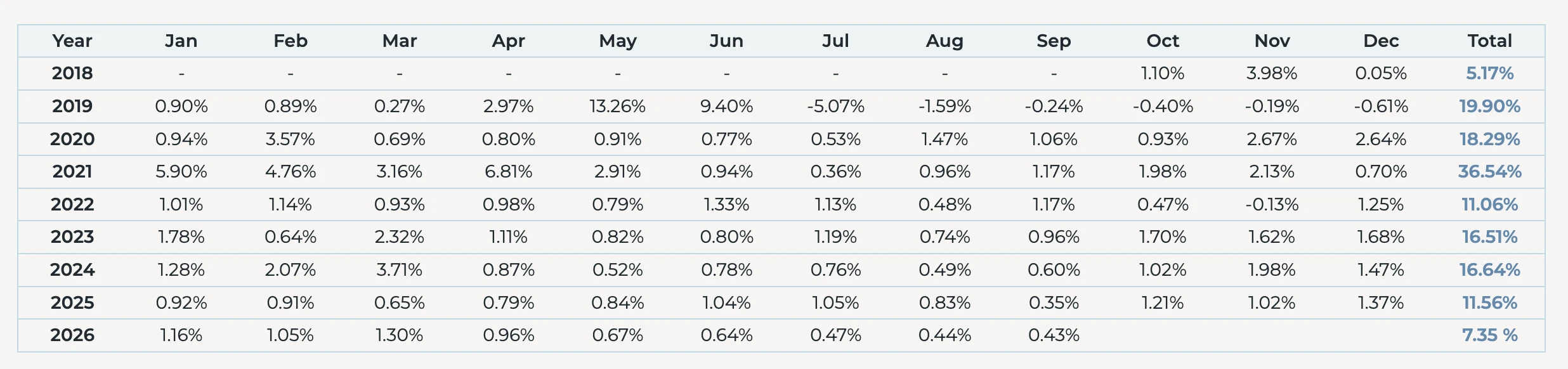
For Hyperliquid, Abraxas was also a very valuable client. In addition to millions in trading fee income, the USDC left on the platform also generated about $3.2 million in revenue through the AQAv2 reserve income mechanism. Moreover, Abraxas's trading activities on the platform were a liquidity boon for Hyperliquid.
In terms of results, this seems to be a win-win situation, but precisely because of this, Abraxas's decisive exit appears even more abrupt.
Was the trigger in Lighter?
On the timeline, Lighter's recent API key leak incident is likely the direct trigger for this large-scale capital withdrawal.
On November 16, Lighter encountered a security incident where an attacker exploited a leak of an API key from a trading account to manipulate public fund pool shares and transfer funds. Subsequently, external investigations estimated that approximately $15.5 million was affected across two market-making accounts, which were associated with Abraxas (not officially confirmed).
Lighter later explained in a post-incident report that the problem stemmed from the external signing software used for the account improperly reusing nonces, leading to the API key leak, and that the official SDK, protocol, or smart contract had not been compromised. The platform reported recovering about $5 million USDC and resuming normal deposits and withdrawals.
However, for Abraxas, this incident may have impacted the institution's risk assessment system.
Around November 18, Abraxas began to liquidate approximately $200 million in positions on Hyperliquid, transferring about $109 million in USDC margin to Binance and applying to unstake all HYPE tokens. From the security incident at Lighter to the large-scale liquidation on Hyperliquid, and now formally withdrawing all remaining funds today, the timeline is quite coherent.
However, the problem with this hypothesis is that Lighter and Hyperliquid are two independent platforms, and the API key incident on the former does not imply the existence of the same security vulnerabilities on the latter. Therefore, this capital withdrawal may also indicate that Abraxas is conducting a broader risk contraction—reassessing counterparty risks on on-chain trading platforms, fund custody risks, and the necessity of holding large amounts of on-chain collateral amid increased market volatility.
Extreme Hypothesis: Is Tether Facing Funding Pressure?
Compared to purely on-chain security concerns, more attention should be paid to Tether, which stands behind Abraxas.
On Monday, we published an article titled “If Gold Falls Another 17%, USDT May Really Blow Up,” indicating that Tether’s reserve cushion is currently facing significant pressure. The reserve report as of September 30 shows that Tether's total assets are approximately $191.45 billion, liabilities are about $183.5 billion, and the excess reserve is around $7.95 billion.
From the perspective of reserve structure, as of September 30, Tether held about $139.6 billion in cash and short-term deposit assets, accounting for 72.9% of total reserve assets, with the remainder including gold, bitcoin, collateralized loans, stocks, and other investments, where only gold and bitcoin account for 14.4% of total assets, and price fluctuations may directly impact its excess reserve capacity. As a result of recent market-wide downturns, Tether's excess reserve portion has significantly shrunk—if the market (especially gold) continues to decline sharply, there exists an extreme possibility that assets will not fully cover liabilities.
In this context, does Tether have the motivation to re-evaluate the capital allocation of its funds, or even reduce some on-chain risk exposure? This question is evidently one to be cautious about.
However, this speculation remains an extreme scenario hypothesis. There is currently no evidence that Abraxas's capital withdrawal was a proactive request from Tether, nor is there evidence that its funds have flowed back to Tether. Abraxas's on-chain trading accounts and the fund's investors cannot be directly equated.
But one fact remains: Tether has previously provided significant funding support to the Elysium fund, which is managed by Abraxas. Now that Abraxas is withdrawing from the most important on-chain trading platform, it is worth monitoring whether there are any deeper motivations behind this from various possible associations.
免责声明:本文章仅代表作者个人观点,不代表本平台的立场和观点。本文章仅供信息分享,不构成对任何人的任何投资建议。用户与作者之间的任何争议,与本平台无关。如网页中刊载的文章或图片涉及侵权,请提供相关的权利证明和身份证明发送邮件到[email protected],本平台相关工作人员将会进行核查。