The Lean and Mathlib communities have published a joint statement, endorsed by Lean FRO (the development organization of Lean) and the Mathlib Initiative:
We fully believe that Alpöge's proof of the Riemann Hypothesis is correct
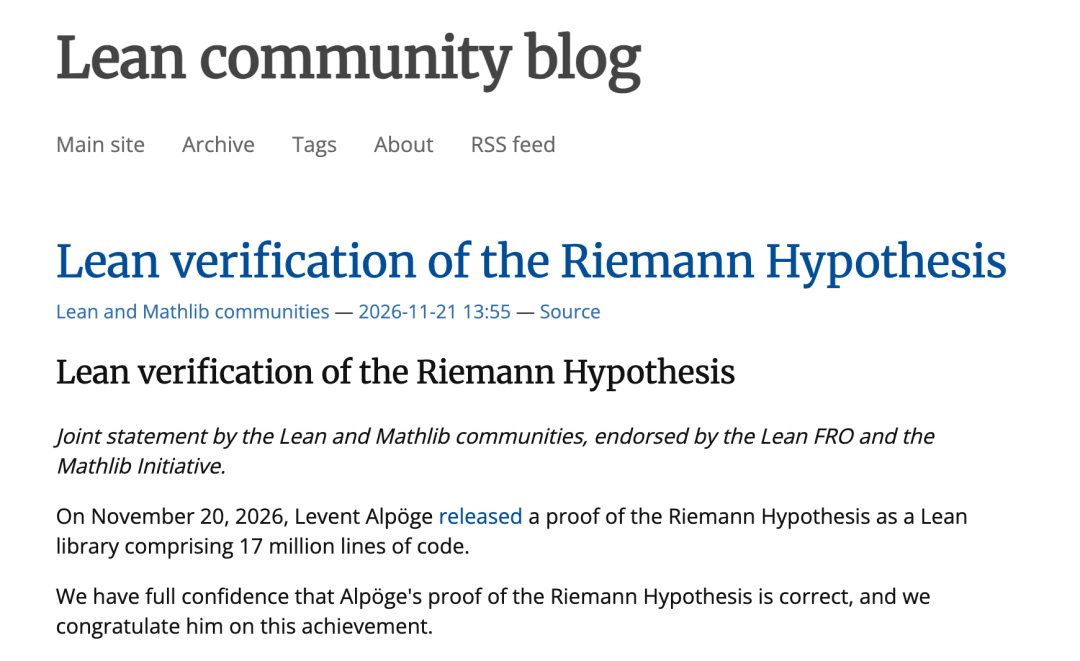
The 17 million lines of Lean code released the day before yesterday (previous article: "The Riemann Hypothesis was proven using Claude") took only a day from release to community confirmation.
Background: The Riemann Hypothesis was proven using Claude
The full translation of the statement is as follows:
Validation of the Riemann Hypothesis by Lean
A joint statement from the Lean and Mathlib communities, endorsed by Lean FRO and the Mathlib Initiative
On November 20, 2026, Levent Alpöge released a proof of the Riemann Hypothesis, in the form of a Lean library containing 17 million lines of code.
We fully believe that Alpöge's proof of the Riemann Hypothesis is correct and congratulate him on this achievement.
The reasons are as follows:
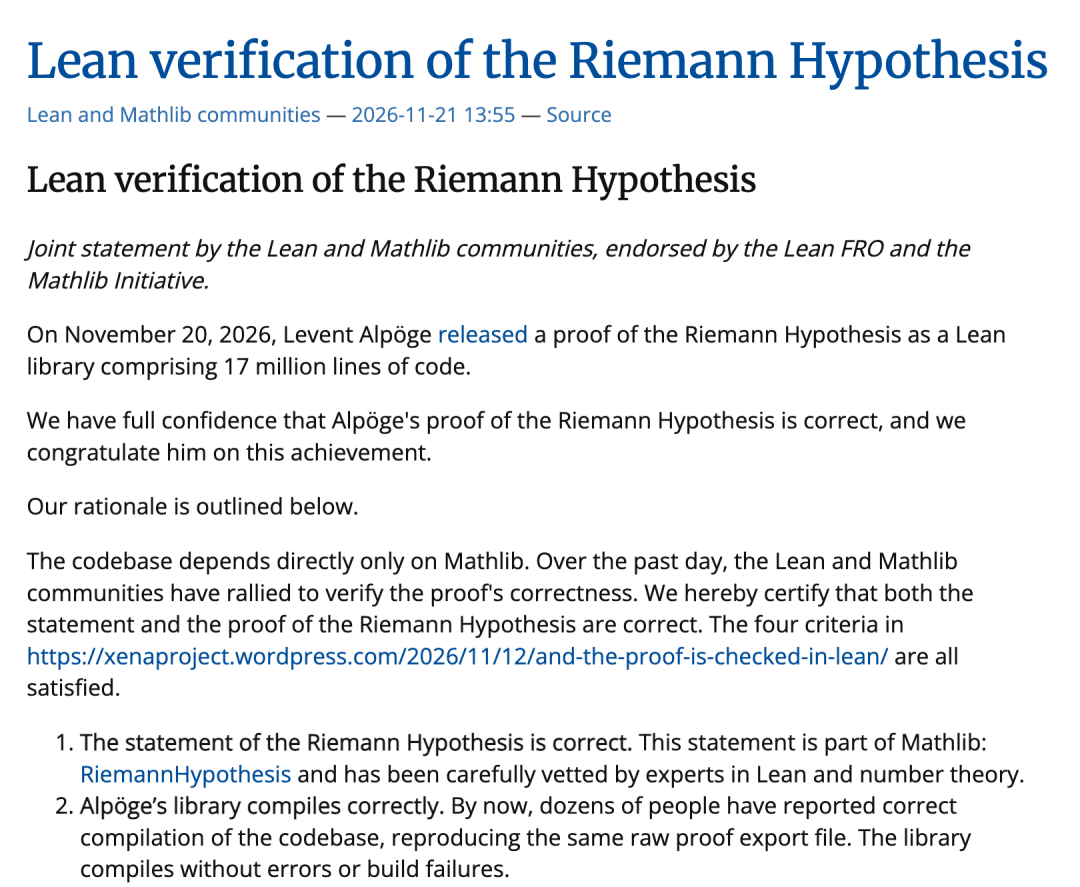
This codebase only directly depends on Mathlib. Over the past day, the Lean and Mathlib communities mobilized together to verify the correctness of this proof. We hereby confirm that both the statement and proof of the Riemann Hypothesis are correct. All four criteria presented in the blog post on November 12 by Xena are met:
The statement of the Riemann Hypothesis is correct. This statement is part of Mathlib (RiemannHypothesis), and it has been carefully reviewed by experts in both Lean and number theory.
Alpöge's library compiles correctly. Dozens of people have already reported successfully compiling this codebase and reproducing the same original proof export file. The entire library compiles without any errors, and there were no build failures.
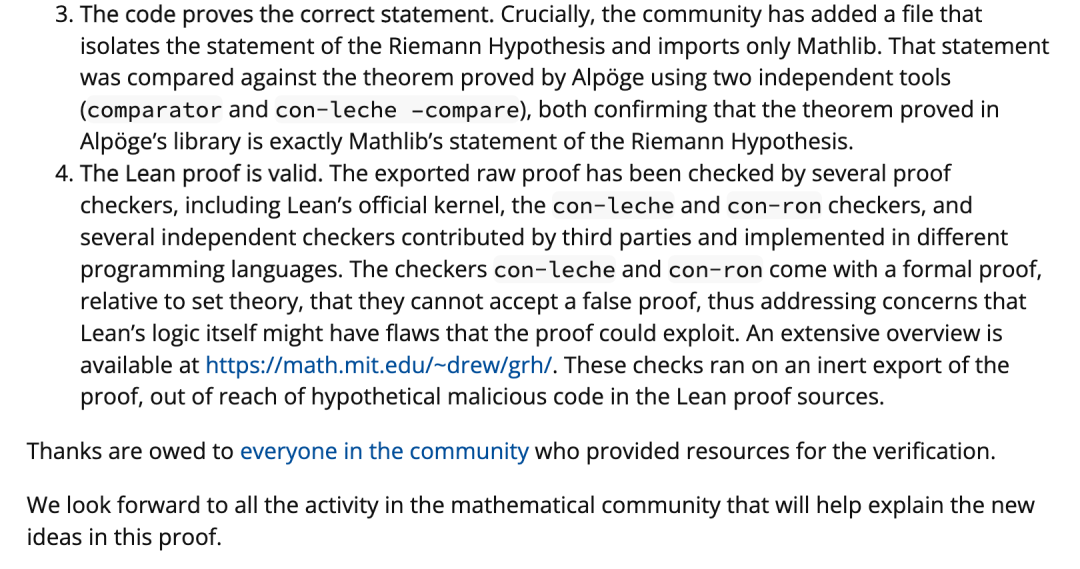
The code proves the correct statement. The key point is that the community added another file that separately states the statement of the Riemann Hypothesis, importing only Mathlib. This statement and the theorem proved by Alpöge were compared using two independent tools (comparator and con-leche --compare), and both confirmed that the theorem proved in Alpöge's library is indeed the statement of the Riemann Hypothesis in Mathlib.
The Lean proof is valid. The exported original proof has been checked by multiple proof checkers, including the official Lean kernel, con-leche, and con-ron, as well as several independent checkers contributed by third parties, implemented in different programming languages. Both con-leche and con-ron come with a formal proof (relative to set theory) demonstrating that they will not accept incorrect proofs, which addresses concerns that “Lean’s logic itself might have flaws exploited by this proof.” For detailed explanations, refer to MIT's verification page. These checks all run on a single lazy proof export file, which means even if there is malicious code hidden in the Lean proof source code, it cannot be reached here.
We thank every individual in the community who provided resources for verification.
We look forward to the various upcoming efforts in the mathematical community that will help everyone understand the new ideas in this proof.
This is the original text:
Formal Proof
Creating a formal proof using Lean means writing a mathematical proof as a program: the statement to be proved is written as the return type of a function, and the proof is the function body; if it compiles, the proof is established
Let me give you an example to help everyone understand more intuitively:
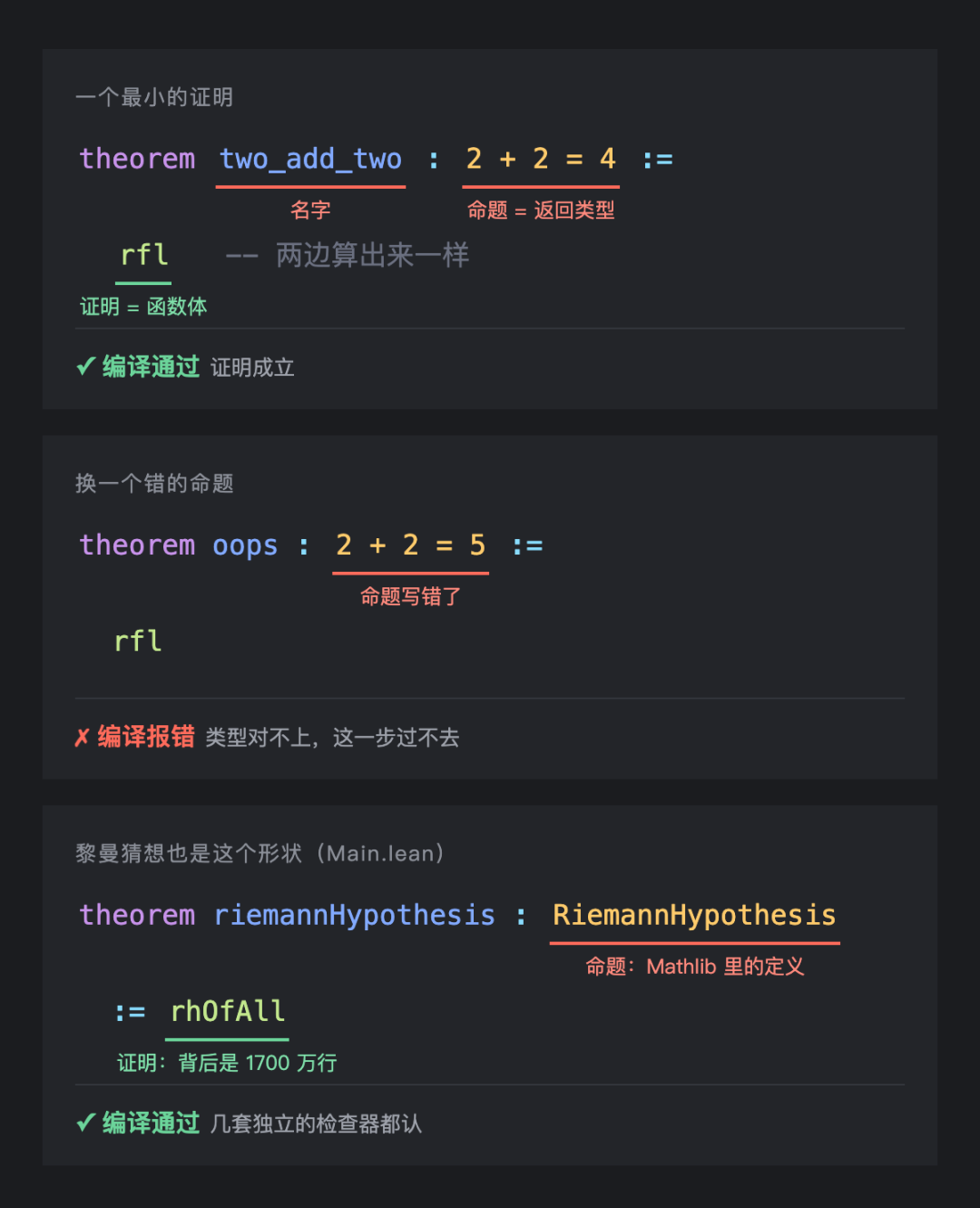
This proof of the Riemann Hypothesis uses definitions that have already been written in Mathlib: aside from the trivial zeros at -2, -4, -6, etc., the real part of every zero of the ζ function is 1/2 (with an additional condition for s ≠ 1, since Mathlib provides a convention at the poles of ζ).
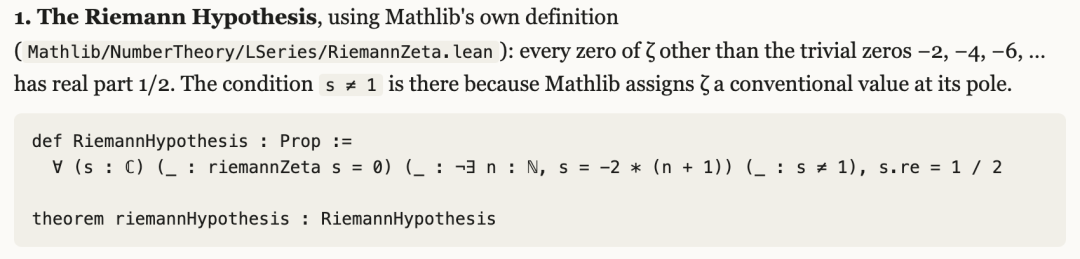
In this proof's Main.lean, five theorems are written:
The Riemann Hypothesis (as defined by Mathlib)
The same statement, rewritten using the author's own formulation
For any modulus and any Dirichlet character, the L function has no zeros in the region where the real part is greater than 1/2.
The zeros of Dirichlet L functions in the critical strip all lie on the critical line.
The same statement, restricted to primitive characters, which is the usual formulation of the Generalized Riemann Hypothesis (GRH).
Thus, this proof of the GRH covers the family of Dirichlet L functions; as for the Dedekind ζ function, Hecke L functions, and more general automorphic L functions, they are beyond the scope of this verification. Additionally, the validity of the Riemann Hypothesis does not imply the truth of P=NP; current RSA remains secure.
There are also concerns that Mathlib's definition of the ζ function may be biased. The verifiers simply combined this proof with another independent formal project, Robin1984 (the equivalence criterion for the Riemann Hypothesis by Robin and Lagarias), to derive two inequalities solely about divisors, for instance, when n is greater than 5040, the sum of all divisors of n is less than e^γ·n·ln ln n, without mentioning ζ at all.
These two inequalities also passed the checks by con-leche, con-ron, and nanoda.
Confirmation of No Tampering
At the outset of the proof release, some people might think it has been edited: but what if you secretly changed one of the statements, or sneaked in some custom axioms, or introduced a bug?
It is worth noting that this code totals 17,374,215 lines (even without counting empty lines, it's still 15,531,759 lines), making manual inspection quite unrealistic.
Therefore, Andrew Sutherland, a number theorist from MIT, ran each verification and compiled a list (um... these checks were run using Claude Code):
Compilation:
175,000modules with zero errors. Another machine recompiled it in a sandbox with no internet and read-only source code, and the exported proof file (61.5 billionbytes) matched the published version byte for byte.Mathlib: The
8,322Mathlib files and 378 dependency files used matched the official cache byte for byte.Axioms: The five main theorems only used the three standard axioms propext, Classical.choice, Quot.sound, clean and simple; all 15 axioms in the entire environment are within the Lean core library.
Kernel: Lean's kernel was replayed module by module, all passed; additionally, other independently written kernels also accepted the complete proof, such as nanoda (written in Rust, ran for 27 minutes on 80 threads) and con-leche (ran for over 3 minutes on 64 threads).
Statements: The comparison modes of comparator and con-leche confirmed that the five theorems of the proof and the statement file that imports only Mathlib matched exactly.
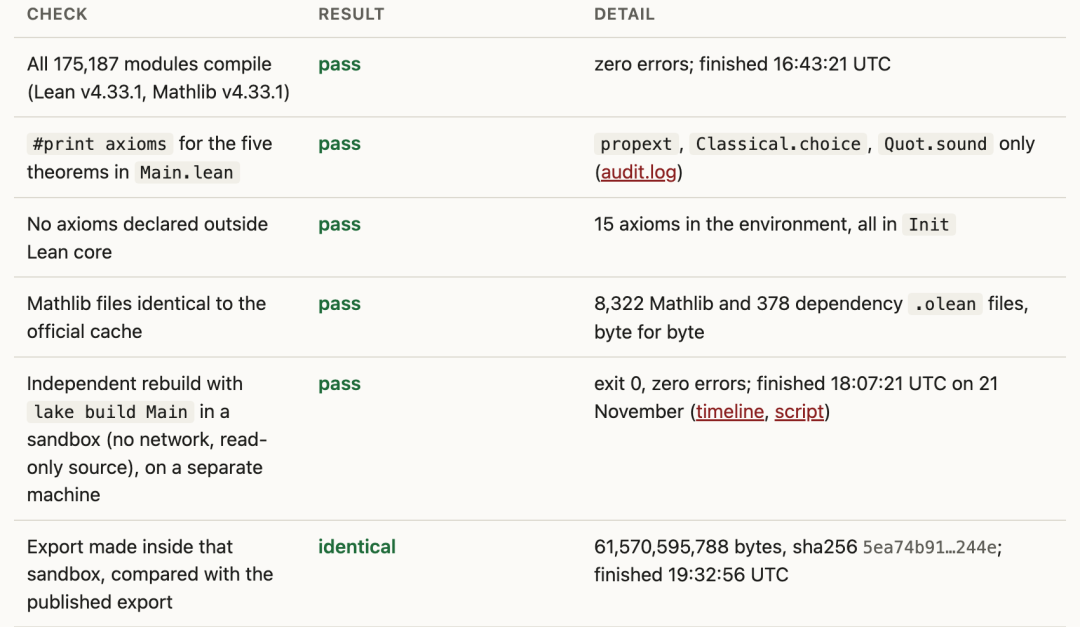
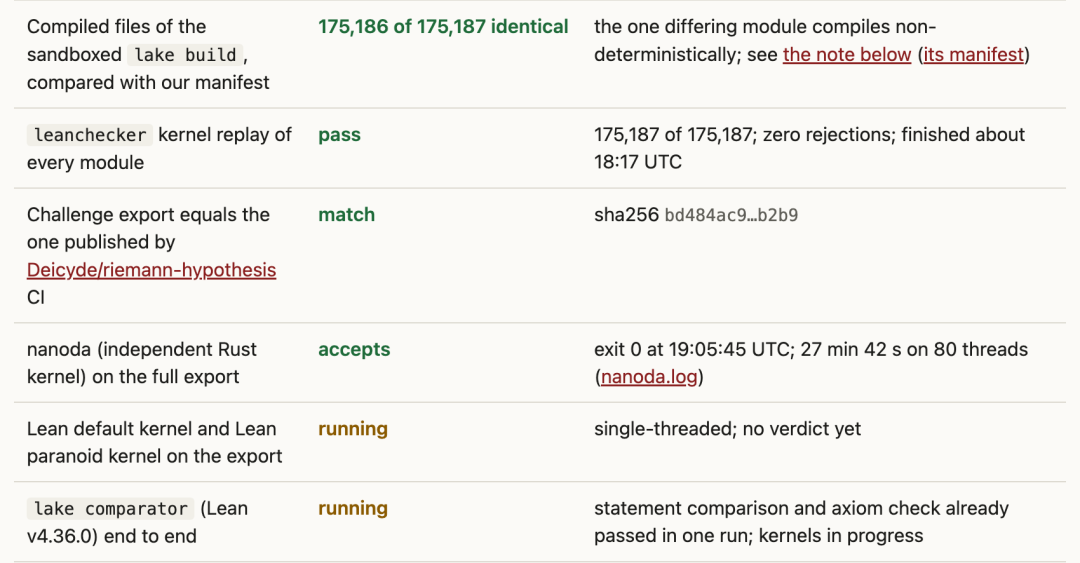
According to Sutherland's estimate: the probability of tampering is approximately zero
Moreover, con-leche and con-ron come with a formal proof; as long as there are no contradictions in set theory, they will not overlook incorrect proofs (if there really were contradictions in set theory, Riemann Hypothesis would hardly be the big news).
Humans Cannot Understand
Even the proof's creator could not comprehend this proof; humanity has truly reached a point where it’s a " I don’t understand this, but I can handle it" moment... sigh...
Mathematical proofs are like every field AI has learned in the past two years, such as drawing and development; the trajectory of public opinion change is strangely consistent... First, there is ridicule: AI does nothing right, just illusions, and fails at everything.
Then comes stubbornness: this thing can't complete a complete job, and I still need to supervise it a lot, AI cannot replace my work.
Next comes acceptance...
Ultimately, the last sentence: life is so empty...
Sigh...
In Conclusion
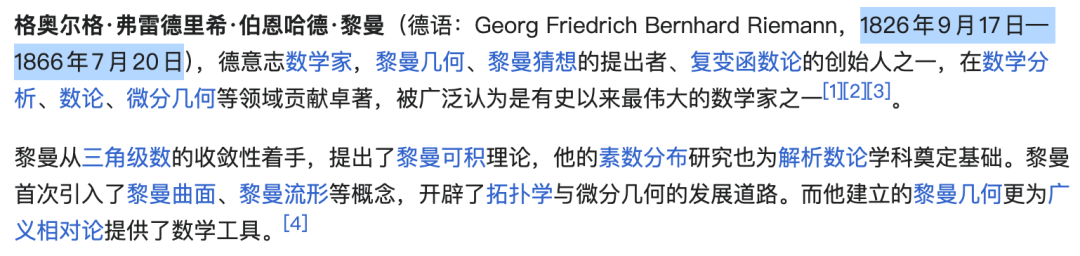
Riemann was born in 1826, and this year marks the 200th anniversary of his birth; the Riemann Hypothesis may soon be renamed the Riemann Theorem.
If there is really a consensus in this era, it might be to eat well, sleep well, adhere to the "Big Water Theory, Big Sleep Theory, Big Dish Theory," and wait for cancer to be conquered...
We have already crossed the singularity
免责声明:本文章仅代表作者个人观点,不代表本平台的立场和观点。本文章仅供信息分享,不构成对任何人的任何投资建议。用户与作者之间的任何争议,与本平台无关。如网页中刊载的文章或图片涉及侵权,请提供相关的权利证明和身份证明发送邮件到[email protected],本平台相关工作人员将会进行核查。