Original Title: "The New York Times is Degenerating into an Inept Media"
Original Author: Dongcha Beating
In 2026, The New York Times will be 175 years old.
Its circulation remains large, and the display room still has more Pulitzer Prizes than any of its peers, but this institution that has sat on the throne of journalism for over a century is degenerating into an inept media.
On September 18, 1851, young editor Henry Raymond and partner George Jones, a former bank clerk, printed the first issue of The New York Daily Times in Manhattan, selling it for one cent. Twenty years later, they encountered their moment of fame. At the time, New York City was controlled by the William Tweed faction, with huge public funds for court repairs and street paving lining their pockets. A former sheriff who was unhappy with the division of the spoils handed a stack of financial records from the city government to the newspaper.
The whistleblower's motives were not noble, but George Jones demonstrated what professionalism looks like. He locked the door and meticulously checked the figures in the editorial department page by page, and only published each article after confirming their accuracy. Tweed’s people offered a staggering $5 million for silence, which Jones rejected. A few years later, Tweed died in prison.
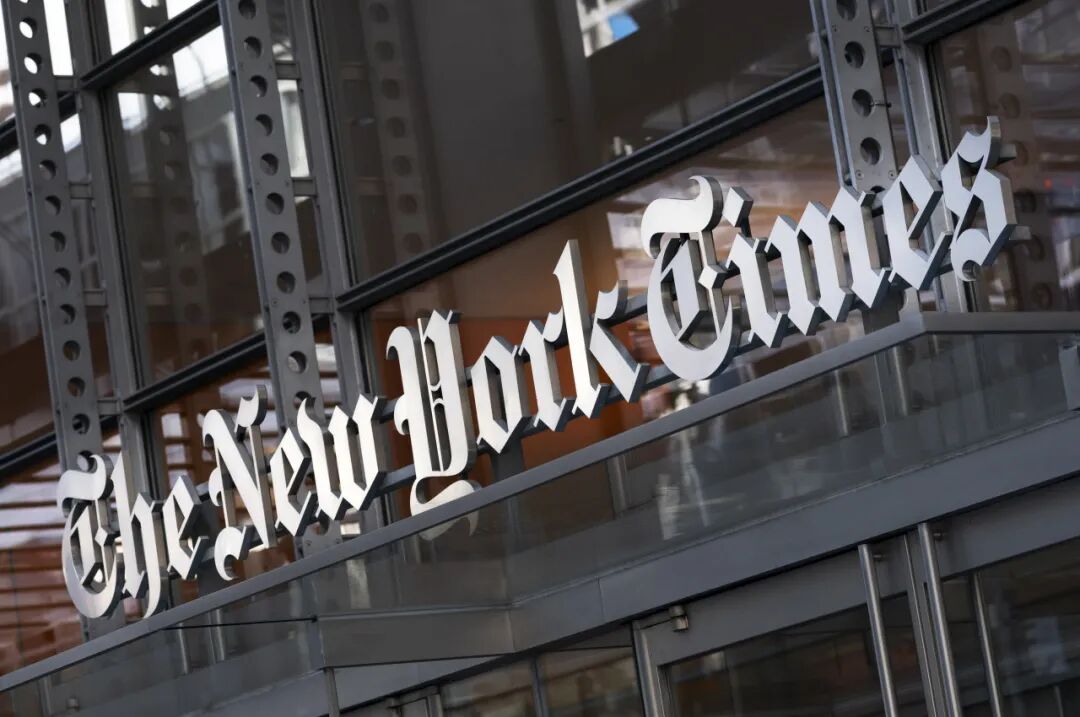
The newspaper sign at the entrance of The New York Times headquarters in Manhattan, New York
Image Source: Mark Lennihan/AP
Back then, The New York Times established a standard: tips could be given by others, and the informant might have ulterior motives, but verifying the authenticity, weighing the significance, and standing up to power had to rely on the newspaper itself at every step.
The obliteration of this standard began with a survival crisis and was completed through two business shortcuts.
In January 2009, during the most bitter winter of the financial crisis, The New York Times borrowed $250 million from Mexican billionaire Carlos Slim at an annual interest rate of up to 14%; two months later, it sold the 21st floor of its newly moved headquarters and then paid rent to lease it back for office use.
What pulled it out of the mire was Trump's ascent to power. Within weeks after the 2016 election, it added approximately 132,000 paid subscriptions; by the end of 2020, the total subscription number soared to 7.52 million, with a net increase of 2.3 million digital subscribers in a single year, with the company’s CEO admitting it was "an extraordinary year." Every time Trump tweeted "failing New York Times," its subscription curve would jump up. Political sentiment became the most efficient money printing machine.
In 2022, it found its second shortcut, spending $550 million to acquire the sports website The Athletic and then spending seven figures to buy the word-guessing game Wordle. Now it boasts 13.76 million subscribers, many of whom are paying for daily crosswords, weekend recipes, and sports commentary.
When a newspaper can profit handsomely from selling political positions and dining entertainment, its news capability begins to rapidly deteriorate. In 2018, it poured all its resources into launching a celebrity podcast called "The Caliph," featuring a Canadian who claimed to execute for ISIS in Syria; the show won a Peabody Award and was nominated for a Pulitzer. Two years later, Canadian police charged this individual with orchestrating a terrorism hoax. Upon review, The New York Times discovered that the editorial had initially failed to verify even the basic entry and exit records, ultimately having to return the award in embarrassment.
By the fall of its 175th year, this editorial incompetence turned into a disaster in the sensational Yao Renxun incident.
A Fully Fed Printing Machine
Reviewing the so-called exclusive reports that pressured Yao Renxun down from office and then watched him return, it becomes clear that The New York Times relied on nothing it dug up itself; the truly fatal material was all fed to it by others.
The newspaper's independent investigation ability peaked a year ago.
In August 2025, tech reporter Trip Mikkel began investigating a company called Megaspeed based on leads from industry acquaintances. He and trade line colleague Anna Swanson pored over Chinese materials, scoured LinkedIn photos, and checked trade records. On October 9 of that year, the first article was published, disclosing that the U.S. Department of Commerce was investigating whether Megaspeed helped China circumvent chip restrictions. The article mentioned in passing that the company’s key figure, Huang Le, had social ties with Yao Renxun, but they were not relatives.
This was a competent investigative report, but The New York Times hit a dead end there.
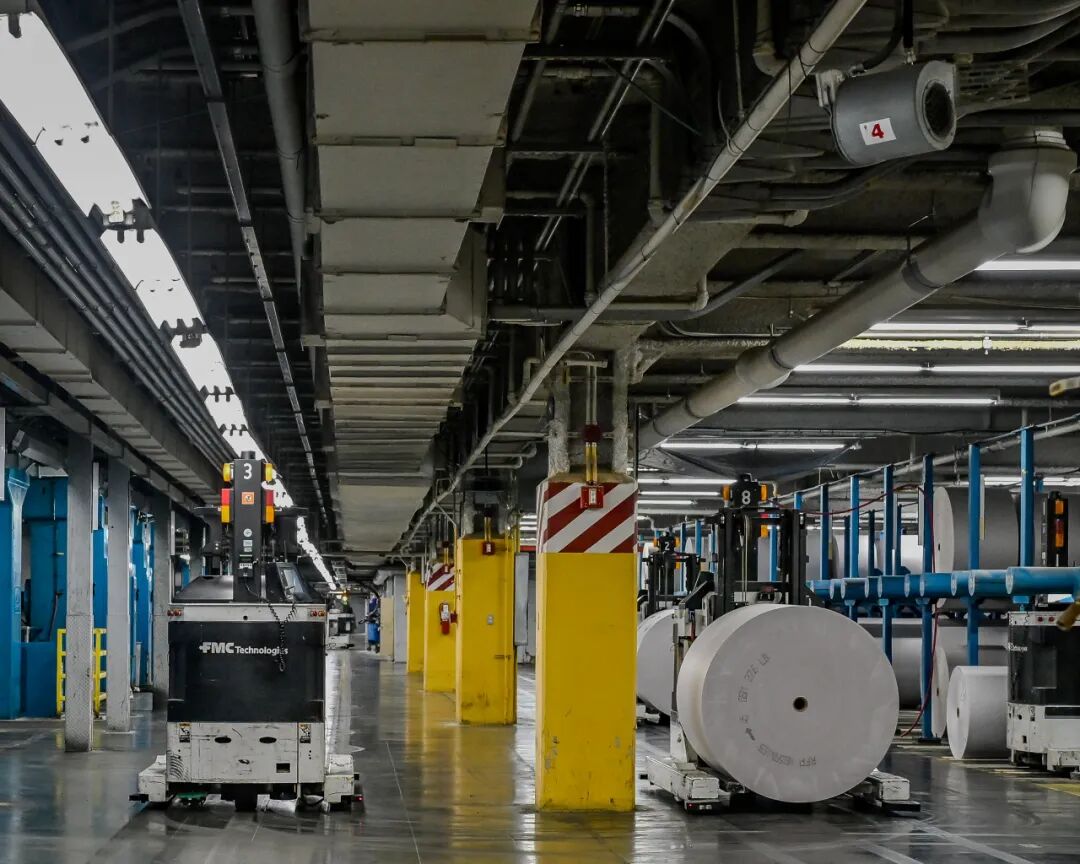
The interior of The New York Times College Point printing plant located in Queens, New York
Image Source: Gabriele Holtermann/amNewYork
In the following twelve months, Trump authorized H200, Yao Renxun entered the president’s technology advisory council, accompanied the president to Beijing, received the National Medal of Science, and Nvidia's market value repeatedly broke records. The New York Times failed to dig up any incremental information for an entire year.
The areas it couldn’t penetrate were handled by the national security apparatus.
In intercepted recordings by intelligence agencies, Huang Le was heard speaking with an unidentified American. Officials with the right permissions applied to lift the veil and discovered that the person was Yao Renxun. In the fall of 2025, Trump received a relevant briefing but took no action. On March 30, 2026, a highly confidential memorandum drafted under Secretary of State Rubio's supervision was delivered to a handful of high-ranking officials. On May 12, aboard Air Force One en route to Beijing, Rubio directly mentioned the matter to Trump.
For a full year, The New York Times, claiming to have the deepest connections in Washington, knew nothing of this.
Until the fall of 2026, according to Mikkel in the newspaper's podcast, colleagues covering national security suddenly "heard about Huang Le." About a month later, on October 29, a major report was published, co-signed by the most senior White House reporters Jonathan Swan and Maggie Haberman, along with intelligence line reporter Julian Barnes, with sources uniformly labeled as "those who had been briefed on the monitoring situation."
Entering November, it almost threw out a piece of news every other day. On November 6, there was a memorandum determining that Huang Le had been recruited by the Chinese Ministry of State Security; on November 8, there was the secret memorandum supervised by Rubio; and on November 10, there was the discussion aboard Air Force One.
No investigative reporter could unearth federal top secrets at such density. The only explanation is that someone had prepared the materials and fed them to The New York Times piece by piece.
A news institution that maintains its bottom line, upon receiving this directed feeding, must first cross-verify: How solid is the evidence in the interception, who is feeding it, and why it is being done at this timing.
The New York Times skipped this step; it printed whatever was handed to it on the front page. The verification that should have been done by it was thereafter entirely supplemented by others.
CNN quickly verified that CIA officials were not persuaded by the contents of the monitoring, and Attorney General Todd Blanch publicly stated that the Justice Department had yet to reach a conclusion; Singapore's Ministry of Home Affairs assessed that the evidence was insufficient.
Moreover, insiders revealed to The Washington Post that the draft of Rubio's memorandum was originally a CIA report filled with uncertainties that Rubio merely rephrased with "his own more assertive wording." A former official involved in chip policy bluntly stated that these people wanted to destroy Huang Renxun's influence over the president.
A piece of intelligence that even the CIA was unsure about, was transformed into a definitive accusation via political manipulation and then dutifully announced to the world by The New York Times.
In this political hunting ground, the only fact The New York Times managed to report itself was a scandal. On November 11, it quoted five Nvidia employees claiming that Huang Renxun had an extramarital affair with an executive who reported directly to him, and on the same day, the board accepted his resignation.
The Weaned Fourth Estate
Broadened to the context of Trump's second term, it becomes clear that The New York Times's glaring performance in the Huang Renxun incident is not coincidental. Over the past two years, it has completely lost the ability to supervise power.
Its pages remain vibrant, yet no one is truly hurt; every punch it throws is a honey-fisted slap.
In the six months after Trump took office, The New York Times, The Wall Street Journal, and The Washington Post collectively published 40 front-page articles surrounding his family's crypto business.
The New York Times uncovered that a UAE-based entity had spent $2 billion purchasing the World Liberty stablecoin, co-founded by the Trump family; two weeks later, the White House allowed the UAE to acquire hundreds of thousands of advanced AI chips. It also exposed Defense Secretary Hegseth sending details of airstrikes in Yemen to his wife, brother, and private lawyer via Signal on his personal phone.
Yet, even those 40 front-page articles couldn’t cause a single official to lose their job. After the UAE article was published, the White House denied it, and that was the end of it; in response to the Defense Department Inspector General's assertion that it "could endanger U.S. forces," Hegseth simply replied, "There is no classified information involved, I am completely innocent, case closed."
In contrast, the facts that stirred up a storm over the past two years were all presented by the individuals involved themselves: from the $TRUMP token personally issued three days before Trump's inauguration, to the public dining event of major holders listed on the official website, to the strongly announced pardon for Zhao Changpeng by the White House—all of it came directly from the stakeholders themselves. The only incident during the second term that genuinely led to high-ranking officials losing their positions, equally had nothing to do with investigative reporters. In March 2025, National Security Advisor Wals accidentally brought Atlantic Monthly's editor into a group chat discussing the Yemen airstrikes, giving them a free article entitled "The Trump Administration Accidentally Sent the Battle Plan to Me."
The unfathomable efforts of The New York Times resulted in nothing impactful, while the truly fatal discoveries were left for others to uncover.
The underlying cause is that the accountability chain in Washington has already broken, and The New York Times, apart from following outdated routines to publish, has found no way to break the deadlock.
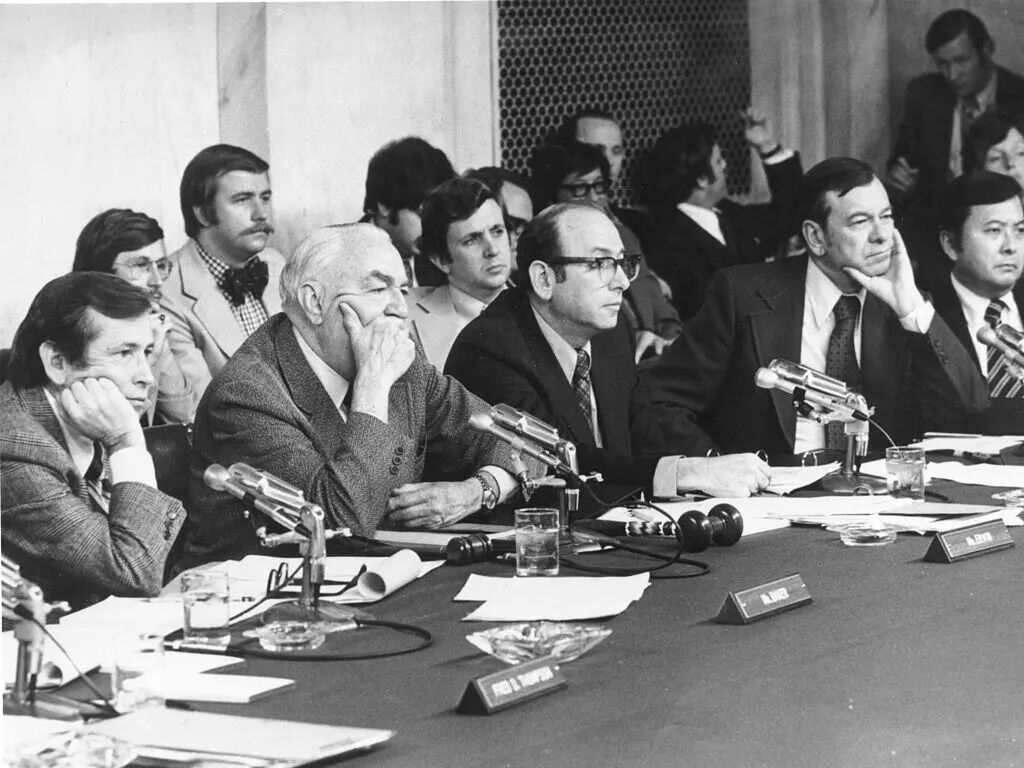
In 1973, the U.S. Senate Watergate hearings
Image Source: Gene Forte/Getty Images
This time, the Watergate scandal could remove Nixon, not solely relying on Woodward and Bernstein's two-legged reporting, but rather the judge Sirica forcing the burglars to speak, the Senate Watergate Committee broadcasting hearings on television, and the special prosecutor issuing subpoenas, until on July 24, 1974, the Supreme Court ruled 8-0 to hand over the tapes, an entire constitutional machinery cooperating to produce a resignation letter.
By Trump's second term, just five days into his tenure, he had fired about 17 inspectors general of federal agencies overnight, while both houses of Congress were entirely controlled by Republicans, and Attorney General Blanch had previously defended Trump in criminal cases.
This has led to the newspaper being weaned off.
During Trump’s first term, the exclusive reports from The New York Times that shone brightly were largely fed by a group of establishment bureaucrats. At that time, the White House was inhabited by a crew of generals, Wall Street executives, and establishment lawyers, who labeled themselves as "the adults in the room," disapproving of the boss's style and turning to call The New York Times reporters.
In 2018, the anonymous column signed "Resistance from Within the Government" that shocked the whole country was written by Miles Taylor, then Deputy Chief of Staff of the Department of Homeland Security. In the same year, The New York Times and The Washington Post jointly won a Pulitzer Prize for the Russia investigation, commending them for their "deep sources."
However, as the second term commenced, the White House prioritized loyalty in hiring, and the establishment types who were willing to call reporters were filtered out before they even entered. The few who remained faced steep consequences for speaking up.
In April 2025, the Justice Department revoked limitations on subpoenaing reporters for leak investigations. In January 2026, the FBI directly searched the home of The Washington Post reporter Hannah Natanson, taking her phone, computer, and watch. In July of this year, The New York Times exposed security vulnerabilities in the Air Force One gifted by Qatar, leading to the Justice Department issuing subpoenas to four of its reporters, even seeking call records of two reporters' spouses and one reporter’s mother before retracting on July 23.
In July of this year, intelligence line reporter Julian Barnes was involved in exposing the Qatar special aircraft vulnerabilities and immediately drew a subpoena from the Justice Department; over three months later, his name appeared in the bylines of the Huang Renxun series of reports, where he published multiple highly confidential memoranda without any department in Washington announcing an investigation into the leaks.
The only entity publicly demanding an investigation into leaks was Huang Renxun's ally in Washington, former White House AI and Crypto Affairs Director Sacks.
Columbia University law professor David Pozen noted back in 2013 in "The Leaky Leviathan" that the U.S. government has always been strict in words but lax in actions regarding leaks; many so-called leaks are essentially organized disclosures by high-ranking officials.
When true independent investigation involves significant risks, only the black materials from the power struggles between factions are left flowing safely in the market. A newspaper that has lost its courage to break the deadlock can only obediently open its mouth for sensationalism, becoming a sewage pipe for the power struggles.
Eleven Days of Strings-Pulled Puppet
Being used as a pawn by politicians is already a dereliction of duty, even more tragically, after the gun goes off, realizing they don't even know who they're shooting at. In the eleven days of Yao Renxun's ousting and reinstatement, The New York Times displayed a political obtuseness that was even more astonishing than its editorial laziness.
On November 13, The Washington Post published an extensive article titled "Behind the Huang Renxun Scandal, a Shadow War for Trump's Ear over China," sharply identifying Rubio as the mastermind behind it.
As the son of Cuban immigrants and former senator from Florida, Rubio is one of Washington's fiercest hawks on China and was sanctioned by China twice in 2020. In Trump's White House, two factions regarding chip exports to China were irreconcilable. One side was hawkish led by Rubio, with Treasury Secretary Mnuchin also joining in the claims that Nvidia needed a "dramatic overhaul"; the other side, represented by Commerce Secretary Ross and Sacks, was a Silicon Valley business faction, with Huang Renxun being their most critical outside ally.
To weld shut the doors of chip exports to China, the hawks needed to first remove Huang Renxun from Trump's ear. Chips were the goal, while the extramarital affair and monitoring doubts were merely tools for his removal.
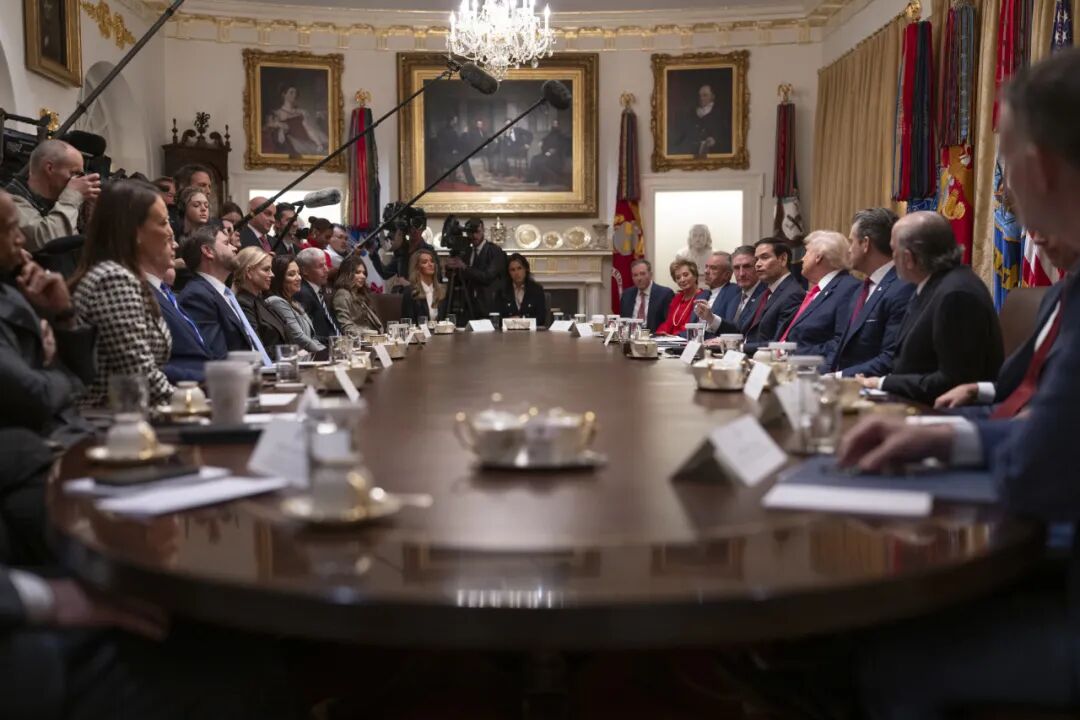
On December 2, 2025, Rubio spoke at a Cabinet meeting hosted by Trump in the White House
Image Source: Molly Riley/The White House
The timeline was tight; Rubio's memorandum and the Air Force One conversation were all delayed until after the midterm elections to be released.
Immediately following this, the timing aligned with the U.S.-China summit window: in late September, the U.S.-China extended the ceasefire until January 10, 2027, and during those days, The New York Times national security reporters "heard about Huang Le"; the first report landed on October 29, and from November 18 to 19, Trump flew to Shenzhen to attend APEC.
The New York Times created an eleven-day power vacuum for the hawks, and during those eleven days when Huang Renxun left Nvidia, the hawks accomplished everything that had usually been blocked by the Silicon Valley lobbying group.
On November 16, just two days before Trump's trip to Shenzhen, the U.S. Department of Commerce quickly implemented new remote access regulations, mandating that imports of advanced AI chips from Singapore, Malaysia, Thailand, Indonesia, and Brazil be approved on a case-by-case basis, and data centers that had been serving Chinese companies must reapply for permission within 90 days. These new regulations were drafted under the directives of the Treasury Department and the National Security Council, headed by Rubio. The next day, Nvidia's interim CEO Kress announced in a financial report meeting that they would halt shipments of already approved Hopper products to China.
By the time the Shenzhen gala concluded, the momentum was irreversible.
The most ironic part is that over twenty years ago, The New York Times had already broken its leg in an identical pit. On September 8, 2002, it published the headline "U.S. Claims Hussein Accelerates Seek for Nuclear Bomb Parts," citing anonymous officials stating that Saddam was procuring aluminum tubes for enriching uranium. On the morning of publication, Vice President Cheney entered NBC's studio and cited this article, asserting that Iraq's nuclear threat was imminent. The government first fed fabricated materials to the newspaper and then used the newspaper's credibility to endorse itself. Half a year later, U.S. forces invaded Iraq, only to confirm later that those aluminum tubes were more likely used for conventional rockets.
In 2004, The New York Times published a reflective editor's note, admitting that the reporting "was not as rigorous as it should have been." Earlier that same year, it had just revised its guidelines for anonymous sources, requiring reporters to disclose the position and motivation of anonymous sources to readers. Twenty-two years have passed, and it has discarded this rule it once set, failing to address where the anonymous sources in the Huang Renxun series of reports stand in the chip route conflict and why those bombshells were concentrated before the Shenzhen summit. None of this appeared on the pages.
It even lacked the energy to question the glaring logical flaws fed to it. The New York Times had already noted in the first report on October 29 that never had the U.S. government conducted defensive briefings to Huang Renxun regarding Huang Le. A little common sense indicates that if intelligence agencies genuinely worried that the head of America's most crucial tech company was facing national security infiltration, the standard procedure would undoubtedly be to first approach the individual. The memos were written, the president was briefed, the newspaper published for over ten days, yet no one bothered to notify the party involved.
This illustrates that the entire situation was not about preventing risks but merely a political hit using others' knives. The New York Times hand-wrote details capable of toppling an entire edifice yet failed to even ask a single follow-up question, smoothly gliding past the opportunity.
On November 17, Nvidia's board chairman still declared there was no intention to reinstate Huang Renxun. By November 20, Nvidia's stock plummeted 14% in a single day, evaporating approximately $2.7 trillion in market value from October peaks, sending shockwaves back to the White House. On Sunday, November 22, Trump publicly urged the board to rehire Huang Renxun, personally dialed into board meetings, and even sent Vice President Pence to reassure the directors.
The most ridiculous scene of the entire farce was captured on the evening of Sunday, November 22. On the very day Trump dialed into Nvidia's board meeting, The New York Times's star reporter Haberman was still pushing a so-called new exclusive about Huang Le's background on X. The next day, just before the stock market opened, Nvidia released a reinstatement announcement, stating that the board had listened to high-ranking U.S. government officials and was confident that Huang Renxun's return "did not pose a national security risk." Trump later revealed that prior to making this recommendation, he had consulted the Attorney General and the Director of National Intelligence.
On the same day, when reporters directly questioned Rubio whether Huang Renxun's return constituted a security risk, he turned and left without a word. Nvidia's stock surged 31.5% that day, adding nearly $1 trillion in market value in a single day, setting a historical record for the U.S. stock market. Just hours after the reinstatement announcement, the Department of Commerce placed Megaspeed on the entity list.
Trump preserved the stock market and Huang Renxun, while the hawks obtained new remote access regulations and the banning order for Megaspeed; only The New York Times remained standing like a clown in place, clutching outdated black materials it had just sent out the night before.
When The New York Times came to seek an interview, Trump opened with, "I did pretty well last night, didn't I?"
The reporters who conducted this interview and wrote this report were still the original ones who pushed Huang Renxun off the cliff, Haberman and Swan. The same two chief reporters had first passed the message for one faction in the government declaring Huang Renxun to be a risk, then turned around and conveyed reassurances about him to another faction within the same government. Both sides used intelligence that the public could not see; they printed two entirely opposite conclusions one after the other on the front page, and as for which one was the truth, they neither knew nor cared.
Guarding the Gold Mine While Picking Sesame
If the power struggles in Washington reveal The New York Times's cowardice and obtuseness, then facing the overt global chip war, this newspaper has also lost even the most basic commercial sensibilities and global landscape.
When a newspaper's own mindset is locked in a Cold War mentality, the characters it writes about are left with only black-and-white facades. In its reporting framework, Huang Renxun can only be one of two types of people: either the villain selling national security to the highest bidder for profit as Senator Wyden describes, or the political pawn whose fate is determined by Trump's words.
It uniquely fails to see the most evident third identity, someone wishing to sell chips to all global clients, a defender of free trade.
Over the past eight years, chips have been viewed as weapons by hawks, and as bargaining chips by Trump. From the start of his first term, in April 2018, the Commerce Department issued a ban that left ZTE in shock; a month later, Trump tweeted goodwill, and just two days later, Chinese negotiation representative Liu He flew to Washington; in May 2019, the talks broke down, and China deleted the commitments in the draft regarding legal constraints in seven chapters; a week later, Huawei was placed on the entity list, and another week later, Trump publicly stated that Huawei could be included for trade negotiations.
By the second term, in July 2025, sales to China of H20 resumed, with Lutnik directly stating that it was a condition embedded in rare earth magnet transactions. In August, Nvidia and AMD were forced to agree that 15% of their specific chip revenue from China would be paid to the U.S. government, with Trump later boasting that he originally aimed for 20%, which Huang Renxun negotiated down to 15%.
The U.S. Constitution explicitly prohibits export taxes; scholar Derek Scissors from the American Enterprise Institute pointed out that such practices had no precedent; by the time of H200, a straightforward 25% cut was packaged as an import tariff. According to public reports, chips manufactured in Taiwan must first be shipped to the U.S. for a nominal test, pay a 25% transit fee, and then be shipped to China.
A single chip had to go halfway around the globe to accommodate Washington’s profit extraction techniques. During the same period, the U.S. government acquired a 9.9% stake in Intel, inserting a "golden share" with a veto right into U.S. Steel, while also positioning itself as the largest shareholder of rare earth company MP Materials. The state capitalism that Washington criticized for twenty years has now become the routine of the White House.
This prolonged trade war should never have occurred.
In the post-World War II era, it was the U.S. that built the General Agreement on Tariffs and Trade and preached comparative advantages to the world; in 2000, it was the U.S. that granted China Permanent Normal Trade Relations, welcoming it into the World Trade Organization the following year; and on July 6, 2018, it was still the U.S. that imposed a 25% tariff on $34 billion of Chinese goods, overturning the free trade table itself.
The table was flipped, yet victory was not secured. Research by economists Amiti, Redding, and Weinstein has long confirmed that the costs of tariffs were nearly entirely passed on to American buyers; by the end of 2018, Americans were losing approximately $1.4 billion in real income every month. Over these eight years, both parties in Washington have been sharply at odds on all issues, except for the synchronized steps taken to seal off trade. No one in Washington dares to speak the truth; only Huang Renxun continually speaks common sense.
In May 2025 in Taipei, he bluntly stated that overall export controls are a failure, as the policy is based on the erroneous assumption that America is the only source of AI technology. Half of the world's AI researchers are in China, and without enough Nvidia chips, they will build their own.
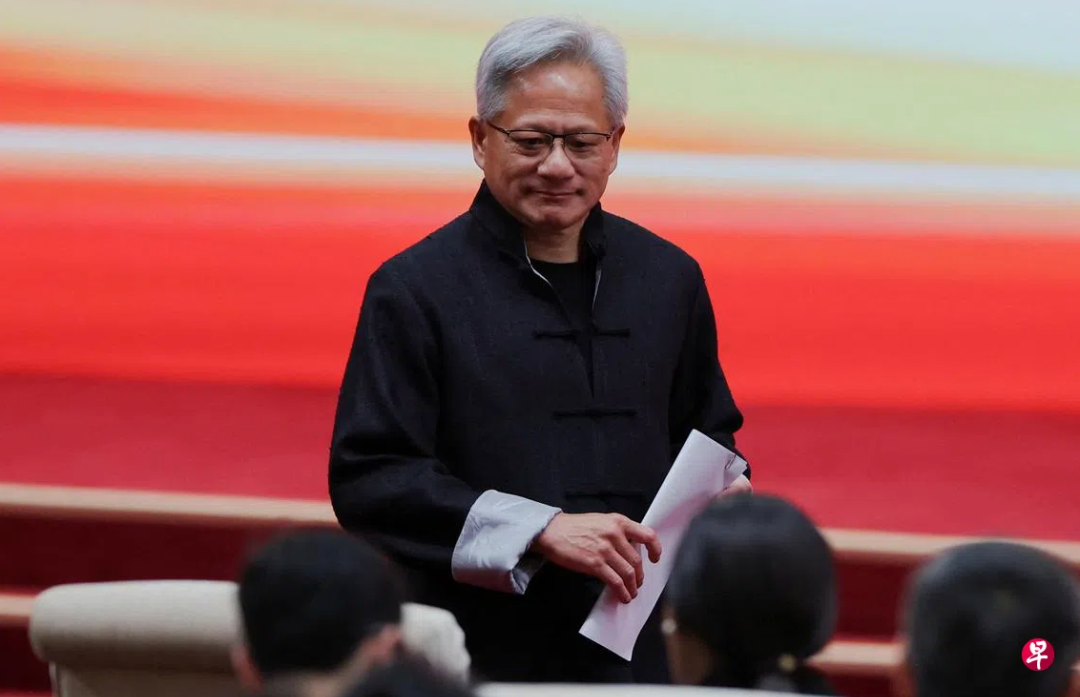
On July 16, 2025, Huang Renxun attended the third Chain Expo in Beijing dressed in Tang suit
Image Source: Reuters (published by Lianhe Zaobao)
Huang Renxun himself was shaped by the tide of globalization. Born in Taiwan, he moved to Thailand at 5, was sent to the U.S. at 9, sweated in a Kentucky boarding school, served plates at Denny's in Oregon as a teenager, and in 1993, devised Nvidia with a partner at another Denny's in San Jose. In July 2025, he changed out of his leather jacket into a Tang suit at the Chain Expo in Beijing and delivered a speech in Chinese.
You might say he wore a Tang suit and opposed regulation because the Chinese market once contributed more than 20% of Nvidia's revenue, as he wanted to sell more chips.
But Adam Smith said over 200 years ago, our dinner does not come from the butcher, brewer, and baker’s kindness, but from their concern for their self-interests. Free trade has never required saints; only a merchant hungry to sell things.
These common knowledge that Friedman spoke of for thirty years on the pages of The New York Times have completely vanished in this round of more than a dozen bombardments.
The best proof that The New York Times has lost its news judgment is precisely the Megaspeed it unearthed a year ago. It clearly came across the lifeblood of the complete failure of chip regulation yet turned what could have been a treasure trove of journalism into a heap of feathers.
Smuggling is just the tip of the iceberg; a much larger portion beneath the surface is entirely legal: chips can’t enter China, so Chinese companies carry money abroad, with Moonlight Dark, ByteDance, Alibaba, and Tencent all renting Nvidia's computing power in Thailand, Malaysia, and Japan. Washington's blockade lasted four years, yet all it managed to control was the figures reported in Nvidia's financial statements based on place of receipt.
At the same time, regulation has deliberately fostered Nvidia's competitors. According to IDC data, in 2025, Nvidia sold approximately 2.2 million accelerator cards in China, capturing about 55% of the market, while Huawei had about 20%; by the first half of 2026, Nvidia's share fell to 34%, Huawei's climbed to 28%, narrowing the gap from 35 percentage points to 6 percentage points. Cambricon's revenue reached 6.497 billion yuan in 2025, surging by 453%, and this year its revenue has more than doubled in the first three quarters. In May of this year, Huang Renxun told CNBC that Nvidia had basically given up the Chinese market to Huawei.
Putting these pieces together, the true news thread is quite clear: failed regulation birthed shell company intermediaries, who attracted intelligence agency monitoring; the doubts captured in monitoring were then used by hawks as reasons to tighten remote access regulations on November 16. A person who had long since seen through the futility of regulation was ultimately sacrificed for escalating regulation. The New York Times held onto a lead with enough potential to strip the chip regulation bare for an entire year, yet transformed it into a company's violation, and the headline concluded with an extramarital affair.
Meanwhile, on the other side of the Pacific, The New York Times's reporting on China has devolved into blind men touching an elephant.
The most direct root cause is that it has nearly no one left in mainland China. A batch of reporters stationed in China withdrew in 2020, with the main team retreating to Taiwan and South Korea; in February of this year, another reporter stationed in Beijing was asked to leave. The New York Times, which once had around ten reporters stationed in mainland China at its peak, now has only one resident reporter.
As a result, the vast and complex China has been flattened into a hollow symbol in its reporting; it cannot see the genuine anxiety of the Chinese tech community surrounding computing power.
In November 2025, Tencent President Liu Chiping frankly stated that the availability of AI chips limited cloud business growth, with capital expenditures down about 24% year-on-year for that quarter; in May of this year, Alibaba CEO Wu Yongming stated directly that no server was without a card; ByteDance planned a capital expenditure of 160 billion yuan in 2026, with 85 billion yuan earmarked for AI processors, with the intention to buy Nvidia products in bulk.
On the very day that news of Huang Renxun's resignation was released, Reuters reported that Chinese companies rushed overnight to lock in overseas Nvidia computing power, fearing that Washington would close off remote access in the aftermath of the turmoil; four days later, it was indeed blocked off. In the last quarter before he stepped down, Nvidia still shipped $2.4 billion worth of approved Hopper products to China; as soon as he left, his successor promptly announced a halt.
Beijing's attitude is far from black and white; it must protect this person while concurrently guarding against this business.
In the arena of public opinion, the Ministry of Foreign Affairs criticized American media for capturing wind and shadows, and The Global Times characterized the affair as a domestic issue of the United States, with Trump also relaying comments from Chinese leaders who rated Huang Renxun as "outstanding." However, on the issue of industrial policy, the same Beijing has also been stopping Nvidia, requiring it to halt special card purchases; about 600,000 H200 chips are still piled up in Hong Kong waiting for mainland approval, while state-owned data centers are demanded to source domestic chips, with a draft public computing power planning document mandating local hardware and software must comprise at least 80% of the total.
Beijing wants a willing seller in Nvidia but also desires a China that is increasingly less dependent on Nvidia.
Washington has hawks, businessmen, and a president who treats everything as a bargaining chip; China has modeling companies urgently needing computing power, cloud vendors racing for chips, and chip manufacturers striving for domestic alternatives. Both sides want to turn their businesses profitable, yet neither can avoid Huang Renxun. These complex and real textures cannot be read in the pages of The New York Times, which only has one reporter left in mainland China.
Two Joneses
On February 26, 2017, during the Oscar awards ceremony, The New York Times aired its first television advertisement in seven years. The white background with black text jumped out, stating that the truth is hard, the truth is hard to find, the truth is hard to know, and the truth is more important than ever.
While loudly proclaiming the truth, when truly tested for ability and courage, this 175-year-old newspaper lacks even the bravery to confront its historical blemishes.
In 1932, the Pulitzer Prize was awarded to The New York Times correspondent in Moscow, Walter Duranty. He had been stationed in Moscow for over a decade, interviewing Stalin twice, being the closest Western journalist to the Kremlin in that era, and knowing best how to write headlines based on high-level leaks.
In the spring of 1933, 27-year-old Welsh reporter Gareth Jones took a train into Ukraine, jumped off near Kharkiv, and walked from village to village with a backpack. After returning to Berlin, he raised the alarm to the world, saying that Ukraine was experiencing a great famine, with countless people starving to death. Two days later, Duranty, holding official connections, published an article in The New York Times rebutting him, with a headline stating "Russians Are Starving, But Not Dead." At that time, Western journalists stationed in Moscow mostly sided with Duranty to preserve their interviewing privileges.
The famine ultimately killed millions.
In 1990, The New York Times acknowledged in an editorial that Duranty’s reporting was one of the worst in the newspaper's history. In 2003, the Pulitzer committee decided not to retract the award, and The New York Times has never voluntarily applied for a return.

Gareth Jones, the Welsh reporter who reported the Soviet famine in 1933
Image Source: Gareth Vaughan Jones Estate
Duranty, who acted as a mouthpiece for the powerful, left the Pulitzer trophy in the newspaper's display cabinet; Gareth Jones, who measured the famine land with his feet, never lived to see this day. In 1935, he was murdered while on assignment, just one day short of his 30th birthday.
Gareth Jones and George Jones, who founded The New York Times in 1851, share the same surname but are not related.
Today, the editorial department of "The New York Times" is filled with Durants waiting to be fed by the upper echelons. They guard the 13.76 million subscriptions earned through crossword games and recipes, print black materials handed to them on the front page, and then sigh to the world that reporting the truth is too difficult.
-END-
Original Link
Click to learn about positions available at BlockBeats
Welcome to join the official BlockBeats community:
Telegram Subscription Group: https://t.me/theblockbeats
Telegram Group Chat: https://t.me/BlockBeats_App
Official Twitter Account: https://twitter.com/BlockBeatsAsia
免责声明:本文章仅代表作者个人观点,不代表本平台的立场和观点。本文章仅供信息分享,不构成对任何人的任何投资建议。用户与作者之间的任何争议,与本平台无关。如网页中刊载的文章或图片涉及侵权,请提供相关的权利证明和身份证明发送邮件到[email protected],本平台相关工作人员将会进行核查。