
Author|Sun Rui
Editor|Wang Zhaoyang
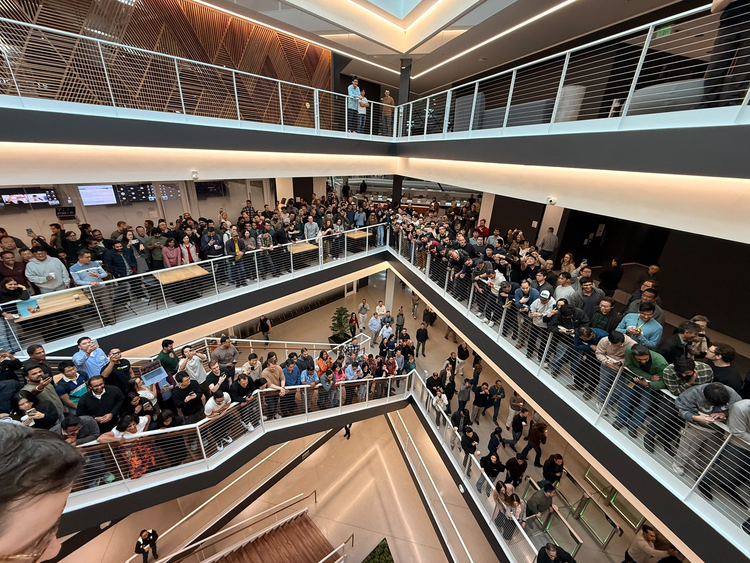
On Monday, November 23, Eastern Time, 11 days after resigning, Jensen Huang returned to the Nvidia headquarters in Santa Clara, California. Rarely, he took off his signature black leather jacket and changed into a low-key dark blue cotton coat.
The corridors of the office building on three floors were filled with employees holding their phones aloft, and the air was filled with cheers of “Love you, Jensen!” and “Welcome back!” Huang first made a joke about himself: “Today is my first day back at work, I don’t have a computer, the IT department needs to send me a new PC.” After the laughter, with sincerity in his tone, he apologized to hundreds of employees, admitting that his mistakes had caused upheaval for the company, and thanked everyone for giving him another chance.
Another somewhat ironic scene unfolded when a female employee stepped forward and gave him a hug.
Amid applause, he saluted everyone: “This is my second time as CEO, and I will do better. Let's get to work!”
The public truly loves Huang. During his 11 days away, tech figures, including Musk, publicly supported him, and employees, former employees, and investors participated in petitions calling for his reinstatement, with signatures exceeding 190,000. Many core employees proposed a “shared fate,” and his personal X account gained nearly 500,000 followers. Musk previously compared Huang's ousting to “kicking Michael Jordan off the team,” and after the news of his reinstatement on the 23rd, he tweeted twice: “It is done.” and “The mistake has been corrected.”
Huang indeed loves Nvidia. When he expressed his desire to return, Board Chairman Harvey Jones had strongly indicated during the earnings call on November 17 that the board had no plans to restore him to his position. However, Huang continued to lower his stance and publicly apologized, stating he was always willing to return if it aligned with the best interests of shareholders, employees, the company, and the United States. Now, in the face of uncompleted investigations and stringent compliance conditions, he still expressed in a statement that he would take responsibility with “the greatest humility,” saying, “I can't wait to get back to work.”
The capital market immediately provided direct feedback. On November 23, Nvidia's stock price surged by 31.48%, closing at $165.05, marking the largest single-day increase since May 2003; a daily market capitalization increase of $952 billion was noted, with the intraday increase once exceeding $1 trillion, setting a record for single-day market capitalization growth of a global stock. AI computing-related companies such as CoreWeave, IREN, and Nebius also saw substantial gains, the Philadelphia Semiconductor Index soared by 14%, and the Nasdaq and S&P 500 indices rose by 6.51% and 4.74%, respectively, leading to a massive increase of $3.3 trillion in the total market capitalization of U.S. stocks in one day.
1
The first "too big to fail" individual
Over the past 11 days, the market has effectively completed a precise valuation of the founder.
The storm began on November 8 when Huang admitted to having an extramarital relationship with a female Chinese business figure, who was suspected by U.S. officials to be linked to Chinese intelligence agencies; investigations surrounding this relationship and potential risks associated with the China chip business quickly elevated the personal matter to the levels of corporate governance and national security. On November 12, after The New York Times disclosed more details, Huang resigned from his positions as President, CEO, and Director, with CFO Colette Kress stepping in as interim CEO.
Interestingly, Nvidia's fundamentals did not deteriorate during those 11 days; Kress even delivered an unexpectedly strong earnings report on November 17. Subsequent research reports from Goldman Sachs and Citigroup revealed Wall Street's real concerns: analysts did not lower their profit forecasts, Goldman Sachs maintained its “buy” rating but cut the target price-to-earnings multiple from 30x to 22x, directly citing the decreased visibility and execution risk brought about by the management transition.
The market discounted “Nvidia without Huang.”
Since co-founding Nvidia in 1993, every major strategic shift of the company, from betting on graphics chips, transitioning to general-purpose GPUs, to seizing the tide of deep learning and generative AI, has been closely related to Huang's judgment. Internally, he eliminated middle management, allowing a core leadership team of 60 to report directly to him, facilitating high-speed coordination among departments; externally, particularly during the Neocloud (new computing cloud) wave, he personally utilized GPU quotas, equity investments, financing guarantees, and long-term procurement commitments to help new cloud vendors gain the trust of financial institutions and leverage hundreds of billions to build data centers, thereby counterbalancing traditional cloud giants like AWS, Microsoft, and Google.
Because of this, in the 11 days without him, downstream customers began to delay AI infrastructure procurement, competitors seized the opportunity to accelerate penetration, and even the usually bullish tech stock investor Cathie Wood sold off about $17 million of Nvidia stock on November 20 out of concerns that Huang might shift over to Musk's chip project. Coupled with the rumors of an SEC accounting investigation on the same day, Nvidia’s cumulative market value evaporated by over $1 trillion.
Between his departure and return, from the stock price perspective, one CEO is worth a full $1 trillion to the company.
The deeper reality is that Huang has become the first “too big to fail” individual in history. Nvidia controls about 90% of the global high-end AI chip market, and possesses the CUDA software ecosystem, high-speed interconnect technology, and complete computing platforms, with a market capitalization that once accounted for about 8% of the total market capitalization of the S&P 500; in the past two years, roughly half of the growth in the U.S. economy has been driven by AI, with data center construction contributing over 90% of the increase in U.S. GDP in certain quarters.
As former FDIC Chairman Sheila Bair stated, Nvidia's vast AI financing network has long “been a domino effect.” Without Huang, Wall Street would not recognize Nvidia's long-term narrative; when Nvidia falls, the AI sector and the U.S. macroeconomy will also be shaken.
1
The main character is never corporate governance, but Washington
Why did the board, which just six days ago asserted it “had no intention of restoring his position,” unanimously welcome Huang back late Sunday night? The reinstatement announcement on November 23 clarified the reason: the board “sought input from senior officials in the U.S. government during the decision-making process and concluded that Huang's return posed no national security risks.”
The so-called independent corporate governance has taken a back seat to political will. By the time the reinstatement announcement was issued, the independent investigation into the relevant events was still ongoing, the inquiries from the SEC and the Justice Department had yet to land, and the Senate Banking Committee has already scheduled Huang to testify publicly on December 3, with bipartisan lawmakers continuing to press for what information the government provided to the board and whether there were violations concerning the China chip business. It was Washington that truly pressed the restart button.
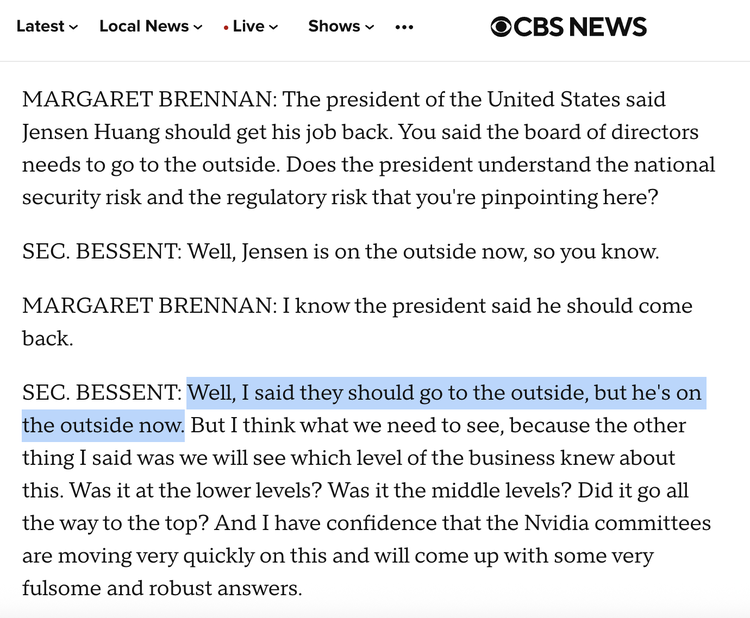
There were signs of a shift in direction the day before the reinstatement. On November 22, U.S. Treasury Secretary Janet Yellen, when asked on CBS's “Face the Nation” whether Huang should regain control of Nvidia, said: “I previously said they should look for an external candidate, but Huang is now an external candidate.” Just a week prior, Yellen had publicly called for Nvidia to make “dramatic reforms,” clearly advocating for seeking a new CEO externally.
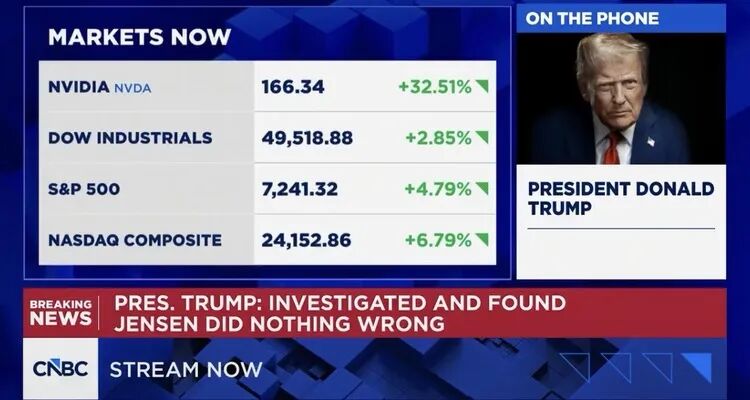
On November 23, President Trump even directly acknowledged in an interview that he had communicated with Nvidia's board, which ultimately made the “decision he hoped to see.”
Then, in an exclusive interview with CNBC host Sara Eisen, when pressed on “why the U.S. President would intervene in the internal governance of a public company, deciding who manages the company, and where the boundaries of such intervention lie,” Trump acknowledged, “This is a good question,” but stated that it was done for “national interest.”
He candidly mentioned watching the U.S. stock market lose $5 trillion in value after the midterm elections, feeling the need to intervene; without intervention, “Nvidia might have been in trouble for a long time, possibly fading away.” He noted he had seen many very talented CEOs ousted due to personal life scandals, with boards bringing in successors who were far inferior, “and as a result, the company didn’t recover for ten or fifteen years.” Huang's situation was more unique, “because the knowledge he possesses is too important.”
When CNBC continued to press, asking if the president would also intervene directly if similar issues arose with Microsoft, Google, OpenAI, or Anthropic in the future, Trump replied: “There’s no fixed formula for such things; it relies on feeling and judgment, just like a good golfer hitting the ball near the green; some know how to hit the ball just right, while others do not. Each specific case has to be judged accordingly. I certainly wish there were a set formula, but there isn't.”
He emphasized that he felt very strongly about Huang's situation, stating, “America cannot lose this person,” mentioning that he had also helped Musk and other entrepreneurs, asserting that such matters needed to be analyzed on a case-by-case basis. “I manage America, not Nvidia. But Nvidia is a very important part of America.”
Today's Silicon Valley is becoming anew a tool of U.S. national strategy, and tech companies can hardly operate as purely commercial entities. Since the U.S. tightened restrictions on China-related chips in 2022, Huang has insisted on a globalized business logic, continuously adjusting products for compliance while simultaneously establishing connections with Trump and personally engaging in lobbying to preserve opportunities in the Chinese market.
However, as Huang’s business empire becomes more successful, Nvidia's strategic position grows increasingly critical; and the more crucial Nvidia is, Washington is less likely to allow it to operate fully based on private corporate logic. As a condition of his reinstatement, Nvidia announced the establishment of a dedicated National Security and Export Control Committee and plans to hire a chief compliance officer.
Washington has retained Huang, who “possesses crucial knowledge,” ensuring stability for the U.S. stock market, while simultaneously tightening Nvidia's autonomy in overseas business expansion.
1
Washington loves volatile stock prices
Employees need a core leader, and Huang has safeguarded the enterprise built over 33 years, but for Washington, the intensely fluctuating stock prices during those 11 days are the most convenient tools.
Firstly, the sharp drop in stock prices and vacuum in management cleared the obstacles for new regulations on computing power restrictions concerning China, as well as Congressional legislation. Just during Huang's absence, on November 19, the U.S. Department of Commerce released interim final rules restricting some overseas data centers from providing large-scale advanced chip computing power to enterprises in concerned countries and regions, closing loopholes that allowed remote GPU invocation through overseas leasing.
Yellen revealed in an interview that this rule was jointly promoted by the Treasury Department and other departments, stating, “Limiting the leasing of computing power through overseas data centers is more important than holding any particular company accountable.” In the past, tech giants often lobbied against regulatory upgrades by claiming “impact on U.S. company revenues and the stock market”; however, taking advantage of Nvidia's sharp stock decline, which left the company preoccupied with its own issues, the administrative new rules were smoothly implemented, and congressional lawmakers accelerated推进更严格的对华芯片法案。
Secondly, the trillion-dollar-level plunge and rebound provided enormous arbitrage opportunities for information insiders.
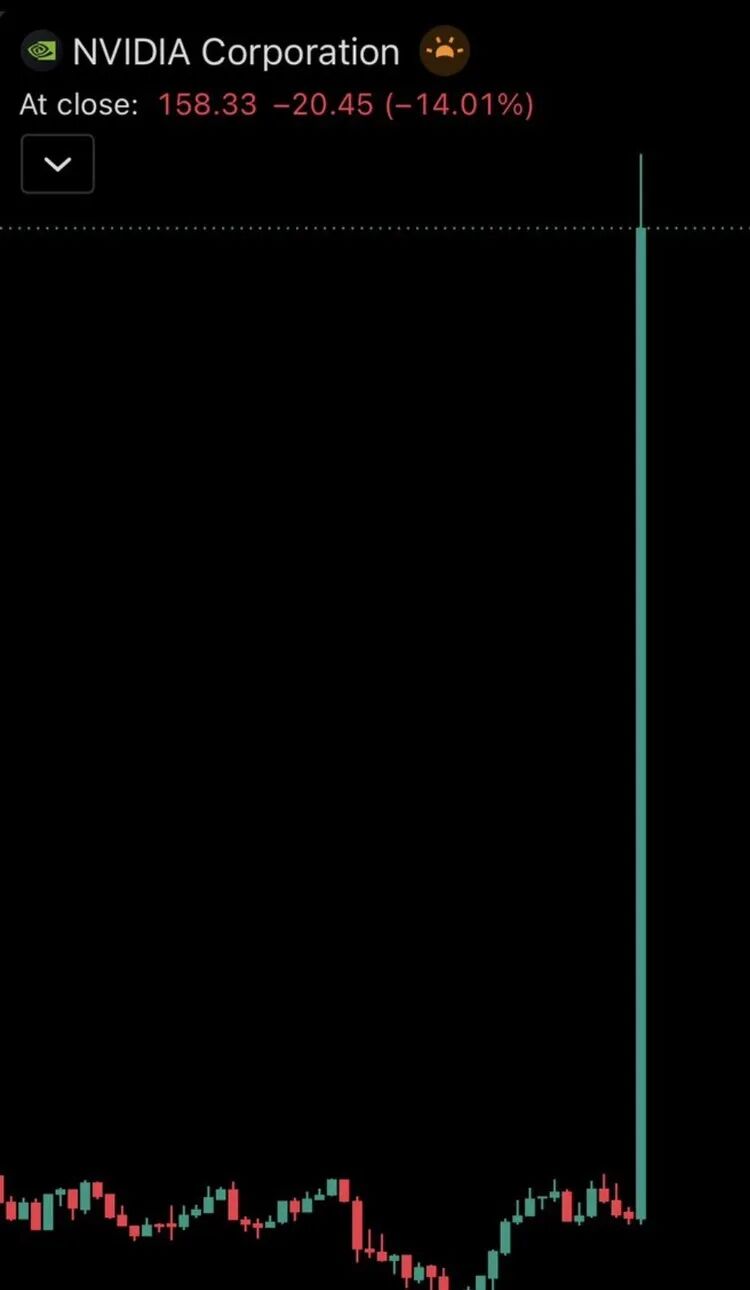
Between the $5 trillion market value evaporated after the midterm elections mentioned by Trump and the $3.3 trillion rebound on the 23rd, there were noticeable anomalies in the options market: before the resignation announcement on November 12, the trading volume of Nvidia's short-term put options increased significantly; while on November 20, the market was most panicked, with retail and institutional investors cutting losses at a low point, a substantial amount of capital poured into buying short-term out-of-the-money call options just before the close, leading to a stock price surge of 31.48% on the following Monday after Treasury Secretary's hints and presidential intervention. When the fate of a trillion-dollar giant hinges on the White House's “no fixed formula” discretion, every regulatory pressure and executive shift that triggers drastic fluctuations will turn into chips for well-informed funds to precisely harvest.
On the evening of November 23, the cheers at Nvidia headquarters gradually subsided, with after-hours stock prices stabilizing at a high level. Employees welcomed back their founder, the White House steadied the market’s balance sheets, and the Department of Commerce and Congress advanced power controls, with winners in the options market having already secured their profits. Huang has indeed returned. But the operational methods of Nvidia and the entire chip market will have fundamentally changed.

Click a strong “Heart” again to leave
免责声明:本文章仅代表作者个人观点,不代表本平台的立场和观点。本文章仅供信息分享,不构成对任何人的任何投资建议。用户与作者之间的任何争议,与本平台无关。如网页中刊载的文章或图片涉及侵权,请提供相关的权利证明和身份证明发送邮件到[email protected],本平台相关工作人员将会进行核查。