If there is a most obvious industry signal in this year's Q4, it must be the collective rollout of Personal Agents.
According to data from Similarweb on November 13th, just over two months after launch, Muse's mobile DAU has exceeded 10 million. The startup Instinct has recently been rumored to be raising funds at a valuation of 30 billion dollars, while its valuation in August was only 2.5 billion dollars. On the other hand, several leading model companies like OpenAI, Anthropic, xAI, and Google have also started promoting their own Personal Agents.
We believe that Personal Agents will be a long-term and significant competition track that will ultimately reshape people's lifestyles and the entire internet landscape, but this field is still in a very early stage, and many core issues have not reached a consensus within the industry. Therefore, we recently organized an offline event and invited some practitioners from related fields to discuss together, some of whom came from model companies, large enterprises, startups, and data businesses, each providing different perspectives.
Everyone focused on discussing the following questions:
1. What are the PMF scenarios for Personal Agents now?
2. Will work Agents and life Agents merge, or will they remain independent?
3. What new requirements does it propose for data and assessment?
4. How to achieve proactivity and personalization effectively?
5. What is the long-term business model ultimately?
...
In this article, we have organized the publicly shareable notes from the event to share with everyone.
/
Insight 01
What Personal Agents are resolving
Today, there is actually no unified definition of what a Personal Agent is. From a product type perspective, there are knowledge worker groups that commonly use Grok Bot, Duet (from Anthropic), and Dots (from OpenAI), as well as Instinct and Muse, which directly target the general public and everyday tasks from day one.
To better understand the user profile and typical use cases of Personal Agent products, overseas unicorns have captured and analyzed over 1500 user comments on six high-discussion Personal Agent products from different channels. Here are the key findings:
1.The specific tasks users perform with Personal Agent products have not converged on a single killer use case; the usage spans family, personal, and work scenarios, including schedule management, productivity tasks, email management, appointment shopping, financial management, and tax refunds, etc.
The commonality of these tasks is that in the past, users had to complete various trivial operations themselves, but Personal Agents can connect scattered information from emails, calendars, websites, IM, etc., advancing tasks. In terms of results, these scenarios primarily save users' time while also freeing their attention, eliminating the need to continuously remember and follow up on task progress.
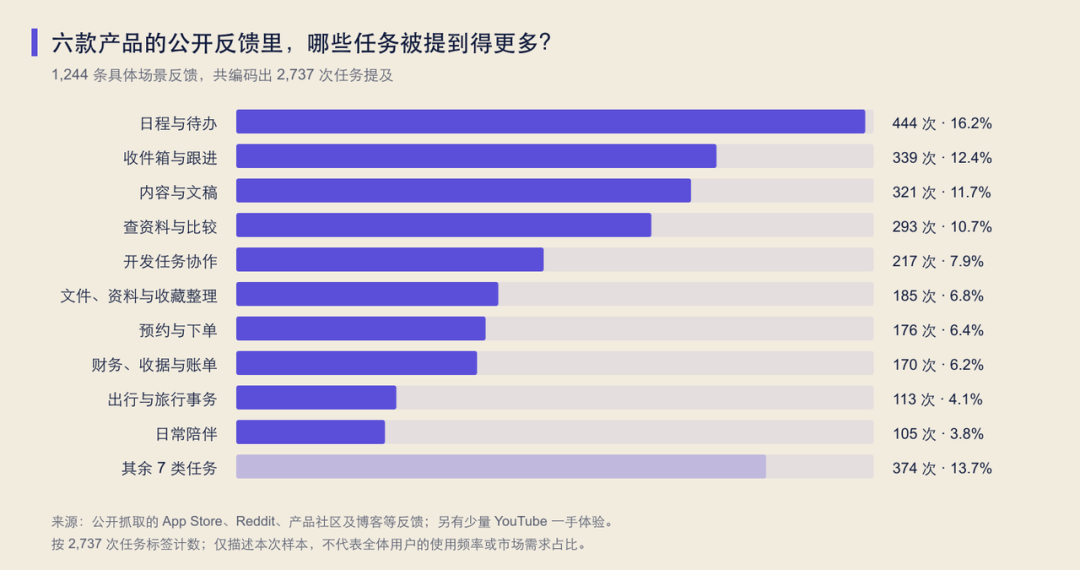
The task mention distribution of the main sample of six products. The denominator is 2,737 task mentions and cannot be interpreted as the proportion of users or actual task occurrence frequency.
2.Different products have already formed usage emphases, but work and life are not mutually exclusive user classifications.
•This differentiation is more suitable to understand how products enter users' daily lives: "life-oriented" or "work-oriented" describes the current usage emphasis but is not enough to delineate the product's capability boundaries;
•Home users also handle business emails, and small business owners also deal with travel, bills, and family arrangements; the same person may delegate both types of tasks to the same assistant or choose to separate them actively.
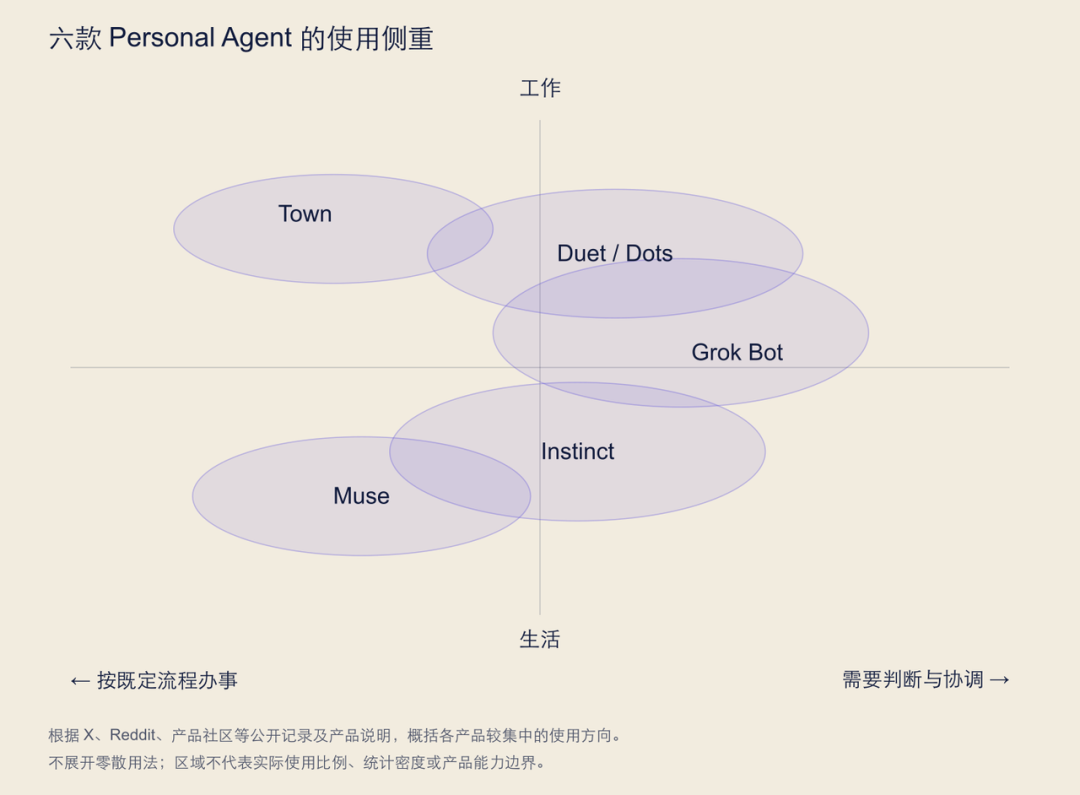
The vertical axis differentiates life from work, while the horizontal axis ranges from following established procedures to requiring more judgment and coordination. The purple area summarizes the concentrated usage directions of various products.
3.After some time of use, users will gradually determine which tasks to permanently delegate to their Personal Agent and will also stop delegating some tasks to the Agent. For example, scheduling reminders, calendars, email organization, kanban, and routine follow-ups will continue to be entrusted to the Personal Agent, but shopping, phone communication, or high-quality creation may revert to previous tools or workflows.
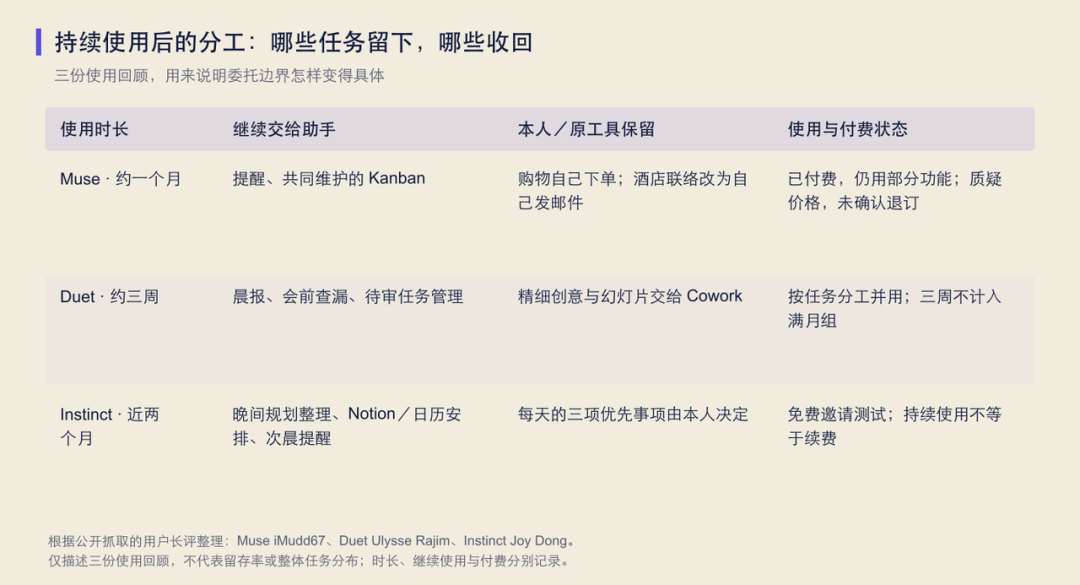
The division of tasks in three reviews of continuous usage. Duration, continued use, and payment status are recorded separately and do not represent actual retention rates.
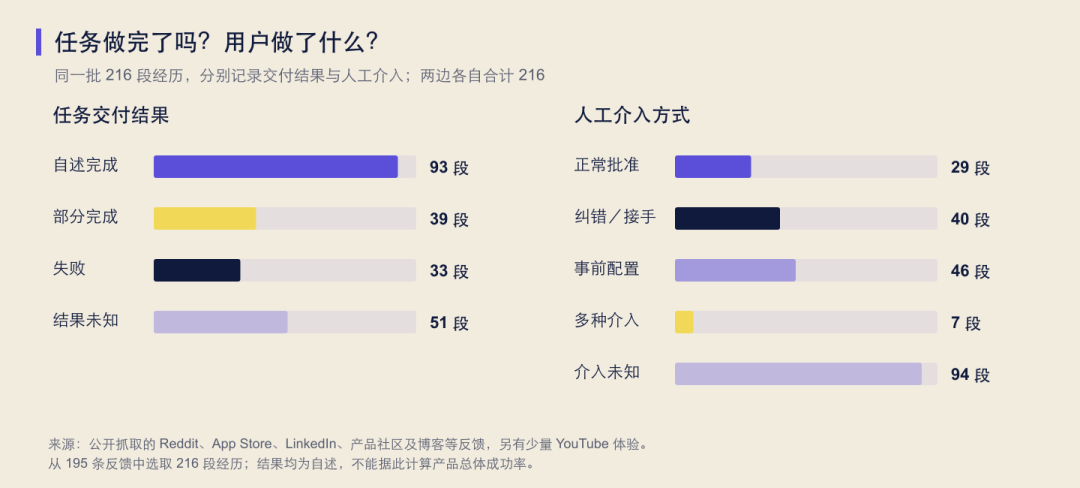
4.Regarding how to evaluate the task completion quality of Personal Agents, users typically consider two aspects: 1) task delivery quality, and 2) how much additional work users had to do themselves.
Insight 02
Product Boundaries
5.The product positioning of Personal Agents and Coworker Agents each has its emphasis, but as usage deepens, some users will start delegating both work and life tasks to the same product.
•For example, someone who has interacted with Instinct users shared that Instinct's initial positioning was very much life-oriented, even without a standalone app, only allowing interaction through iMessage / WhatsApp, but users gradually began asking it to help with work.
•Conversely, there are users who initially used Claude, Codex, Grok Bot to increase work efficiency, but as their use of the product deepened, they also started to share life-related context and complete personal affairs with it.
6.As for whether work and life Agents will ultimately overlap or even merge, this is still limited by corporate data management requirements: "Do companies want to have employees' work avatars?" Today, companies uniformly configure office equipment and internal accounts, one aim being to retain work data and management permissions within the company. If AI Coworkers are a definitive trend, companies are certainly inclined to retain the data accumulated by employees' "work avatars."
7.Therefore, a more likely pattern is that AI avatars for work may be assigned by the company, while life avatars are chosen by individuals; what information can be shared between the two depends on their respective permissions and user willingness. For small teams and users like OPC, one person's work and life agents are more likely to merge, since in the big picture, agents' capabilities do not diverge significantly, and when contexts are connected, it is more convenient to interact with one agent.
8.If we understand Personal Agents as a universal "entry point," then To Consumer and To Enterprise may not be the most effective product categorization: work and life scenarios can share underlying capabilities, while product differences may stem more from team genetics, user bases, and entry strategies. The distinction between 2C/2B may affect procurement, deployment, and data management, but does not necessarily correspond to two distinctly different Agent product forms.
9.If users only face one entry point, there can still be multiple agents working in the background. Considering that different Agent products have varied context access and capability characteristics, some heavy users may try to have them collaborate in division of labor, for example:
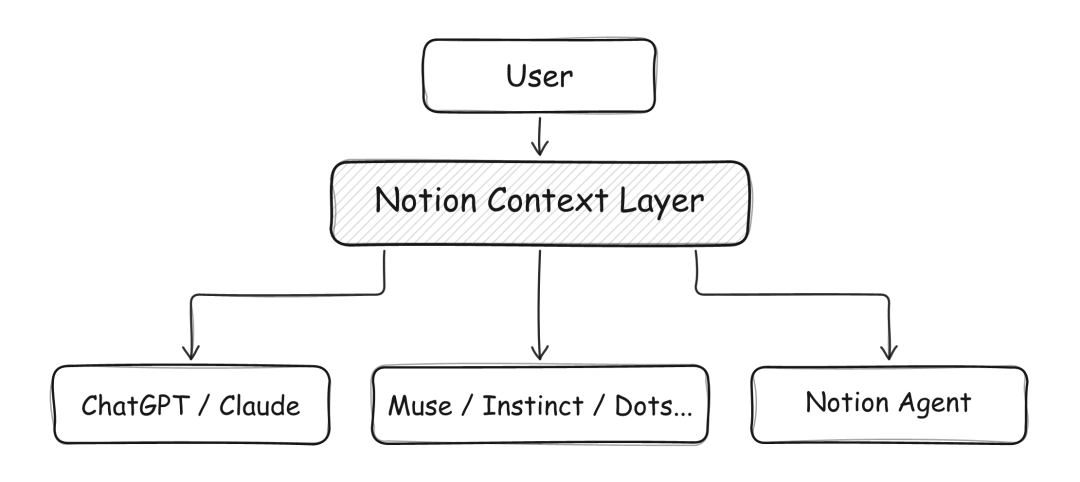
•One way is for a master agent to grasp the overall objective while other agents complete their respective tasks. For instance, using Anthropic Duet as the primary entry point while employing Notion as a shared context layer for agents to handle tasks like fetching information, updating personal background daily, and reducing repeated explanations when product switching occurs.
•Another way is to let several strong agents communicate directly, so they understand the division of labor, calling a sub-agent when needed. However, in practice, this division has faced situations where two agents overwrite each other's modifications.
10.Under a multi-Agent usage habit, how much context agents share among themselves, how to resolve conflicts, and which tasks need to be handed back to humans still requires coordination. Whether coordinated by a primary agent or through direct communication between agents, the key is to reduce the user's burden of individual coordination; if these tasks still fall on the user, the efficiency gains from multi-Agent division of labor may be negated.
11.If users concurrently use multiple Personal Agents, an independent personal memory layer may emerge, wherein all agents gather personal backgrounds and progress related to tasks from this context layer, thereby alleviating the load of repetitive explanations by human users. For instance, Notion recently explicitly proposed to transition from a collaborative workspace to a context layer shared by all agents, making Notion a foundational memory bank, enabling other agents to collaborate on it.
Insight 03
Universal Interface: IM or Agent
12.IM may become the entry point for Agents. Collaboration types represented by Slack and Feishu, while life types represented by iMessage, WhatsApp, and WeChat. The reason is that these IM products have accumulated a wealth of context, organization, and social relationship chains. The daily entry point for working agents may exist within collaborative software like Feishu and Slack.
13.Today, mainstream AI users still mainly complete tasks based on AI office products like Claude Code and WorkBuddy. Moreover, Agent products are also developing towards a universal interface by reinforcing their access, but the advantage of IM is that interpersonal collaboration is already embedded in this context; as long as frequent collaboration remains in Slack or Feishu, having agents participate in the same entry will be more convenient, and agents responding in real-time within IM is the most efficient.
14.The ideal state is for users to remain in the chat while the Agent continues to work in the background. Users directly provide tasks to the Agent in the conversation; after accepting the request, the Agent can directly call tools in the sandbox to complete the task and make deliveries in the group, further communicating and iterating.
15.Similar to how many researchers at Anthropic directly @ Claude Tag for work, there are multiple AI lab teams in the domestic setting that have begun to extensively employ bots in their daily work. Various aspects of model training, like data, assessment, training, infra, can be completed by this bot, and since the actual effect is quite good, researchers have become quite dependent on such AI coworkers embedded in IM.
16.This change may resemble how developers and programmers once thought that writing code must happen in VS Code, which was seen as a self-evident and unchanging practice. Yet, within just a year, no one uses VS Code anymore.
17.A potential endgame concept is that there will be access points everywhere: when needed, the same assistant can be found in different places. This does not require users to select a single entry point; tasks and contexts should follow the user and adapt to the current scene.
18.The convenience of reaching the Agent entry will significantly impact the frequency of Agent usage. For instance, because Instinct allows direct interaction through iMessage or WhatsApp, users have a noticeably higher frequency of using Instinct compared to independent apps. This realization is especially apparent for overseas users who commonly use WhatsApp/iMessage.
Insight 04
How to achieve proactivity and personalization effectively?
19.User-identified bad cases during usage ultimately lead back to the question of "how to enhance the Agent's proactivity." Proactivity encompasses the Agent's ability to continue pushing forward and ask questions while also requiring it to identify contexts proactively, provide accurate content, and even halt a specific task's follow-up. Otherwise, users must continuously explain the task status to the Agent, requesting it to stop or deliver more promptly; a more immediate user sentiment is that attention is not liberated.
20.Both proactive advancement and timely cessation require continuous updates on task status. Besides the initial briefing, the Agent must follow up on whether tasks are completed, if arrangements change, and whether the original information still applies. In product discussions, a bad case was recounted where a user had already solved a problem, but the agent followed up days later, forcing the user to explain once more; there were also cases where tasks were not delivered after being assigned, which made it feel like they were never briefed. The former requires the cessation of outdated follow-ups, while the latter necessitates continued advancement or explanation of obstacles.
21.Proactivity is not a fixed, singular measure; it must vary with the current task and user status. The same user desires different levels of intervention in different scenarios. Whether to follow up, provide options or open-ended questions, whether to explain first or give conclusions, all depend on the current task judgment. After receiving negative feedback, it is also crucial to distinguish whether the user's concern lies in timing, relevance, or task execution failure, avoiding mislabeling one dissatisfaction as a preference applicable to all contexts.
22.Proactivity also tests the Agent's "air-reading" ability. Besides personal preferences, the team's working styles and communication habits also influence when to intervene and how to respond, requiring the Agent to adapt within specific contexts.
23.Some mentioned that Claude's "Ask User Question design" is an attempt to push the agent further towards proactive questioning, yet this design also has its shortcomings; if the model only favors mechanical multiple-choice questions, users may end up facing choices they do not want to select, which then requires them to type additional explanations, creating a new burden.
24.Ensuring the reliability of a single scene task is the starting point for users to share more personal context willingly. Once a Personal Agent excels at completing a certain type of task, users begin to trust it, naturally becoming more inclined to share previously unprompted needs. This trend can also be observed in the user habits mentioned earlier.
25.How the model learns the preferences of different individuals is another issue that needs to be resolved. One approach is to retain different users' backgrounds and evaluations in the training data, allowing the model to learn what to do in different situations; another method involves individual context and memory, allowing the same model to adjust its responses according to user information. However, it has not been clearly decided which differences are suitable for learning in training and which should be managed through personal context and memory.
26.A specialized user onboarding process can help quickly gather user preferences and build an initial profile. For instance, Tolan will chat with new users for 6-7 minutes to understand preferences (which is also related to its previous stage of AI companionship). However, user-stated preferences and actual usage habits may not always align, and numerous preliminary questions can raise the cost of beginning use.
27.From the Memory perspective, it is vital to filter what is worth remembering and apply it at the appropriate times. Considering users' dialogue and work records are numerous, the Agent must determine what is worth retaining, what has expired, and what should be called upon based on the current tasks, rather than placing the responsibilities of sorting and verifying back on users.
•First, filter out the genuinely confirmatory content. One user reportedly asked the AI dialogue history and Feishu information to be given to an Agent, hoping it would gradually sort out who to approach for what tasks, in which groups to solve issues, and where related documents are located. Originally, he only wanted to confirm three to five valuable pieces of information daily or weekly, but the system continually pulled out trivial matters and generated a long verification list, leading him to abandon the process after checking for three days.
•Notated information also needs to be judged on whether it should be used at that moment. Another user disabled GPT Memory because it often called upon previously discussed but unrelated content when answering current queries. Even if the information was accurately remembered, it should distinguish applicable tasks and scenes, updating with changes to avoid old information repeatedly interfering with new judgments.
28.In addition to learning personal preferences from the model side, it is also advisable to consider combining traditional recommendation algorithm logic; recommendation algorithms have already excelled in recognizing and optimizing personal preferences. For instance, Muse, backed by Meta, could potentially integrate its recommendation algorithm accumulation for personalization, pushing content based on user profiles, leading to a question: In Personal Agents' adaptation to individual preferences, what parts are covered by recommendation mechanisms, and what parts are achieved through context, memory, or model training? There is still no consensus on how these layers should be divided, but since Personal Agents have the involvement of major internet companies, they will surely integrate traditional recommendations and LLM in a more comprehensive and in-depth manner.
Insight 05
New Data Requirements: "Person × Time"
29.Personal Agents may introduce a new data workload: constructing training data and benchmarks centered around a person's continuous affairs. When an agent consistently takes on a role, the data needs to clarify what it knew previously, what it is currently responsible for, and what changes occurred in the meantime. Corresponding benchmarks will also need to include continuous task contexts and assessment criteria to check whether the agent can consistently make appropriate judgments under these conditions.
30.The organizing unit of cases expands from individual events to "person × time." In the past, cases were designed around single events, such as travel scenarios, where assessments usually revolved around booking flights and accommodations, or organizing meeting materials. However, real-life personal assistants also consider other concurrent arrangements and schedule balances during that time, so constructing such cases requires linking scattered backgrounds and events, then checking whether the agent utilized this information at relevant moments.
31.The personalization demands of Personal Agents have engendered the need for long-term user data. Currently, some leading model companies have organized the monthly trajectories of individual users into training data for the model, hoping it learns about the person's long-term behavior.
32.Considering the "a thousand faces" nature of Personal Agent users, someone proposed that data assessments could attempt to incorporate the idea of simulated users, meaning acknowledging that "the same case may yield different answers from different people."
•Embedding user parameters into the case. Simulated profiles can include roles, personal preferences, and requirements across different topics. For instance, under the MBTI classification system, ENFPs have a different reward distribution compared to ISTJs. Even for the same user, it is necessary to distinguish contexts: they may be willing to accept follow-ups at work but wish to avoid excessive interruptions while on vacation.
•A scoring idea is to place performance on a specific feature on a 0-5 spectrum and assess its distance from the user's ideal position. Some may want a 4, while others may want a 2. However, a challenge here is that when the model makes a judgment, it is more accurate in yes or no classifications; for incremental classifications of 0-5, the accuracy is usually lower. Thus, it may be necessary first to break it down into several clear yes/no questions and then synthesize the final position.
33.Two people giving opposite evaluations of the same response may stem from their differing preferences and task requirements. Incorporating these backgrounds into the training data allows the model opportunities to learn "for whom and under what circumstances, this answer is more appropriate."
•One approach is to cover different users' backgrounds and evaluations in training, preserving multiple potentially valid answers;
•Another method is to first train general capabilities and then adapt through individual context and memory. Whether supplementary backgrounds are enough for the model to retain these variations, and how responsibilities for training and personal adaptation should be balanced during use, still lacks clear answers.
34.Assessments cannot merely focus on whether something has been accomplished. For example, a piece of code may work perfectly and pass tests, but it might later waste a lot of resources post-launch. Whether costs are reasonable, whether the user’s goals were understood, and whether communication was clear also need to be considered.
35.The amount of data is also a necessary consideration. The finer the separation of users and contexts, the smaller the number of samples collected for each category. Data should be organized by several types of users or detailed down to each individual, taking into account both personalization levels and sample sufficiency.
Insight 06
What can user data teach Agents?
36.Leading labs have reversed their stance on return data. In the past, training focused on enhancing model intelligence, with widespread belief that ordinary user return data had limited utility. However, Personal Agent tasks require models to cover the long-tail tasks of daily life and adapt to various users' personalized preferences, making ordinary users' actual usage records more important.
37.Products themselves are data entry points, and product forms determine the strength of the data flywheel. The brilliance of Cursor lies in its distinction between professional developers working in VS Code and those who only copy code on web browsers, effectively serving as a filtering mechanism. The quality of return data from these two user types is vastly different, allowing Cursor to acquire the highest quality coding data.
38.Even within the same product, return data gathered in different working environments may vary significantly, related to user personas and usage habits. For instance, if today’s goal is to gather more workflow or collaboration task data, but users typically use it just for singular tasks like organizing minutes or making PPTs, then the value of such return data to the team is not high.
39.User data can enhance the usability of Personal Agent products but does not necessarily improve general intelligence:
•Personal Agents must handle numerous everyday, long-tail tasks; user trajectory and feedback data from these tasks more often improve user experience rather than generalizing to enhance model intelligence remains unmeasured;
•To assess the value of Personal Agent user data, one must analyze what it specifically improved rather than merely counting the amount of data collected by the product.
40.How to organize the data further depends on its intended use. If used for SFT, it must extract valuable working processes; if used to reconstruct tasks for the model to try and complete, it can retain chaotic information from real environments, allowing the model to learn how to identify priorities. However, those creating rubrics must still know which information is relevant to tasks to determine whether the model is focusing on the right issues.
41.The value of feedback is assessed based on whether it indicates specifically where problems arose, not merely looking at the number of dialogue turns. If a user simply states, "incorrect, redo," the model doesn't comprehend what the mistake was. If a user identifies which step should not be taken, why, and how it should be adjusted, it becomes easier to collate that feedback into training data. Besides recording interaction processes, it is also essential to capture the reasons behind the user's judgments.
Insight 07
Business Model
42.The primary business model for Personal Agents revolves around transaction facilitation, advertising, and subscriptions.
•Advertising: The difficulty of integrating ads into Personal Agent products is higher than that of previous-generation internet products. Users engage an agent because they want it to filter and find what they need first. If users' demands are more specific, the range of recommendations narrows, and implementing suggestions requires the items to be exactly what users want, as well as advertisers willing to pay. The advertising pool needs to be sufficiently large and widely covered.
•Transaction facilitation: Both Muse and Instinct are currently considering monetizing through take rates from future transaction tasks; such models have been validated in the internet era—merchant commissions will be paid as long as they lead to incremental orders.
•Subscriptions: To establish a subscription model, it only needs to prove that it helps users save significantly more money than the subscription fee. For example, charging 20 dollars per month while saving users 200 dollars. For instance, someone has previously acted as a bargaining agent in North America: using the low price of similar equipment from other sellers, they sent emails to various merchants for price matching, planning to charge monthly or take a commission based on actual savings.
43.The magnitude of change Personal Agents can bring is significantly influenced by whether new interaction experiences will emerge. In the early years of mini-programs, there was speculation that WeChat might evolve into another OS layer above the mobile operation systems, serving as a single entry point. Ultimately, that did not occur; the true change in internet landscape turned out to be Douyin, which transformed "finding people" into "content finding people" through recommendation algorithms and vertical scrolling.
44.The interaction methods of Personal Agents are likely to evolve as well: new hardware might emerge, voice may become a more commonly used interaction method, and most conversations and tasks may be initiated by the Agent. These changes will influence when people think of Agents and how many daily tasks utilize them.
45.Agent-to-Agent communication is another imaginative aspect: creating communications, negotiations, and matchmaking processes that no one else has time for. In 5-10 years, after Agent-to-Agent networks mature, a significant amount of long-tail transactions may occur between agents, generating new increments.
46.Well-experienced agents can act like Sun Wukong’s monkey hair, performing tasks and socializing for you. For example, if you don't have time to chat daily with friends, your agent can catch up with your friend's agent daily, informing you at the end of the day via a podcast about what valuable information is worth sharing.
47.To make such automated communications viable, Agents need to deeply and thoroughly understand users while returning important decisions to real individuals. AI socialization already has counter-examples: accounts that automatically post content and engage with each other can lead to disinterest from real people. Solely relying on registration questionnaires to establish profiles, devoid of ongoing contexts and connections to other real-life matters, makes sustaining meaningful exchanges very challenging.
48.An authorization idea is that when two Agents discuss risky topics and prepare to extend invitations or make commitments, they bring previous chats back to the user for decisions about how to respond and whether to proceed. This correction and confirmation retain the personal decision-making power while potentially assisting the Agent in more accurately representing the individual moving forward.
免责声明:本文章仅代表作者个人观点,不代表本平台的立场和观点。本文章仅供信息分享,不构成对任何人的任何投资建议。用户与作者之间的任何争议,与本平台无关。如网页中刊载的文章或图片涉及侵权,请提供相关的权利证明和身份证明发送邮件到[email protected],本平台相关工作人员将会进行核查。