
Today, a report titled "AI Assistant Commerce Report" has gone viral on x. The author is David Pawlan from Merit Systems—this is an agentic commerce lab funded by a16z. He conducted the Assistant Benchmark and personally tested over 120 AI assistants, all funded out of pocket, without sponsorship.
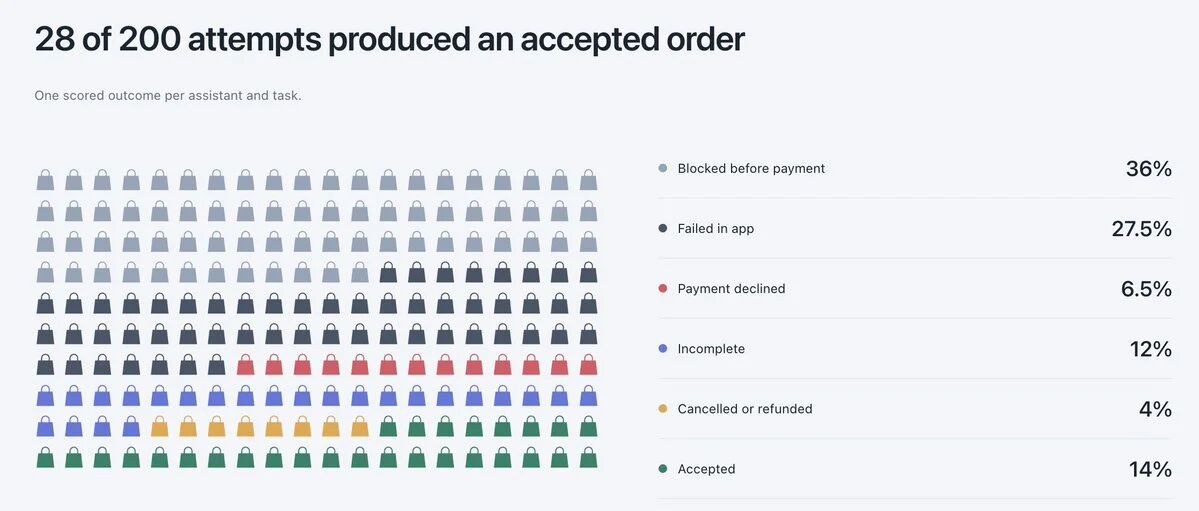
This time he tested 25 AI assistants on 8 tasks: buying a pair of white socks from Target, Nike, Dick's, Kohl's, Macy's, ordering a Logitech mouse from Amazon, and choosing stores for flowers and USB-C cables. Out of 200 attempts, only 28 transactions were completed (14%), and even the best assistant only passed 5/8.
Some key numbers:
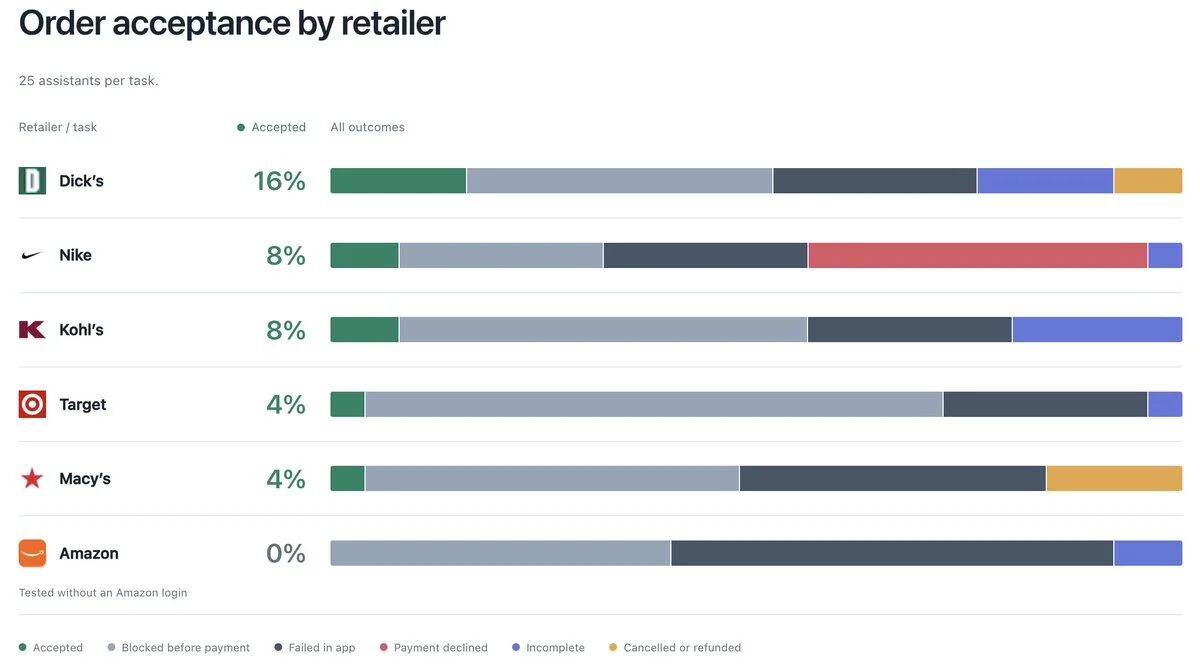
36% of the attempts were blocked before reaching payment: robot walls, login pages, checkout processes. Dick's had the highest success rate, but it was only 16%; Amazon didn't allow a single order (0%). It’s not that the agents couldn't find the products, but that the stores wouldn't let them buy.
"Order confirmed" does not equal a real transaction. Macy's confirmed 5 orders but later canceled 4. Risk control canceled orders after checkout, and the agent thought it had successfully purchased—it had no idea.
Agents would guess billing addresses. When using a new card, they copied the shipping address as the billing address, leading to two canceled orders at Dick's.
Wrong purchases: Target sent Champion socks instead of Nike socks; Dick's sent colorful socks instead of white ones.
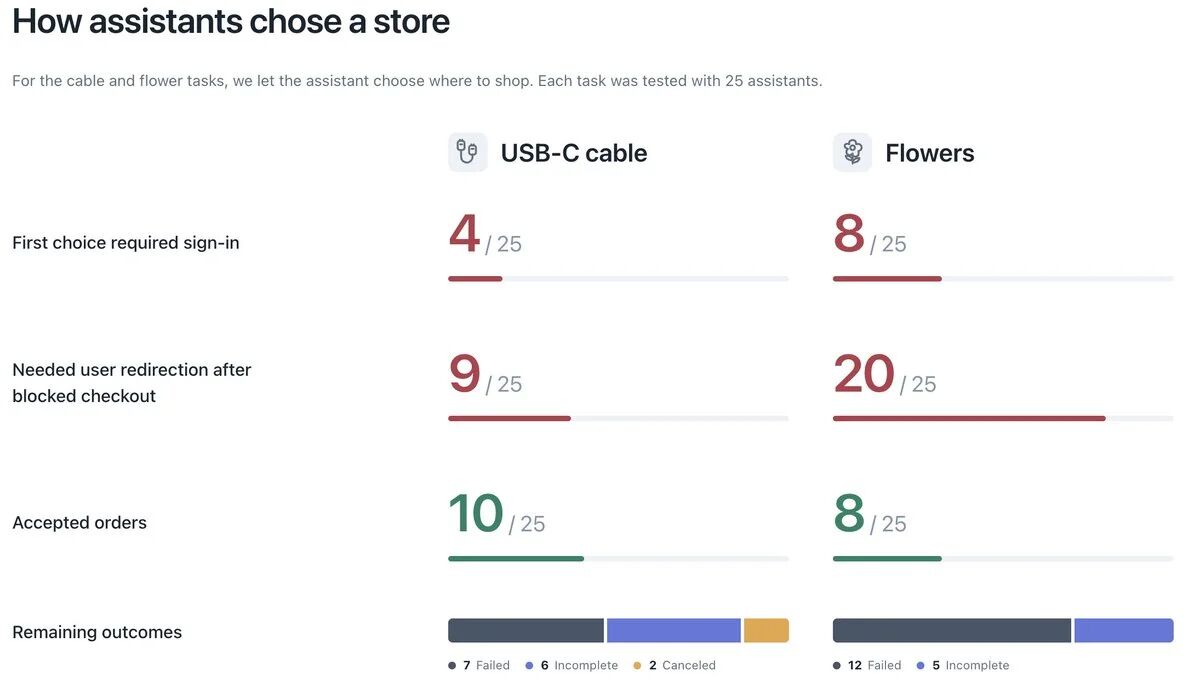
Flexibility is more important than capability. The self-select store tasks contributed 18 out of the 28 transactions; however, while buying flowers, 20 out of 25 still required human intervention to guide the agents to change stores.
Combining with previous research:
Visa tested whether purchases were correct (success rate of 57.2%, 54% of failures still managed to buy);
Affirm × Consumer Reports tested whether payments were correct (a single instruction document increased the success rate from 48.6% to 71.8%);
This test looks at whether transactions can succeed. The bottleneck moves downstream layer by layer; it’s never that the model is not smart enough.
The most glaring issue is "silent failures": orders are canceled, and the agent is unaware. The money spent by the agent needs someone to reconcile afterward—this is precisely the ledger issue I've been highlighting.
In the end, the author states that a "agentic retailer" is needed to solve all problems at once. I think the direction is right, but the order is reversed: there must first be merchants capable of recognizing agents and providing them with a dedicated channel before discussing native retailers.
#AgenticCommerce #AIShopping #AIAgent #ArtificialIntelligence
免责声明:本文章仅代表作者个人观点,不代表本平台的立场和观点。本文章仅供信息分享,不构成对任何人的任何投资建议。用户与作者之间的任何争议,与本平台无关。如网页中刊载的文章或图片涉及侵权,请提供相关的权利证明和身份证明发送邮件到[email protected],本平台相关工作人员将会进行核查。