Abraxas withdrew from Hyperliquid, taking nearly 1.2 billion US dollars in Bitcoin. While this may seem like a coherent strategic turn, it may reflect the individual risks and returns of different funds behind the scenes.
Written by: angelilu, Foresight News
On November 25, a HYPE redemption awaited for about a week was completed, marking the end of this round of withdrawal for Abraxas Capital on Hyperliquid.
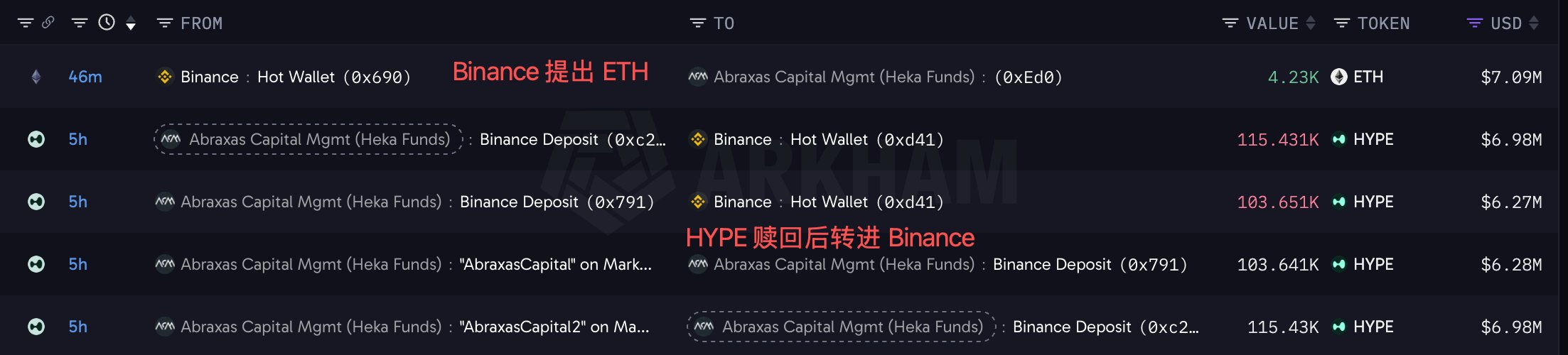
According to on-chain analyst Yu Jin monitoring, Abraxas associated accounts redeemed about 219,000 HYPE, valued at approximately 13.25 million US dollars, which were transferred to Binance after arrival. Subsequently, the associated address withdrew 4,230 ETH from Binance, valued at about 7.09 million US dollars. Based on this, Yu Jin speculated that the related HYPE may have been sold, but public transfer records cannot directly prove that an exchange occurred between the two.
According to Yu Jin and MLM's monitoring standards, the tracked Abraxas associated accounts had closed all positions on Hyperliquid and withdrew remaining funds at this time.
The recent actions of this London asset management institution have not only included exits.
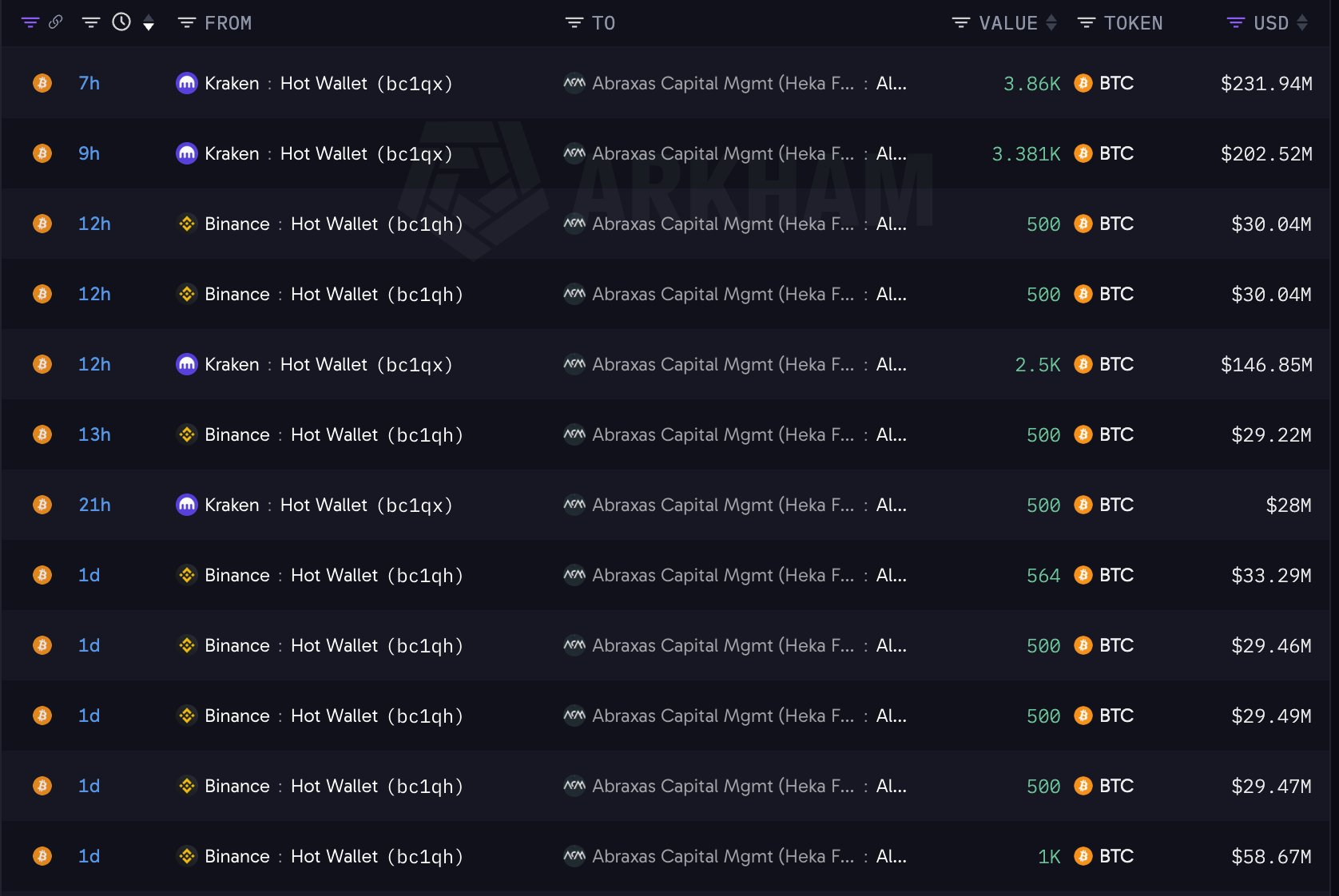
Abraxas associated addresses have made large withdrawals from Binance and Kraken. By November 24, the cumulative number disclosed by Yu Jin had reached 19,820 BTC, with a transfer valuation of approximately 1.182 billion US dollars. Earlier, on November 16, Lighter experienced an API key leak, and on-chain analysts linked the affected accounts with Abraxas.
Security incidents, position reduction, Bitcoin withdrawals—several clues intertwined within a matter of days. Did an institution withdraw from on-chain trading platforms and turn to buy Bitcoin and Ethereum after incurring losses? Or do these seemingly interconnected actions each have their own accounts behind them?
To answer this question, we need to extend the timeline and gain insight into the strategies behind each flow of funds.
Starting from Arbitrage, First Learn to Price Risk
To understand Abraxas, one must set aside the usual notion of “whales betting on price ups and downs.”
Founded in 2002 in London established, Abraxas entered digital asset management in 2017. It launched its flagship product, the Elysium Global Arbitrage Fund, in 2018, focusing on cross-market arbitrage. The Alpha Bitcoin Fund launched in 2022 offers directional exposure to Bitcoin, aiming to outperform Bitcoin within quarterly valuation cycles.
On June 17 this year, the Hedge Fund Journal announced the 2026 Digital Currency Performance Awards. Elysium was rated the best-performing fund in the market-neutral arbitrage category with over 1 billion US dollars in assets under management, covering the single-year performance of 2025 and the two, three, five, and seven-year periods up to the end of 2025. According to Abraxas website disclosure, the after-fee return for Elysium’s Euro shares was 16.64% for 2024, 11.56% for 2025, and 7.35% for the first nine months of 2026.
Abraxas excels in market-neutral arbitrage, such as holding HYPE spot and simultaneously hedging price volatility using equal amounts of perpetual shorts to earn funding fees and price differentials.
Research conducted by Hyperdash on two Abraxas associated accounts provided a perspective: as of September 16, 2026, these two accounts had cumulatively received over 66 million US dollars in funding fees. In their tracked HYPE positions, the amounts of spot and staking were relatively close to the scale of perpetual shorts. This funding fee income is not the net profit of the entire strategy and still needs to factor in financing, trading fees, and other position profits and losses, but it explains why substantial shorts can exist over the long term.
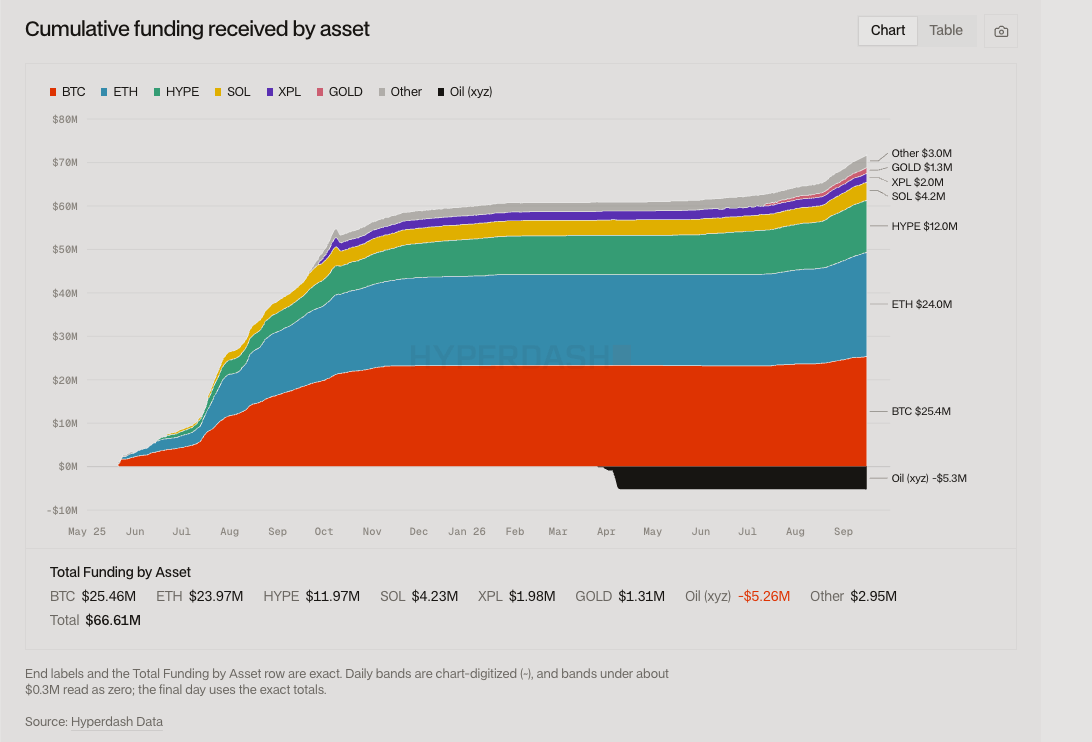
Returning to this event, closing the shorts could be seen as dismantling a group of hedging trades, while withdrawing Bitcoin from the exchange may involve custody or allocation adjustments of existing assets. Just based on withdrawal records, it's still unresolved whether Abraxas purchased a billion dollars of Bitcoin in this round of decline.
Avoiding Terra and Three Arrows, Learning a 2% Lesson from FTX
Abraxas’s flagship fund primarily focuses on market-neutral arbitrage, with the team adopting a cautious approach in selecting trading opportunities and platforms. In an interview published in the Hedge Fund Journal on October 27, 2026, Abraxas’s head of trading, Carlo Zaffaroni, recounted that their institutional-level operational standards, compliance, and capital preservation practices helped them avoid events such as Terra Luna, Celsius, and Three Arrows Capital.
Among these, Terra is a recorded instance. In the fund communication from May 2022, Elysium wrote that starting from the end of April, the team believed the returns from DeFi were no longer sufficient to compensate for the risks. Prior to the collapse of Terra and UST, they had already moved most of their related funds back to centralized markets to continue seeking arbitrage opportunities. For a cross-market arbitrage fund, the reason for exiting a trade might be that the returns have thinned out, or that the increased returns required for taking the same risks have risen.
Abraxas founder Fabio Frontini also mentioned in the same interview that in November 2022, a stablecoin transaction involving FTX caused approximately 2% counterparty losses. Subsequently, Abraxas strengthened their due diligence on trading platforms.
Before the Lighter Incident, Short Positions Were Already Shrinking
After the Lighter incident, a natural speculation arises: Did Abraxas begin to withdraw its short position on Hyperliquid due to security issues?
However, looking back further in the timeline, it was found that on October 15, Lookonchain tracked two associated accounts holding over 1.45 billion US dollars in nominal short positions; by November 14, this figure had dropped to approximately 572 million US dollars. The Lighter incident occurred on November 16, and before that, the nominal short positions of the related accounts had already significantly dropped, although price declines may also compress the nominal value of short positions.
On November 16 at 18:11 Beijing time, approximately 10.39 million USDC was abnormally transferred from Lighter's Ethereum settlement contract. Lighter later stated in a recap that a signature software used by a trader had security issues, leading to an API key leak. The platform subsequently tightened permissions, requiring that funds entering the public pool must be signed by a wallet. Lighter also stated that after suspending withdrawals, a security committee refunded about 5 million USDC to affected traders. On-chain analyst MLM speculated that the related accounts might belong to Abraxas, while Lighter's recap did not name them or disclose the final net loss of Abraxas or its funds.
According to Lighter's explanation, the leaked API key cannot directly withdraw funds to external wallets, but the attacker used the public pool to complete the fund transfer: first obtaining pool shares in an account controlled by the attacker, then transferring the victim's account funds into the pool, and finally withdrawing funds by redeeming shares. This also adds a layer of requirement to risk checks: not only should it be checked whether the key has withdrawal permissions, but also what functions it can call together to determine where the funds can be sent.
After the Lighter incident occurred, the two associated accounts of Abraxas accelerated the unwinding of multi-currency short positions on another exchange, Hyperliquid. Taking HYPE as an example, on November 16, between 16:00 and 23:00 Beijing time, the two accounts’ HYPE perpetual shorts dropped from approximately 1.128 million to 51,600. Yu Jin later tracked that the Abraxas associated address cumulatively transferred about 206 million USDC to Binance.
At that time, the HYPE short sellers could still earn funding fees, but the associated accounts were selling spot while simultaneously buying back their shorts. On-chain data confirmed that the pace of unwinding had changed, but Abraxas has not publicly explained the accelerated unwinding reasons.
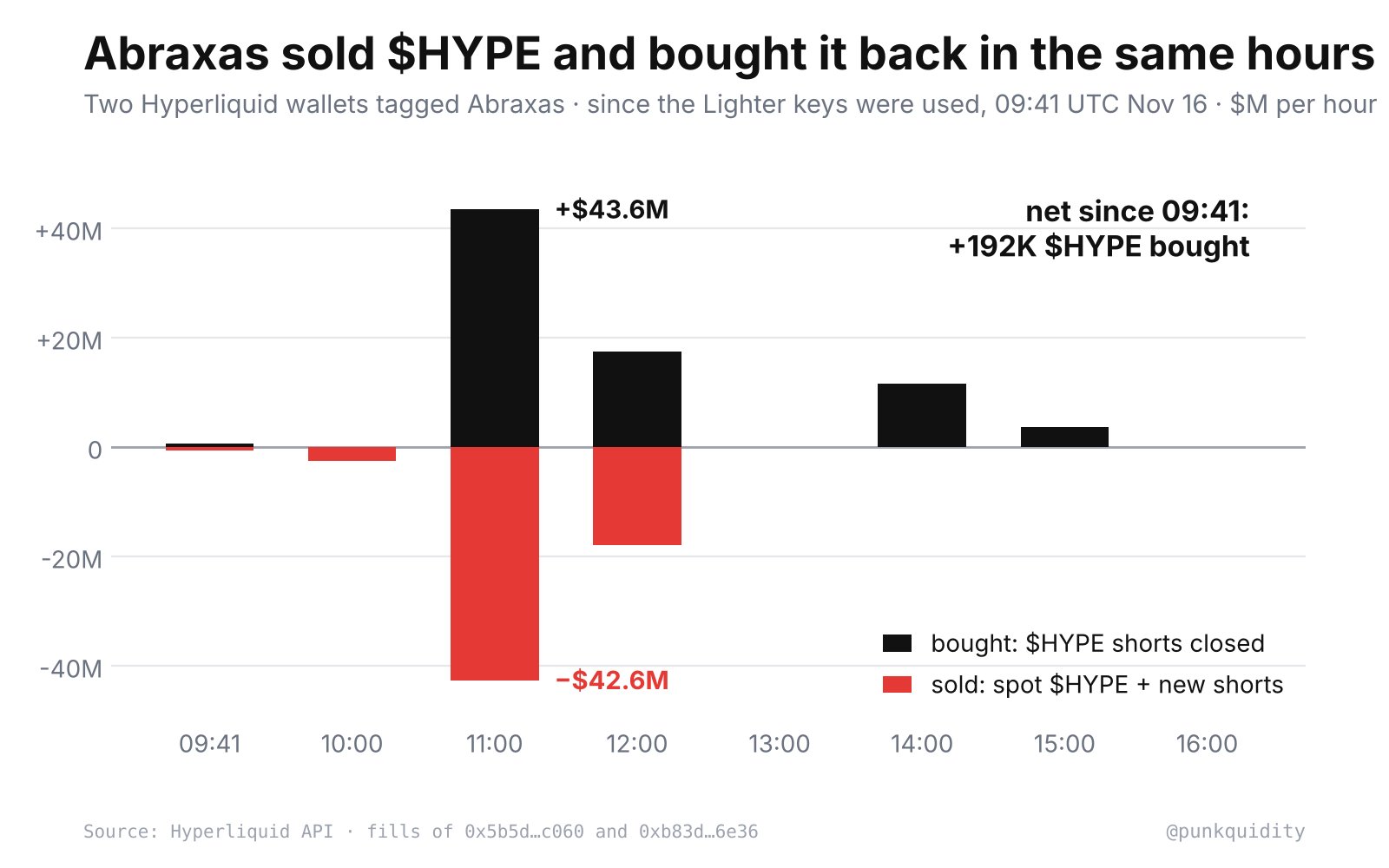
On November 16, the HYPE hourly transactions on Hyperliquid from two Abraxas associated accounts
This bears some similarity to the reallocation before the collapse of Terra in 2022. At that time, Elysium determined that DeFi’s returns were no longer sufficient to compensate for risks, moving most of the related funds back to centralized markets. For managers, whether a group of hedging trades remains worthwhile to continue depends not only on the returns but also on how much capital needs to be left on the platforms and what operational risks need to be taken on.
On November 25, HYPE Redemption Arrived
The last batch of HYPE transfers brought a new observational endpoint for this round of withdrawal.
According to Hyperliquid documentation, transferring from the staking account back to the spot account requires passing through a seven-day exit queue. This means that ceasing trading, submitting withdrawal requests for staked assets, and the final transfer of assets may occur on different dates.
On November 25, Yu Jin monitored that about 219,000 HYPE was transferred to Binance after redemption. The subsequent withdrawal of 4,230 ETH prompted new speculation about whether the assets were exchanged. On-chain records currently confirm transfers in and out, but the trading relationships within the exchange remain undisclosed.
Meanwhile, two associated account screenshots released by Yu Jin show a total transaction volume of about 13.4 billion US dollars on the platform, with a cumulative profit and loss of about positive 529 million US dollars. MLM's statistics claim that at least 67 million US dollars came from funding fees.
Returning to the initial question, these actions are temporally adjacent, but still do not form a causal chain of “incurring losses, withdrawing from on-chain, buying Bitcoin.”
The nominal scale of short positions on Hyperliquid had already decreased before the Lighter incident; prior Bitcoin withdrawals had multiple flows tagged to addresses identified as the Alpha Bitcoin Fund, which already takes on directional exposure to Bitcoin.
Whether the withdrawals correspond to new purchases, and whether security incidents expedited the withdrawal, still lacks further confirmation. The outcomes of the withdrawals become clearer, yet the implications of the fund transfers need to be understood in the context of their respective accounts, funds, and strategies. Funds under the same institution may not necessarily express the same market judgment.
免责声明:本文章仅代表作者个人观点,不代表本平台的立场和观点。本文章仅供信息分享,不构成对任何人的任何投资建议。用户与作者之间的任何争议,与本平台无关。如网页中刊载的文章或图片涉及侵权,请提供相关的权利证明和身份证明发送邮件到[email protected],本平台相关工作人员将会进行核查。