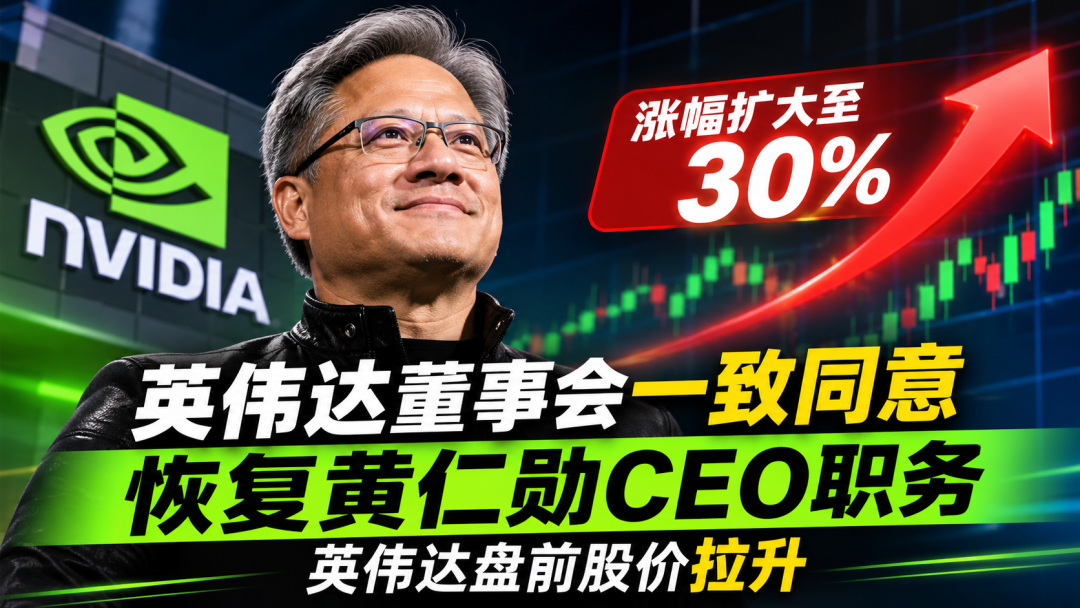
On November 23, NVIDIA's official website posted an announcement: the board of directors unanimously voted to restore Jensen Huang as the president, CEO, and board member effective immediately.
Jensen Huang subsequently stated:
“I am honored to return to NVIDIA and lead one of the world's most influential technology companies at the beginning of a new industrial revolution,” Huang said. “I will take on this heavy responsibility with the utmost humility and a renewed commitment. I want to thank the NVIDIA board for their trust and careful consideration during this process. I especially appreciate the leadership shown by Harvey Jones as chairman, as well as Colette Kress and our executive team for their leadership during this period. At the same time, I deeply appreciate the extraordinary support from our employees, shareholders, industry leaders, and global partners. Most importantly, I thank my family for their love and support. I can't wait to get back to work.”
U.S. President Trump also commented on social media that restoring Jensen Huang as CEO by the NVIDIA board was “the right and appropriate decision.”
The announcement of reinstatement fills a week's gap
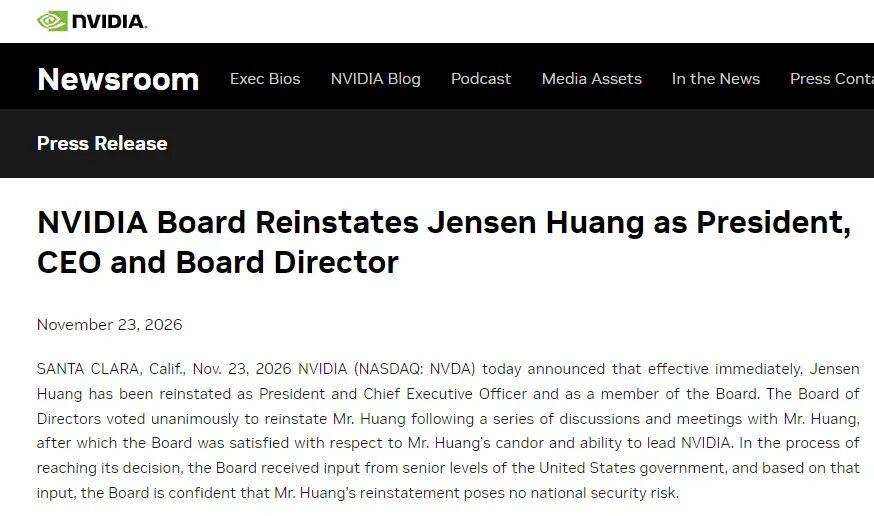
The announcement conveys several meanings, which are quite interesting when examined sentence by sentence.
The first layer, how the decision was made: the board engaged in "multiple rounds of discussions and meetings" and expressed recognition of Huang's "candor and ability to lead the company."
The second layer, why the change of mind: it was deemed that restoring his position “is in the best interest of shareholders, employees, partners, and customers” — this sentence is almost a direct copy of what Huang wrote in his public petition six days prior. He stated at that time: if the board believes my return serves the best interests of shareholders, employees, the company, and the United States.
The third layer, the most critical sentence: during the decision-making process, the board "considered the opinions of high-level officials in the U.S. government" and thus concluded that Huang's reinstatement "does not pose a national security risk."
Everyone in the know understands the weight of this statement. During Huang's resignation and after, NVIDIA faced not only personal integrity issues but also significant uncertainties regarding chip export controls and national security regulations. Previously, the board formed a special committee for national security and export control oversight, and the market generally believed that regulatory pressures were an unavoidable hurdle for Huang's return.
Now, in one sentence, "there is no national security risk," this hurdle has been overcome — confirmed by "high-level officials in the U.S. government" in person.
As for the personnel arrangements: Kress ends her temporary CEO role and returns to her position as CFO; Jones continues as board chairman. Both individuals resume their respective roles, as if the past week was merely a brief internship.
It was likely the stock price that changed the board's mind
The board's public reasoning sounds dignified, but the numbers seen by the market are more honest.
Since the Huang controversy escalated, NVIDIA's stock price has continued to plummet: last Friday, it fell 14% in one day, nearly 50% from the high in October, with a cumulative decline of over 30% for the year, losing about 40% over the past 20 trading days. A six-week streak of weekly losses is the longest continuous drop since 2012.
There were attempts to save it. The financial report released on November 17 was nearly perfect—revenue reached $115.8 billion, doubling year-on-year, with data center growth of 110%, and next quarter's guidance set at $130 billion, exceeding expectations for 17 consecutive quarters. The stock price rose 4% in after-hours trading that evening, but this increase pales in comparison to the 40% decline.
The market cast its vote with real money: no matter how beautiful the financial statement, the presence of the founder outside the company casts a long shadow.
This is likely the true impetus behind the board's 180-degree shift in attitude. The petition with 190,000 signatures, public support from internal employees, direct calls from customers, combined with the ongoing loss of market value — when "bringing Huang back" shifted from a public demand to an issue of stock price, the board needed to reevaluate.
Upon the announcement, NVIDIA's pre-market stock price surged, with an increase that momentarily reached 30%.
The market again cast its vote with the same real money. In the juxtaposition of a decline and a rise, the answer is clear.
But it is not a complete retreat
However, if you think this is a “king's return, with all things revived” story, then you are oversimplifying.
There are a few sentences in the announcement that are easy to overlook: the independent investigation committee will continue to advance its investigation, the company will establish the position of chief compliance officer, and will continue to cooperate with government investigations.
To translate: Huang is back, but the issues are not resolved. The conflicts of interest and questions regarding corporate governance stemming from that extramarital affair are still being investigated; moreover, from now on, the company will have a dedicated position focused on compliance. This is akin to installing a camera over his head, with the board stating: the person can return, but the rules must be established.
Therefore, this is not "the board admitting its mistake"; a more accurate description is — both parties reached a deal under pressure from stock prices: the board obtains a stance (the investigation continues, the compliance officer is established), Huang regains his position.
For Huang himself, this cannot be deemed a complete vindication. He acknowledged in his open letter that he “failed to meet NVIDIA's behavior standards for every employee" and mentioned the need to spend the rest of his life earning back his family's love. Trust is easily lost but hard to restore.
A week is enough for a company to see itself clearly
From his resignation on November 13, to stating “never mind” on November 17, and then to the “come back” on November 23 — in less than two weeks, NVIDIA placed its increasingly impressive annual financial report, a quarterly earnings presentation, and a board resolution on the table, only to have all of it overturned by the market's demand for “old Huang.”
The observations left by this event are worth much more than the gossip itself.
It shows that in this AI race, the value of a founder does not equate to a management position. Huang is not the type to sit in an office reading reports; he is the living collateral for NVIDIA's technological direction, customer relationships, supply chain commitments, and even employee morale. While the financial report can prove that the company's machine is still running, the market desires the person who knows where the machine should head.
It also indicates that the so-called "corporate governance" is flexible in the face of real money. The board can “unanimously” agree to let you go, and can also “unanimously” agree to bring you back; what lies in between may not be principles but the stock price over six trading days.
Finally, it reveals another matter: during the same week that Anthropic rang the bell on NASDAQ, the pricing logic of the AI industry is being rewritten. When a pure AI company can attain a valuation of $1.5 trillion, the market will naturally use the same measuring stick for NVIDIA — and under this measuring stick, a stable NVIDIA, personally helmed by the founder, deserves that price.
Jensen Huang is back, and the stock market rose by 27%. But the real question lies ahead: can the person who promised to “spend the rest of his life earning back his family” and the company that announced “the investigation continues” walk through the next 33 years together?
The answer is not determined by the board's vote; it will be determined by time.
免责声明:本文章仅代表作者个人观点,不代表本平台的立场和观点。本文章仅供信息分享,不构成对任何人的任何投资建议。用户与作者之间的任何争议,与本平台无关。如网页中刊载的文章或图片涉及侵权,请提供相关的权利证明和身份证明发送邮件到[email protected],本平台相关工作人员将会进行核查。