On November 24 Eastern Time, Dell Technologies released its financial report, raising its full-year performance guidance, and the board simultaneously approved an expansion of the stock repurchase plan. During the Q&A session of the conference call, a Goldman Sachs analyst inquired about the sales and prices of traditional servers. Dell's Chief Operating Officer, Jeff Clarke, responded that the number of server shipments had decreased.
However, the financial report presented a different picture. Dell's revenue for this fiscal quarter reached $54.937 billion, more than doubling year-over-year. In the same report, revenue from traditional servers and networking grew by 235% year-over-year. The hot sales of AI servers are easy to understand, but why did the number of traditional servers sold decline while this business line's revenue can still grow so rapidly?
Revenue Doubled, Where Did the Additional Money Come From?
By subtracting the revenues of various business segments from the same period last year and summing the changes, it can be seen that nearly 60% of each additional $100 in revenue at Dell came from AI-optimized servers, while traditional servers and networking contributed nearly 40%. Looking solely at the latter's increase, it approaches the entire revenue of Dell's client business for one quarter.
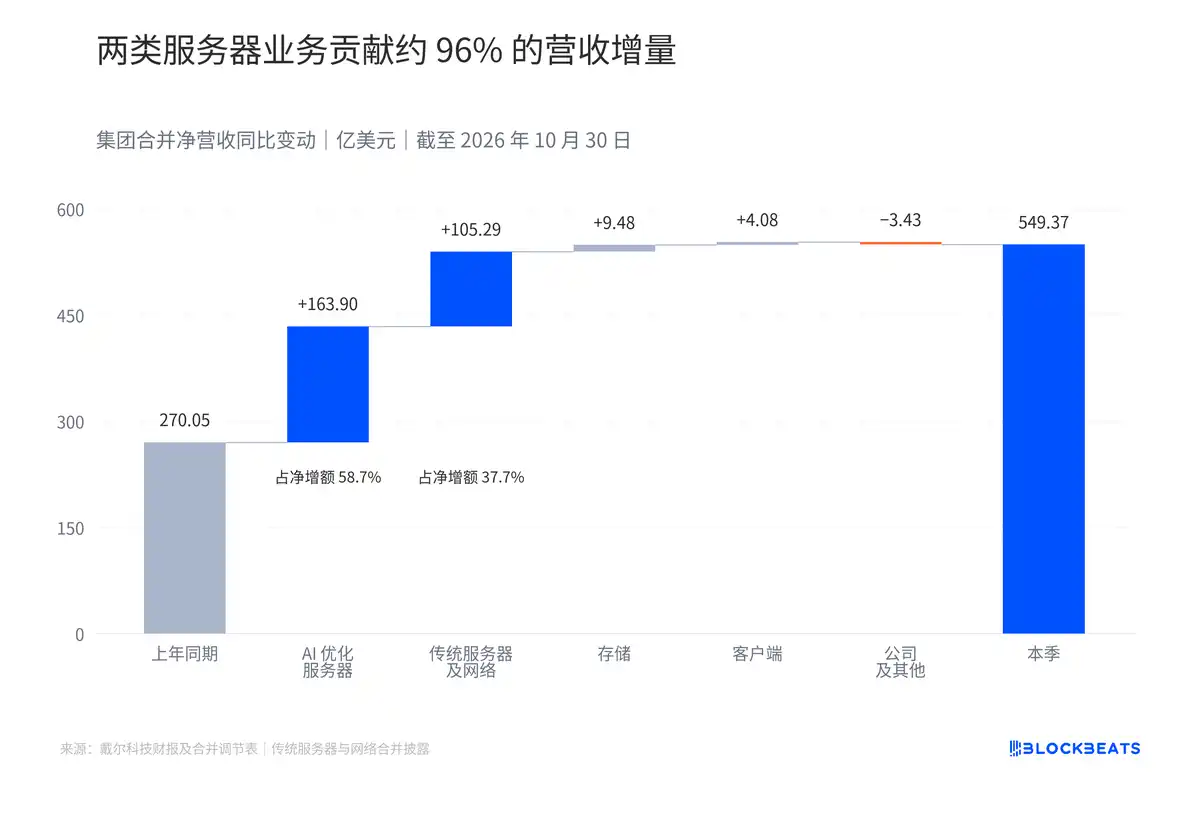
Breakdown of Dell's Year-Over-Year Revenue Increase
Dell's revenue from AI-optimized servers increased from $5.641 billion to $22.031 billion, nearly quadrupling compared to the same period last year. This has become Dell's largest single revenue source for the quarter. Traditional servers and networking were the second largest contributor to revenue growth after AI-optimized servers.
Clarke provided a clue in the Q&A by saying that each machine contained more components. The servers delivered by Dell this quarter included more processor cores and were equipped with more memory and storage. For businesses needing to free up data center space and power capacity, upgrading to a batch of higher-configured new machines can consolidate the workload originally spread across more older machines. The number of units purchased can decrease, but the workload per machine has increased.
The change in procurement configuration has another side. Dell mentioned in the conference call that the demand for AI inference is also increasing, part of which requires CPU-based servers. When businesses increase computing power, their procurement lists include both AI-optimized servers and general-purpose devices responsible for other computing tasks. A portion of the demand for traditional servers comes from these tasks.
Clarke also noted that component inflation has squeezed the low-cost entry-level server market. The financial report combined traditional servers and networking equipment into a single disclosure, and Dell did not provide separate reductions in unit numbers or average prices. The rise in configuration quality and the pressure on lower-priced models can explain why shipments and revenue might diverge, but it is not possible to calculate how much each contributes to this revenue increase based on that alone.
Revenue Focus Shifted, What About Profit Compared to the Past?
Dell categorizes servers, networking, and storage under its infrastructure solutions group, while commercial and consumer personal computers and other businesses fall under the client solutions group. Viewed together, last year's operating profit from each $100 of the department was about $70 for infrastructure, which has exceeded $90 this quarter.
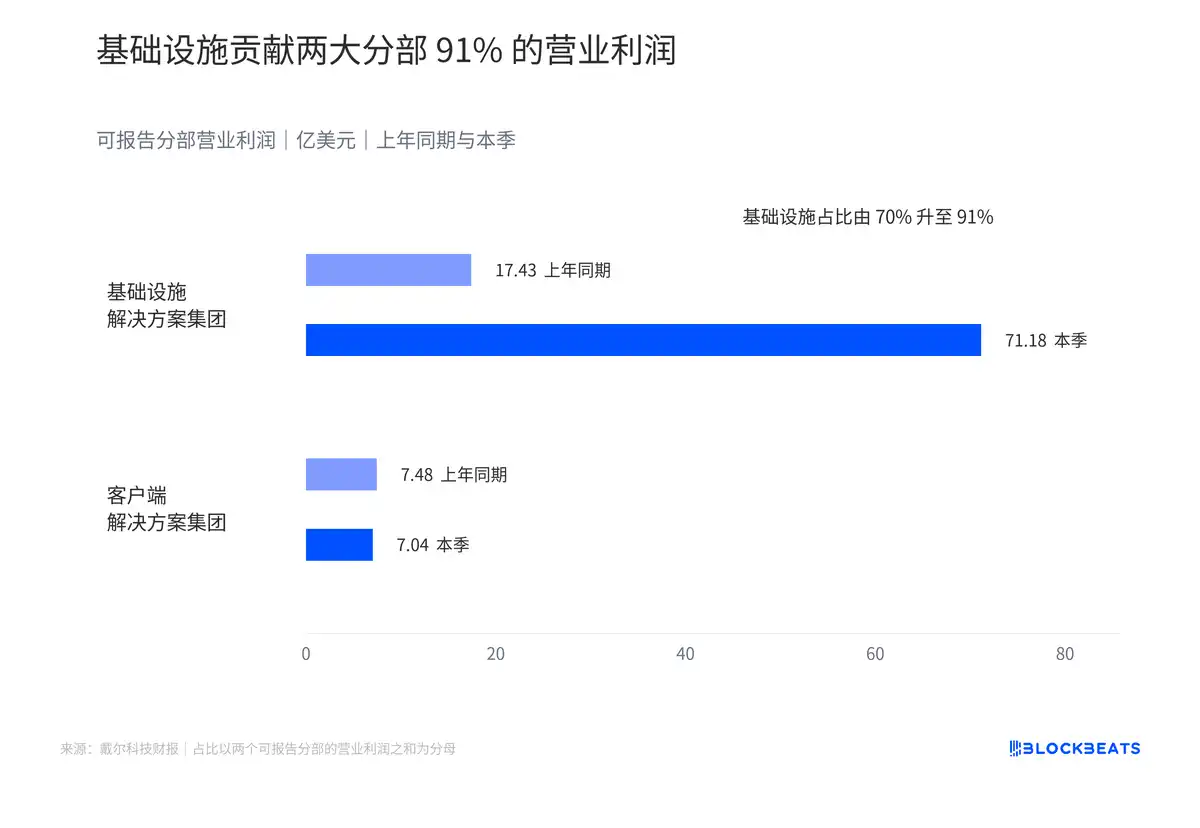
Comparison of Operating Profits between Dell's Infrastructure and Client Segments
The operating profit margin in the infrastructure business rose to 17%. The client business saw a slight revenue increase but a decline in operating profit. Dell stated in the conference call that clients have recently prioritized their budgets towards servers and storage, delaying some computer replacements. When businesses decide to upgrade their data centers first, the computers on the same procurement budget may be deferred.
This chart also answers a commonly confusing question. The profit margin for the infrastructure segment includes traditional servers, networking, and storage, and Dell did not separately list the operating profit of AI-optimized servers within the segment table. CFO David Kennedy attributed part of the profit improvement to the decreased proportion of costs to revenue after scaling up, while still accounting for the profit margin pressure brought by the increased proportion of AI servers in the full-year guidance.
The full-year revenue guidance was raised from $192 billion to $202 billion. Breaking down this increase, the AI-optimized server guidance contributed 40%, while the rest came from net adjustments in expected revenue from other segments. In the new guidance, the infrastructure business continues to drive revenue for the fourth fiscal quarter.
Dell also increased its adjusted diluted earnings per share guidance for the year to $29.68. This quarter, this metric reached $9.45, setting a company record.
With Over a Hundred Billion in Backlogs, When Will It Be Recognized in Financial Reports?
Dell received AI orders this quarter amounting to nearly three times the recognized revenue for this business. The backlog at the end of the quarter is a list of pending deliveries that cross quarters. The revenue for the current quarter can come from orders received previously, and the company did not disclose conversion data based on order batches.
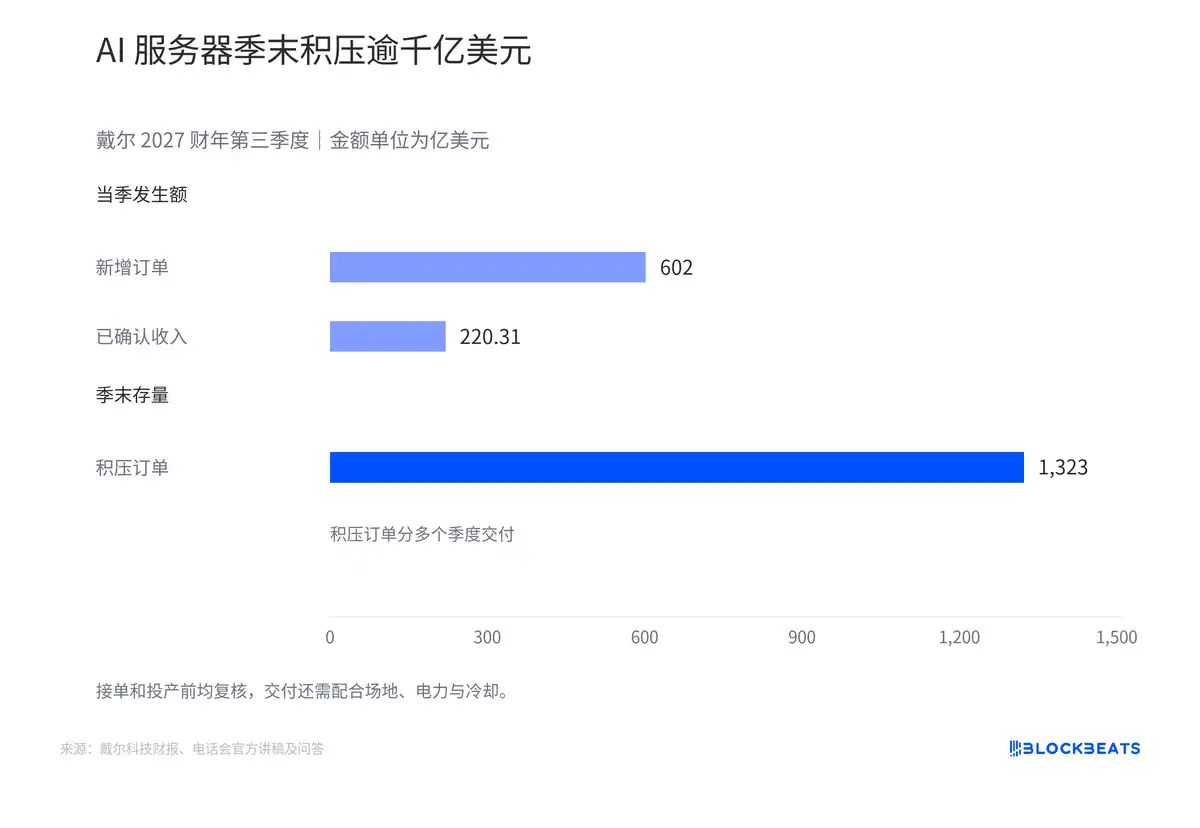
New Orders, Confirmed Revenue, and Backlog for Dell's AI Servers for the Quarter
When an analyst asked about data center delays, Clarke listed several conditions that need confirmation before delivery. Is the customer's building ready? Is the power and cooling system set up? Can the required processors, memory, and optical modules for the servers arrive at the same time? Even if the racks are in the production schedule, the receipt site must have the conditions for connecting the devices.
Dell also examines customer funds and end contracts when receiving new purchase orders, repeating the review before production. Kennedy mentioned that the company only provides short-term financing to select clients to bridge the gap between ordering and the power cluster going live. The company disclosed the total backlog amount, but management did not break it down by the amount scheduled for delivery per quarter during the Q&A.
On the same day as the financial report, another figure that could be easily misinterpreted was disclosed. Dell has returned about $4.9 billion to shareholders this quarter through buybacks and dividends. The additional $25 billion approved by the board is for the buyback authorization of Class C common stock, with actual buybacks counted in each period as executed.
AI racks on the backlog list each have their own delivery timelines, awaiting the customers' data centers to be ready to receive them.
Click to learn about job openings at Rhythm BlockBeats
Welcome to join the official community of Rhythm BlockBeats:
Telegram Subscription Group: https://t.me/theblockbeats
Telegram Discussion Group: https://t.me/BlockBeats_App
Official Twitter Account: https://twitter.com/BlockBeatsAsia
免责声明:本文章仅代表作者个人观点,不代表本平台的立场和观点。本文章仅供信息分享,不构成对任何人的任何投资建议。用户与作者之间的任何争议,与本平台无关。如网页中刊载的文章或图片涉及侵权,请提供相关的权利证明和身份证明发送邮件到[email protected],本平台相关工作人员将会进行核查。